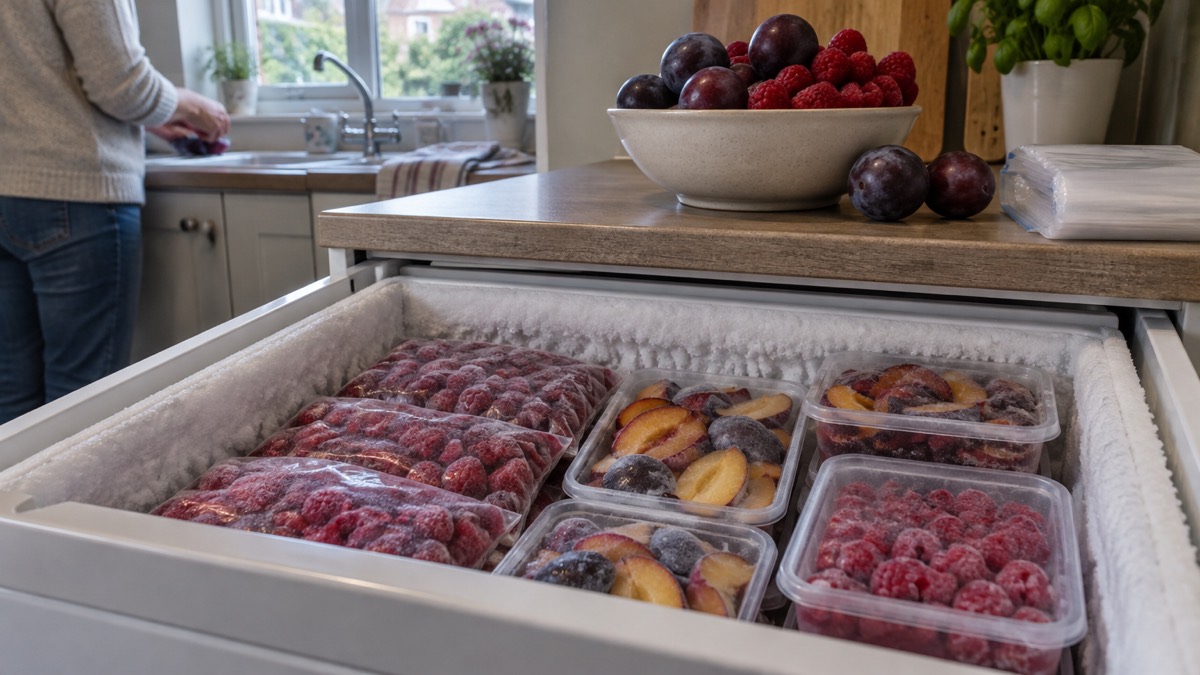
Yes, it is safe to freeze fruit without sugar. Sugar is not used as a preservative in frozen fruit; it is there only to maintain flavour, colour and texture1. That single point answers most of the worry. If you have a glut of apples, plums, berries or currants and no sugar in the cupboard, you can still get them into the freezer safely.
What changes without sugar is the quality of the result, not its safety. Fruit may soften more on thawing, some may darken, and it will not have the syrupy sweetness that sugar gives. You can manage all three by freezing in small, manageable quantities, by blanching where it helps, and by planning to cook with fruit that will not hold its shape.
The one fruit that is genuinely better treated differently is the tomato. Tomatoes are best cooked into a sauce before freezing2. Everything else on this page follows from those two facts: freeze it plain, freeze it small, and cook what will not survive the thaw.
What sugar actually does in frozen fruit
It helps to be clear about what sugar is and is not doing. In a jam, sugar is part of the preservation: it binds water and helps keep the contents safe on a shelf. In a freezer, the cold is doing that work. The National Center for Home Food Preservation is direct about it: sugar is not used as a preservative but only to maintain flavour, colour and texture1. The same guidance appears across its freezing, canning and storage pages, which is a useful sign that it is a settled point rather than one author's view3.
So what are you giving up when you leave it out?
- Flavour: sugar sweetens and rounds off sharp fruit. Without it, tart fruit tastes tart.
- Colour: sugar syrups help fruit hold its colour. Without them, some fruit browns more.
- Texture: sugar firms the fruit and thickens the liquid around it. Without it, thawed fruit is softer and wetter.
None of these is a safety issue. They are quality issues, and you can decide how much they matter for each batch. Fruit destined for a crumble, a smoothie or a sauce can be frozen plain without regret. Fruit you hoped to serve raw and perfect may disappoint, and that is worth knowing before you fill the drawer.
If you want sweetness without sugar, artificial sweeteners can be used in its place, following the equivalents on their labels6. The same source is honest about the limit: sweeteners give a sweet flavour but do not provide sugar's benefits, such as the thickness of a syrup and colour protection1. Use them for sweetness, not for structure.
Freeze in quantities you will actually use
The commonest mistake with a fruit glut is freezing it in one enormous block. A bag of fruit welded together by ice is hard to use, and every time you wrestle it apart you warm the whole lot. Freeze in manageable quantities instead2. Small portions freeze faster, thaw faster, and let you take out exactly what a meal needs.
A practical method, drawn from harvesting and storage guidance, works for most fruit and vegetables:
- Wash and dry the fruit.
- Cut it up; the smaller the pieces, the quicker they will freeze7.
- Spread the pieces out in a shallow pan and freeze them.
- Once frozen, pour them into freezer bags7.
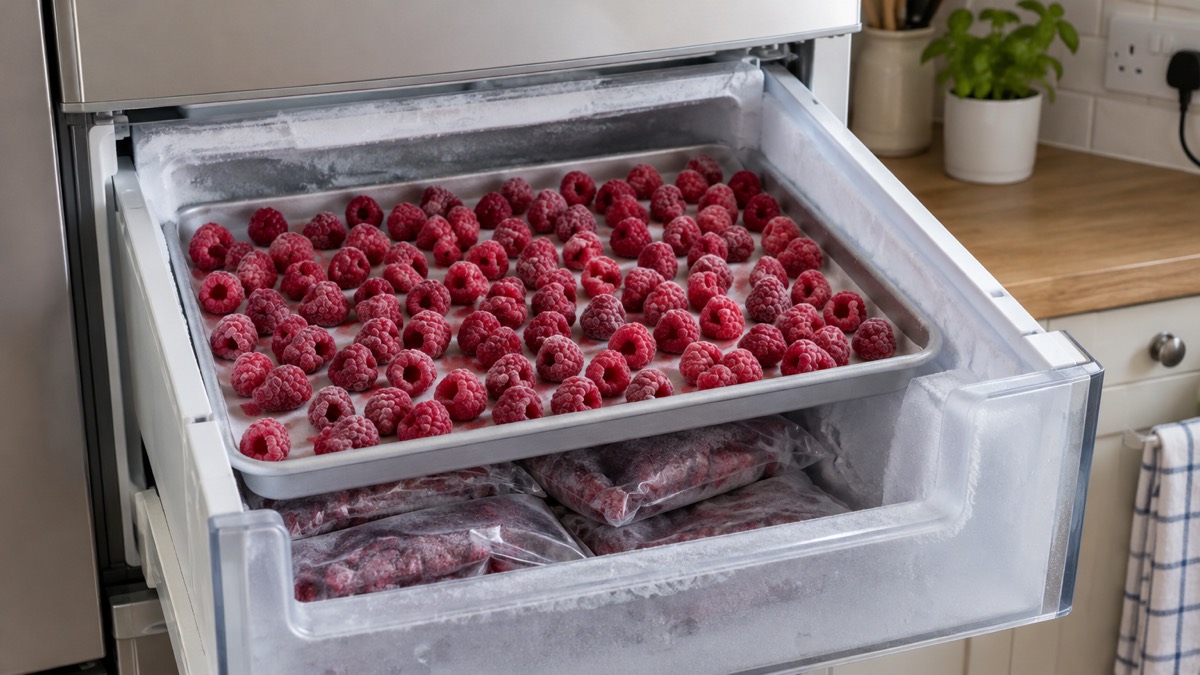
This is often called tray freezing, and it keeps the pieces separate so you can pour out a handful at a time. It costs you one shelf of freezer space for a few hours and saves you a season of chipping at a solid block.
Label each bag with what it is and when you froze it. Fresh fruit and vegetables that have not been peeled or cut are exempt from the date labelling rules that apply to prepacked foods8, so once it is in your own bag, the only record of its age is the one you write. A date saves you guessing next spring.
Blanching before freezing
Blanching means briefly scalding the produce in boiling water before it goes into the freezer. It is recommended for vegetables, and the reasons are consistent across the guidance: blanching slows or stops the action of enzymes which cause loss of flavour, colour and texture3. It also cleanses the surface of dirt and organisms, brightens the colour, helps retard loss of vitamins, and wilts or softens vegetables so they are easier to pack3.
For fruit, the picture is more mixed. Many fruits freeze perfectly well raw, especially if you are going to cook with them. Blanching is most useful where you want to hold colour and texture, or where the fruit would otherwise darken. If you are freezing fruit to eat raw later, try a small batch first and see how it thaws before committing the whole harvest.
| What you are freezing | Blanch first? | Why |
|---|---|---|
| Most vegetables | Yes | Slows enzymes that cause loss of flavour, colour and texture3 |
| Fruit for cooking | Usually not needed | Texture matters less once it is cooked |
| Fruit to serve raw | Test a small batch | Blanching can help colour and texture but changes the fruit |
| Tomatoes | Cook into a sauce instead | Best cooked before freezing2 |
The general rule from the preserving guidance is simple: it is best to blanch in boiling water first and to freeze in manageable quantities2. If you are freezing a mixed harvest of fruit and vegetables, blanch the vegetables and freeze the fruit as it is, unless you have a reason to do otherwise.
For a fuller treatment of the vegetable side, see why blanch vegetables before freezing, and for the wider picture of getting a garden harvest into the freezer, freezing home-grown fruit and vegetables.
Tomatoes are best cooked into a sauce first
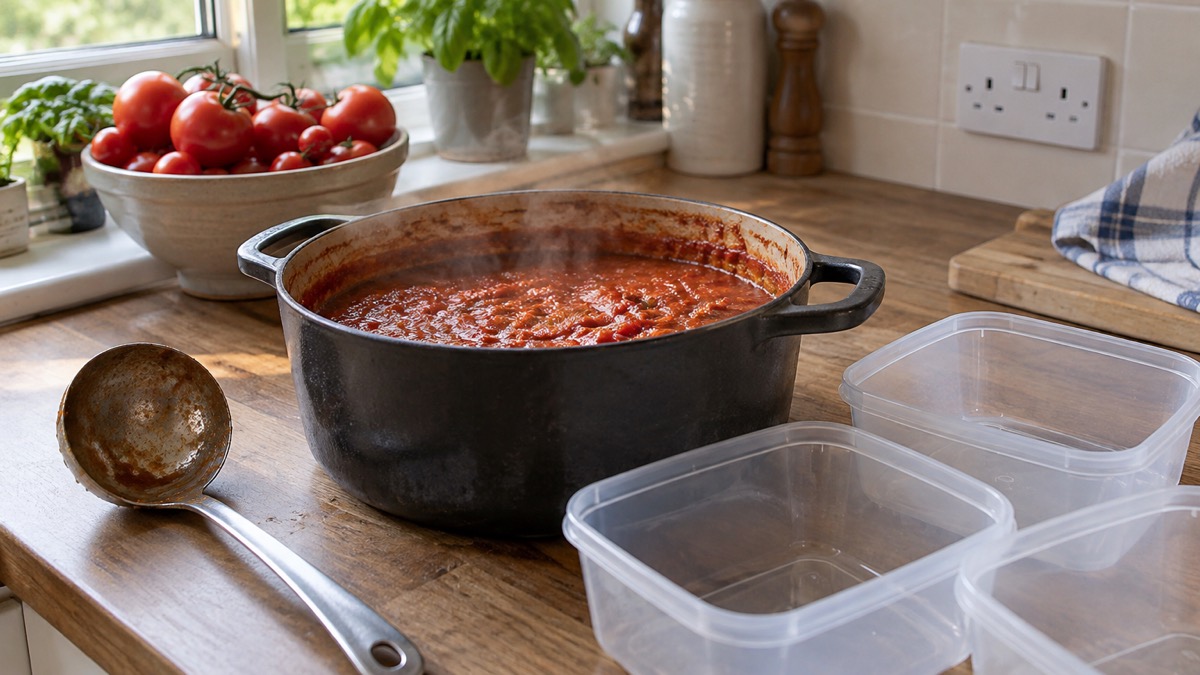
Tomatoes are the exception worth making a fuss about. They are best cooked into a sauce before freezing2. The reason is practical: tomatoes are watery and soft, so freezing them raw gives you a mushy bag that is only really useful as an ingredient, and you will still have to cook it down later. Cooking first concentrates the flavour, drives off some water, and gives you a sauce that freezes and thaws well and can go straight into a pan.
If you have more tomatoes than you can cook, deal with the green ones before the cold arrives. Pick green tomatoes before the first frost, then ripen them either by hanging the whole vine in a cool dry place or by wrapping individual fruit in paper and storing them in trays2. That way the last of the crop ripens indoors instead of rotting on the plant.
The same principle applies to other soft, watery produce: if the raw frozen result would only be cooked anyway, cook it first and freeze the finished dish. It takes the same freezer space and saves you a step on the night you want to eat.
Keeping colour and texture without sugar
Without sugar, you are relying on speed and air exclusion rather than chemistry. A few habits make a real difference:
- Work quickly. The sooner fruit is cold, the less it darkens.
- Exclude air. Press the air out of bags, or freeze in rigid containers with as little headspace as you can manage.
- Freeze small. Small pieces freeze fast, and fast freezing gives better texture7.
- Keep the temperature steady. A freezer that is opened constantly warms and refreezes, which is hard on texture.
If colour matters, remember that sweeteners will not help: they give sweetness but not sugar's colour protection1. For fruit you plan to cook, a little browning is cosmetic. For fruit you plan to serve raw, choose varieties and fruits that hold up well, and accept that a sugar-free freeze will look a little different from a sugared one.
Frozen fruit in a power cut
A full freezer of home-frozen fruit is a genuine asset in a power cut, but only if you treat it right. The single most useful instruction is to keep the door shut. Keep your freezer closed to make sure that the food stays cold4. Every time you open it, you let the cold out and warm the food.
The official order for using food during a power cut is worth knowing by heart: use chilled fridge foods first, then defrosted frozen food that does not need cooking, then room-temperature perishable food such as bread, then room-temperature tinned, bottled and dried food11. That order uses the food most at risk first and saves the shelf-stable stores for last.
If your freezer is not full, group packages so they form an "igloo" to protect each other, and place them to one side or on a tray so thawing juices will not get on other foods12. A fuller freezer holds its cold longer, so bags of frozen fruit can help protect the rest.
Alongside the freezer, keep food that needs no electricity or heat to prepare13. The official advice is to store non-perishable food that does not need cooking, plus a tin opener, and ready-made baby formula and pet food if needed14. Fruit that is frozen is not much use if the power is out and you cannot cook, so pair it with food you can eat cold.
Where frozen fruit fits in your store
Frozen fruit is one part of a sensible household store, not the whole of it. The NHS advises including plenty of fruit and vegetables, whether fresh, frozen, tinned or dried17. That is a useful framing: frozen, tinned and dried fruit all count, and having some of each means a power cut or a bad harvest does not leave you without.
A few practical points:
- Frozen fruit is for the freezer. It depends on power, so do not count it as your only fruit.
- Tinned and dried fruit need nothing. They sit in a cupboard and are ready whatever happens.
- Grow what you can. Growing fruit organically, with minimal inputs and without pesticides, fungicides or herbicides, will ensure the food you grow is healthy, delicious and perfectly safe to eat18.
If you are planning a store, the emergency food section covers the wider list, and storing the harvest covers the crops that keep without a freezer at all. For the growing side, growing fruit at home is the place to start.
Sources (18)
- Freezing fruits without sugar, National Center for Home Food Preservation, 2026
- Harvesting and storing vegetables, Garden Organic, 2026-10-29
- Canning and freezing guidance, National Center for Home Food Preservation, 2026
- Will food in my fridge freezer be ok?, NIE Networks, 2026-10-25
- Storing and freezing guidance, National Center for Home Food Preservation, 2026
- Drying and preserving guidance, National Center for Home Food Preservation, 2026
- Harvesting and storage, Harrod Horticultural, 2026-11-04
- Use-by and best before dates, Food Standards Scotland, 2026-10-25
- Chilling food safely, Food Standards Scotland, 2026-10-25
- Preparing and cooking food safely, NHS Inform, 2025-02-21
- Power cuts and food safety, Food Standards Scotland, 2026-10-25
- Power cut food safety, NIE Networks, 2026-10-25
- How you can prepare for a power cut, Lancashire Prepared, 2026-10-29
- Power cuts: be prepared, UK Government, 2026-10-21
- Strong winds: weather warning information and advice, nidirect, 2026-10-24
- Be prepared for a power cut, Northern Powergrid, 2026-10-26
- Stay warm and nourished, NHS Norfolk and Suffolk ICB, 2026-10-16
- How to grow fruit, Garden Organic, 2026-10-29
 Hydroponic System Parts List
 Year-Round Sowing Calendar
 Preserving Equipment Checklist
 Blanching Vegetables
 Carrot Fly Protection
 Knowing When Chutney Is Ready
 Clubroot in Your Soil
 Drought-Resistant Vegetables
 Edible Flowers Safety
 Extending the Growing Season
 Garden Fleece Frost Protection
 Avoiding the Hungry Gap
 Keeping Varieties Pure for Seed
 Making Leafmould
 Growing Microgreens Indoors