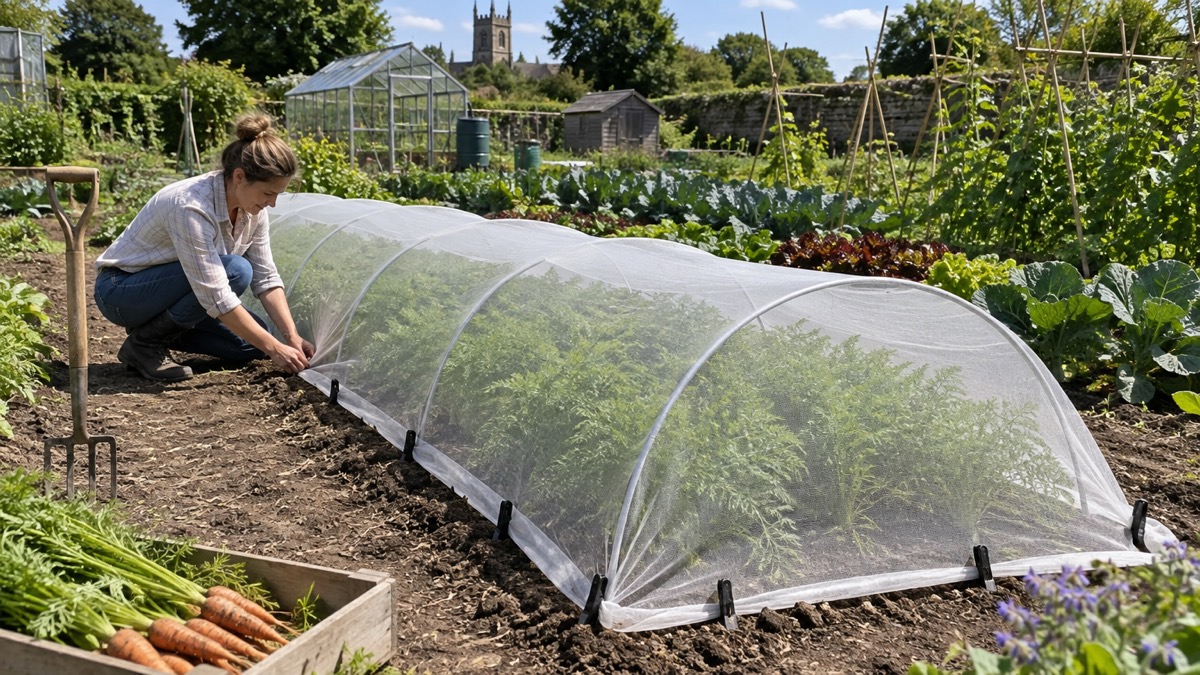
Carrot fly is the pest that turns a promising row of carrots into a brown, tunnelled mess, and it is the reason so much carrot growing advice begins with a cover. The practical answer is a physical barrier: put insect mesh over the crop so the fly cannot reach the plants to lay its eggs1. Carrot fly can destroy a crop of carrots, so this is not a cosmetic job1.
The detail that decides whether a cover works is height. Carrot flies do not fly much above 50cm (19.5 inches) above ground, so a cover that stands clear of the foliage and is sealed along every edge keeps the crop out of reach2. The second detail is timing: the Royal Horticultural Society's growing guides say to grow carrots under fleece to protect them from carrot fly in March, and to keep carrots covered with fleece for the same reason as the season goes on3.
Get those two things right, a barrier that clears the crop and edges that stay shut, and you have most of the protection you need. The rest of this page is about choosing between mesh and fleece, where covers fail, and how to look after them so they work again next year.
Why a cover, and not a spray
Carrot fly is a low-flying pest, and the damage it does is done below ground, out of sight, which is why the advice leans on blocking it rather than treating the plant afterwards. The maker guidance is blunt: put up a barrier of insect mesh to stop them getting access to your crop1. The same approach is recommended for related root crops. For turnips, employing mesh or horticultural fleece can deter cabbage root fly from accessing the roots5.
A cover also fits the way most households grow carrots, in a bed or a raised bed rather than a field, where a physical barrier is practical to erect and to keep in place. It has the further advantage of doing several jobs at once. A fleece cover protects plants against frost and stops wind, hail, birds and insects damaging them6. A mesh cover stops pests such as carrot fly and cabbage root fly from damaging your plants7. Neither needs applying, mixing or repeating after rain.
There are supporting measures worth knowing about, though they are secondary to the barrier. Intercropping leeks with carrots can help manage onion fly, while also protecting the carrots from carrot fly too8. Shallots work well alongside carrots and help with carrot fly, while carrots help shallots with onion fly9. If you grow celery, note that carrot flies are among the pests to look out for and protect against10. And if you would rather start from a variety with some resistance built in, Organic 'Flyaway F1' is described by its supplier as carrot fly resistant1.
What a cover cannot do is rescue carrots already infested, or protect a crop you keep opening up. The sections below deal with both.
Mesh or fleece: how each one protects the crop
Both work by putting something between the fly and the plant, but they are different materials doing different jobs, and it helps to know which you are buying.
| Cover | What it does | Best suited to |
|---|---|---|
| Insect mesh | Stops pests such as carrot fly and cabbage root fly from damaging your plants7 | The main growing season, when the priority is excluding the fly |
| Garden fleece | A soft, fibrous, translucent material laid over or around plants, hastening their growth and protecting them against weather and pests, usually used without supporting hoops3 | Early sowings and cold snaps, where warmth matters as much as exclusion |
| Fleece plant jackets | A warmer fleece jacket, depending on the type of plant being protected11 | Individual plants rather than a whole row |
| Cloches | Early cultivars can be sown in late winter (February or March) under cloches1 | Small patches and early cultivars |
Mesh coverings with a fine enough weave can protect not only against birds, slugs and snails but also cabbage caterpillars and cabbage root flies12. That fine weave is the point: the barrier has to be fine enough to stop the fly, not merely shade the crop.
Fleece earns its place for early sowings because it does two jobs. It protects against frost and stops wind, hail, birds and insects damaging your plants6. Cloches or fleece can allow earlier plantings as well as offering the young plants a little extra protection13. The same logic appears across crops: celeriac can be covered with cloches or row covers during early growth to keep it warm and reduce bolting risk from cold snaps14.
The trade-off is straightforward. Fleece is lighter and warmer; mesh is the more single-minded barrier against insects. Many households use fleece for the earliest sowings and mesh for the main crop, and some covers let you swap between the two: the Popadome crop protection system takes a choice of fleece, polyethylene and insect mesh covers6.
How high, and how to seal the edges
The height question has a clear answer in the guidance. Carrot flies do not fly much above 50cm (19.5 inches) above ground2. A cover that stands at or above that height, with the crop growing underneath it, puts the plants above the fly's working range as well as behind a barrier.
Raised beds do some of this work for you. If you are growing in raised beds at 18 inches high, the risk of carrot root fly is lower, for the same reason2. If you want to be absolutely sure your crop is protected, you could erect an anti carrot fly screen around your raised bed2. For anyone building raised beds from scratch, the Royal Horticultural Society's guidance on creating raised beds is worth reading before you fix the height15.
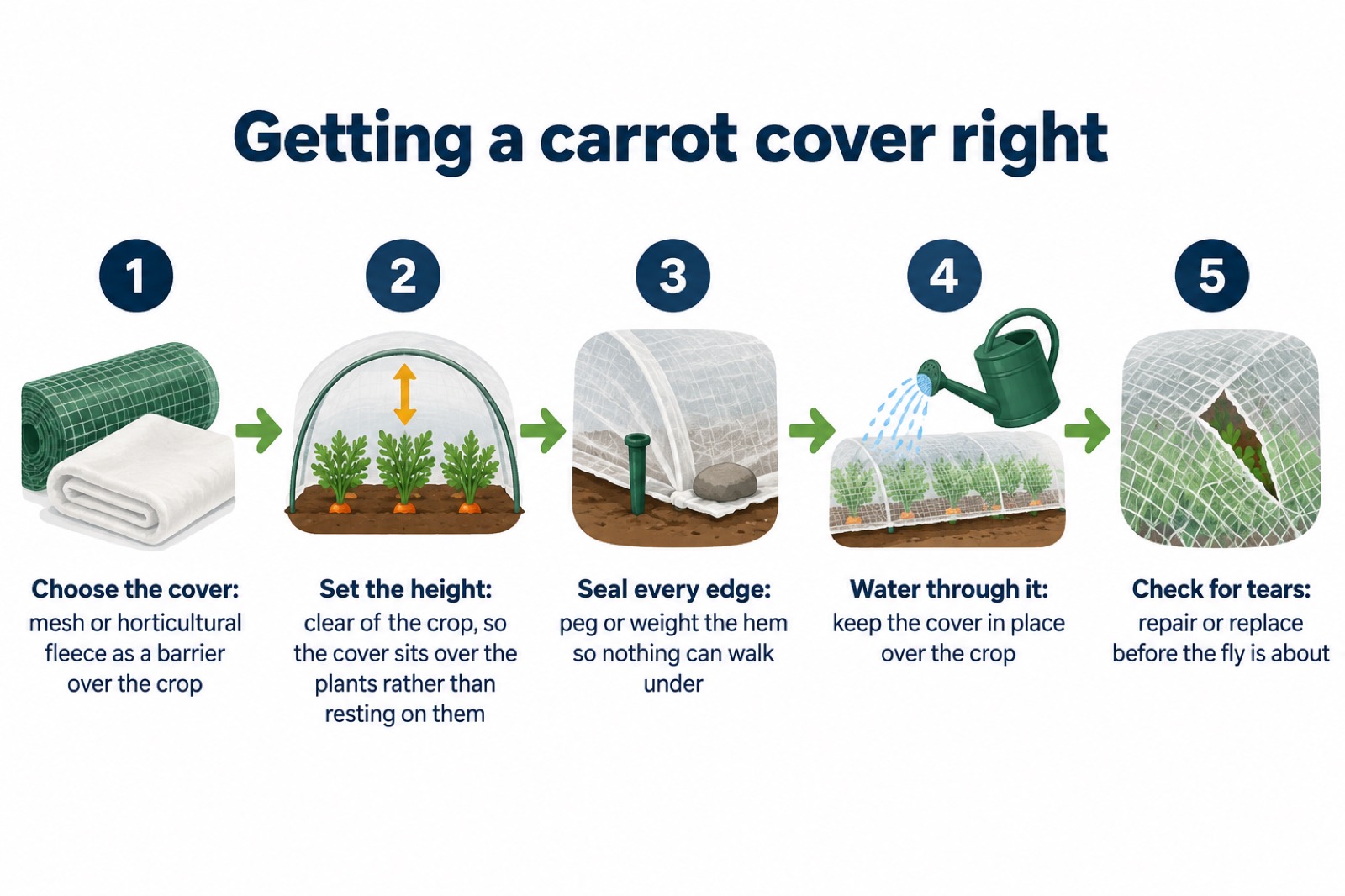
Height alone is not enough. A cover fails at its edges, and the fly will find the gap. Work through these checks:
- Peg or weight every edge, including the ends, so there is no lifted hem for the fly to walk under.
- Keep the cover clear of the leaves so the crop is not pressed against the mesh.
- Repair tears before the season starts, not after you notice damage.
- Water through the cover rather than lifting it, so the seal is never broken.
- Do not lift the cover to weed and leave it open while you work.
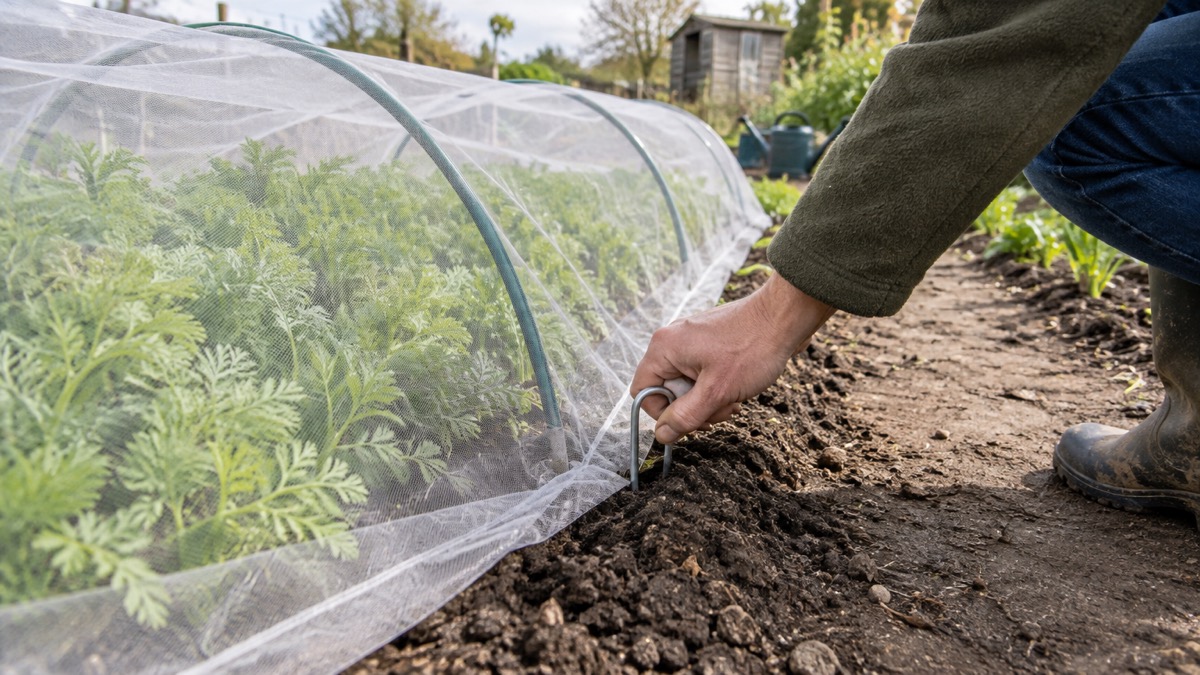
The principle that a barrier is only as good as its openings holds well beyond the vegetable bed. On a private water supply, all openings must be protected using a fine mesh screen to prevent the ingress of insects and animals16, and overflow pipes or vents should be protected by a suitable mesh to prevent small animals entering the tank or chamber17. Around a roof, gaps in soffits and cladding can be screened with wire mesh, which retains ventilation but helps to prevent embers from getting in18. The lesson is the same each time: the mesh is only doing its job where it is continuous.
Fleece over March sowings
March is the month the advice names. The Royal Horticultural Society's spring growing guide says to grow carrots under fleece to protect from carrot fly3. Early cultivars can be sown in late winter, in February or March, under cloches1. Fleece over a March sowing therefore does two things at once: it warms the ground and shelters the seedlings, and it puts a barrier over the crop before the fly is active.
Fleece is well suited to this because it can be laid without hoops. It is a soft, fibrous, translucent material laid over or around plants, hastening their growth and protecting them against weather and pests, usually used without supporting hoops3. That makes it quick to put on a small sowing, though it also means it sits close to the plants and needs weighting along the edges.
The same material is used the same way on other early crops, which is a useful cross-check on technique. Onions can be covered with fleece until the sets have rooted, because birds like to pull freshly planted sets from the soil19. Shallots can be covered until the sets form roots and are more firmly anchored9. Kohlrabi benefits from cloches or fleece to allow earlier plantings and give young plants a little extra protection13. In each case the cover is temporary and its job is defined.
There is a second sowing date worth knowing. Carrots can be sown in June for use over winter, which also has the added bonus of missing the first attack of the carrot root fly20. That is a timing strategy rather than a barrier strategy, and the two combine well: a June sowing under mesh, or a March sowing under fleece kept on through the season, both reduce the exposure.
Where a cover fails: gaps, lifting and the end of the season
Most carrot fly damage in covered beds comes down to one of three things: an edge that was never sealed, a cover lifted for a job and not put back properly, or a cover removed too early.
The first is the commonest. A cover pegged at the corners but loose along the sides is an open door. The second is a habit problem: lifting the mesh to weed, thin or water breaks the seal, and the fly is small enough to take advantage. Water through the cover and weed at the edges rather than in the middle.
The third is a judgement call. The summer growing guide says to keep carrots covered with fleece to protect them from carrot fly4, which points to leaving the cover on rather than whipping it off once the seedlings are up. If you want to reuse the cover for something else, do it after the carrots are lifted, not before.
Covers also come to the end of their life. Fleece and mesh wear, tear and thin, and a worn patch is a gap. When you take covers in at the end of the season, check them over, and replace anything that no longer forms a continuous barrier.
There is a related point about how long protection is needed. If you save seed, you may leave a carrot plant to over-winter so it flowers the next year21. That plant is in the ground for far longer than a cropping row, so plan its protection accordingly.
Reusing fleece and mesh next year
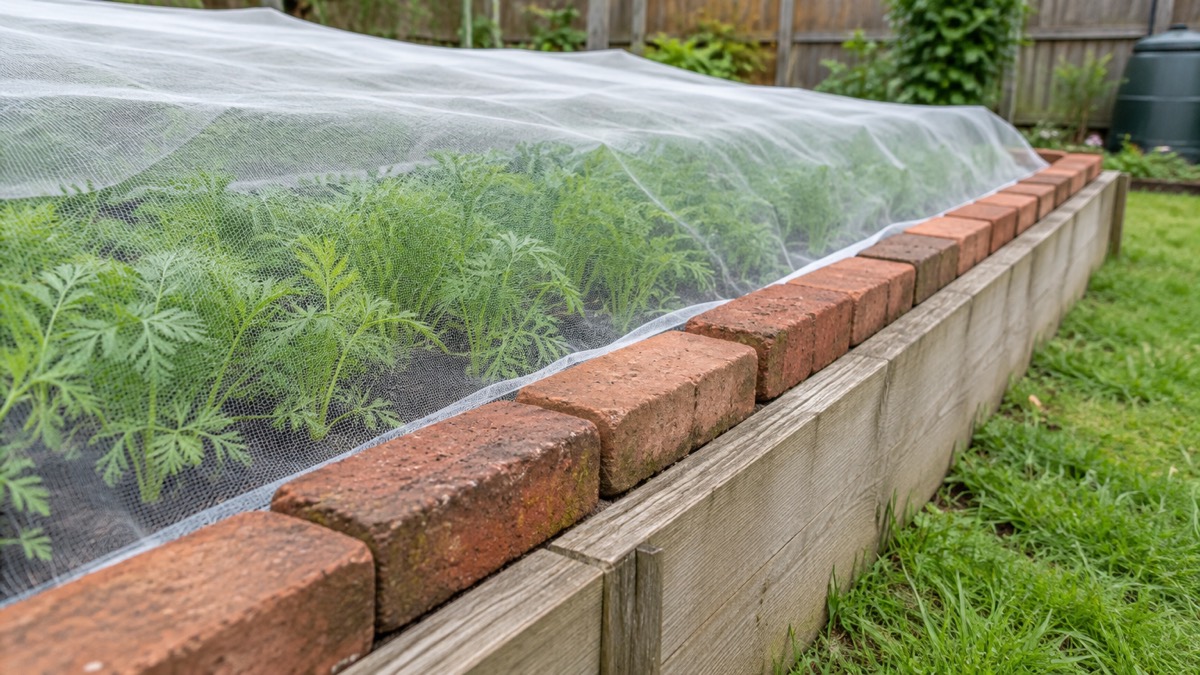
Both materials are reusable, and looking after them is part of getting value from them. The pattern in the guidance is to remove covers once their job is done and store them for the next season. Netting over grapes and pears is used in July to protect against birds and wasps and removed in autumn once picking is finished22. The same discipline applies to crop covers: take them off when the crop is lifted, shake them out, check for damage and store them dry.
There is a second life for some kit. Individual cloche hoops can be converted into garden netting hoops by swapping the polythene for a net cover later in the year, to protect from both airborne and ground-dwelling pests23. If you already own cloches, that is a way to get mesh protection without buying a separate frame.
Before you put a cover back out, check three things:
- Tears and thin patches, which are gaps however small.
- The edges, which should still take a peg or a weight along their full length.
- The fit, which should still clear the crop rather than press on it.
Fleece that has been used for frost protection through the winter may have stiffened or torn; mesh that has been out all summer may have UV damage. Neither is expensive to replace relative to the crop it protects, but replacing it mid-season, after the fly is about, is the wrong time to discover the problem.
If you grow under cover more widely, whether in a polytunnel, a greenhouse or a cloche system, the same principles of sealing, height and material choice carry across. For the wider picture on managing pests without reaching for a spray, see Vegetable Pests and Diseases: Prevention and Control, and for fitting covers into a longer growing plan, Polytunnels and Greenhouses: Growing Under Cover All Year.
Sources (23)
- Carrots, Harrod Horticultural, 2026-11-04
- Carrot root fly, Harrod Horticultural, 2026-11-04
- Month by month guide to food growing: spring term, Royal Horticultural Society, 2026
- Month by month guide to food growing: summer term, Royal Horticultural Society, 2026
- Top Of The Crops - Turnip Growing Guide | First Tunnels, First Tunnels
- Popadome Crop Protection System 1.2m x 1.2m, Harrod Horticultural, 2026-11-04
- Popadome Crop Protection System 2m x 2m, Harrod Horticultural, 2026-11-04
- Top of the Crops: Leeks, First Tunnels, 2026-09-29
- Top of the Crops: Shallots, First Tunnels, 2026-01-14
- Top of the Crops: Celery, First Tunnels, 2026-01-14
- Fleece protection, Harrod Horticultural, 2026-11-04
- Top of the Crops: Cabbage, First Tunnels, 2026-01-14
- Top of the Crops: Kohlrabi, First Tunnels, 2026-01-14
- Top of the Crops: Celeriac, First Tunnels, 2026-01-14
- Creating raised beds, Royal Horticultural Society, 2026
- Water storage, Drinking Water Inspectorate, 2025-11-05
- Private water supply pipes and tanks, Scottish Borders Council, 2026-10-29
- Reduce the risk of wildfire damage to your property, Hampshire Fire and Rescue Service, 2026-08-27
- Onions, Harrod Horticultural, 2026-11-04
- Vegetables all year round, Garden Organic, 2026-10-29
- Tips on saving your own seeds, Royal Horticultural Society, 2026
- Fruit gardening calendar, Royal Horticultural Society, 2026
- Individual Cloche Hoops, Premier Polytunnels, 2026-11-04
 Hydroponic System Parts List
 Year-Round Sowing Calendar
 Preserving Equipment Checklist
 Blanching Vegetables
 Knowing When Chutney Is Ready
 Clubroot in Your Soil
 Drought-Resistant Vegetables
 Edible Flowers Safety
 Extending the Growing Season
 Freezing Fruit Without Sugar
 Garden Fleece Frost Protection
 Avoiding the Hungry Gap
 Keeping Varieties Pure for Seed
 Making Leafmould
 Growing Microgreens Indoors