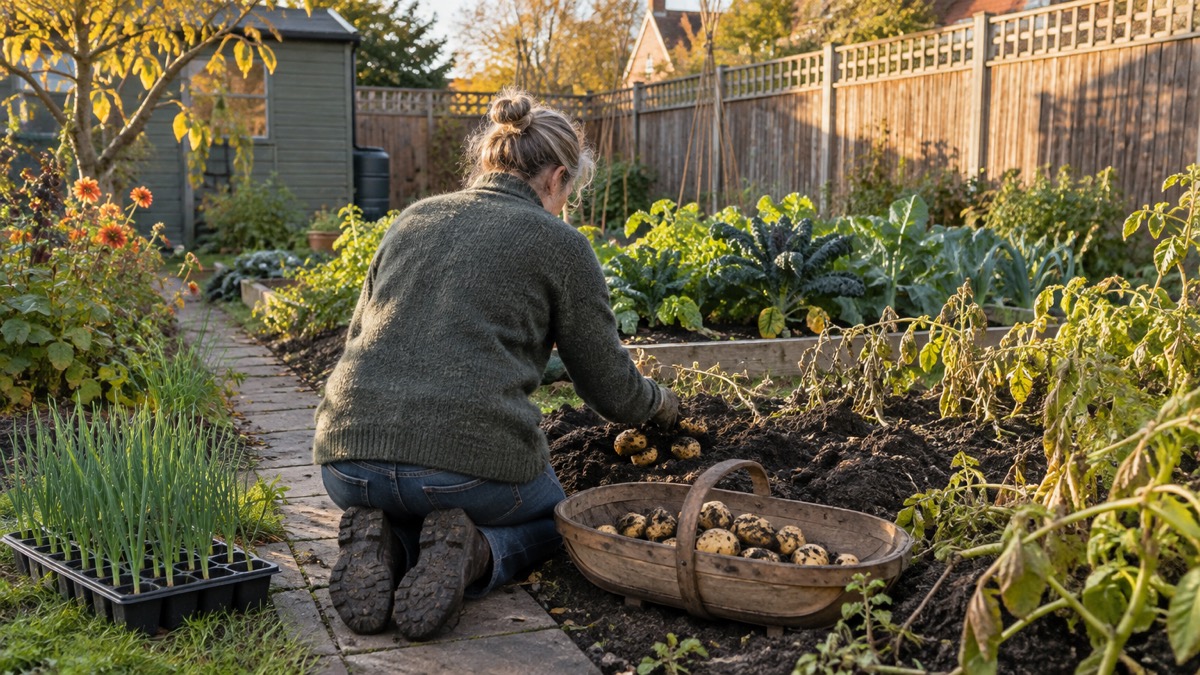
You do not need a large garden, a greenhouse or years of experience to grow some of your own food. What you need is a plan of what to sow and when, and a rough idea of when it will be ready. The single most useful habit is to work month by month: for each vegetable you choose, write down when to sow it and when to harvest it, and follow that plan through the year1.
The UK growing year has natural quiet points and busy ones. Garlic and shallots can go in during January, with onions and celeriac sown under glass2. By March the ground is workable and the list lengthens considerably, with carrots, early potatoes, spinach, chard and salad leaves all going in3. High summer is about keeping the succession going so that autumn and winter are covered, and late autumn is for garlic, broad beans and the last of the root harvest2.
This page sets out a month-by-month checklist, then explains the choices behind it: whether to sow indoors or out, what frost and cold soil do to your plans, how to keep seed dry and labelled, and how to store what you grow so it lasts.
The month-by-month checklist
Treat this as the spine of the year. It is not a list of everything you could grow, but a working sequence of what can be sown, planted and picked in each month, drawn from published monthly growing guides. Work through it in order and tick off what applies to your plot.
Sowing indoors or outdoors: which suits each month
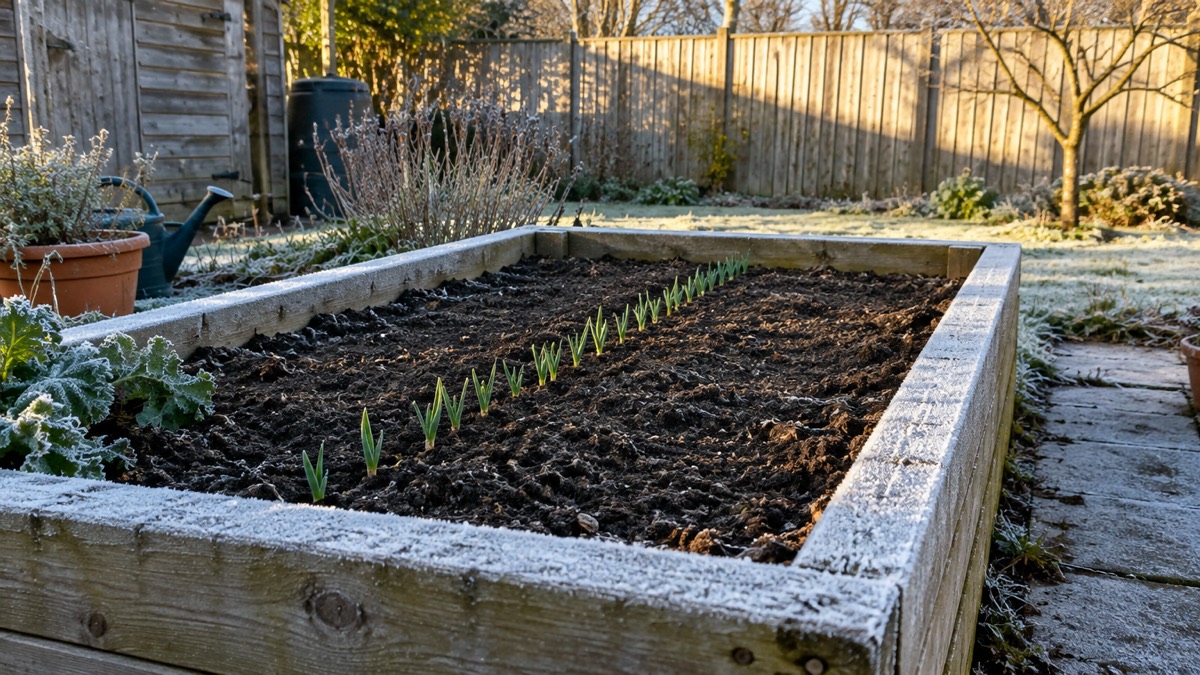
The choice between a windowsill, a cold frame and open ground is mostly about temperature and timing. Sowing under glass buys you weeks at either end of the year; sowing direct saves handling and suits anything that resents root disturbance.
The monthly guides use the phrase "under glass" deliberately. In January and February, onions, celeriac, lettuce, carrots, radish and turnips are all sown that way, while hardier things such as early peas, broad beans and spinach go straight outside2. By March the balance shifts: most of the list is sown or planted outdoors, with tomatoes, aubergines and peppers still under cover2.
Individual crops have their own windows. Beetroot can be sown indoors from March to August and outdoors from March to July7. Mustard can be planted outdoors between March and September, with timing depending on location and what you want8. Mizuna and mibuna are sown direct between March and August, or indoors in February for an earlier crop, hardening them off before planting out9. Sorrel seed can be sown any time between February and July, and young plants, including those raised indoors, can be planted out between April and August10. Lemon balm seed is sown between March and May into trays of compost11. Turnips are sown outdoors from March to mid April12.
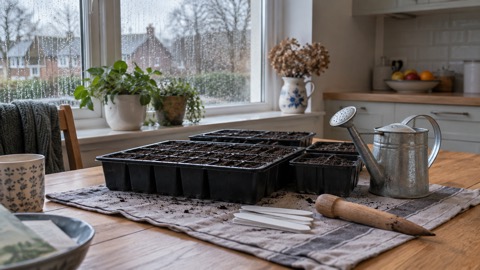
If you are starting seeds in pots, the method matters as much as the date. For small seeds, sprinkle them on top of the compost with space between them, then sieve a thin layer of compost over the top. Put the containers in a sheltered place with good light, such as a sunny windowsill, greenhouse or cold frame13. A clear plastic lid keeps seeds warm and moist, and an upcycled clear food tray works well as a propagator lid14.
For a fuller treatment of depth, spacing and germination, see Sowing Seeds Indoors and Outdoors, and for the kit itself, the seed sowing equipment checklist.
Where frost and cold soil stop sowing
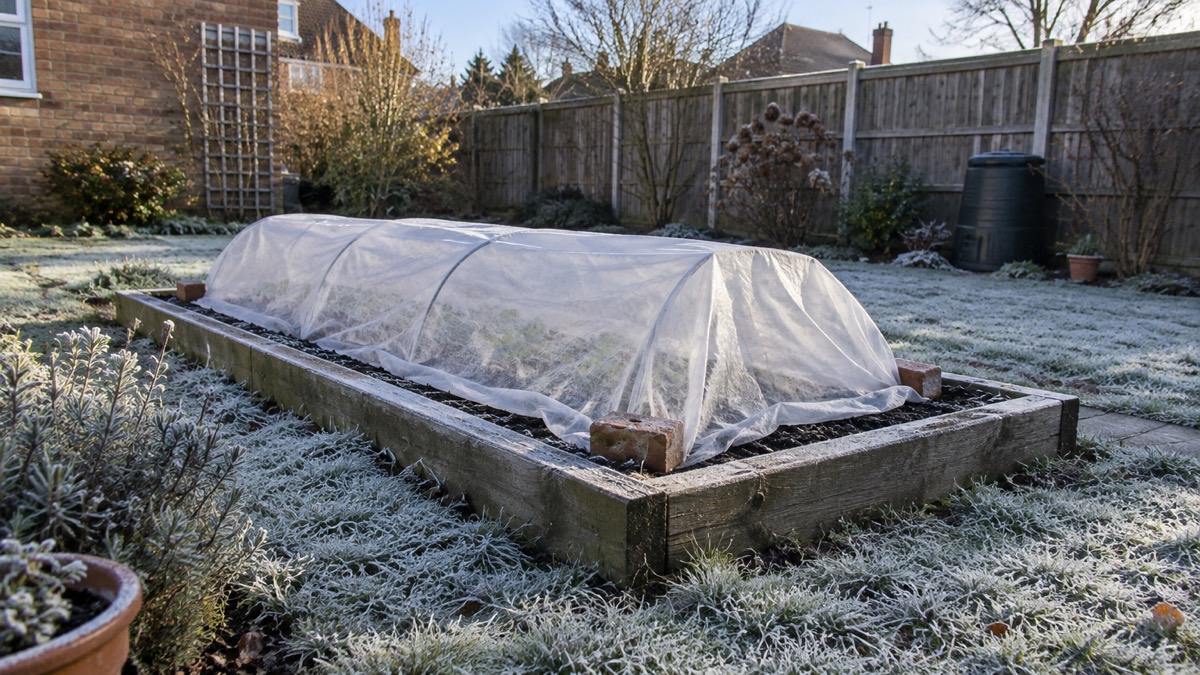
Cold is the main limit on the calendar, and it acts in two ways: frost damages young plants, and cold, wet soil stops seed germinating at all. The practical rule is to wait until the ground is workable and to protect anything tender.
Fruit trees and bushes can be planted any time from November to February, unless the ground is frozen or waterlogged15. That single condition tells you most of what you need to know about winter work: if you can't dig it, don't plant it. Roots also stop growing during flowering, so plant before that point, and planting in autumn or spring avoids disturbing soil during the dry season16.
Protection is cheap and effective. Beetroot sown in early March benefits from frost protection over the seeds, even inside a polytunnel, to reduce frost damage to seedlings7. In September, the seasonal work includes protecting crops from frosts6. If you garden under cover, outdoor crops such as potatoes and peas can be grown in greenhouse beds to bring them forward several weeks, and by July and August the space is clear for winter salads and vegetables4.
Some crops are built for the cold. Brassicas such as kale, cabbage, turnips and broccoli will all grow over the winter months4. Beetroot sown in July, August or early autumn can be left in the ground to over-winter and dug up on demand, with frost-protection fleece or a polytunnel heater in cold winters7. A hot bed, once set up, can be used to grow salad crops in winter and to get a head start on seed sowing in spring by up to a month17.
Keeping seeds dry, labelled and ready to sow
Seed kept well is money and time saved, and it makes the monthly checklist far easier to follow. The principles are dryness, coolness, labelling and a note of the date.
Store seeds in labelled paper envelopes or bags, kept in a cool, dry place, within an airtight container if possible. Sachets of silica can absorb excess moisture18. Label with the name and the date of sowing to avoid confusion later18. When you sow microgreens, add a thin layer of compost over the seeds, just enough to cover them, then label with the seed variety and date of sowing14.
Before sowing direct, prepare the ground properly. Ensure the area is weed free, rake the soil gently so it is fine and crumbly and reasonably level, wear gardening gloves, and read the seed sowing instructions on the packet to work out the sowing distances19. The equipment for the job is modest: a trowel, hand rake, dibber, measuring stick, kneelers, gardening gloves, watering can, labels and a waterproof pen or pencil, sticks or straws to mark rows, and the seeds themselves19. Large seeds can be sown individually using a dibber to make a hole, which is known as station sowing19.
Watering is where newly sown seed most often fails. Beetroot needs thorough watering and soil that does not become dry, and in summer, particularly with July or August seedlings, an automatic watering system is worth considering7. Mizuna and mibuna need watering well throughout the year, taking care that the soil around the plants does not dry out9. Sorrel wants the soil or growing medium consistently moist but not waterlogged through the growing season10. Lemon balm needs watering well on planting and through the summer, preferring consistently moist soil while it establishes and tolerating drier conditions once established11.
For more on keeping saved and bought seed in good condition, see How to Store Saved Seed So It Lasts and How to Test Whether Old Seeds Will Still Grow.
Succession sowing, and growing in a small space
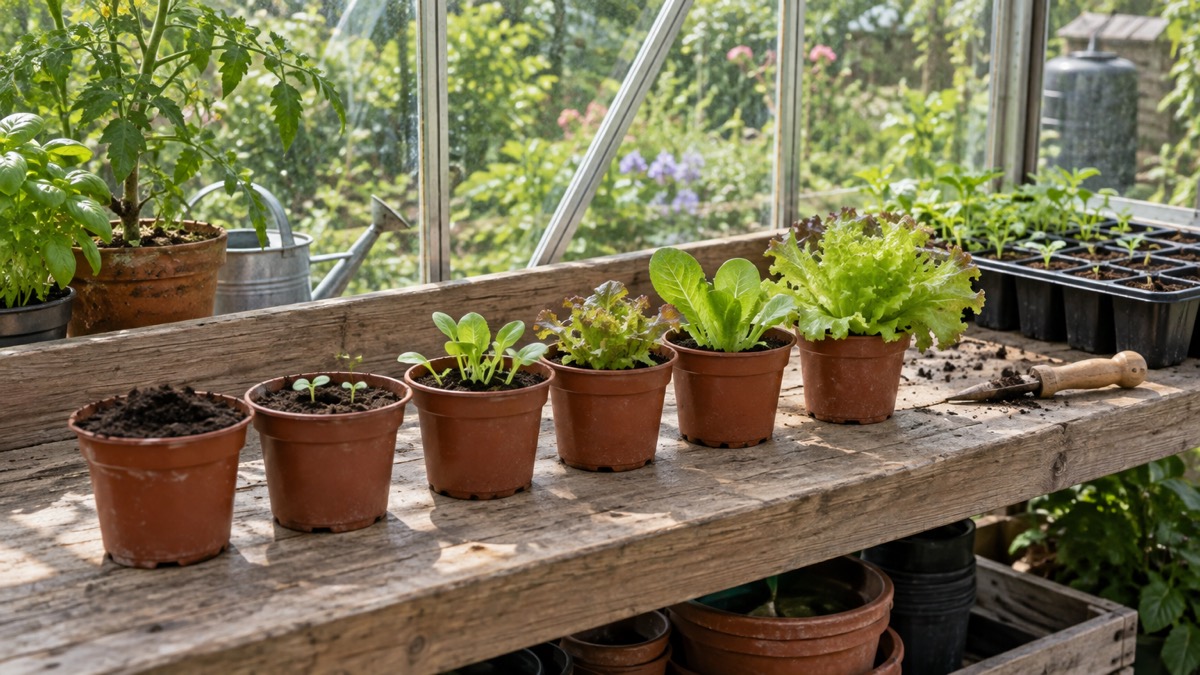
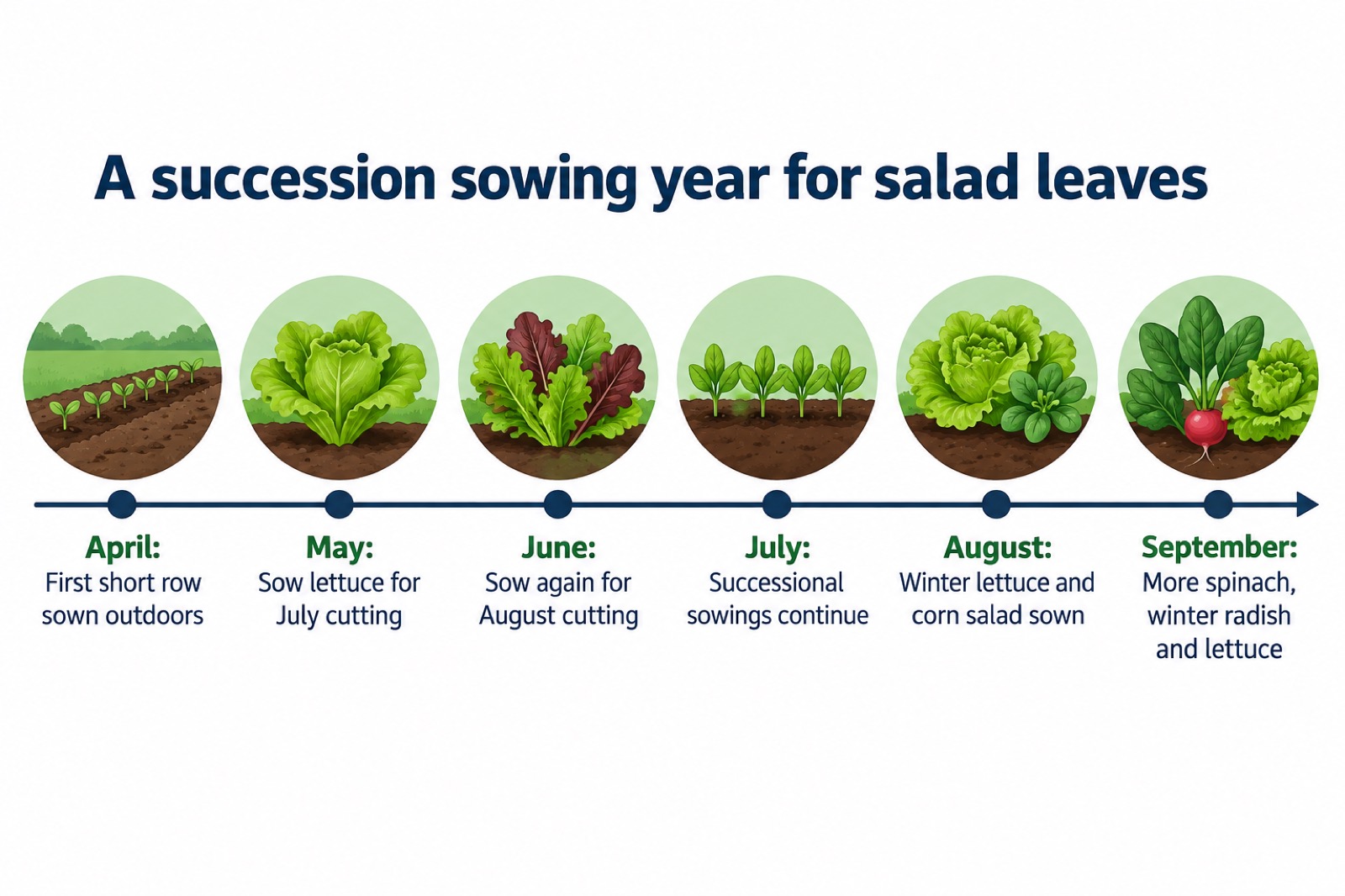
Succession sowing is the technique that turns a few packets of seed into a supply that runs for months. Instead of sowing a whole row of lettuce in April and eating it all in June, you sow a short row every week or fortnight and pick continuously.
Salad leaves show the principle clearly. They can be sown continuously throughout the summer, and sowing at weekly intervals keeps you in fresh leaves for months20. Lettuce sown in May is ready in July; sow again in June and it is ready in August, and so on2. The monthly guides build successional sowings into the plan from April onwards, covering beans, lettuce, radishes, beetroot, spinach, turnips, endive, onions and corn salad at different points in the year2.
Small spaces reward the same discipline. Cut-and-come-again salad leaves, mustard, oriental salad and rocket give tasty leaves in just a few weeks and can be grown in containers20. Microgreens can be sown indoors throughout the year for a continuous harvest, placed on a warm, sunny windowsill or in a bright indoor space, with the compost kept moist but not soggy while the seeds germinate14. Potatoes grow well in containers: once shoots appear, gradually add more compost around the base of the stems to cover them, and continue burying the stems by topping up until the container is full. Water when the compost is dry, particularly in hot or dry weather, and stop watering when the potatoes are ready to harvest21.
Fruit works in pots too, with more attention to feeding. Blueberries need the ericaceous compost kept moist and a feed of ericaceous liquid fertiliser once a month; gooseberries want liquid tomato feed fortnightly when the plant comes into leaf22. Plants in containers may need watering every day, though a visit once or twice a week should keep outdoor plants ticking over15.
Storing a harvest so it lasts
Growing more than you can eat in a week is the point of a garden, and storage is what makes it worthwhile. Some crops keep for months with very little effort; others need eating, freezing or preserving.
Root vegetables are the easiest. Carrots and beetroot can be harvested in late autumn and stored carefully for several months, as can potatoes, onions and garlic4. Beetroot for storing is harvested in September or October and kept in boxes layered with sand in a cool, dark place7. If you grow more beans than you can keep up with, either freeze them or leave some pods to set seed; when the pods are dry, shell out the dry beans and store them in a paper bag23.
Plan for the hungry gap as well as the glut. The key to having vegetables through autumn and winter is to continue sowing, even in mid-summer4. Brassicas such as kale, cabbage, turnips and broccoli will grow over the winter months4. Medium-term crops sown or planted in one term are harvested in the next, 14 to 25 weeks (three to six months) later24.
Saving your own seed closes the loop. Saving seed each year allows your varieties to adapt to your own conditions, and you can note useful characteristics such as pest or disease resistance26. Leave one leek plant, an onion plant and perhaps a carrot and parsnip plant to over-winter; the next year they will flower and you can save their seeds18. Lettuces, spinach and Swiss chard that have gone to seed form flowers on a long stalk and then seeds, which can be collected, dried, sorted and saved to sow next year18.
For the detail on each of these, see Storing the Harvest, Freezing Home-Grown Fruit and Vegetables, How to Save Seed from Your Own Vegetables and How to Avoid the Hungry Gap in Your Vegetable Garden.
Planning the plot around the calendar
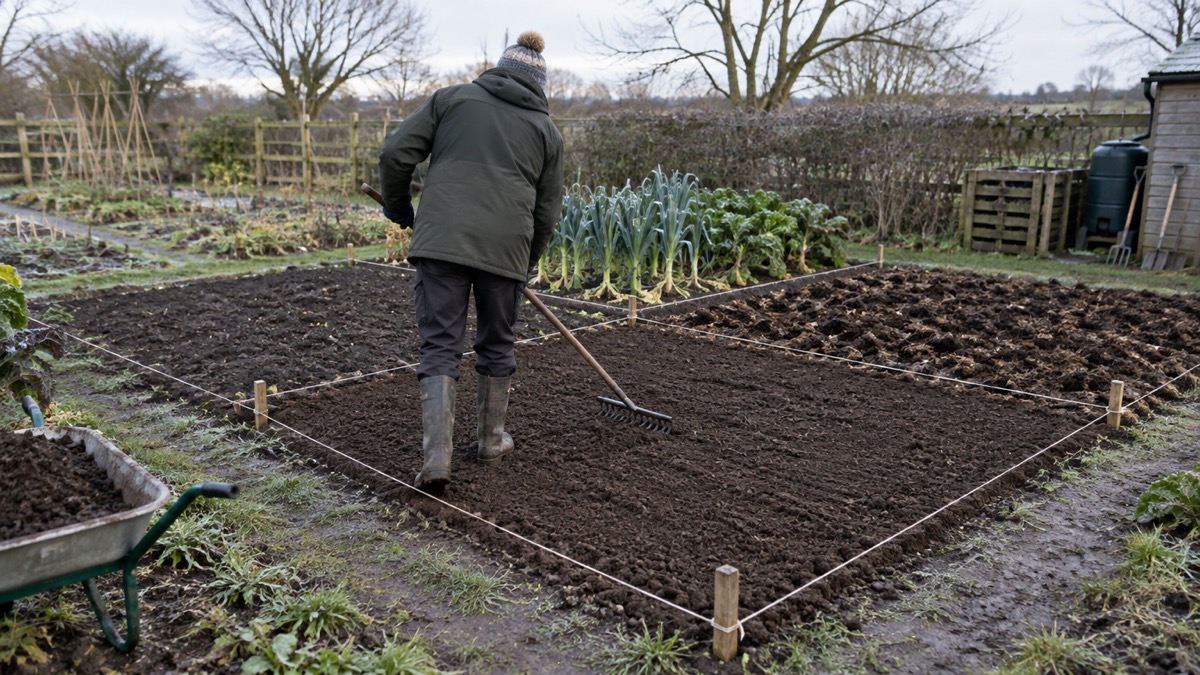
A calendar only works if the plot can supply what it promises. Two planning habits make the difference: grouping crops by family and moving them round, and choosing what you actually like to eat.
Keep plants in the same families together, such as potatoes and tomatoes, but move them around the different sections each year27. Plant what you like to eat in the quantities you like to eat it, and taste before planting, especially the more unusual crops. Select for disease resistance, especially in fruit, find out whether your fruit plants need a pollinator, and plan for the whole year so there is plenty to harvest at all times28.
Pollinators deserve a line in the plan too. Think about plants, including trees and shrubs, that flower at different times so there is food available throughout the year, but especially from March through to October29. If you are growing under cover, remember that a greenhouse or polytunnel changes the calendar: outdoor crops can be brought forward in the beds, and the space can then be turned over to winter salads4.
For the wider picture, start with Growing Your Own Vegetables: Where to Start, and see Polytunnels and Greenhouses if you are considering cover. If you are weighing up a structure, Polytunnel or Greenhouse? sets out the choice.
Sources (29)
- What shall we grow?, RHS, 2026
- Growing Year-Round, Centre for Alternative Technology, 2025-07-02
- Month by month guide to food growing: spring term, RHS, 2026
- Vegetables all year round, Garden Organic, 2026-10-29
- Month by month guide to food growing: summer term, RHS, 2026
- Month by month guide to food growing: autumn term, RHS, 2026
- Top of the Crops: Beetroot, First Tunnels, 2026-01-14
- Top of the Crops: Mustard, First Tunnels, 2026-01-14
- Top of the Crops: Mizuna and Mibuna, First Tunnels, 2026-01-14
- Top of the Crops: Sorrel, First Tunnels, 2026-01-14
- Top of the Crops: Lemon Balm, First Tunnels, 2026-01-14
- How to grow turnip, Garden Organic, 2026-10-29
- Sowing in pots, RHS, 2026
- Growing microgreens, RHS, 2026
- Fruit gardening calendar, RHS, 2026
- Saving water in the garden, Centre for Alternative Technology, 2025-06-27
- Garden Organic | How to grow vegetables and herbs, Garden Organic
- Tips on saving your own seeds, RHS, 2026
- Direct seed sowing, RHS, 2026
- Quick growing food, Garden Organic, 2026-10-29
- How to grow potatoes in containers, RHS, 2026
- Growing fruit in containers, RHS, 2026
- Harvesting and storing vegetables, Garden Organic, 2026-10-29
- Vegetable crop planner, RHS, 2026
- Sewage flooding in your property, Yorkshire Water, 2018-02
- Why save seed, Garden Organic, 2026-10-29
- Planning your planting, Garden Organic, 2026-10-29
- Forest garden, Centre for Alternative Technology, 2025-06-27
- Planting for pollinators, British Beekeepers Association, 2026-11-04
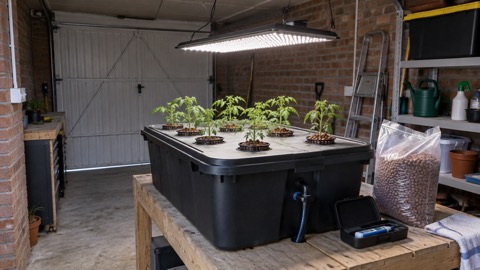 Hydroponic System Parts List
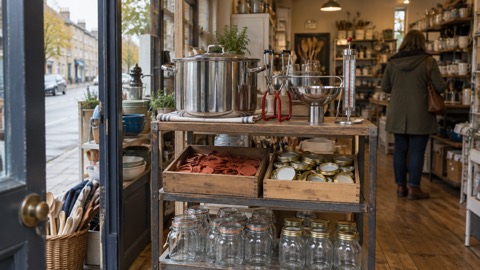 Preserving Equipment Checklist
 Seed Sowing Equipment Checklist