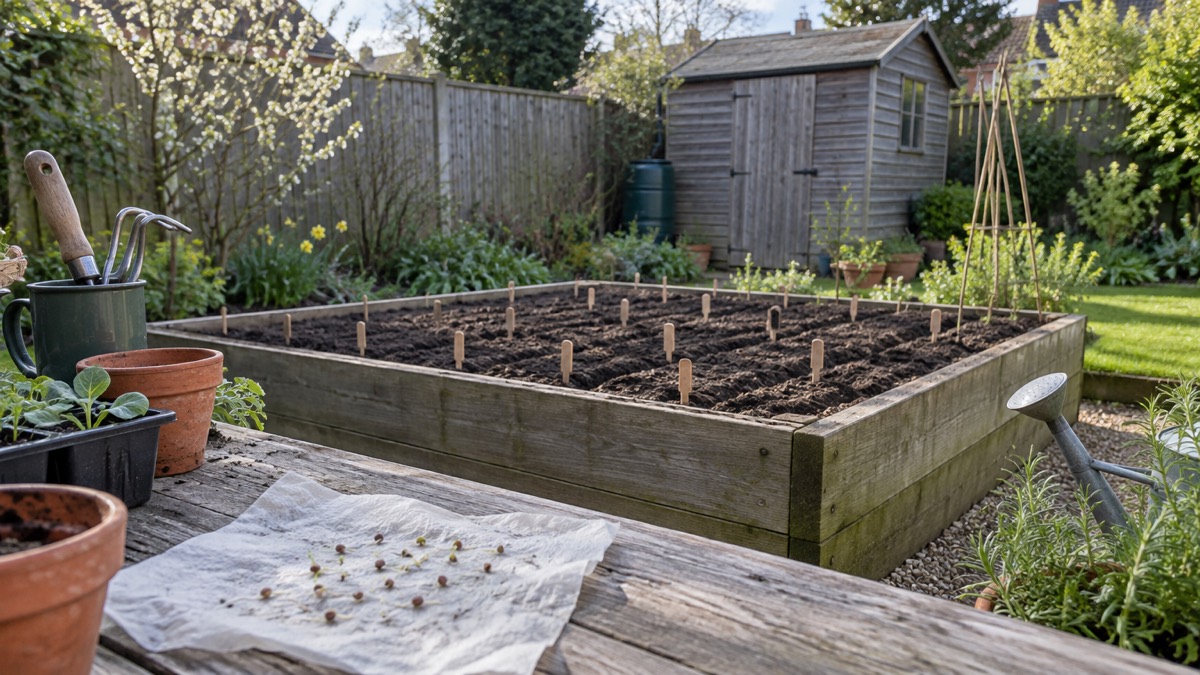
Before you rely on a tin of seed from last year, check it. The simplest test is a jar of water: put medium to large seeds in a jar of water, and viable seeds will sink while dead seeds float to the surface1. For smaller seeds, sow a pinch on damp kitchen paper or in a small pot of compost and see how many come up. Either way, the point is to find out now, while there is still time to buy fresh seed or change your plan, rather than at sowing time.
The second thing to settle is what kind of seed you have. Seed saved from F1 hybrids will not grow true to type, so if you want to save your own seed and stop depending on a seed company, you need to start from open-pollinated varieties2. Garden Organic's guidance is blunt on this: "You will need to save seed from open-pollinated varieties (not F1 hybrids)"2.
Once you have open-pollinated seed, saving it comes down to two simple rules. Garden Organic states them as: "Preservation of seeds has two simple rules: Remove undesirable individuals and prevent cross-pollination"2. Everything else, from bagging flower heads to leaving a carrot in the ground over winter, is detail hanging off those two rules.
Start with open-pollinated varieties, not F1 hybrids
An F1 hybrid is a first-generation cross between two parent lines, bred so the offspring are uniform. That uniformity is why the catalogues sell them: modern F1 sweetcorn varieties are described as ideally suited to growing in most of the UK, where older varieties were difficult5, and many of the highest quality celery varieties are F1 hybrids bred for good yields in our climate6. Hybrid courgette varieties are also described as often having better disease and pest resistance7. None of that makes them a bad choice for eating.
It does make them a dead end for saving. Seed saved from an F1 hybrid will not grow true to type2, so the plants you raise from it will be variable and unpredictable. If your aim is a seed supply you control, the parent line has to be open-pollinated. The case for open-pollinated varieties is that their variability is an advantage: it allows some degree of adaptable resistance to diseases, pests and stress, and lets future breeders select characteristics2. Real Seeds makes the same point in plainer terms, describing open-pollinated seed as a huge living genebank that was very resilient against disease or climate change, so that if your cabbages did not do well, someone down the road had a slightly different one that would cope8.
If you are not sure what you have, the packet or catalogue entry is the place to look: F1 varieties are labelled as such. A tomato sold as "Cherry, 'Sungold', F1 Hybrid" is telling you exactly what it is10. Where the label is lost, treat the variety as unknown and save from a plant you are certain of instead.
Two rules: remove poor plants, prevent crossing
The first rule is to remove undesirable individuals. In practice that means saving seed only from healthy looking plants1, and sowing more than you need so there is something to rogue out: Garden Organic advises considering sowing extra to allow for roguing out, and notes that some of its guidelines give recommended minimum numbers of plants2.
The second rule, preventing cross-pollination, is where most of the work lies, and how much work depends on the crop. Garden Organic splits vegetables into two groups:
| Group | Examples | Crossing risk | What it means for you |
|---|---|---|---|
| Inbreeding | Peas, French beans | Will not cross with each other, or cross rarely, though precautions still need to be taken2 | Several varieties can usually be saved together |
| Outbreeding | Brassicas, runner beans, alliums, beetroots | Keeping pollen from different varieties apart is more important than roguing out2 | Grow one variety, or isolate physically |
With outbreeding vegetables, letting varieties mix widens genetic variability, and rectifying that takes patience and several seasons2. That is why isolation is worth doing properly the first time rather than trying to sort it out later.
Some crops need more than isolation. Pumpkins, squashes, marrows and courgettes will all cross readily with each other, and Real Seeds describes hand pollinating one or more fruits as the best, usually only, way to save pure seed on a home scale11. Squash varieties easily cross pollinate, and hand pollination is important if you are saving seed11. Sweet peppers cross very easily too: either grow only one variety, or keep the insects out with a net cage or by bagging individual flowers12. Parsley is insect pollinated, so flat and curly leaved varieties will cross and you should grow only one type for seed at a time11.
Keeping varieties apart in practice
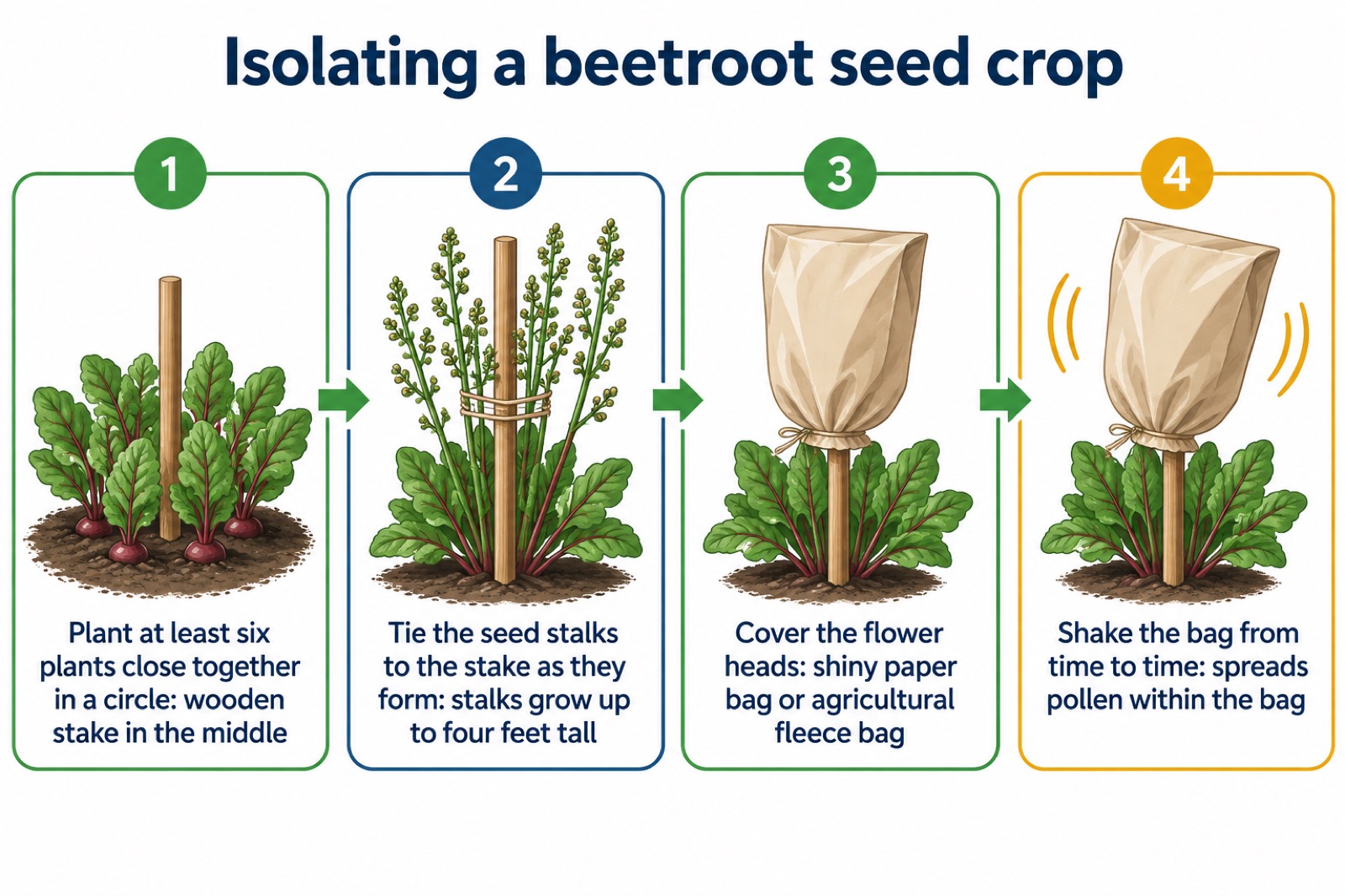
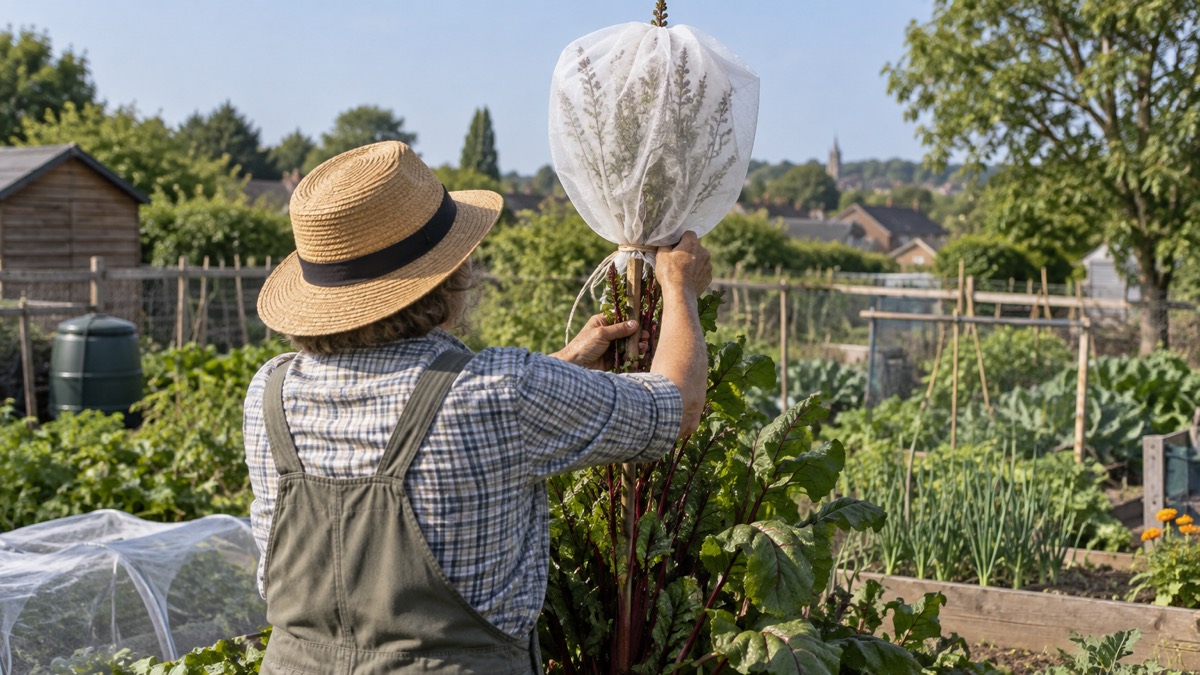
For beetroot, chard and leaf beet, Real Seeds gives a method that needs no cage: plant at least six plants very close together in a circle with a wooden stake in the middle; as the seed stalks form, growing up to four feet tall, tie them together supported by the stake; then cover the group of flower heads with either a shiny paper bag that will withstand rain, or a bag made out of agricultural fleece, shaking the bag from time to time to make sure pollen is distributed within the bag11.
For other crops the approach is simpler: grow only one variety for seed in a given year, or use distance and physical barriers. Basil is easily cross-pollinated, so if you are growing two varieties together, let only one variety flower and seed1. Coriander, dill, parsley, basil and chives can all be grown from saved seed1.
There is a practical limit on how small a gene pool you can save from. For carrots, Real Seeds advises saving seed from at least 40 good roots to maintain good genetic diversity, warning that with too small a genetic pool you will end up with small, poor quality roots in a very few generations11. That is a bigger number than most gardens will manage, and worth knowing before you commit a carrot variety to a saved-seed future.
Some plants are easier to keep going than to isolate. Leeks, onions, carrots and parsnips can be left to over-winter: leave one leek plant, an onion plant and maybe even a carrot and parsnip plant in the ground, and the next year they will flower and you can save their seeds1. Biennials like these reward a little patience rather than any special kit.
Peas rarely cross, so several varieties can be saved together
Peas are the crop to start with if you want an early success. Garden Organic classes them as inbreeding vegetables that will not cross with each other or cross rarely, though precautions still need to be taken when saving seed2. Real Seeds is more relaxed still: "Peas don't in general cross very easily, so you can save seed from several varieties without worry"3.
That means a household can grow, say, an early, a maincrop and a late variety in the same plot and save seed from all of them, provided you follow the first rule and save only from your healthiest plants1. It also fits the way peas are usually grown: by carefully selecting different varieties and successional sowing it is possible to enjoy peas from early summer to early autumn13. Saving from several varieties keeps that spread of harvest dates in your own hands.
The same low-crossing logic applies to French beans, which Garden Organic groups with peas2. It does not extend to runner beans, which are outbreeding and need their pollen kept apart from other varieties2.
Seed saved each year adapts to your own conditions
Saving your own seed each year allows your varieties to adapt to your own specific conditions, and lets you note any interesting or useful characteristics, such as pest or disease resistance14. Over several seasons that is a real advantage: the plants that do well on your soil, in your wind, and against your local pests are the ones you are selecting, whether you mean to or not.
This is not a new idea. Amateurs can save their own seed, as has been done for thousands of years, well before the advent of large seed companies and modern agriculture14. The Heritage Seed Library alone holds over 800 varieties being saved14. You do not need a laboratory or a polytunnel to join in; you need open-pollinated seed, healthy parent plants and a bit of separation.
There is a supply argument too. Saving your own seed each year allows your varieties to adapt to your own specific conditions, and lets you note any interesting or useful characteristics, such as pest or disease resistance9. Amateurs can save their own seed, as has been done for thousands of years, well before the advent of large seed companies and modern agriculture9. A household with its own saved seed and a few neighbours doing the same is less exposed to a bad year in the seed trade.
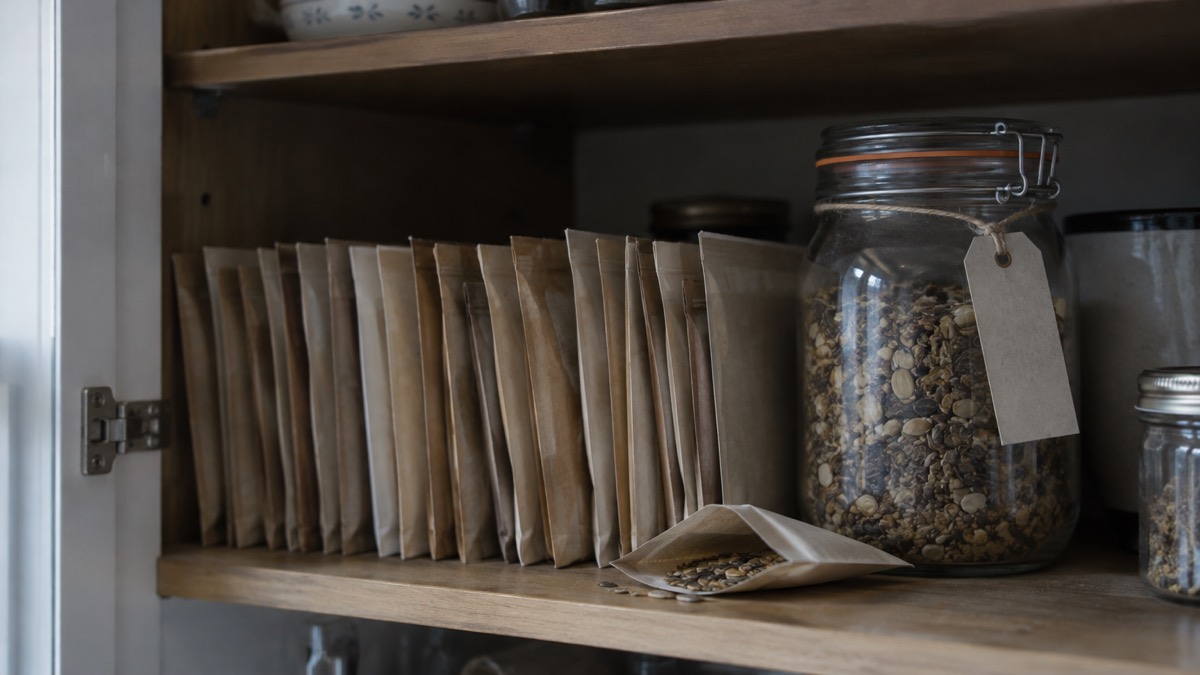
To make saved seed last, deal with the two things that shorten its life: "The two factors that reduce the life of the seed are moisture and warmth"4. Keep seed in a sealed container in a cool, dry place. How long it then keeps varies by crop: oregano seed stored this way is described as remaining viable for up to 3-5 years15, while parsnip is at the other end, with stored seed viable for 1 or 2 years16. That difference is exactly why testing before you sow matters more for some crops than others.
Testing and sowing what you have
The water test is quick and needs nothing but a jar. Put medium to large seeds in a jar of water: viable seeds will sink, whereas dead seeds will float to the surface1. It suits beans, peas, squash and similar-sized seed. For fine seed, sow a small sample and count what comes up instead.
If the seed is sound, sow it well. Prepare the ground first: ensure the area is weed free, rake the soil gently so it is fine and crumbly and reasonably level, wear gardening gloves, and read the seed sowing instructions on the packet to work out the sowing distances17. Remove old plant material and weeds, digging out all the roots and shoots, shaking the soil back over the beds and composting what you can18. Large seeds can be sown individually using a dibber to make a hole, which is known as station sowing17.
For an early start, module sowing lets you either delay planting outdoors if conditions are not right, or plan a succession of plantings every few weeks for a constant supply19. Fill the module tray with potting compost, make sure it is evenly spread and tap the tray on the bench a couple of times to level it20. When pricking out, always hold the seedling by its leaves, never by the stem20. A windowsill propagator helps: fill each cell with seed and cutting compost, water well with a fine spray, and for faster germination place the inserts in the water tray and cover with the lid, propping one side open by about 1cm as plants grow21. Keep it bright but out of direct sun21.
Outdoors, a sheet of clear plastic over sown ground can bring germination forward; remove it as soon as the seedlings appear22. Water often but do not overwater: test by poking a finger into the compost, and slightly moist just below the surface is right23.
Where to go next
If you are starting from scratch, the growing your own vegetables guide sets out where to begin, and sowing seeds indoors and outdoors covers timing, depth and germination. For the seed-saving method in more detail, see how to save seed from your own vegetables, keeping vegetable varieties pure and how to store saved seed so it lasts. A seed sowing equipment checklist lists the kit worth having before the season starts.
Sources (23)
- Tips on saving your own seeds, RHS, 2026
- Preserving varietal purity, Garden Organic, 2026-10-29
- Soup peas, Real Seeds, 2026
- Seed storage for longer life, Garden Organic, 2026-10-29
- Sweetcorn, First Tunnels, 2026-01-14
- Celery, First Tunnels, 2026-01-14
- Courgettes, First Tunnels, 2026-01-14
- Why save seed, Real Seeds, 2026
- Seed life, Real Seeds, 2026
- Tomato Cherry Sungold F1 Hybrid Seeds, Chiltern Seeds, 2026-11-04
- Seed saving instructions, Real Seeds, 2026
- Sweet peppers, Real Seeds, 2026
- Peas, Harrod Horticultural, 2026-11-04
- Why save seed, Garden Organic, 2026-10-29
- Oregano, First Tunnels, 2026-09-29
- How to grow parsnip, Vital Seeds, 2026-11-04
- Direct seed sowing, RHS, 2026
- Get the soil ready for planting, RHS, 2026
- Vegetables all year round, Garden Organic, 2026-10-29
- How to prick out seedlings into modules, RHS, 2026
- Windowsill greenhouse, Garland Products, 2026-11-04
- Growing year-round guide, Centre for Alternative Technology, 2025-07-02
- Limited space, Harrod Horticultural, 2026-11-04
 Hydroponic System Parts List
 Year-Round Sowing Calendar
 Preserving Equipment Checklist
 Blanching Vegetables
 Carrot Fly Protection
 Knowing When Chutney Is Ready
 Clubroot in Your Soil
 Drought-Resistant Vegetables
 Edible Flowers Safety
 Extending the Growing Season
 Freezing Fruit Without Sugar
 Garden Fleece Frost Protection
 Avoiding the Hungry Gap
 Keeping Varieties Pure for Seed
 Making Leafmould