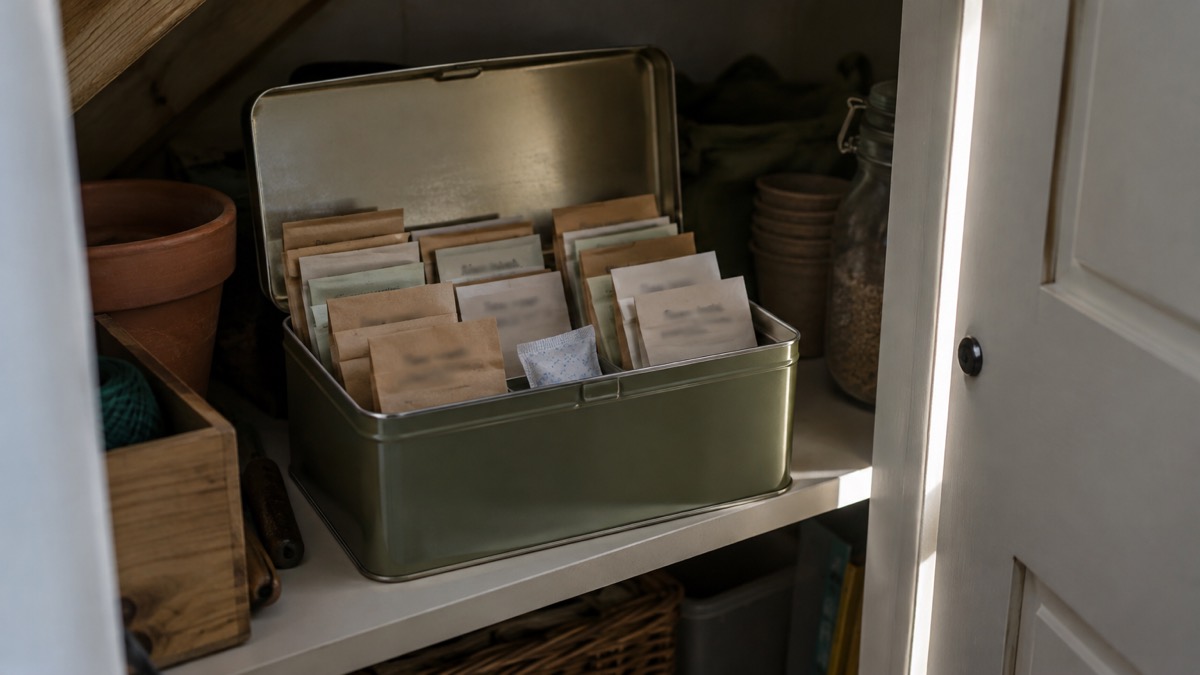
Saving your own seed is one of the simplest self-reliance skills, and most of the work happens after the seed is off the plant. Get the storage right and a paper envelope of seed can sit in a cupboard until next spring and still grow. Get it wrong, and the seed either rots, dries out too far or quietly loses the will to germinate.
The short version: dry the seed, put it in a labelled paper envelope or bag, and keep it in a cool, dry place, within an airtight container if possible1. The two things that shorten a seed's life are moisture and warmth, so the whole job is keeping both away from it2. Save from open-pollinated varieties rather than F1 hybrids if you want the seed to come true3, and save only from healthy looking plants1.
This page covers how to dry and store seed, why paper beats plastic, how to keep varieties pure, and how to save several pea varieties without them crossing. If you are starting from the plant rather than the envelope, see how to save seed from your own vegetables, and to check whether last year's seed will still grow, see how to test whether old seeds will still grow.
Store seed in labelled paper envelopes, somewhere cool and dry
The core routine is short. Dry the seed, label it, and put it somewhere cool and dry. The RHS advises storing seeds in labelled paper envelopes or bags, kept in a cool, dry place, within an airtight container if possible, and notes that sachets of silica can absorb excess moisture1. That is the whole method: paper for the seed, an airtight box for the paper, silica if the air is damp.
Drying comes first. Capsules and pods should be dried in a warm, dry place until the seeds are released1. For sunflowers, the maker's advice is to dry out the seeds for a few days and then store them to plant the following spring4. The principle is the same across crops: get the seed properly dry before it goes into storage, because any moisture sealed in with it is moisture working against it.
Labelling matters more than people expect. The RHS advises labelling with name and date to avoid confusion later1. Two envelopes of small brown seed look identical in March. Write the variety, the crop and the date collected on the envelope before the seed goes in, not after.
The storage place should be cool and dry, away from direct sunlight, heat and moisture, which is the same standard the NHS gives for storing medicines at home5. A cupboard in a cool room works; a warm airing cupboard or a sunny windowsill does not. The Scottish food safety agency's household guidance makes the same point about keeping dry goods in sealed bags or containers to keep them fresh and stop anything falling in6, which is a useful reminder that a sealed container protects against more than damp.
An airtight container keeps damp out
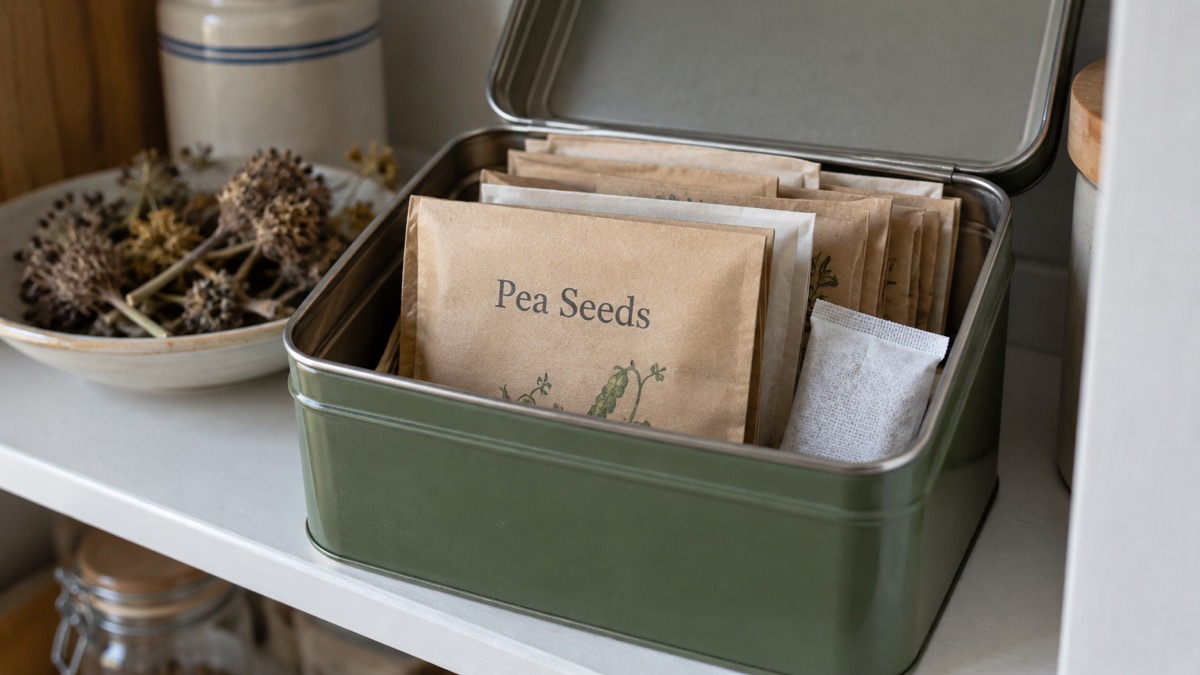
The container is doing one job: keeping the air around the seed stable and dry. The RHS recommends an airtight container if possible, with silica sachets to absorb excess moisture1. The reason is that moisture is one of the two factors that reduce the life of the seed, alongside warmth2. An airtight box slows the exchange of damp air with the room, and silica mops up what is already inside.
This is the same principle used across food storage. Frozen food should always be stored in airtight containers or freezer bags, because cold air causes food to dry out7. The mechanism is different, but the lesson is the same: a sealed container protects the contents from the air around them. For seed, the aim is a steady, dry microclimate rather than a vacuum.
A few practical points follow from this:
- Use a container with a good seal. A tin, a clip-lid box or a screw-top jar all work. The point is that it closes properly.
- Keep the silica separate from the seed. A sachet in the box, not mixed in with the envelopes.
- Do not overfill. Leave room so the envelopes are not crushed and air can move around the box.
- Keep the box cool. Airtight does not mean cool. The container goes in a cool, dry place, not a warm one1.
There is a limit to what a container can do. If seed goes in damp, an airtight box holds the damp in. Dry first, then seal.
Save from open-pollinated varieties, not F1 hybrids
The single decision that most affects whether saved seed is worth keeping is the variety you start with. Garden Organic is direct: you will need to save seed from open-pollinated varieties, not F1 hybrids3. Seed saved from an F1 hybrid will not reliably come true, because the parent was itself a cross. Open-pollinated varieties breed true, so the seed you save next year grows into the same plant.
This is why some suppliers make a point of it. The Real Seed Catalogue states that none of its seeds are hybrids, so customers can save their own for future use, with no need to buy new each year8. That is a supplier's own description of its own stock, not a recommendation, but it illustrates the practical difference: if you want to save seed, choose varieties that allow it.
The second decision is which plants to save from. The RHS advises saving seed only from healthy looking plants1. Garden Organic's two simple rules for preserving seed are to remove undesirable individuals and prevent cross-pollination3. In practice that means walking the row before seed set and pulling out anything weak, diseased or not true to type, so that only the best plants contribute.
For more on keeping a variety true once you have chosen it, see keeping vegetable varieties pure when saving seed.
Two rules for seed worth keeping: remove poor plants and prevent crossing
Garden Organic reduces seed saving to two rules: remove undesirable individuals and prevent cross-pollination3. Everything else is detail. The first rule is about which plants you let set seed. The second is about what else is flowering nearby.
Removing poor plants, sometimes called roguing, is the selection step. You are choosing, deliberately, which plants pass on their genes. Garden Organic advises sowing extra seeds to allow for roguing out, and notes that some of its guidelines give recommended minimum numbers of plants3. The minimum matters because a very small population narrows the gene pool; saving from a handful of plants year after year gradually weakens the variety.
Preventing cross-pollination is the harder rule, and how hard depends on the crop. Some vegetables cross readily with related varieties and need separation in space or time. Others barely cross at all. Sweetcorn is a clear example from the maker's guidance: to prevent undesirable cross-pollination, avoid planting supersweet varieties alongside standard varieties, and be cautious near maize crops or ornamental maize, as this can lead to starchy kernels with diminished flavour9. That is about eating quality in the same season, but it shows how readily maize crosses.
The practical approach for a household garden is to be realistic. Save seed from one variety of each cross-prone crop per year, or accept that some seed may be crossed. Keep notes on what you grew where, so that if a result looks odd you can work out why.
Peas: saving several varieties without crossing
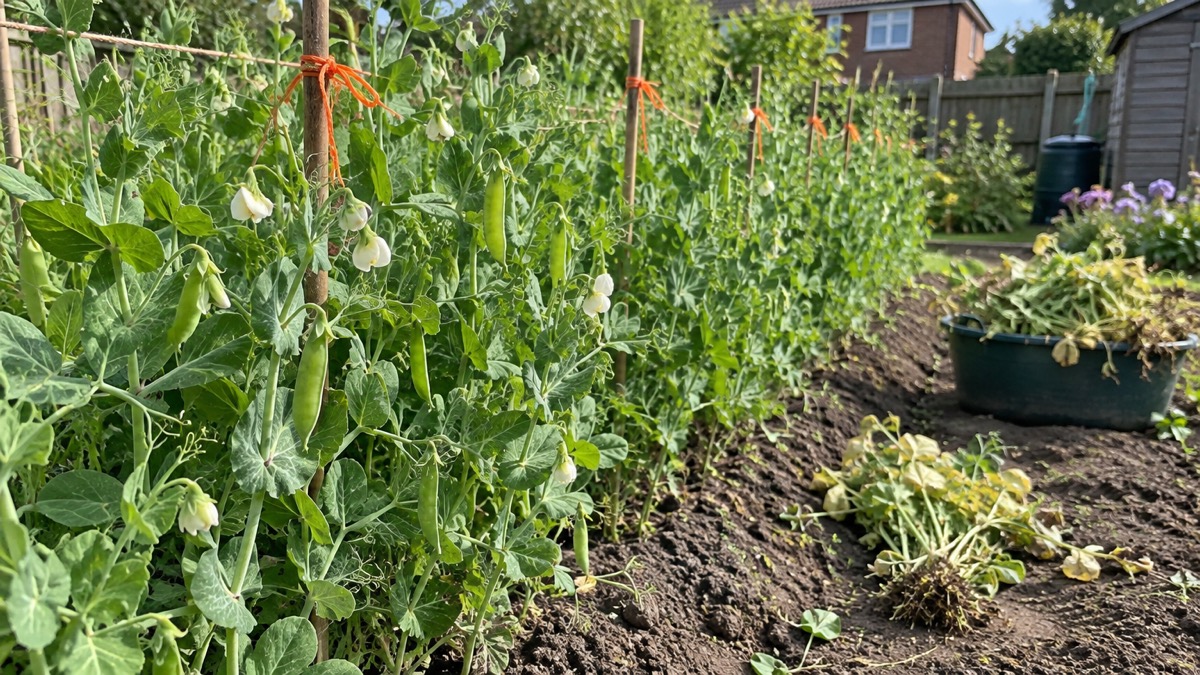
Peas are the beginner's crop for seed saving, and the reason is genetic. Garden Organic notes that inbreeding vegetables, for example peas and French beans, will not cross with each other or cross rarely, though precautions still need to be taken when saving seed3. That means you can grow several pea varieties in the same garden and still save seed from each with reasonable confidence, which is not true of most crops.
The precautions are still worth taking. Keep varieties apart where you can, and save from plants that look true to type. For beans, Garden Organic's harvesting advice is practical: if you cannot keep up with the harvest, either freeze or leave some pods to set the seed, and when the pods are dry, shell out the dry beans and store them in a paper bag10. That paper bag is the same principle as the paper envelope: dry, breathable storage.
Other easy crops follow similar lines. Radish is a quick one: allow no more than two radishes to go to seed, eat some pods and allow others to dry completely to collect seeds for next year11. Herbs can be left to set seed too; parsley, if allowed to set seed, can have its seeds collected to sow or the plant left to self-seed naturally12. For crops that overwinter, the RHS suggests leaving one leek plant, an onion plant and maybe even a carrot and parsnip plant to over-winter, so that the next year they flower and you can save their seeds1.
| Crop | Cross-pollination risk | Beginner-friendly? |
|---|---|---|
| Peas | Will not cross with each other or cross rarely, but precautions still needed3 | Yes |
| French and runner beans | Same inbreeding group as peas3 | Yes |
| Radish | Allow no more than two plants to seed11 | Yes, quick |
| Sweetcorn | Avoid planting supersweet alongside standard varieties9 | Needs care |
| Leeks, onions, carrots, parsnips | Leave one plant to over-winter to flower1 | Slower, biennial |
How long saved seed lasts, and what shortens it
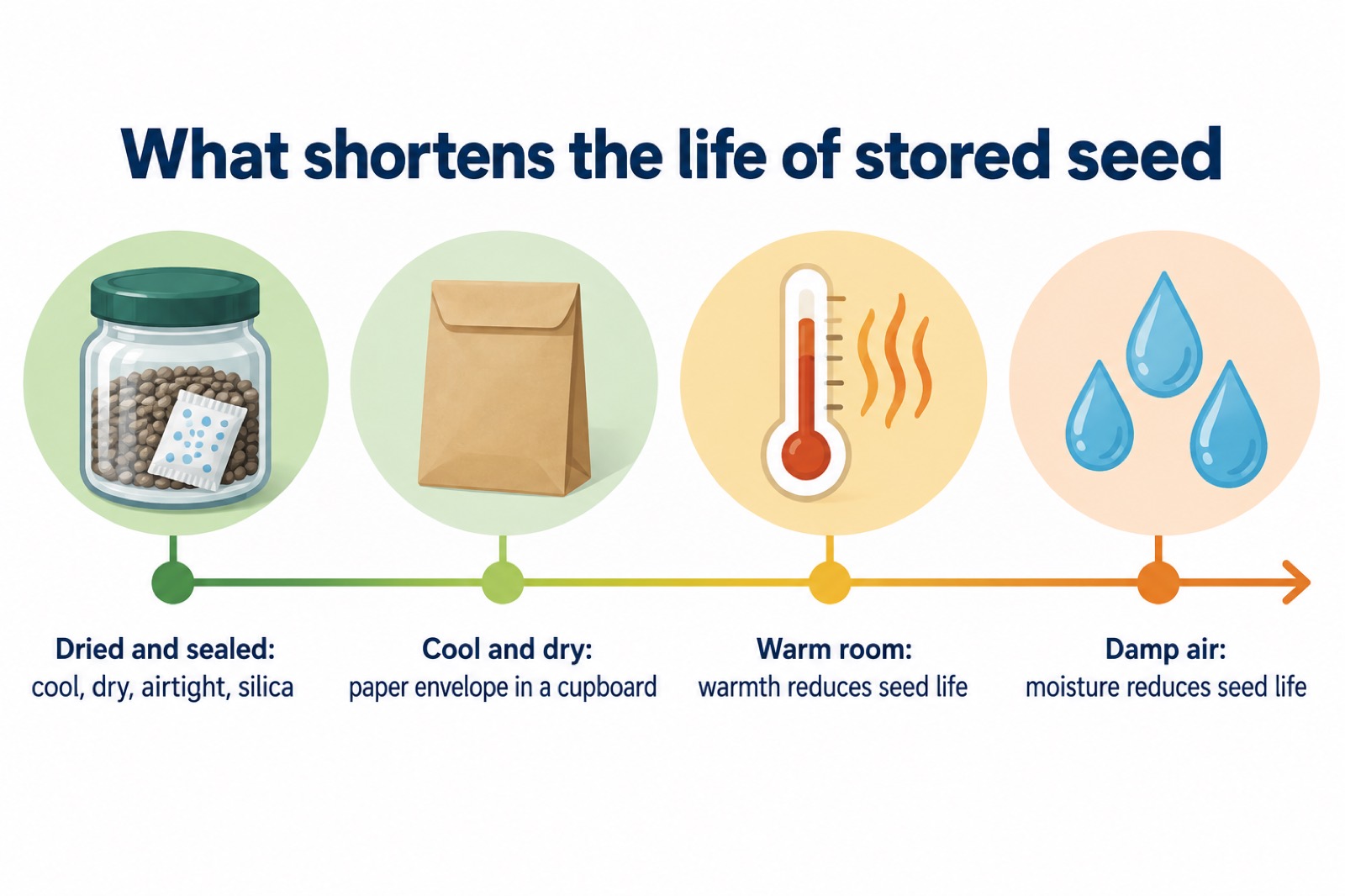
Seed does not last forever, and the storage conditions decide how long it lasts. The two factors that reduce the life of the seed are moisture and warmth2. Keep both low and seed keeps longer; let either in and it fades faster. That is why the cool, dry place and the airtight container are not optional extras but the core of the method.
Some crops have a known working life. Oregano seed, stored in a sealed container in a cool, dry place, remains viable for up to 3 to 5 years, according to the grower's guidance12. That is a useful benchmark for a small herb seed: a few years, not a decade. Other crops vary, and the honest answer for most is that it depends on how well you dried and stored them.
What you can do is check before you rely on a batch. Rather than sowing a whole envelope and hoping, test a few seeds first. The method is set out in how to test whether old seeds will still grow. If germination is poor, sow thicker or replace the seed.
Where to get help and what to read next
Seed saving is well supported in the UK, and the help is mostly free. Garden Organic runs the Heritage Seed Library, which is saving over 800 varieties13, and its expert advice pages cover storage, varietal purity and why to save seed at all. The RHS publishes school gardening resources on saving your own seed that apply just as well to a household plot1. Both are independent organisations giving practical guidance rather than selling a method.
If you are buying seed with saving in mind, some suppliers state plainly whether their stock is hybrid. The Real Seed Catalogue describes its seeds as non-hybrid, so customers can save their own for future use8. That is a statement about its own catalogue, and other suppliers differ, so check the packet or the catalogue entry.
For the wider picture, the self-reliance section covers growing food, storing the harvest and keeping livestock. If you are planning a seed-saving year, these pages go with this one:
- How to save seed from your own vegetables for the plant side, from flower to dry seed.
- Keeping vegetable varieties pure when saving seed for separation distances and isolation.
- How to test whether old seeds will still grow before you commit a whole envelope to the ground.
- Sowing seeds indoors and outdoors for what to do with the seed when spring comes.
- Storing the harvest for the same cool, dark, dry principles applied to vegetables rather than seed.
Sources (13)
- Tips on saving your own seeds, RHS, 2026
- Seed storage for longer life, Garden Organic, 2026-10-29
- Preserving varietal purity, Garden Organic, 2026-10-29
- Sunflower, First Tunnels, 2026-01-14
- Storing medicines at home, University Hospitals of Leicester NHS Trust, 2026
- Food storage, Food Standards Scotland, 2025-02-21
- Preparing and cooking food safely | NHS inform, NHS inform
- Beginners, Real Seeds, 2026
- Sweetcorn, First Tunnels, 2026-01-14
- Harvesting and storing vegetables, Garden Organic, 2026-10-29
- Radish, First Tunnels, 2026-01-14
- Oregano, First Tunnels, 2026-09-29
- Why save seed, Garden Organic, 2026-10-29
 Hydroponic System Parts List
 Year-Round Sowing Calendar
 Preserving Equipment Checklist
 Blanching Vegetables
 Carrot Fly Protection
 Knowing When Chutney Is Ready
 Clubroot in Your Soil
 Drought-Resistant Vegetables
 Edible Flowers Safety
 Extending the Growing Season
 Freezing Fruit Without Sugar
 Garden Fleece Frost Protection
 Avoiding the Hungry Gap
 Keeping Varieties Pure for Seed
 Making Leafmould