Fruit is one of the most rewarding things a UK household can grow, and most of it needs less day-to-day attention than vegetables. The work is front-loaded: choose the right plant for your soil and space, plant it well, protect it from frost and birds at the right moments, and it will crop year after year. The three fruits this page covers in depth are the ones people ask about most: blueberries, which need acidic conditions a pH between 4 and 5.51; peaches, which are easiest in the south of the country and do best against a south-facing wall2; and figs, which fruit best when their roots are restricted3.
The decisions that matter most come before you plant. Blueberries in most gardens should go in pots of ericaceous compost, because they require acidic soil and containers suit areas with alkaline ground4. Peaches and figs both want as much sun and warmth as you can give them, ideally a free-draining spot against a sunny south-facing wall5. Plant trees and bushes any time from November to February, unless the ground is frozen or waterlogged6. Growing fruit organically, with minimal inputs and without pesticides, fungicides or herbicides, will ensure the food you grow is healthy, delicious and perfectly safe to eat1.
Blueberries: the fruit that decides your soil for you
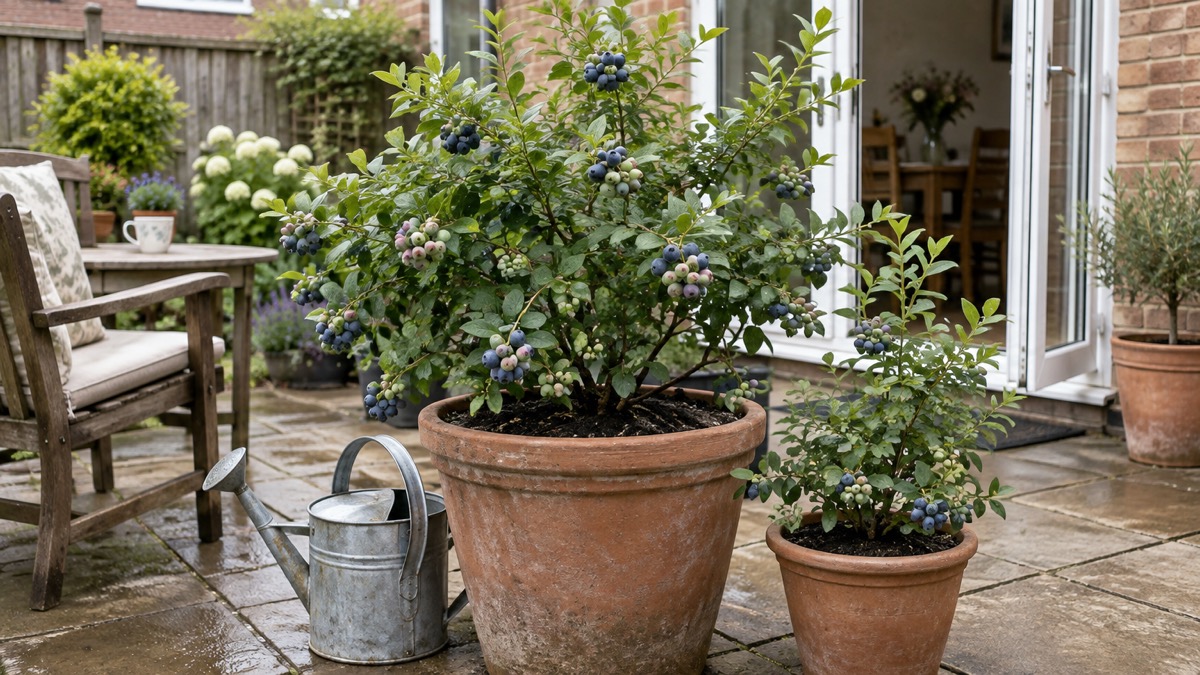
Blueberries are the one fruit in the ordinary garden where the soil test comes before the plant. They need acidic conditions, a soil pH between 4 and 5.5 to be specific1. Most garden soil in many parts of the UK is not that acidic, and this is exactly why blueberries are so often grown in pots: they require acidic soil, and so can be grown in containers in areas with alkaline soil4. If you do not know your soil's pH, assume it may not suit them and plan for containers from the start.
Container growing is straightforward. Use ericaceous compost, keep it moist, and feed with an ericaceous liquid fertiliser once a month4. That monthly feed and constant moisture are the whole of the routine: blueberries have fine roots near the surface that dry out quickly, and a pot in summer can go from damp to parched in a few dry days. Rainwater is the natural match for an acid-loving plant, and a water butt filled from the roof gives you a supply that has no lime in it, unlike hard tap water in many regions.
Repot every two years4. This is the maintenance step people forget: after two summers the compost is exhausted and compacted, and the plant's growth slows well before it shows any other sign of trouble. Repotting refreshes the acidity and the feed the roots can reach.
Yellowing leaves on a blueberry usually point back to the same root cause. The plant wants pH 4 to 5.51; if the leaves pale between the veins, the most likely explanation is that the compost or soil has drifted away from those acidic conditions, or that the feed has lapsed. Return to the basics: fresh ericaceous compost, moist conditions, and the monthly ericaceous fertiliser4. A bush in a pot you can control will always be easier to correct than one in the wrong ground.
For the pot itself, size for stability and root run. A generous pot holds more moisture between waterings, which suits a plant that the RHS says should be kept moist but not saturated2. Site the pot where the plant gets sun but the pot itself is not baked against a south-facing wall all summer.
Can you grow peaches in the UK?
Yes, but it is easier in the south than further north, and it can be more challenging in colder areas2. That is the honest answer, and it shapes every choice that follows. A peach needs a location in full sun and as much warmth as possible2. In the UK, the easiest route for many households is to grow peaches in containers, so they can be moved to a warmer location when required2; peaches are tender fruit that enjoy sunny summer growing conditions and can be grown indoors in a light place over winter when container grown4. A polytunnel makes it much easier to grow peach trees successfully in our climate, and makes this an option even for more northerly gardeners and growers2.
Varieties worth considering in the UK include 'Bonanza', 'Crimson Fire', 'Garden Lady', 'Peregrine' and 'Rochester'2. Dwarfing varieties will do best in pots2, and Garden Organic notes that 'Aprigold' is a genetic dwarf, ideal for pot culture, which produces full-sized fruit1. Peach trees are usually grafted trees, with a particular scion grafted onto a rootstock base, and the cultivar and its rootstock will determine the eventual size of the tree2. So the label tells you more than the fruit name alone: check both before you buy, because a vigorous rootstock in a small pot is a losing battle.
Soil and watering come next. Peaches need soil that is deep, fertile and rich in organic matter, moist yet well drained, neither drying out entirely in summer nor becoming waterlogged during the colder and wetter part of the year2. In a container, choose a good quality soil-based potting mix2. During the growing season you should water almost every day, reducing the water given during the dormant season2. That sounds demanding, and it is: a peach in fruit is a thirsty plant, and irregular watering shows up in the fruit.
Plant during the dormant period, between November and early spring2. Potted specimens are available from garden centres and plant nurseries all year round2, so there is no need to wait for a bare root season as with apples. Feed with a good, potash-rich organic mulch, which helps retain soil moisture and feeds the tree; a comfrey tea can be ideal for this purpose2. Chopping and dropping plant material like comfrey is a popular sustainable strategy for many fruit trees, peach trees included2.
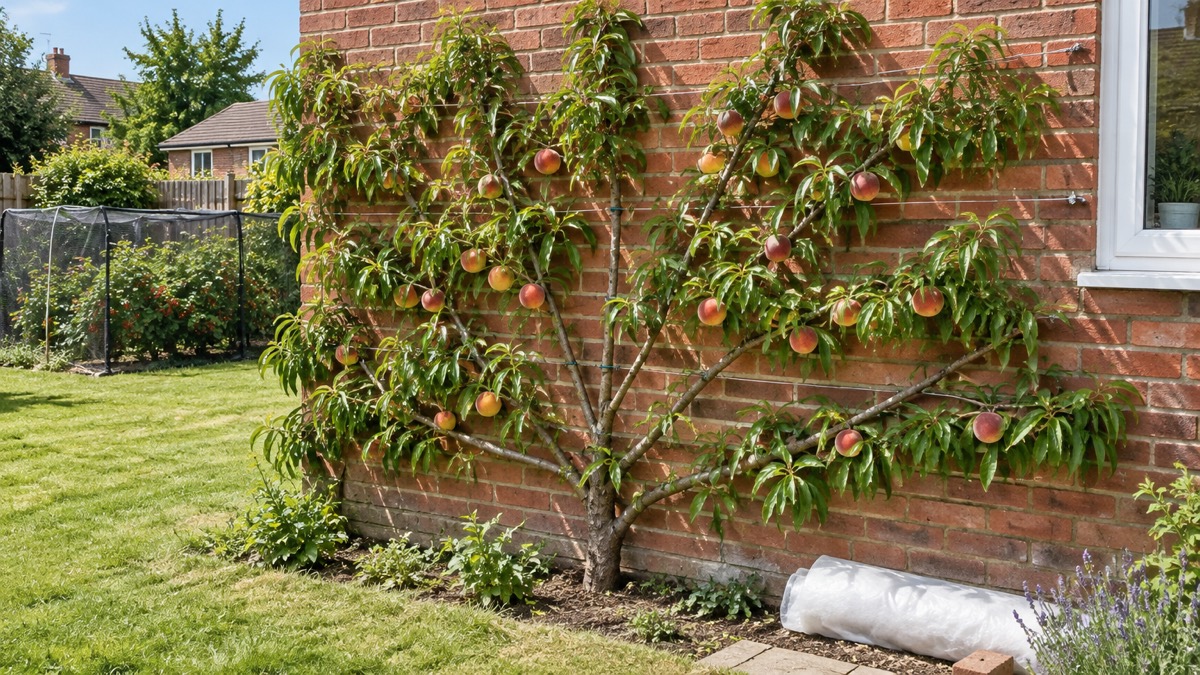
Fan training a peach on a south-facing wall
A peach will do best planted against a south-facing wall2, and wall-grown peaches are usually fan trained, because training into this shape increases the yields of fruit2. The wall does two jobs: it stores heat through the day and releases it at night, and it shelters the blossom that appears so early in the year. South-facing parts of a garden are the sunniest and suitable for growing all fruit, especially those that need ripening5.
If you wish to have a fan trained peach, it is far easier to select and purchase one that has already been fan-trained to begin with2. Building a fan from a young whip takes several years of pruning; a pre-trained tree gives you the framework on day one. For a fan-trained tree, remember that you will need around 3.6m of horizontal space along the wall2. That is a real commitment of wall, so measure before you buy.
When planting, place the tree at least 30cm away from the base of the wall2, and angle the tree so that it leans slightly backwards towards the wall or support structure2. The gap matters: a tree planted hard against the wall sits in poor, dry soil, and the 30cm gives the roots room and the trunk air.
One warning that catches many first-time peach growers: the wall or fence against which peach trees are placed can cast a rain shadow, and this may mean that even when it rains, peach trees growing outside as fans may still need additional watering through the summer months2. The wall shelters the tree from rain as well as wind. Check the soil at the tree's base, not the weather, when deciding whether to water.
Trained fruit of any kind, whether cordons, espaliers or fans, needs to be pruned twice a year, in summer and in winter5. An espalier, for comparison, is a fruit tree trained flat against a wall or fence and regularly pruned to form a single vertical trunk with three to five pairs of horizontal side branches5. The peach fan follows the same logic: prune to keep the shape flat, open and evenly filled along the wall.
Hand pollination and thinning: the two peach jobs that decide the crop
Peaches flower so early in the year that it is unlikely, unless you keep your own bees, that there will be enough pollinating insects about to pollinate them2. This is the single biggest reason a healthy peach tree sets no fruit. The fix is to pollinate by hand: on a sunny day, take a small brush and gently press the bristles into every flower. Do this on several afternoons and you should get some fruit2. Garden Organic's guidance on hand pollination agrees that the method is very time consuming but effective, and advises using a fine brush, while warning to be prepared for some flowers to abort if it is not done properly7.
Thinning comes next, and it is not optional if you want good peaches. Remove any small or misshapen fruits when they are around the size of your fingernail2. When fruits appear, these should be thinned to give a final spacing between fruits of around 15cm2. Crowded fruits stay small, strain the branch, and compete with each other for the water you are supplying almost daily2.
The same discipline applies to tree fruit generally. The RHS fruit calendar advises thinning pears to one or two fruit per cluster in June, culinary apples to 15 to 20cm apart, and dessert apples to 10 to 15cm apart in June for larger, tastier crops6. Thinning feels like throwing away fruit, but it is the difference between a branch of marbles and a branch of proper apples.
Splitting fruit is usually a watering and spacing problem rather than a disease. A peach that goes from dry to soaked and back again, or one carrying fruits crowded far closer than 15cm, is the one that splits. Keep the almost-daily watering steady through the growing season2, remember the rain shadow2, and thin early and properly2.
Harvest runs from July to September2. You will need to harvest over a long period, as not all the fruits will develop at once2. Cup each fruit in the palm of your hand and then lift gently2: a ripe peach comes away; one that resists is not ready, whatever the calendar says.
Figs: the fruit that needs its roots held back
Fig trees are very vigorous and are best grown in containers, or they will tend not to fruit3. This is the counter-intuitive heart of fig growing: a fig with unlimited root run grows leaves and wood, not fruit. Restricting the roots is not a compromise for small gardens, it is how you get a crop.
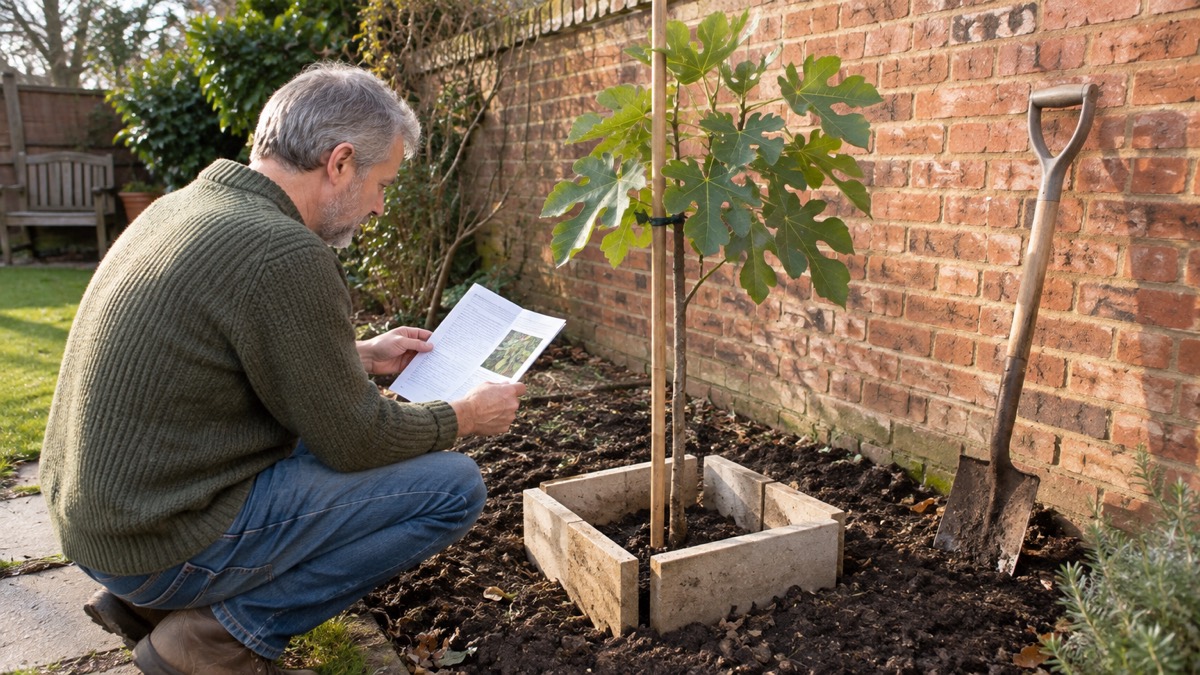
If you are planting in the ground, the method is a root restriction pit. The perfect location is a free-draining, root restricted site against a sunny south facing wall3. Dig the hole, then line the sides with paving slabs placed vertically, protruding a couple of centimetres above the soil surface, to form constraints for the roots of the fig tree3. The lip above the surface stops the roots simply escaping over the top. Fill with free-draining soil and plant as normal. In a container, the pot itself does the same job.
On varieties: the most common variety grown in the UK is 'Brown Turkey'3, and it is the dependable choice for most gardens. There are also a number of other cultivars that can work in our increasingly warming climate, including Brunswick, Chelsea, Dalmatie, Doree, Ice Crystal, Madeleine des Deux Saison, Panachee, Sultane and Violette de Bordeaux3. Figs are usually sold as small, pot-grown trees in the UK, though they can also be bought as bare root specimens3.
Understand the fig's two-crop year, because it explains the odd pruning instruction. Figs will bear two fruit crops, but in this country only one of these fruit harvests will come to full fruition3. Young fruits start to form twice a year, the first batch in late summer and the second batch in late spring the following year, and only the first batch ripens in the UK3. When fruits form, they typically take around 12 months to mature in the UK3, and the harvest period is in early to mid autumn3.
So the late-summer batch, which would ripen the following year, is the one you keep, and the spring batch is the one that never makes it. The instruction that follows from this: by the end of summer, any fruits larger than the size of a pea or so should be removed, as otherwise they will simply rot over the winter3. Leaving pea-plus-sized fruits on the tree in autumn gains nothing and risks rot spreading into the branch.
Patience is part of the deal. Figs typically take a few years to establish, and in favourable conditions you may see fruit within 2 to 4 years after planting3. Figs are woody perennial plants, meaning they can live for many years and produce fruit seasonally3, so the wait buys decades of harvests. You can create healthy, ecologically functioning systems in your garden by underplanting a fig, like other fruit trees, with a guild of beneficial companion plants3.
Protecting figs and peaches from frost through winter
In almost every UK location, fig trees will need protection over the winter months, and the part that needs protecting is the young fruits formed in late summer3. Those embryos are next year's crop: lose them to frost and you lose the harvest before spring arrives. Fleece is the usual answer, and how much protection different weights give is covered in our guide to garden fleece.
Peaches face the same problem at the other end of winter. Peach trees can flower as early as February when grown undercover, and these flowers are vulnerable to frost2. You can protect peach trees with a layer of horticultural fleece or hessian supported on canes; or, if you are growing a peach tree in a pot, you might move it into a warmer and more sheltered location or indoors during the crucial time period2. The pot-grown peach's great advantage is exactly this mobility.
The same fleece discipline applies to tree fruit generally: the RHS calendar advises protecting pear and plum blossom from frost with fleece in March6. Apricots need shelter from frost when in flower, so trained against a warm wall is an ideal situation1; Garden Organic notes 'Flavorcot' is frost tolerant and fruits later, with smaller orange fruit1, and 'Tomcot' is very hardy and frost resistant1, so variety choice can reduce the frost risk at the blossom stage.
If a polytunnel is part of your set-up, consider adding thermal mass for temperature regulation and to improve the conditions for these heat-loving trees2. Water barrels or stone absorb heat by day and release it at night, smoothing out the frosts that kill blossom.
One piece of general winter tree care from the Met Office: prune your trees before winter really kicks in, to avoid a build-up of leaves in the guttering, and to avoid snow building up on the trees, which brings the risk of damage from broken branches8. It is a reminder that fruit trees near a house are part of the household's winter storm readiness, not just the garden's.
Birds, squirrels and other pests on fruit
Ripening fruit attracts everything with a beak or a sharp tooth. On peaches, pests like birds and squirrels may damage or eat the fruits before you get the chance to harvest2. On figs, protect ripening fruits from birds and squirrels with netting held away from the fruits with canes3. The canes matter: netting draped directly onto the fruit lets birds peck through it and can trap them.
For soft fruit generally, net against birds in May, and remove the netting in late summer once fruiting has finished6. Leaving nets up all year stops the beneficial visitors as well as the thieves, and nets degrade in winter weather. On which trees need it: apple, pear and plum trees will not need netting, but cherries will5.
Rabbits take young trees rather than fruit. Put tree guards around all fruit trees, and protect all fruit from rabbits; this may mean a rabbit proof fence around the fruit beds, or netting over hoops5. A tree guard is a few minutes' work at planting time and saves the tree from ring-barking, which kills it.
For the crawling pests, Garden Organic advises applying greasebands to apple, pear, plum and cherry trees in October. These stop wingless female winter moths and March moths from crawling up the tree to hibernate or lay eggs1. The caterpillars those moths produce in spring are what tunnel through the fruit later in the year, so a greaseband fitted in October prevents that damage before it begins. Our guide to vegetable pests and diseases covers the same preventive approach for the rest of the plot.
Not everything visiting the tree is a pest. Fruit trees are an excellent source of pollen for bees and other pollinating insects9, and those insects are what pollinate your apples and pears. Fruit trees need pollen from other cultivars that flower at the same time for successful cross pollination, and are grouped into pollination groups according to when they flower5. When buying apple or pear trees, check the pollination group: a tree whose flowering time matches a neighbour's, or a nearby tree in the same group, will set fruit where an isolated one may not.
Buying and planting: bare root or potted, and where
Bare-rooted plants are grown in open ground, then dug up for sale. They can only be moved between late autumn and early spring, when the plants are dormant, and they are usually cheaper and available in more varieties than container-grown plants5. That is the trade: a wider choice and a lower cost, in exchange for a planting window. Plant fruit trees and bushes any time from November to February, unless the ground is frozen or waterlogged6, which fits the bare root season exactly.
Potted plants buy you flexibility. Figs are usually sold as small, pot-grown trees in the UK3, and potted peaches are available from garden centres and plant nurseries all year round2. If you miss the dormant season, or you want to see the plant before you commit, containers are the way.
On soil preparation, whatever you plant: fruit trees like a weed free, deep fertile organic rich soil5. Clear the ground, dig deeply and work in organic matter before planting, whether the plant arrives bare root or in a pot. If you are replanting a spot where fruit stood before, treat it as a fresh site and prepare it fully rather than assuming the old ground is ready.
If you need to move existing plants rather than plant new ones, fruit bushes can be moved when they are dormant, which is best carried out November to December or in March, and it is best to move the plants to their new site straight after lifting rather than storing them in pots first1.
Watering after planting is where new fruit most often fails. Water developing fruit plants, especially those near walls or on dwarfing rootstocks, and trees or bushes planted in the last 12 months, if the weather is dry for more than two weeks; soak each area thoroughly6. New plants near walls, which includes every fan-trained peach and wall fig, dry out fastest of all.
When fruit fails: reading the signs
A fruit tree that flowers but sets nothing is telling you something specific. On peaches, if the temperatures are too cold during blossoming time, or pollination was not taken care of, there may not be any fruits2. Those are the two causes to check first: frost at blossom, and the missing insects of early spring. Both have answers in this page, fleece or a movable pot for the first2, and a small brush on several sunny afternoons for the second2.
For apples and pears, the parallel cause is pollination group mismatch. Fruit trees need pollen from other cultivars that flower at the same time for successful cross pollination5. A lone tree of a variety no neighbour matches will flower beautifully and crop nothing, year after year, and no feeding will fix it.
Watering failures show up more slowly. Trees on dwarfing rootstocks, and anything planted in the last 12 months, need thorough soaking after two dry weeks6. A tree that struggles in its first summer rarely catches up in its second.
The encouraging backdrop is that fruit fits the low-input garden well. Growing fruit organically, with minimal inputs and without pesticides, fungicides or herbicides, will ensure the food you grow is healthy, delicious and perfectly safe to eat1. Most of the work is the preventive kind described across this page: the right site, the right soil, greasebands in October, nets in May, fleece in March. Once a tree or bush is established and these habits are in place, the harvest, from blueberries in midsummer to figs in early to mid autumn3 and peaches between July and September2, arrives with very little further effort. What you do with it then is covered in our guides to storing the harvest and freezing fruit and vegetables.
Sources (9)
- How to Grow Fruit, Garden Organic, 2026-10-29
- Top of the Crops: Peaches, First Tunnels, 2026-01-14
- Top of the Crops: Figs, First Tunnels, 2026-01-14
- Growing Fruit in Containers, Royal Horticultural Society, 2026
- Planning a Fruit Garden, Royal Horticultural Society, 2026
- Fruit Gardening Calendar, Royal Horticultural Society, 2026
- Preserving Varietal Purity, Garden Organic, 2026-10-29
- Protecting Your Property from Winter Weather, Met Office, 2026-10-25
- Planting for Pollinators, British Beekeepers Association, 2026-11-04
 Hydroponic System Parts List
 Year-Round Sowing Calendar
 Preserving Equipment Checklist
 Getting an Allotment
 Composting at Home
 Vegetable Pests and Diseases
 Fermenting Vegetables at Home
 Freezing Home-Grown Produce
 Indoor Hydroponics
 Growing Under Cover All Year
 Sowing Seeds
 Storing the Harvest