Preserving your own food at home has become popular again, and social media is full of methods for bottling vegetables, infusing oils and making pesto from foraged ingredients. The official UK position is plain: preserving food at home can be done, but canning and bottling food safely at home can be difficult to carry out safely, and if you are unsure whether a process is safe, you should not take the risk1.
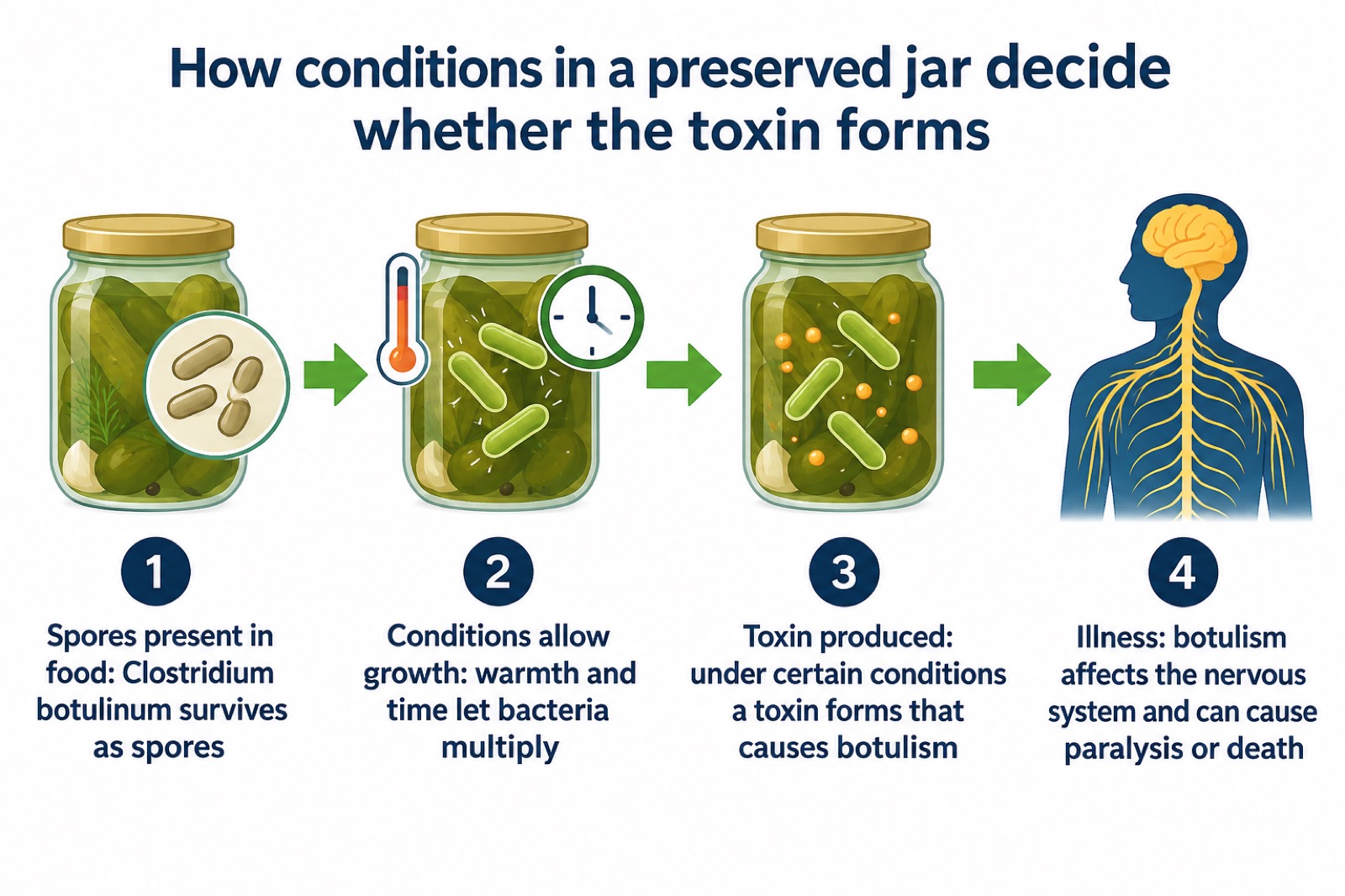
The reason is one bacterium. Clostridium botulinum can survive in food as spores and, under certain conditions, can grow and produce a toxin that causes botulism, a rare but serious illness that affects the nervous system and can cause paralysis or death1. The Food Standards Agency's advice on botulism sets out what you can do to reduce the risk of becoming ill2.
This page explains what the bacterium is, how the toxin forms, why home bottling goes wrong, what you can do to reduce the risk, and when to get urgent medical help. It follows the official guidance for England, Northern Ireland and Wales, and points to the equivalent Scottish advice.
Botulism: the risk that matters when you preserve at home
Most food poisoning is unpleasant but passes. Botulism is different. It is a rare but serious illness that affects the nervous system and can cause paralysis or death1. Food Standards Scotland has warned that Clostridium botulinum may produce a toxin which can cause this serious form of food poisoning and can be fatal3.
What makes botulism the central risk for home preserving is that the bacterium behaves differently from the bacteria behind most everyday food poisoning. Many sorts of bacteria can cause foodborne illness, and when food is kept warm these bacteria can grow rapidly and reach dangerous levels within hours4. Those bacteria generally make food smell or look off, which gives you a warning. Clostridium botulinum, by contrast, survives in food as spores and produces its toxin under certain conditions without necessarily announcing itself1. A jar can look and smell acceptable and still be dangerous.
That is why the official guidance does not treat home preserving as an ordinary cooking task. It asks you to understand the preservation method you are using, to follow trusted instructions exactly, and to avoid taking risks if you are unsure whether a food has been preserved safely1. The rest of this page explains what that means in practice.
What Clostridium botulinum is and how it survives
Clostridium botulinum is a bacterium. The official guidance explains that it can survive in food as spores, and that under certain conditions those spores can grow and produce a toxin that causes botulism1. A spore is a dormant, tough form of the bacterium, and its ability to sit in food and wait is what makes it hard to control with ordinary kitchen processes.
Two points from official guidance explain why the usual household defences do not solve it. First, freezing food does not kill some harmful bacteria; bacterial growth can be paused at low temperatures but can start to grow again at higher temperatures6. A freezer is not a steriliser. Second, when food is stored above fridge temperatures, bacteria can grow and multiply, a range official guidance calls the "Danger Zone" for bacteria6. Warm storage does not just fail to make food safer, it gives surviving bacteria the conditions they need.
This is also why the guidance on defrosting and chilling matters to anyone who preserves: defrosting in the fridge overnight keeps food out of the Danger Zone6. Preserved food that should be chilled, or that you have opened, faces the same rule as any other food. The spores are already in the environment and on food; what decides whether they cause harm is whether the conditions you create let them grow.
How the toxin forms when conditions let the bacteria grow
The toxin appears when the conditions in a jar, bottle or oil infusion let Clostridium botulinum grow out of its spore form. The official guidance describes this as growth "under certain conditions"1. Those conditions are the ones ordinary food safety advice warns about everywhere: warmth and time.
Warm weather enables bacteria to multiply faster where food hygiene practices are poorer7. When food is kept warm, bacteria can grow rapidly and reach dangerous levels within hours5. Cases of foodborne illness have grown mainly in the summer months5. When it is hot, bacteria on food can multiply very quickly, which increases the risk of food poisoning, so food should only be out of the fridge for a short period before eating or cooking8.
A home-preserved jar can create those warm, low-oxygen conditions for weeks or months, which is exactly why the method matters more than the ingredients. The same principles apply in your kitchen afterwards: food poisoning can result from food that is not cooked or reheated thoroughly, not stored correctly, left out for too long, handled by someone ill or who has not washed their hands, or eaten after its "use by" date9. Anyone with diarrhoea, vomiting or nausea should not prepare food, food should not be prepared too far in advance, and food should be kept either piping hot or refrigerated until it is served10.
Why botulism is serious and can be fatal
Botulism is rare, but the official guidance is unambiguous about its severity: it is a serious illness that affects the nervous system and can cause paralysis or death1. Food Standards Scotland uses the same language in its alerts, stating that the toxin "may produce a toxin which can cause a serious form of food poisoning called botulism and can be fatal"3.
Because the illness affects the nervous system rather than the gut alone, it is not simply a bad night of vomiting. The guidance for households on recognising illness makes the general point plainly: recognising symptoms and getting the correct treatment is important to ensure your health does not deteriorate11. With a nervous system illness, delay makes things worse, which is why the section on getting urgent help below matters as much as the sections on preventing the problem in the first place.
This severity is the reason the official position on home bottling is cautious rather than encouraging. Regulators are not warning you off jam because a bad batch is unpleasant; they are warning that a small number of preserved foods can cause an illness capable of paralysis and death, and that a home kitchen has no way of proving a batch is free of it.
Where home bottling goes wrong
The official guidance states that canning and bottling food safely at home can be difficult to carry out safely1. The reason is structural, not a matter of care or equipment. Commercial producers use validated processes that control Clostridium botulinum. A household following a method found online has no equivalent assurance.
A real example shows what this looks like in practice. In June 2025, Food Standards Scotland warned Scottish consumers not to eat a fresh wild garlic pesto, citing concerns over an absence of procedures in place to control the bacteria Clostridium botulinum3. The product was not a home preserve, but the failure was the same one a home bottler risks: nothing in the process reliably controlled the bacterium, and the toxin could form without any obvious sign.
That is the core of the problem with unofficial methods circulated on social media. A recipe can look plausible, be shared widely and still omit the control step that matters. The official guidance asks you to understand the preservation method you are using and to follow trusted instructions exactly1. If a method cannot tell you how it controls Clostridium botulinum, it is not a method you can trust, and if you are unsure whether a process is safe, the guidance is to not take the risk1.
"Canning and bottling food safely at home can be difficult to carry out safely."
Jams, pickles and curing compared with bottling
The official guidance treats preservation methods differently. It defines curing as a way of preserving foods by adding salt or other ingredients to draw out moisture, with common methods including smoking, salting and drying1. It does not warn against curing in the way it warns against canning and bottling. The warning it does give, that canning and bottling can be difficult to carry out safely at home, is specific to those methods1.
What the guidance does not do is declare any method risk-free. Whatever you make, the same three rules apply: understand the method, follow trusted instructions exactly, and avoid taking risks if you are unsure whether a food has been preserved safely1. A jam made to a trusted recipe and stored in a sound jar is a different proposition from vegetables bottled by an unverified method, but both go through the same check before you eat them.
| Method | What the official guidance says | What to do |
|---|---|---|
| Canning and bottling | Can be difficult to carry out safely at home1 | Do not take the risk unless you are sure the process is safe1 |
| Curing (smoking, salting, drying) | Preserves by adding salt or other ingredients to draw out moisture1 | Follow trusted instructions exactly1 |
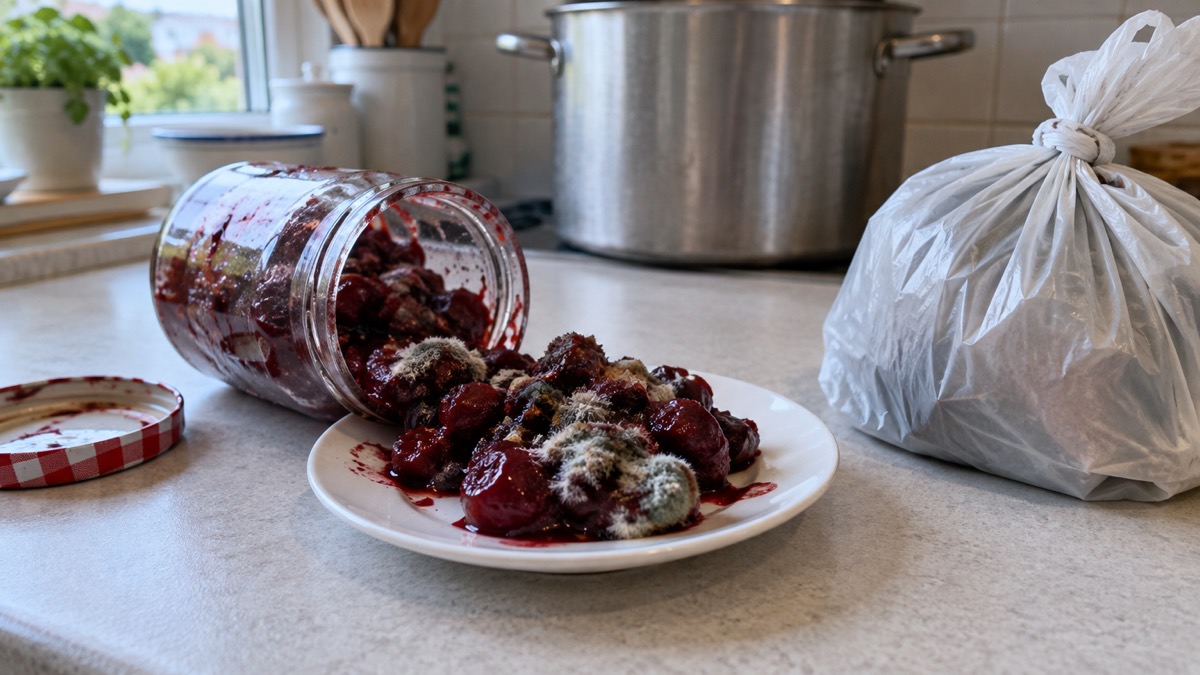
| Any preserved food | Check the container and the food before eating1 | Do not eat if bulging, leaking, damaged, heavily rusted, mouldy or spoiled, or if you are unsure1 |
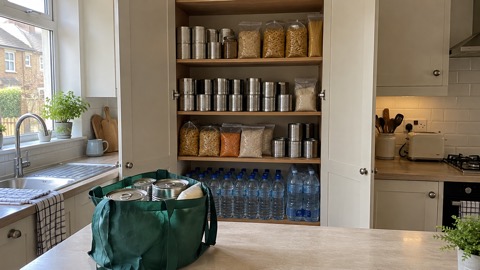
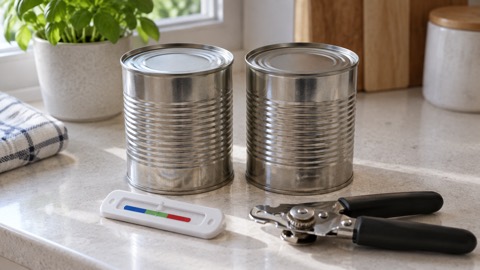
If your interest in preserving is partly about building up food stores, note that shop-bought tinned and dry foods give you long-life storage without this risk. Official guidance recommends keeping a supply of long-lasting cupboard essentials such as tinned vegetables, beans, pulses, soup and pasta12, and food normally stored at room temperature remains safe to eat even if the best before date has passed13. Our pages on what to keep in an emergency store cupboard and shelf life, use by and best before dates cover this in detail.
What you can do to reduce the risk
The Food Standards Agency sets out what you can do to reduce the risk of becoming ill due to Clostridium botulinum2, and the home preservation guidance turns that into household rules1.
Before you preserve anything:
- Understand the preservation method you are using1
- Follow trusted instructions exactly1
- If you are unsure whether a process is safe, do not take the risk1
Before you eat anything preserved:
- Do not eat preserved food if containers are bulging1
- Do not eat it if containers are leaking, damaged or heavily rusted1
- Do not eat it if the food shows signs of mould or spoilage1
- Do not eat it if you are unsure it was preserved safely1
Around the preserving kitchen, the standard food hygiene rules apply as they do to all cooking. Keep chilled ready-to-eat foods cold, and make sure your fridge is working properly and is set to 5°C or below14. Cooked dishes and foods labelled with a "use by" or "keep refrigerated" label can be stored in the fridge15. Eat leftovers within 2 days6. Store raw meat in sealed containers at the bottom of the fridge, use different boards for raw and ready-to-eat foods, and keep raw and ready-to-eat foods apart10.
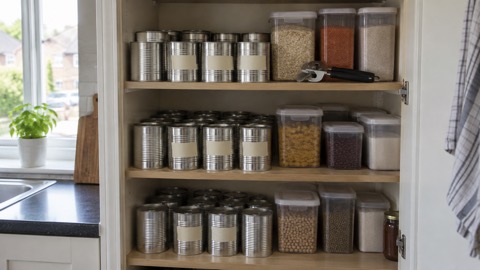
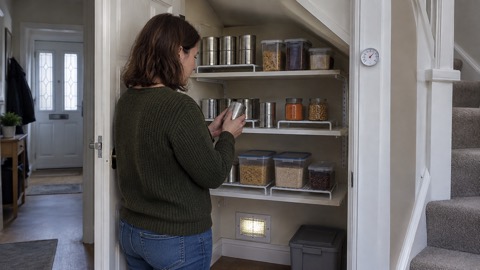
Once jars are sealed and shelf-stable, store them as you would tinned foods: keep them in a dry place where the temperature is fairly cool, and store boxed food in tightly closed plastic or metal containers to protect it from pests16. Our page on keeping a long-term store cool, dry and free of pests covers the storage side, and how to sterilise jars for preserving covers jar preparation.
Storing and using preserved food after a disruption
Preserves often sit in the cupboard for months, and emergencies can affect them. Food that is normally stored at room temperature will continue to be safe to eat as you usually would, even if the best before date has passed, and some foods such as tinned foods are safe to eat without heating through13. In a disruption, eat perishable foods requiring chilled storage first and ambient foods after17.
If your area floods, the rules change. Food in water-resistant packaging such as metal cans, sealed pouches and tetra packs can be kept if they are not damaged, but the outside of the packaging will need to be cleaned and sanitised first to avoid cross-contamination18. Canned food may be kept if undamaged as long as the cans are cleaned and sanitised before opening18. A jar of preserves that has been in flood water is not water-resistant packaging in the way a sealed can is, and the general rule applies: if you are unsure it is safe, do not eat it1. Our page on food after a flood goes through this in full.
Food recalls and alerts
Food is recalled for a number of reasons, for example contamination with pathogens like listeria or salmonella that could give you food poisoning, or because of manufacturing faults such as plastic or metal being found in the product19. The government publishes recalls and alerts, and these apply to England, Northern Ireland and Wales19.
Recent examples show the range. MOMA Foods recalled various porridge pots and sachets because of possible mouse contamination at the manufacturing site, making them unsafe to eat20. Farmfoods recalled packs of 8 Quarter Pounder Burgers and packs of 16 Beef Burgers because of safety concerns21. Neither was a botulism recall, but both show that even commercial production goes wrong, which is the context for the caution about unverified home methods.
If you keep home preserves alongside shop-bought food, check the official recalls and alerts pages if you hear that a product you own has been withdrawn. Our page on reporting food poisoning or a food problem to your council explains how to raise a concern about a product.
Reporting a suspected case and getting help
If someone becomes ill after eating preserved food, act on two fronts.
First, medical help. Call for medical help if needed22. Botulism affects the nervous system and can cause paralysis or death, so treat any illness after eating home-preserved food as urgent and say what was eaten1. Recognising symptoms and getting the correct treatment is important to ensure your health does not deteriorate11. Our page on food poisoning symptoms and when to get help covers the general warning signs.
Second, reporting. You can report suspected food poisoning or concerns about food safety to your local council, whose environmental health team handles concerns about food safety and food poisoning from consumers10. Councils also have a role in infectious disease control more generally23. Keep the jar or container, unopened if possible, so investigators can see it, and do not eat any more of the batch.
Where the official advice applies, and the Scottish position
The Food Standards Agency's botulism advice applies to England, Northern Ireland and Wales2. Its consumer advice for food preservation at home carries the same territorial extent1, as do the government's recalls and alerts pages19.
In Scotland, food safety advice comes from Food Standards Scotland and NHS inform. Food Standards Scotland publishes consumer advice on chilling, cooking and the causes of food poisoning6, and it issues its own food alerts, including the 2025 warning over fresh wild garlic pesto linked to Clostridium botulinum3. The science is the same on both sides of the border: the bacterium, its spores and the conditions that let the toxin form do not change with the postcode, so households in Scotland should treat the safety principles here as applying to them, using Food Standards Scotland and NHS inform as their official sources6.
In Northern Ireland, the Public Health Agency works in partnership with local councils and community partners to promote home safety and support people to live safely and independently at home24. Its home safety checks offer practical advice on a range of home safety issues and may include the provision of free safety equipment, subject to eligibility and availability24.
Signs of botulism and when to get urgent help
The official guidance describes botulism as an illness that affects the nervous system and can cause paralysis or death1. Because it acts on the nervous system rather than only on the gut, any illness that follows eating home-preserved food should be treated as possibly serious, whatever the first symptoms seem to be. Do not wait to see whether it passes.
The practical instruction from official first aid guidance is simple: call for medical help if needed22. Say clearly that the person has eaten home-preserved food, what it was and when. If the food is still available, keep it and its container, and do not serve any more of it to anyone.
The wider lesson from official health guidance is that recognising symptoms and getting the correct treatment early is what protects your health11. Prevention is better: every rule on this page, from following trusted instructions exactly to refusing any jar that is bulging, leaking, damaged, heavily rusted or mouldy, exists so that this call never has to be made1.
Sources (24)
- Consumer advice for food preservation at home, Food Standards Agency, 2026-10-26
- Botulism (Clostridium botulinum), Food Standards Agency, 2026-06-25
- Scottish consumers warned not to eat Trotters fresh wild garlic pesto, Food Standards Scotland, 2025-06-20
- Food poisoning, Belfast City Council, 2026-10-29
- Infectious diseases, Northumberland County Council, 2026-10-28
- Chilling: food safety in the kitchen, Food Standards Scotland, 2026-10-25
- BBQ and food safety, Welsh Ambulance Service, 2026-10-29
- How to keep cool this summer, Lancashire County Council, 2026-10-29
- Food poisoning, NHS inform Scotland, 2026-08-17
- Food poisoning and waterborne infections, Shropshire Council, 2026-10-29
- Your Health Guide, Winter 2025, West of Scotland Innovation and Improvement Hub, 2025-12
- Stay warm and nourished, Norfolk and Suffolk Integrated Care Board, 2026-10-16
- Power cuts: food safety in the kitchen, Food Standards Scotland, 2026-10-25
- Listeria, Food Standards Scotland, 2026-10-25
- Preparing and cooking food safely, NHS inform Scotland, 2025-02-21
- Emergency supplies kit, Denbighshire County Council, 2020
- Food safety in a power cut: advice for consumers, UK Government, 2023-07-26
- Flooding: food safety in the kitchen, Food Standards Scotland, 2026-10-25
- Recalls and alerts, UK Government, 2026-07-07
- MOMA Foods recalls various porridge pots and sachets, Food Standards Scotland, 2026-03-27
- Farmfoods recalls packs of burgers because of safety concerns, Food Standards Scotland, 2026-07-21
- Home safety in other languages, Devon and Somerset Fire and Rescue Service, 2024-06-07
- Infectious diseases, Cornwall Council, 2026-10-29
- Home accident prevention, Public Health Agency Northern Ireland, 2026
 Long-Term Storage Kit Checklist
 Store Cupboard Checklist
 30-Day Household Checklist
 How Much Emergency Food to Store
 What to Store in an Emergency
 Starting a Store Cupboard
 Shelf Life and Date Labels
 Rotating Your Food Store
 Long-Term Storage Conditions
 Meals Without Power
 Self-Heating Meals
 Tinned Food Guide
 Rice, Pasta and Pulses Storage
 Freeze-Dried Meals
 Emergency Ration Packs