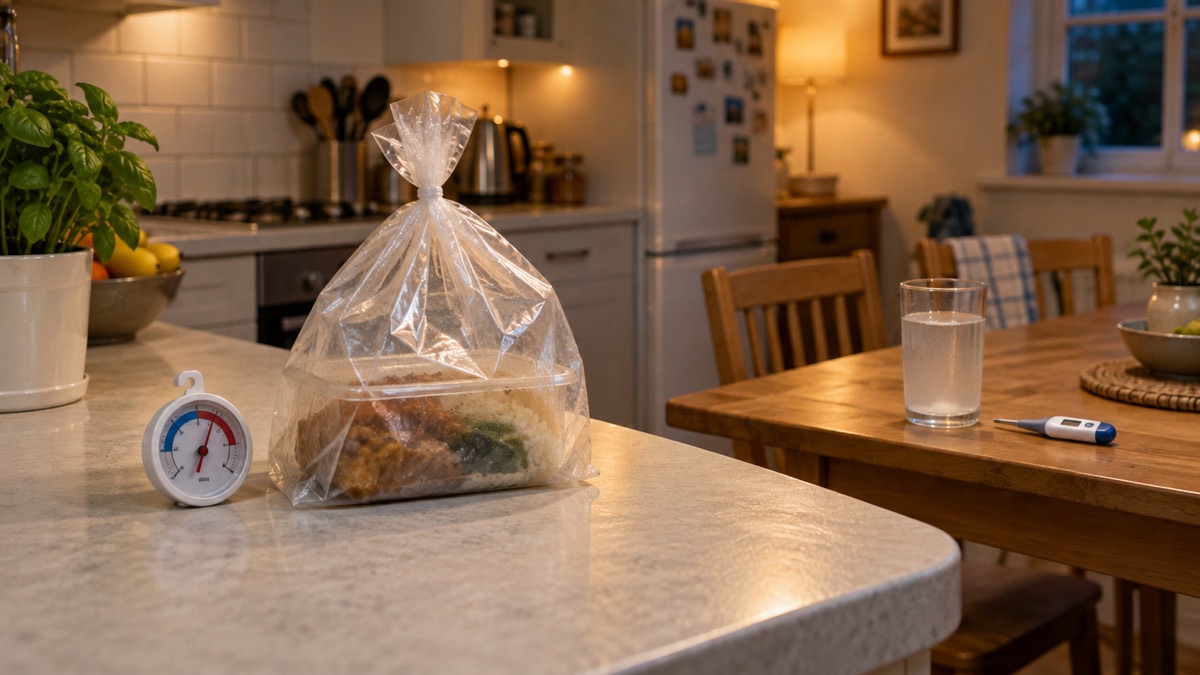
If you think a meal, a takeaway or something you bought made you ill, report it to your local council. Food poisoning is infectious, and Belfast City Council's advice is typical of councils across the UK: if you think you have food poisoning or a food-related illness, you should contact your council for advice1. At the same time, visit your doctor, because a laboratory test on a stool sample is often what confirms the cause and triggers the formal investigation2.
Most councils let you report online. Somerset Council, for example, lets you report an incident of food poisoning by completing a form on its website3. Others take reports by email or phone: Belfast City Council asks residents to email or call 028 9027 04681, and Northumberland County Council's Public Protection team takes reports at public.protection@northumberland.gov.uk4. Find your own council's environmental health or public protection page and use whichever route it offers.
This page explains who to contact, what to have ready before you report, what happens after you report, when national agencies step in, and when to seek medical help rather than, or as well as, reporting. If you want the wider picture of symptoms and who is most at risk, see our guide to food poisoning.
How to report food poisoning to your council
Reporting works in two directions at once, and both matter. You report the illness to your council, and you report it to your doctor. Cornwall Council is explicit about this: you should report your illness to your doctor, and if you provide a stool sample it can be tested to determine what organism caused it; you should also let the council know2. The reason is that food poisoning caused by bacteria or a parasite is normally only diagnosed once a patient has provided a faecal sample to their doctor or at a hospital, which is then tested at a laboratory5. Without that clinical confirmation, councils have less to work with.
The council side is straightforward. Look on your council's website for environmental health, food safety or public protection. Somerset Council publishes an online form for reporting an incident of food poisoning3. Belfast City Council takes reports by email or on 028 9027 04681. Northumberland County Council's Public Protection team can be emailed at public.protection@northumberland.gov.uk4. In Scotland, the equivalent teams sit within council environmental health departments too: Highland Council's Environmental Health team handles concerns about food safety alongside noise, housing conditions, pests and pollution8.
Once a council receives a food poisoning notification, it acts. Belfast City Council contacts the person with the symptoms and asks what and where they ate, the details of their symptoms, whether they were abroad, whether the GP took a faecal sample, and whether others who ate with them had symptoms1. So the report you make is not a dead end: it starts a conversation that can connect your illness to a business or to other cases.
Timing matters as well. Symptoms of food poisoning usually begin within 1 to 2 days of eating contaminated food, but they can also start a few hours later or several weeks later6. Report as soon as you suspect the link, even if you are not certain, because the food history the council needs stretches back days.
Who to contact: environmental health or public protection
Every council in the UK has a team responsible for food safety and infectious disease, though the name varies. In England and Wales it is usually called environmental health; in some councils, public protection. In Scotland, environmental health sections assist the Health Board with the investigation and prevention of communicable disease including food poisoning, and liaise with bodies such as SEPA, Scottish Water and the health board during public health incidents like food-borne disease outbreaks9. In Northern Ireland, Belfast City Council's environmental health service handles food poisoning notifications directly1.
What these teams cover goes beyond your own illness. Highland Council's Environmental Health team is the contact point for concerns about food safety and other issues affecting health and wellbeing8. Northumberland County Council's Public Protection division covers both food safety advice and infectious disease control4. So the same team is the right contact whether you are ill yourself or you have spotted a problem at a business.
A few practical points on contacting them:
- Use the council for the area where you live, or where you ate if that is different. If you are unsure, your own council will point you to the right one.
- Have your details ready, including when you became ill and where you ate (see the next section).
- If you work with food yourself, the stakes are higher. Somerset Council warns food handlers that reporting symptoms is a legal requirement, and failure to report symptoms could lead to prosecution of the individual rather than the business3.
What to have ready before you report
The single most useful thing you can prepare is your food history. Cornwall Council advises that you may need to give a food history of up to 5 days before becoming ill to assist with any investigation2. That is a long window to recall, so write it down before you contact anyone: meals at home, takeaways, restaurant meals, food bought at events, and anything unusual.
Beyond the food history, gather the details the council will ask about, which mirror the questions Belfast City Council poses on receiving a notification1:
- What you ate and where, including the name and address of any business, and the date and time.
- Your symptoms, and when they started.
- Whether you were abroad in the period before becoming ill.
- Whether your GP took a faecal sample, and any result you know of.
- Whether others who ate with you had symptoms, and how to reach them if the council asks.
If you still have the suspect food, keep it. Seal it, keep it separate from other food and refrigerated, and tell the council you have it. Environmental health officers may take food samples as part of an investigation2. One caution from Shropshire Council's guidance: you cannot tell contaminated food by looking at it, because even food which looks and tastes good can cause food poisoning5. The same point is made in official guidance on preserved foods: do not rely on appearance, smell or taste to decide whether food is safe to eat11.
While you are ill, follow the hygiene measures Cornwall Council sets out to stop the illness spreading in your household: wash your hands after contact with the sick person and before handling food, do not share towels or face cloths, disinfect the toilet handle and seat, drink plenty of fluids, avoid preparing food for others, avoid sharing bathwater, put the toilet lid down when flushing and ventilate the house2. NHS inform adds that you should not rely on alcohol hand gels, as they are not always effective6.
Report a food problem: unsafe food, a dirty premises or a hygiene concern
You do not need to be ill to report a food business. The same environmental health teams take complaints about unsafe food, dirty premises and poor hygiene practices, whether you spotted them as a customer or found a problem with something you bought. You can report an incident of food poisoning online by completing your council's form8, and Northumberland County Council's Public Protection team, for example, can be reached by email at public.protection@northumberland.gov.uk8.
What counts as a reportable food problem? The causes of contamination listed in official guidance give a good picture of what officers look for: food not cooked or reheated thoroughly, not stored correctly, left out for too long, handled by someone ill or who has not washed their hands, or eaten after its 'use by' date6. If you observed any of these, describe exactly what you saw.
If the problem is with a product rather than a premises, check whether it has been recalled. Food can be recalled for contamination with pathogens like listeria or salmonella that could give you food poisoning, or because of manufacturing faults such as plastic or metal being found in the product12. The government publishes food recalls and alerts, and you can sign up to its food and allergy alerts service so you are notified any time a product recall is published12. Our page on shelf life and date labels explains how 'use by' and 'best before' differ, which is often at the heart of these complaints.
For context on why councils take these reports seriously: community risk registers rate food supply contamination as a high risk. A community risk register lists a major contamination incident involving a microbiological pathogen in the food supply chain as a high-rated risk13. Individual reports from the public are one of the ways problems in the chain come to light.
What happens after you report
After you report, two things can happen, and they often happen together.
First, the council contacts you. Belfast City Council's process is representative: on receiving a food poisoning notification, it contacts the person with the symptoms and asks what and where they ate, symptom details, whether they were abroad, whether the GP took a faecal sample, and whether others who ate with them had symptoms1. Answer as fully as you can, because these answers are what turn a single report into an investigation.
Second, if cases connect, an investigation begins. Cornwall Council describes the method: interviewing people who are ill, interviewing others who ate at the venue but did not have symptoms, taking faecal and food samples if appropriate, and inspecting the implicated venue2. Comparing what ill people ate with what well people ate is how investigators narrow down the source.
There is an important limit, though. Cornwall Council states plainly that it does not investigate all claims of food poisoning without clinical confirmation2. This is why the doctor's visit and the stool sample matter so much: a laboratory result identifying the organism is often what opens the door to a full investigation. Northumberland County Council's guidance similarly directs anyone who thinks they have food poisoning to visit their doctor as soon as possible, noting the doctor might ask for a sample for examination, or that you can request to submit one10.
If your illness is confirmed as a notifiable infection, the public health side follows. A patient diagnosed with a food poisoning infection may be contacted by the Health Protection Team to identify the most likely source of the infection and to offer hygiene advice5. Such infections are notifiable to the UK Health Security Agency (UKHSA), formerly known as Public Health England (PHE)10. Older guidance pages still carry the PHE name: some state that content originally produced by Public Health England is now owned and managed by the UK Health Security Agency14.
When the UK Health Security Agency gets involved in an outbreak
Most single cases stay with the council. UKHSA's role grows when cases cluster into an outbreak, or when an incident crosses local authority boundaries. Community risk registers set out the division of responsibility. Surrey's register names the Food Standards Agency and UKHSA as the lead agencies for food supply contamination13, and names UKHSA as lead agency for an outbreak of an emerging infectious disease13. The London Risk Register rates an outbreak of an emerging infectious disease as very high15.
For you as a household, this changes nothing about what you do: you still report to your council and your doctor. What it means is that your report may feed into something bigger. A cluster of similar reports from one venue, or one product, is what triggers the multi-agency response, with environmental health officers inspecting premises and taking samples locally2 while UKHSA coordinates the wider picture across England.
It is worth knowing that UKHSA's remit is England-wide. Its heat health alerting work, for example, looks at health impacts in England16. In Scotland, the equivalent functions sit with Health Boards and Public Health Scotland, with council environmental health sections assisting the Health Board on communicable disease including food poisoning9. In Wales, Public Health Wales runs the environmental public health function. In Northern Ireland, councils such as Belfast handle food poisoning notifications directly1.
When to get medical help instead of reporting
Reporting and getting medical help are not alternatives: do both. But some situations are medical first, and you should not wait on a council reply before seeking treatment.
NHS guidance is that food poisoning is rarely serious and usually gets better on its own within a week, and that food poisoning due to eating food that has not been prepared or stored properly can be treated at home7. In most cases your GP will not prescribe medication, as it will not help you recover any faster; instead they will advise you to keep drinking regularly to avoid dehydration5.
Phone 999 or go to A&E, NHS inform advises, if you have symptoms of severe dehydration, are vomiting constantly and unable to keep down fluids, have bloody diarrhoea, have had diarrhoea for more than 7 days or vomiting for more than 2 days, have returned from a part of the world with poor sanitation in the past few weeks, or have kidney disease, inflammatory bowel disease or a weak immune system alongside diarrhoea and vomiting6. Some groups should contact their GP if badly affected even without those red flags: babies, young children, people with a weak immune system, pregnant women and the elderly5.
For suspected poisoning more broadly, nidirect guidance is blunt: do not try to treat the person yourself, get medical help immediately, and if the person has no symptoms and appears well, call the GP or GP out of hours service for advice17. NHS guidance on poisoning in children and young people sets out the same ladder: with any red features, go to the nearest hospital emergency department or call 999; otherwise contact your GP practice or call NHS 111, and if symptoms persist for 4 hours or more without speaking to a clinician, recheck for red features18. When you speak to a doctor about any suspected poisoning, have ready what the substance was, when it happened, how contact happened, how much was taken, the person's age and weight, existing medical conditions, medications and allergies18. After getting advice, keep an eye on yourself for the next 1 to 2 days, eat and drink as normal, and seek medical help again if you feel worse18. For non-urgent concerns, a local pharmacist or health visitor is a good first port of call19.
What your council cannot do for you
It helps to know the limits of a council report so you are not disappointed by the outcome.
- No clinical confirmation, no full investigation. Cornwall Council does not investigate all claims of food poisoning without clinical confirmation2. A report without a stool sample result may be recorded but not pursued.
- No diagnosis. The council cannot tell you what made you ill. Diagnosis comes from a faecal sample tested at a laboratory, via your doctor or a hospital5.
- No treatment. Treatment is a matter for the NHS. Most cases are managed at home with fluids7.
- No instant action against a business. An inspection or enforcement follows evidence, gathered through interviews, samples and inspection of the venue2.
One more thing worth knowing: more than half of food poisoning cases are not caused by food businesses at all. NHS Borders guidance notes that germs passed on by other people, pets or farm animals cause more than half the cases, transferred via hands and surfaces, through the air if someone is vomiting, or via the toilet20. That is why the household hygiene measures matter so much2, and why a report sometimes leads nowhere: the source may have been a person, not a meal.
Where to get help and further advice
Your first contacts, in order:
- Your GP, or NHS 111 for advice, if you are unwell18.
- 999 or A&E for the severe symptoms listed above6.
- Your council's environmental health or public protection team to report the illness or a food problem1.
- A pharmacist or health visitor for non-urgent concerns19.
For staying ahead of problems, sign up to the government's food and allergy alerts service, which notifies you any time a product recall is published12. To reduce the chance of illness in the first place, the official advice is consistent: cook food thoroughly and make sure it is hot throughout before consumption, following manufacturers' guidelines10; store raw meat in sealed containers at the bottom of the fridge, use different boards for raw and ready-to-eat foods, and keep raw and ready-to-eat foods apart5; keep perishable foods below 5°C, keep to the 'use by' date of wrapped foods, and eat foods within 3 or 4 days of opening20; and ensure anyone with diarrhoea, vomiting or nausea does not prepare food5. Our pages on fridge temperatures, handling raw meat, poultry and eggs and how long leftovers keep cover these in detail.
If you are a food handler, remember the legal duty: report your symptoms, because failure to do so could lead to prosecution of you as an individual rather than the business3. And if you want to understand the bugs behind the illness, our guide to salmonella, E. coli, listeria and other causes explains the main ones, including campylobacter, the most common cause of food poisoning20.
Sources (20)
- Food poisoning, Belfast City Council, 2026-10-29
- Infectious diseases, Cornwall Council, 2026-10-29
- Food poisoning, Somerset Council, 2026-07-09
- Food poisoning advice, Northumberland County Council, 2026-08-11
- Food poisoning and waterborne infections, Shropshire Council, 2026-10-29
- Food poisoning, NHS inform, 2026-08-17
- Poisoning, NHS, 2025-06-12
- Private water supplies and environmental health contact, Highland Council, 2025-10-10
- Public health and housing, Argyll and Bute Council, 2026
- Infectious diseases, Northumberland County Council, 2026-10-28
- Consumer advice for food preservation at home, GOV.UK, 2026-10-26
- Recalls and alerts, GOV.UK, 2026-07-07
- Community Risk Register 2026, Surrey County Council, 2026
- Public health advice following Salisbury nerve agent incident, GOV.UK, 2018-03-11
- London Risk Register v14, Greater London Authority, 2025-01
- Amber extreme heat warning issued by the Met Office, Met Office, 2026-08-11
- Poisoning, nidirect, 2021-06-27
- Poisoning / accidental swallowing, Healthier Together (NHS), 2026-10-29
- Poisoning, Frimley Healthier Together (NHS), 2026-10-29
- Food poisoning, NHS Borders, 2014-06
 Long-Term Storage Kit Checklist
 Store Cupboard Checklist
 30-Day Household Checklist
 How Much Emergency Food to Store
 What to Store in an Emergency
 Starting a Store Cupboard
 Shelf Life and Date Labels
 Rotating Your Food Store
 Long-Term Storage Conditions
 Meals Without Power
 Self-Heating Meals
 Tinned Food Guide
 Rice, Pasta and Pulses Storage
 Freeze-Dried Meals
 Emergency Ration Packs