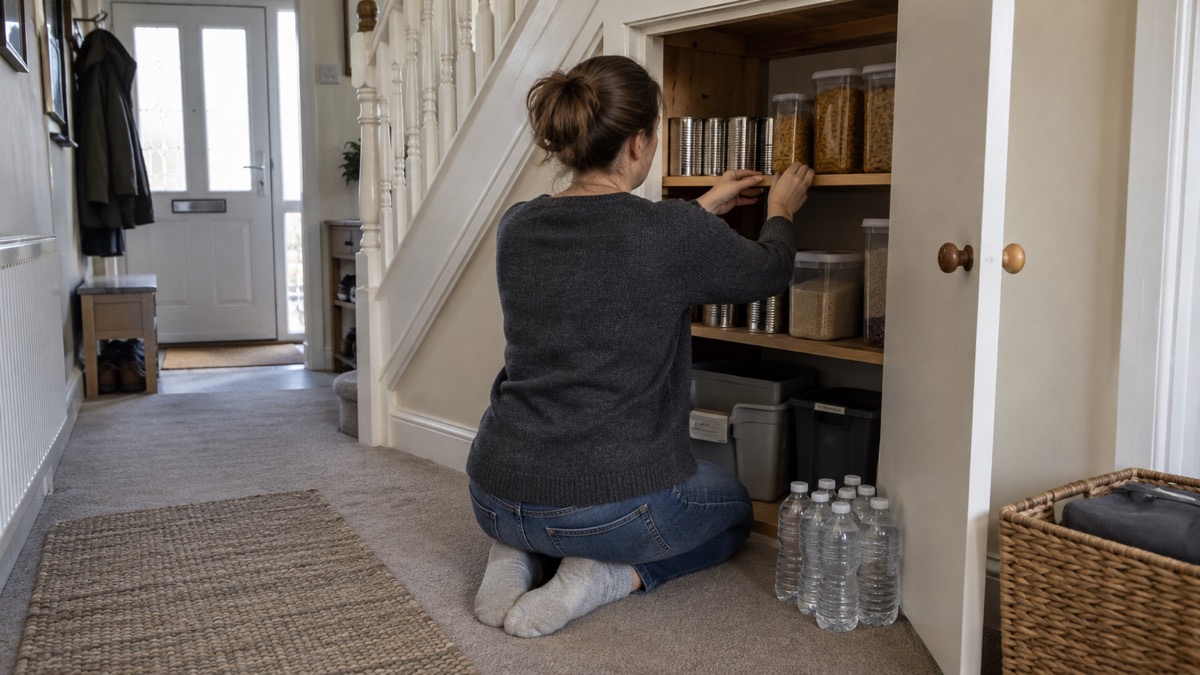
How much food to store for an emergency is the first practical question most households ask, and UK official guidance gives a clear starting answer: at least three days of non-perishable food per person, food that does not need refrigeration or cooking1. Emergency food can simply be the everyday food families already buy and store in their refrigerators and pantries, including vegetables, fruits and perishables, which can sustain a household for a good number of days2. Some councils go further and suggest a week or more, so three days is a floor, not a ceiling.
The food itself does not need to be special. The Be Ready checklist advises "Food with a long shelf life that doesn't need refrigeration or cooking e.g. tinned meat, fish or vegetables, dried fruit and nuts. It's best to buy food you'd usually eat"1. In other words, your emergency store is an ordinary cupboard, deliberately kept a little fuller than usual, stocked with things your household will actually eat. That single principle, buy what you normally eat, answers most of the questions about what to buy and how much, because you size the store around your own meals rather than around a survival product.
This page sets out how much to store per person and per household, how the official figures differ between three days, seven days and ten days, what to do about fresh and perishable food, and how emergency food relates to the "survival food" you may see sold online. Water matters just as much as food, and the official figure is 3 litres per person per day for at least 3 days3, so it is covered here too.
What emergency food actually is
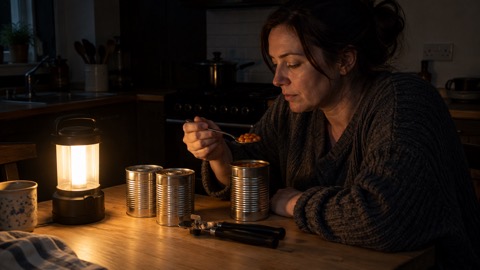
Emergency food is the food you keep at home so that you can feed your household through a disruption: a power cut, a storm that stops you shopping, a flood, or a period when you are advised to stay indoors. It is not a separate category of product. It is ordinary food, chosen for two qualities: it keeps for a long time without refrigeration, and it can be eaten without cooking, or with minimal preparation.
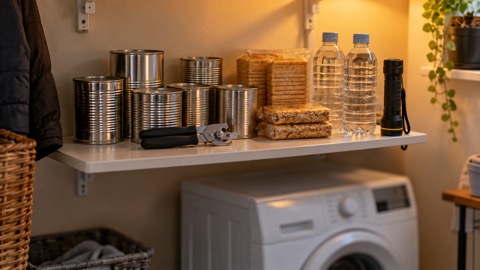
The national guidance is specific about the types of food that fit. The Be Ready checklist names tinned meat, fish or vegetables, and dried fruit and nuts, all foods with a long shelf life that need neither refrigeration nor cooking1. Greater Manchester's guidance on losing essential services adds ready-to-eat tinned meat, fruit or vegetables and a tin opener, and says to include ready-made baby formula and pet food if your household needs them8. Hillingdon Council's advice for staying indoors is the same in spirit: keep a supply of tinned food and bottled water at home9.
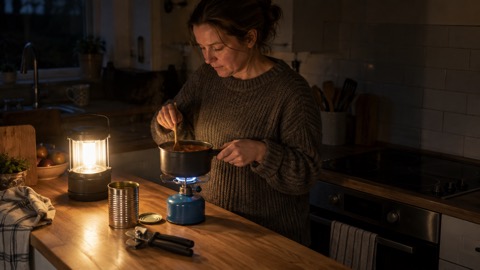
A few points follow from the definition. First, the food should not depend on your fridge, freezer, hob or oven working. West Yorkshire's household emergency plan says plainly "do not rely on fridge/freezer for food"10, because a power cut takes both out of action at once. Second, it should not depend on a supply of water to rehydrate it, unless you are also storing that water; Denbighshire's emergency supplies kit lists foods "that you can readily eat without heating or water", including ready-to-eat meats or tuna, fruits, vegetables, canned or boxed juices, UHT milk, soup, high energy food like crackers or cereal bars, biscuits, boiled sweets and powdered milk11. Third, it should suit everyone in the house: babies, anyone on a special diet, and pets all need their own place in the store8.
If you are starting from nothing, the companion page What to Keep in an Emergency Store Cupboard lists the foods in detail, and Starting a Store Cupboard Supply Step by Step walks through building it up over a few shopping trips.
How many days of food to aim for
The standard answer: three days
Three days is the figure that appears again and again in official UK guidance, and it is the right target for a first store.
| Source of guidance | Recommended amount |
|---|---|
| Be Ready national checklist (2026) | Non-perishable food for 3 days1 |
| Be Ready Household Emergency Plan (2026) | Non-perishable food to last at least 3 days, no cooking or refrigerating3 |
| Be Ready power cut advice | 3 days' worth of bottled water and non-perishable food13 |
| Renfrewshire Council | Essential household supplies for at least 3 days2 |
| Lancashire Prepared | Enough food and bottled drinking water to last three days14 |
| Lincolnshire Council | At least three days' supply of non-perishable food15 |
| Ready Scotland | 3 days' supply of food that does not need cooking and will not go off16 |
| Argyll and Bute Council | At least three days' supply of food, bottled water and other essentials17 |
| Dumfries and Galloway Council | Enough emergency food for three days, plus a can opener18 |
| Bradford Council flood pack | At least a three-day supply of non-perishable food19 |
| North Hertfordshire Council | Plan for at least three days20 |
The consistency is deliberate. The reasoning behind it is that in a major emergency covering a widespread area, "you may have to survive on your own for up to three days or more", as Denbighshire's emergency supplies kit puts it11. Three days is roughly how long local responders may need to reach everyone and restore basics after a serious incident. For a power cut, which is the most likely disruption most households will face, three days also comfortably covers the longest typical outage, and you can find more on that in Power Cuts: A Household Guide.
The longer answers: seven days and ten days
Some councils and community guidance go beyond three days, and it is worth knowing the range before you decide your own target.
Central Bedfordshire Council recommends a Home Emergency Kit "so you can look after you and your family for at least 7 days of disruption"4. A community preparedness booklet from Culham Parish Council goes further still, advising residents to "Ensure you have enough emergency reserves in your house for up to ten days including: essential medications, food and water"5. Neither contradicts the three-day figure; they build on it. Emergency food is generally described as food that can last a couple of days or weeks, so a store built around these longer figures simply extends the same approach6.
Which target suits you depends on your circumstances. Three days is the sensible minimum for every household. Seven days makes sense if you live somewhere remote, if severe weather regularly cuts off your area, if you have babies or someone with a medical diet at home, or if you would find it hard to get to a shop quickly. Ten days is a reasonable ambition once three days is in place and being rotated, and it is easiest to reach by simply buying a little more of what you already eat on each shop. Whatever you choose, store the food you rely on: Ready Scotland's wording is "food that does not need cooking and will not go off, or that you rely on"16.
Working out your household's total
Because official guidance expresses the store in days rather than in calories or kilograms, the practical way to size it is to work from your household's own eating for a normal three days, then multiply.
Start with the people. Count everyone who lives with you, including babies and anyone who stays regularly. Then count the days you have chosen: three as a minimum, seven if you are following Central Bedfordshire's recommendation4. Then ask what your household actually eats and drinks in a day. Emergency food can be the everyday food families buy and store in their refrigerators and pantries, including vegetables, fruits and perishables, which can sustain individuals or families for a good number of days2. Guidance does not publish a calorie figure per person for household stores, so the reliable measure is your own routine, scaled up.
Water is the one item with a published per-person figure. The Be Ready Household Emergency Plan states "Bottled water (3 litres per person per day for at least 3 days)"3, and the national power cut advice repeats the same figure13. Multiply that figure by the number of people in your household and by the number of days you want to cover before you buy bottles, and there is more detail in Water in an Emergency: A Household Guide.
A worked example, using only the official figures:
| Household | Days | Water | Food |
|---|---|---|---|
| 1 person | 3 | 3 litres per person per day, for 3 days3 | 3 days of non-perishable food1 |
| 4 people | 3 | 3 litres per person per day, for 3 days, for each person3 | 3 days of non-perishable food per person1 |
Do not forget the extras that turn a pile of tins into a workable store. A tin opener is named again and again in official lists3. Spare medication belongs in the same kit, as Wiltshire Council's emergency kit list makes clear21. Babies need ready-made baby formula, which official power cut advice specifically names because it needs no boiling water to prepare13. Pets need their own food: Wiltshire and Swindon Prepared advise "a couple of days' supply of food (ideally tinned or long lasting)" in a pet emergency kit12, while Slough Council suggests having a week's worth of everything your pet uses regularly22. If anyone in the house has allergies, a medical diet or religious food requirements, build those into the store from the start; Emergency Food for Medical, Religious and Allergy Diets covers the detail.
Fresh food and perishables: what to eat first
Fresh and perishable food has a place in an emergency, but only at the beginning. Wiltshire and Swindon Prepared's guidance on a national power outage is blunt about the store itself: "The food you have does not need to be fresh or perishable, in fact it is better to avoid these and keep some longer lasting products such as tinned food for emergencies"23. Perishables spoil, and in a power cut they spoil faster, so the plan is to use them up in a fixed order and fall back on the store.
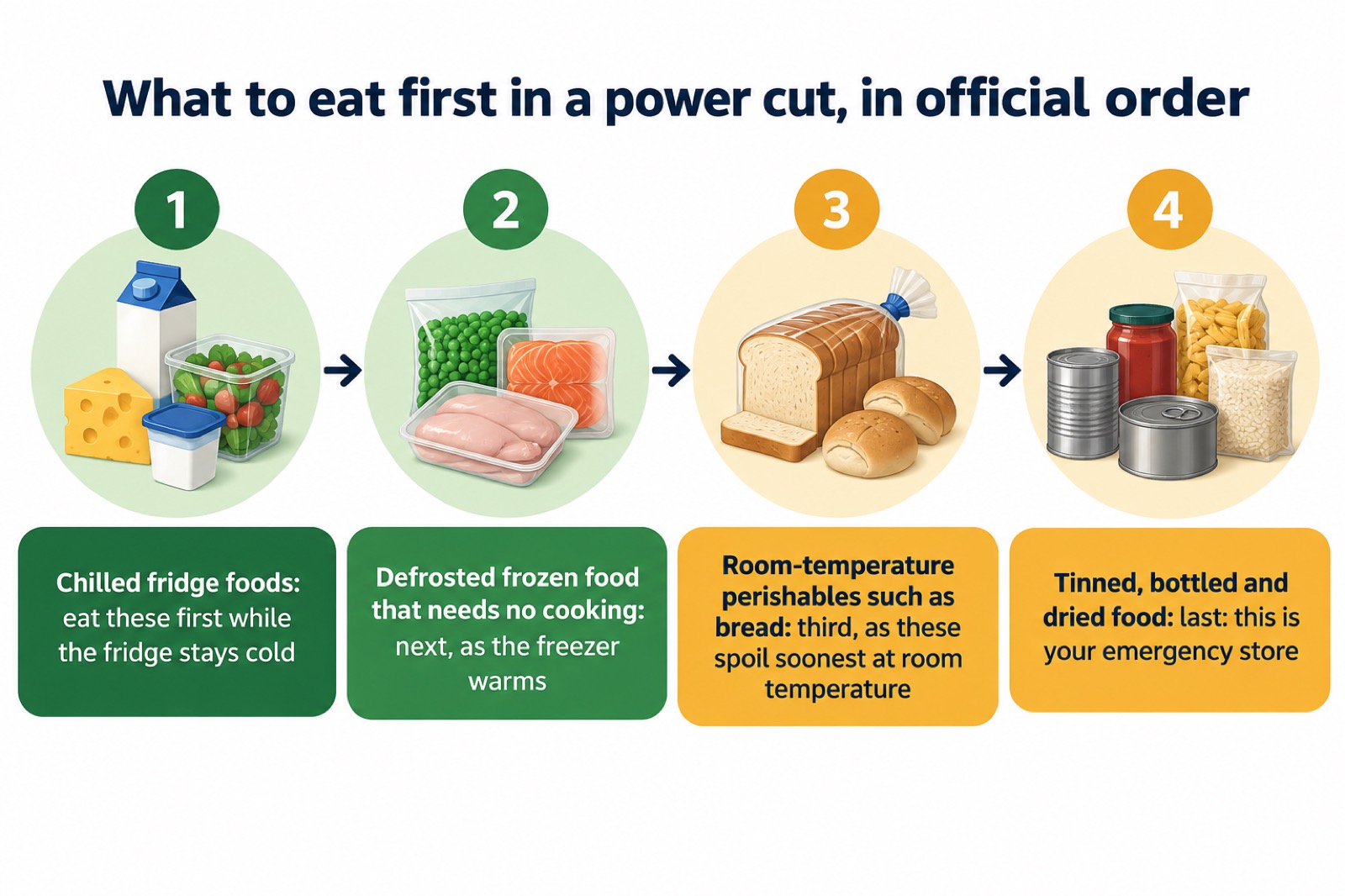
Food Standards Scotland gives that order for a power cut: "To keep food safe and reduce food waste, use up foods in the following order:" chilled fridge foods first, then defrosted frozen food that does not need cooking, then room-temperature perishable food such as bread, and finally room-temperature tinned, bottled and dried food6. In other words, eat your way down from the most fragile food to the most durable, and your three-day store is what remains when everything else is gone.
How long the fridge and freezer hold depends on two things: whether the power comes back, and whether you keep the doors shut. Food Standards Scotland states "The food in your freezer should stay frozen up to 48 hours if it's full or about 24 hours if it's half full", with the doors kept closed6. A full freezer therefore buys you twice as much time as a half-empty one, which is a good argument for keeping yours well packed. UK Government advice states that in normal circumstances fridges should be kept at 5º C or below, but in power cuts "food can be stored in fridges at temperatures under 8°C"7, so fridge food stays usable for a while after the power goes, provided the door stays shut.
The same advice contains a reassuring rule for short cuts: "If the power outage is for less than 4 hours this is unlikely to impact the safety of food in chilled or frozen storage"7. Most power cuts are shorter than that, so in the common case there is nothing much to do except keep the doors closed and wait.
Once the power is back, or once food has been out of cold storage for longer, the ordinary safety rules apply. NHS inform advises "don't keep leftovers for longer than two days"24, and Food Standards Scotland says the same: "eat leftovers within 2 days"25. NHS Borders' food poisoning advice adds the everyday rules that matter most in a disruption: keep perishable foods below 5°C, keep to the "USE By" date of wrapped foods, and eat foods within 3 or 4 days of opening26. If you are unsure whether something is still safe, do not eat it; Food Poisoning: Symptoms, Who Is at Risk and When to Get Help explains the signs and when to seek medical advice.
Emergency food and survival food: where the two overlap
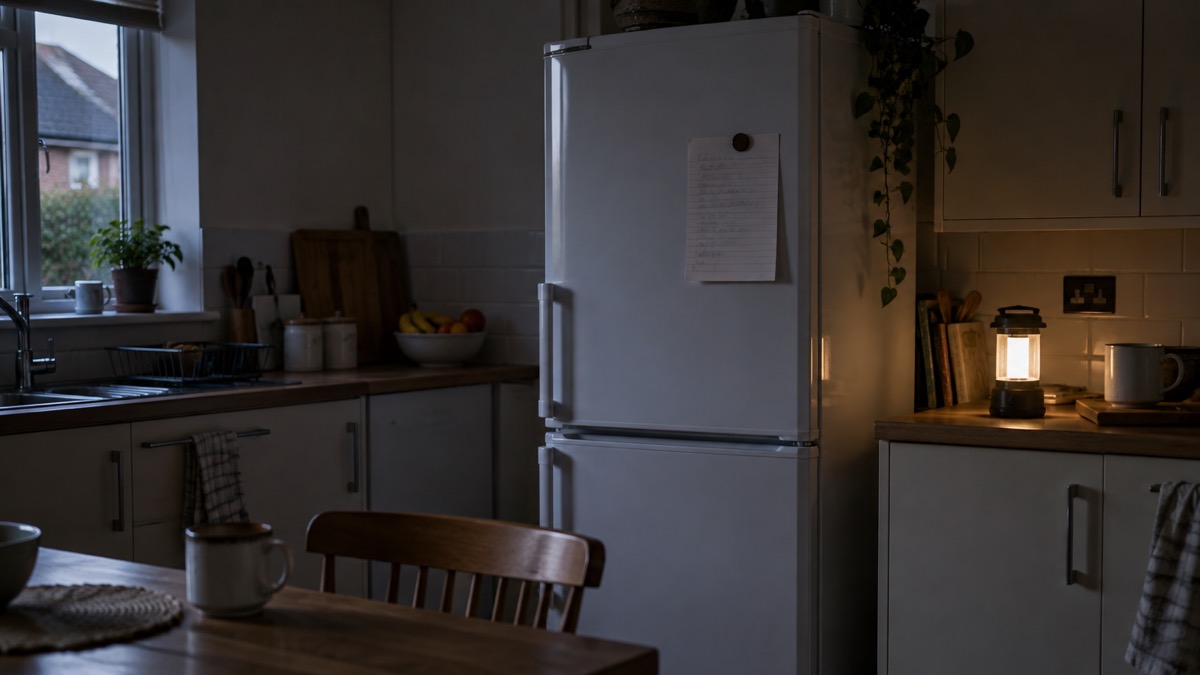
You will see "survival food" sold online: freeze-dried meals, ration packs, ration bars, buckets of dried staples. How does that relate to the emergency food official guidance describes?
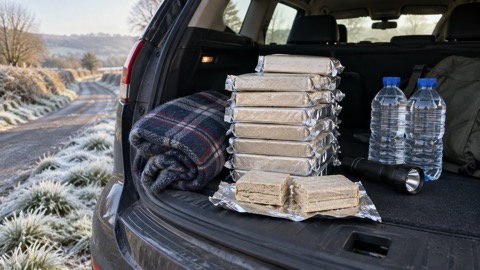
The overlap is real. Both are food that keeps without refrigeration and is held at home for a disruption. The difference is in the packaging and the timescale. Official UK guidance describes a store built from tinned and dried foods you already eat, sized in days1. Much of what is sold as survival food is the same idea taken to a longer timescale: freeze-dried meals sealed to keep for years, or compressed ration bars designed to deliver a day's food in a small, light packet. If you keep those products, they sit on top of a three-day store, they do not replace it.
There are practical cautions. Many freeze-dried meals need water, and sometimes hot water, to be edible, so a store of them is only as good as your water store; the official figure of 3 litres per person per day covers drinking and basic needs3, and rehydrating meals draws from the same supply. Denbighshire's guidance to choose foods you can eat "without heating or water"11 is the safer default for the core store. If you want to explore the long-keeping options, Freeze-Dried Meals: What They Are and How to Choose, Emergency Ration Packs: Calories, Weight and Contents and Emergency Ration Bars: How They Work and How to Choose set them out, and Tinned or Freeze-Dried Meals compares the two approaches directly.
The other half of "survival food" thinking is the grab bag: a small, portable kit for leaving home in a hurry. Official guidance treats this as a separate, smaller store. Neath Port Talbot's emergency kit checklist says to take "ready-to-eat food, a warm drink in a flask and bottled water" if you have to leave your home27, and West Yorkshire's flooding checklist advises storing emergency items in a bag so they are easy to grab, with everyone in the house knowing where it is kept10. A grab bag holds hours of food, not days; its job is to get you through the first period away from home, and Emergency Kit: What a UK Household Should Keep Ready covers the rest of what goes in it.
Keeping the store usable: rotation and dates
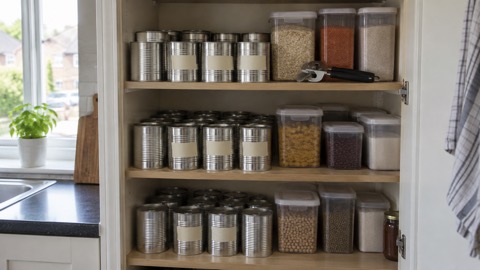
A store of food you actually eat solves its own maintenance problem, because it turns over naturally. The alternative, a box of emergency food bought once and forgotten, ends in wasted food and out-of-date tins.
The clearest official instruction on rotation comes from Denbighshire's emergency supplies kit: "just replace the whole food side of the kit every six months and live off the replaced food for a few days"11. That is a workable rhythm for any household: twice a year, eat your way through the oldest part of the store and buy replacements. North Hertfordshire's kit list makes the everyday version of the same point, telling households to keep items such as canned food, cereal and fruit bars "up to date"20, and Lincolnshire's list specifies "in date tinned food and tin opener"15.
In practice, rotation means a few habits rather than a system:
- Buy food you normally eat, so the store empties and refills as part of ordinary shopping1.
- Put newer tins and packets at the back and older ones at the front, and use the front ones first.
- Check dates twice a year, and eat the replaced food rather than throwing it away11.
- Keep a tin opener with the tins, and check it works3.
- Eat leftovers within 2 days, so nothing lingers in the fridge25.
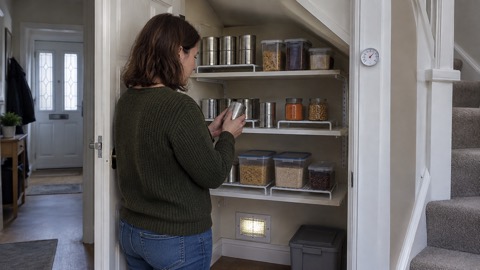
Rotating Your Store: First In, First Out gives the full method, and Shelf Life, Use By and Best Before Dates Explained explains what the dates on the packets actually mean. If you extend your store towards the seven or ten day figures, Keeping a Long-Term Store Cool, Dry and Free of Pests matters more, because longer storage makes conditions count.
Where to get help if you cannot build a store
Not every household can afford to hold extra food, and if that is your situation there is help, and it is better to use it before an emergency than during one. Food banks provide emergency food via a referral, and How to Get a Food Bank Voucher Referral explains the process; Getting Emergency Food Help: Food Banks, Councils and Local Support lists the wider routes. If you are on a low income and pregnant or have a young child, the Healthy Start scheme may help with the cost of milk, fruit and vegetables, and The Healthy Start Scheme: Who Qualifies and What It Gives sets out who qualifies.
If someone in your household depends on electricity for medical equipment or would struggle in a power cut, join your supplier's Priority Services Register; Extra Help in an Emergency explains who qualifies and how to sign up. And if an emergency has already begun and you cannot feed your household, contact your local authority, which has duties to help people affected by an emergency.
Sources (27)
- Be Ready Checklist, UK Government Be Ready campaign, 2026
- Prepare your home for emergencies, Renfrewshire Council, 2025
- Be Ready Household Emergency Plan, UK Government Be Ready campaign, 2026
- Emergency kits and grab bags, Central Bedfordshire Council, 2026
- Are You Ready booklet, Culham Parish Council, 2025
- Food safety in the kitchen: power cuts, Food Standards Scotland, 2026
- Food safety in a power cut: advice for consumers, UK Government, 2023
- Loss of essential services: prepare yourself, Greater Manchester Combined Authority, 2026
- Household emergency plan, Hillingdon Council, 2026
- Household Emergency Plan, West Yorkshire Prepared, 2026
- Emergency Supplies Kit, Denbighshire County Council, 2020
- Your pets, Wiltshire and Swindon Prepared, 2026
- Power cuts: how to prepare, UK Government Be Ready campaign, 2026
- Emergency pack, Lancashire Prepared, 2026
- Get help and advice in an emergency, Lincolnshire County Council, 2026
- Emergency kit, Ready Scotland
- Be prepared at home and in your community, Argyll and Bute Council, 2026
- Prepare for emergencies, Dumfries and Galloway Council, 2026
- Create a flood pack, Bradford Council, 2026
- Preparing for emergencies, North Hertfordshire District Council, 2015
- Planning for an emergency kit, Wiltshire Council, 2026
- How you can prepare for an emergency, Slough Borough Council, 2026
- What is a national power outage, Wiltshire and Swindon Prepared, 2026
- Preparing and cooking food safely, NHS inform, 2025
- Food safety in the kitchen: chilling, Food Standards Scotland, 2026
- Food poisoning advice, NHS Borders, 2014
- Emergency kit checklist, Neath Port Talbot Council, 2026
 Long-Term Storage Kit Checklist
 Store Cupboard Checklist
 30-Day Household Checklist
 What to Store in an Emergency
 Starting a Store Cupboard
 Shelf Life and Date Labels
 Rotating Your Food Store
 Long-Term Storage Conditions
 Meals Without Power
 Self-Heating Meals
 Tinned Food Guide
 Rice, Pasta and Pulses Storage
 Freeze-Dried Meals
 Emergency Ration Packs
 Emergency Ration Bars