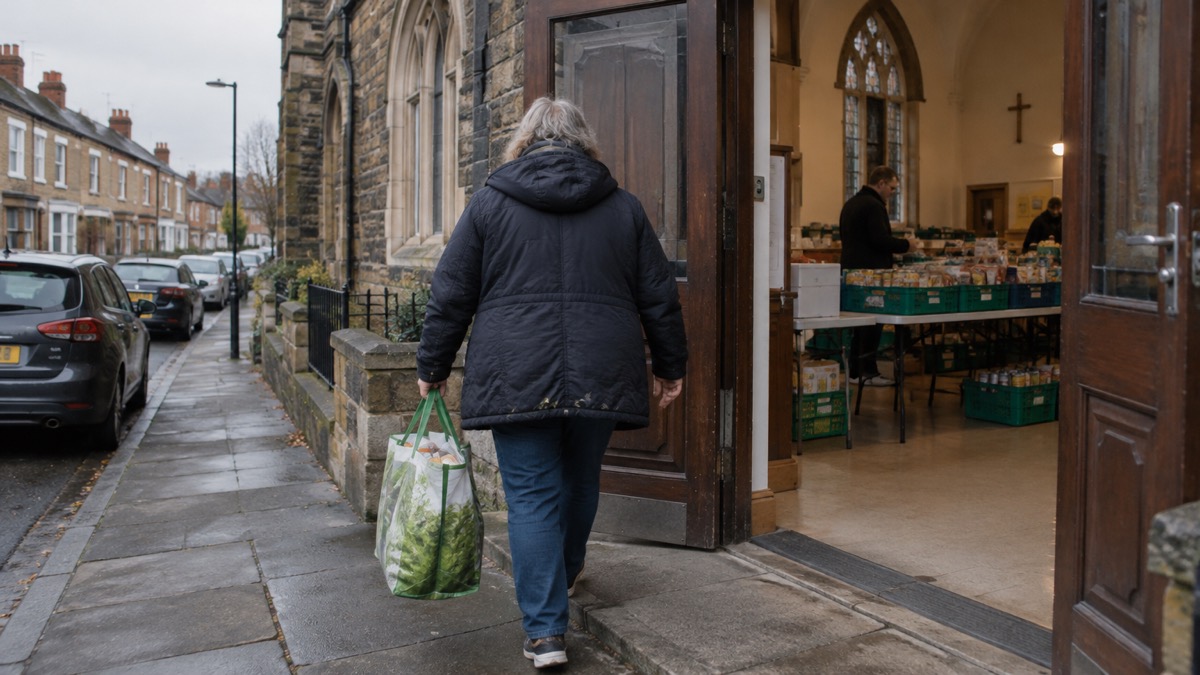
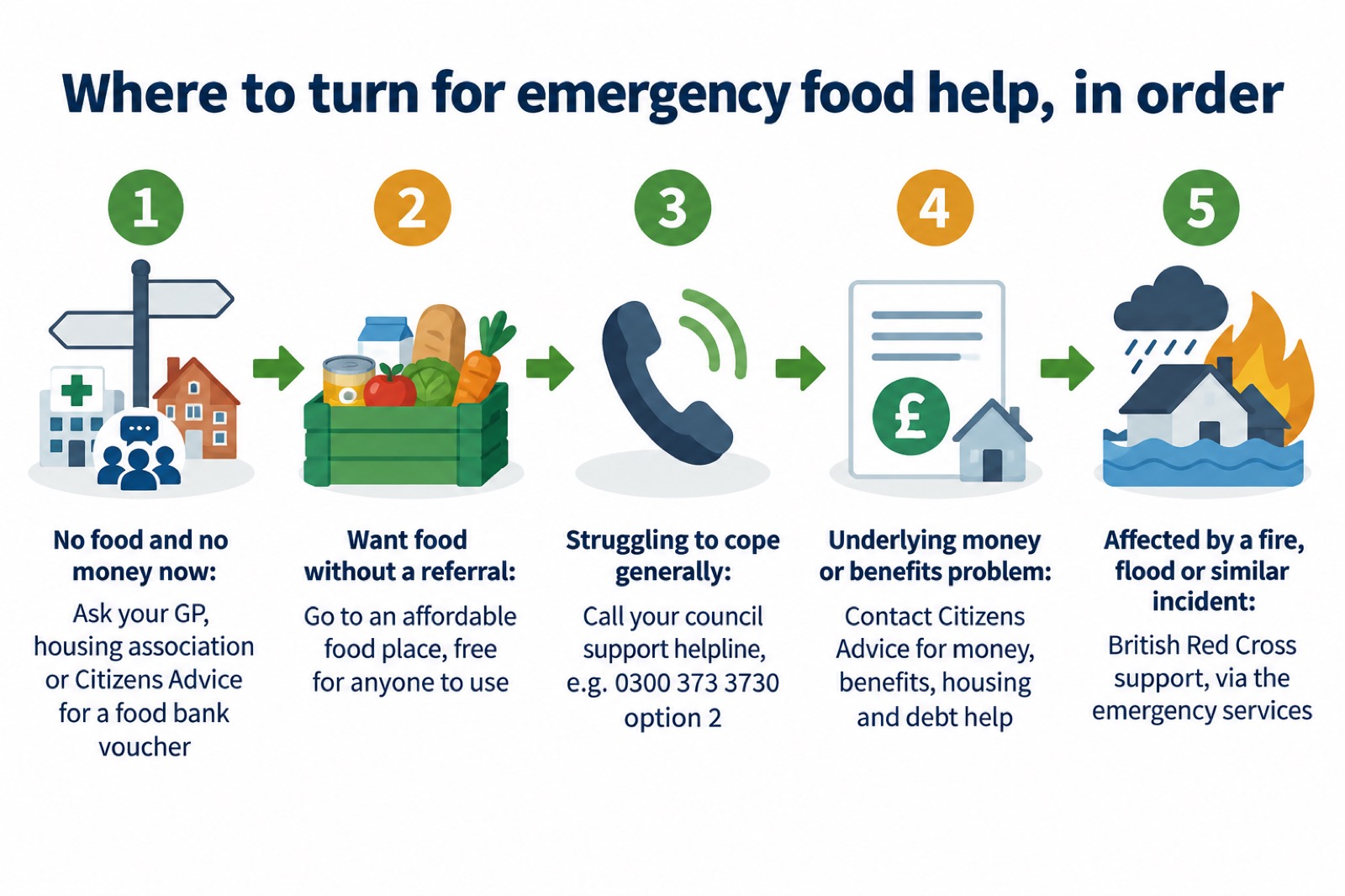
When there is no food in the house and no money to buy any, the fastest routes to help are the ones that already exist in your area: a food bank voucher from a referrer such as your GP, housing association or Citizens Advice, an affordable food place you can walk into without a referral, or your council's support helpline. To get help from a food bank you need to be referred with a voucher, and your GP, housing association or Citizens Advice can assess you for one and point you towards wider crisis support1. Affordable food places are different: they are free for anyone to use and you do not need a referral1. Councils run helplines for exactly this situation: Cumberland Council, for example, advises anyone who needs urgent help finding food and essential items, or who is struggling to cope, to call its support helpline on 0300 373 3730 (option 2)1.
This page sets out each route in the order you are likely to need it: vouchers and referrals first, then the places you can simply turn up to, then the helplines and charities that help with the money problems behind an empty cupboard, and finally how your area plans food help for a real emergency such as a flood or a major power cut. If you also want to build up a small store of food at home so a short crisis never becomes a food crisis, our emergency food guide covers that separately.
Food bank vouchers: who can refer you
Most food banks in the UK work on a referral system. You cannot usually walk in and ask for a parcel: to get help from a food bank you need to be referred with a voucher1. The referral exists so that someone checks your situation first and connects you to the help that fits it, rather than just handing over food and sending you back into the same problem next week.
The people who can refer you are wider than many households expect. Your GP, housing association or Citizens Advice can assess you for a food voucher and provide signposting for help towards your crisis1. Health and social care services are also involved in some areas: hospital discharge support in Nottingham and Nottinghamshire includes access to food supply, such as food banks, for individuals able to confirm they are without financial means7. In Scotland, the Stornoway Eilean Siar Foodbank provides food, toiletries, baby supplies and cleaning products, and referral bags can be collected by a social worker or health visitor who takes food parcels to designated homes, with families identified by numbers for anonymity8. That last detail matters if you are worried about being known in a small community: anonymous delivery arrangements do exist.
If you are not sure who refers in your area, our page on how to get a food bank voucher referral walks through the process in more detail. The practical steps are:
- Contact a referrer: your GP surgery, housing association or local Citizens Advice1
- Explain briefly why you have no food and no money to buy it
- Ask them to assess you for a voucher, and also ask what else they can signpost you to, since the referral is meant to open up wider crisis help1
- Take the voucher to the food bank it names, or ask whether the parcel can be delivered if you cannot collect it, as some services arrange8
One point worth knowing: a food bank parcel is emergency help, normally a few days of food, not an ongoing supply. If the underlying problem is income, benefits, debt or housing, the referrer should connect you to help with that too, and Citizens Advice, covered below, is the main free service for it.
Affordable food places and other walk-in options
Not every food service needs a referral. Affordable food places are free for anyone to use, you do not need a referral1. They are typically community shops or social supermarkets where food is sold at well below normal prices, or given freely, and the point of them is that nobody has to prove a crisis first. If you would find a referral conversation embarrassing, or you need food today and cannot wait for an appointment, these are the places to look for.
Other services work the same way. Recovery Cafés run by South West London and St George's Mental Health NHS Trust state plainly: "You don't need a referral or an appointment to visit"9. Warm hubs, covered in a later section, similarly offer a heated place to spend time with no gatekeeping.
| Type of place | Referral needed? | What you get | Who runs it |
|---|---|---|---|
| Warm hub | No | Heated place, refreshments, local support10 | Community centres, libraries, churches, village halls, voluntary organisations10 |
To find affordable food places near you, your council's cost-of-living or emergency food pages are the usual starting point, and the council helpline can tell you directly.
Council helplines for urgent food and essentials
Your council is the single most useful phone call in a food crisis, because it can help with food and with the essentials around it. Cumberland Council's guidance is a good model of what councils offer: if you need urgent help finding food and essential items, or if you are struggling to cope with your current situation for any reason, you are advised to call the support helpline on 0300 373 3730 (option 2)1. Councils elsewhere run equivalent lines, usually listed on the council website under cost of living, emergency help or community support.
Beyond the helpline, councils distribute the Household Support Fund. Your local council may help with energy bills, food and other essential costs, and you do not need to be on benefits to get help11. That last point catches many households out: people assume they must be claiming benefits before they can ask, and delay asking. If your income has just dropped, ask.
Councils also help when the problem is housing itself. They may be able to help you with emergency housing if you have nowhere to stay12. In Cumberland, if you are homeless now or in danger of losing your accommodation you can contact the homelessness service by email for Allerdale, Carlisle and Copeland, or telephone 0300 373 3730 for Cumberland as a whole13. The Salvation Army provides warmth, food and shelter to anyone aged 18 or over who finds themselves without a place to stay14.
Some councils also run hardship funds of their own. The Crisis and Resilience Fund in Cumberland provides one-off support for essential costs to households that have no other way to pay for what they need13. When you call a council helpline, it is worth asking specifically whether a fund like this exists, because staff will not always offer it unprompted.
Citizens Advice: free help with money, benefits and food vouchers
Citizens Advice is the main free service for the problems that usually sit behind an empty cupboard. You can contact Citizens Advice for concerns around money, benefits, housing, employment, legal, debt, family and consumer problems5. It is also one of the referrers that can assess you for a food voucher1, so a single contact can both get you food this week and start fixing the cause.
Contact works in several ways. You can find support over the phone, with hours that may vary: Suffolk's Adviceline, for example, is 0300 330 11515. For consumer problems specifically, you could contact the Citizens Advice Consumer Service on 0808 223 1133 for help and advice2. Most local Citizens Advice offices also offer web chat and online contact forms, which suit households that cannot easily make calls during office hours.
Citizens Advice also carries information on the payments that reduce winter pressure on a food budget. The Citizens Advice Bureau has information about Winter Fuel Payments and Cold Weather Payments, which help with energy bills15. If a choice between heating and eating is part of your situation, ask about these when you make contact, because a payment you are entitled to but not claiming frees up money for food directly.
If you are struggling with energy costs specifically, two further routes exist. The Fuel Bank Foundation provides emergency financial support through a network of partners, identifying people who cannot afford to pre-pay for their fuel or energy2. And if you or someone in your household depends on electricity for medical or other essential reasons, energy suppliers offer priority help in an emergency through the Priority Services Register16. Our extra help page covers that register in full.
British Red Cross: food parcels, transport and hardship support
The British Red Cross is the charity most often working alongside the emergency services when a fire, flood or similar incident leaves a household with nothing. The Red Cross responds to an emergency in the UK approximately every four hours, supports rest centres and provides safe spaces offering emotional and practical support, and helps around half a million people in the UK every year to prepare for, respond to and recover from a crisis such as house fires, floods and evacuations17.
Its emergency response support service is designed to meet the needs of people who have suffered damage to their home following a fire, flood or similar incident, and the volunteers can provide emotional support and care for those affected while the emergency services manage the incident6. You do not usually need to find the Red Cross yourself: it is called to incidents alongside the fire and rescue service. After a fire, for example, emergency help is available with things like accommodation, clothing and food, as well as help dealing with insurance companies12.
The most developed example is the Fire and Emergency Support Service (FESS), run in partnership with the British Red Cross by trained volunteers who offer practical and emotional support18. Trained British Red Cross volunteers use a specially adapted vehicle equipped with a hot shower, clothing, a mobile telephone, baby food, a camera for clients to take photographs for insurance purposes and a small kitchen18. The team responds to incidents 24/7/36519, and voluntary donations to the British Red Cross cover the cost of the scheme18.
If you want to give time rather than ask for it, the Fire and Emergency Support Service provided by the British Red Cross recruits volunteers: you can find more information on the Volunteer in emergencies pages of the British Red Cross website19.
Warm hubs: a heated place to eat, meet and get local help
Warm hubs exist for the months when heating and eating compete for the same money. In Norfolk and Suffolk, community centres, libraries, churches, village halls and voluntary organisations may operate warm hubs during periods of cold weather, and these venues provide a safe, heated place to spend time, meet others and access local support10. The support available at a hub is not only warmth: staff and volunteers there can point you towards food help, benefits checks and other local services, which makes a warm hub a good first stop if phone-based services are hard for you.
Warm hubs are usually free, drop-in and open to all, with no referral or assessment. They typically run through the winter months, so check current opening times rather than relying on last year's schedule. Some hubs offer hot drinks and biscuits; some offer hot food; the common thread is a heated seat, company and a route to local help.
The same buildings often serve a second purpose in emergencies. A Community Emergency Information Hub can also act as a safe shelter, cool or warm hub, or assembly point for the community20. So the village hall that hosts a warm hub in January may be the same place your community gathers in a flood or a major power cut, and knowing where it is before you need it is worth the effort.
Community hubs and local voluntary support
Behind the warm hubs sits a wider network of community emergency hubs, and it is worth knowing how yours works before an emergency. Community Emergency Hubs are a national initiative; they cooperate with the council and emergency services and usually operate out of a chosen location21. Surrey's Community Emergency Information Hubs aim to establish a network in community venues such as village halls, faith group meeting places, sports clubs or parish halls20.

What a hub offers depends on what the community can provide. Helpful facilities listed by Surrey include a building, running water with a sink to wash up in and fill water bottles, toilets, chairs and tables, and heating20. But there is no required list of facilities for a Community Emergency Information Hub, allowing the hub to be as accessible as possible to the community20. One honest limitation comes from Dorset Prepared: any building used as a hub should support people with the basic essentials such as water, toilets and insurance cover, but a hub likely won't come with food, so the community will need to consider how they will feed people who are evacuated17.
Hubs also feed information upwards. During a major flooding incident, community issues are shared with the local authority or the Environment Agency by phone, email or when a representative visits the hub20. In practice this means a hub can be where you report that a neighbour is out of food or without heating, and expect that to reach the council.
A Wiltshire and Swindon case study shows the range of approaches: some hubs, particularly in urban areas, use a different approach of signposting, messaging and raising awareness through local events like fetes or markets, and one hub in Calne encourages people to sign up with skills like first aid, nursing, or even offering 4x4 vehicles to help when hubs need to open during an incident22. The same study makes the point that matters most to a household in trouble: your local community will often be the first and most immediate source of support22.
In Scotland, Resilient Communities groups provide hot meals and assistance within community centres and village halls23, and in Herefordshire, community resilience groups are advised to have an emergency contacts list so they can keep in touch during an emergency event24. If you want your street or group to be part of this, our community resilience guide is the place to start.
How Local Resilience Forums plan food help in an emergency
When an emergency is bigger than one household, food help is organised through your Local Resilience Forum (LRF). An LRF is a multi-agency partnership that brings together Category 1 and Category 2 responders under the Civil Contingencies Act 2004 to coordinate planning, preparation and response for emergencies and major incidents within a specific geographical area25. Each region has one, made up of local authorities, the emergency services, the NHS and health bodies and environment-related government agencies, set up to warn, inform and advise the public in the event of an emergency26.
The LRF's food role is coordination rather than handouts. Based on risk assessments, the LRF helps develop joint emergency plans and contingency plans that outline how different agencies will respond to specific types of incidents25. During the Covid-19 pandemic, the Nottingham and Nottinghamshire Local Resilience Forum helped co-ordinate and put in place a number of voluntary services working across the City and County to offer different types of support to those who needed it7. Community and voluntary organisations, such as faith groups, Community Councils and resident groups, may for example provide hot food or shelter, working with responders and helping the community directly27.
The structure differs slightly across the four nations: there are 38 Local Resilience Forums in England, four Local Resilience Forums in Wales, three Regional Resilience Partnerships in Scotland, and Emergency Preparedness Groups in Northern Ireland25. Whichever body covers you, the practical effect for your household is the same: in a major incident, food help appears through council and voluntary services coordinated by that partnership, and the places it appears are usually the community hubs described above.
You do not need to contact your LRF directly in a crisis; help reaches you through the council, the hubs and the voluntary organisations. But knowing the arrangement explains why, in a flood or a major power cut, the advice is to go to the hub or call the council rather than to wait for a national scheme. Our UK preparedness guide explains the whole system in more depth.
What Covid-19 taught about emergency food help
The pandemic is the clearest recent test of emergency food support in the UK, and it showed both what works and where the gaps are. Official schemes in each nation were set up at speed and later withdrawn as guidance changed, which is the pattern any household should expect in a national emergency. Our page on food supplies in a pandemic covers what happened in detail.
Charities that respond to crises have drawn on that experience since: the British Red Cross responds to an average of four crises a day across the UK and helps around half a million people in the UK every year to prepare for, respond to and recover from a crisis such as house fires, floods and evacuations. If you want to understand how food help scales up in a national emergency, our page on food supplies in a pandemic covers it in detail.
Two lessons matter for an ordinary household now. First, official schemes take time to stand up and can be withdrawn quickly, so a small store of your own is the fastest help there is. Second, the system relies on local coordination, which is why the council helpline, the hubs and the voluntary groups on this page are the routes that worked. Our pages on how much food to store per person and what to keep in an emergency store cupboard cover that step by step.
Getting help when phones and appointments are difficult
Several of the services above assume you can make a phone call or attend in person, and not every household can. For non-emergency lines, Citizens Advice phone support hours may vary5, and web chat and online forms are alternatives. For textphone, Citizens Advice advises dialling 18001 followed by the helpline number5. If you cannot collect a food parcel in person, ask the referrer or the food provider about delivery when you arrange it.
If you have to leave your home in an emergency, official kit advice is to take cash and credit cards28, and to keep at home a mix of coins and notes, cards, copies of ID documents, and important phone numbers and information such as regular medication and doses29. Cash matters because card payments can fail during power cuts and IT outages, and shops that cannot take cards can still take coins.
Finally, if you are supporting a vulnerable neighbour during an evacuation, official advice is to support them and alert the local council if further help and support is required, such as transport, medication, temporary accommodation and medical attention14. And for the power cut itself, whatever the cause, the number to call is 1053.
Sources (29)
- Emergency food, essential items and support, Cumberland Council, 2026
- England and Wales energy domestic consumer advice, Ofgem, 2023
- Emergency home emergency plan, Royal Borough of Windsor and Maidenhead, 2026
- Home safety advice for people with disabilities, Mid and West Wales Fire and Rescue Service, 2026
- Covid-19 community support, Suffolk County Council, 2026
- Steps after a fire, North Yorkshire Fire and Rescue Service, 2026
- Hospital discharge support during Covid-19, Nottinghamshire County Council, 2026
- Keep Safe Keep Well winter safety campaign 2024-2025, NHS Western Isles Health Board, 2024
- Urgent help, South West London and St George's Mental Health NHS Trust, 2026
- Stay warm and nourished this winter, NHS Norfolk and Suffolk Integrated Care Board, 2026
- Keeping warm and well in winter with sickle cell disease, Liverpool University Hospitals NHS Foundation Trust, 2026
- Financial help after a fire, UK Government, 2026
- Help in winter: snow, ice and winter ready advice, Cumberland Council, 2026
- Are You Ready booklet, Culham Parish Council, 2025
- Winter weather advice, Welsh Government, 2026
- Priority Services Register, Surrey County Council, 2026
- Community involvement, Dorset Prepared, 2026
- Fire Emergency Support Service, Warwickshire County Council, 2026
- Fire and Emergency Support Services volunteering, Northern Ireland Fire and Rescue Service, 2026
- Set up a Community Emergency Information Hub, Surrey County Council, 2026
- Community resilience, Buckinghamshire Council, 2026
- Spotlight on Emergency Contact Hubs, Wiltshire and Swindon Prepared, 2026
- Resilient communities, Scottish Borders Council, 2026
- Community resilience in Herefordshire, Herefordshire Council, 2026
- What is a Local Resilience Forum?, Essex Prepared, 2026
- Emergency alerts, Denbighshire County Council, 2026
- Partnership working in emergency management, Lesson 2, Ready Scotland, 2026
- NPT Prepared emergency kit checklist, Neath Port Talbot Council, 2026
- Be Ready Checklist, UK Government Be Ready campaign, 2026
 Long-Term Storage Kit Checklist
 Store Cupboard Checklist
 30-Day Household Checklist
 How Much Emergency Food to Store
 What to Store in an Emergency
 Starting a Store Cupboard
 Shelf Life and Date Labels
 Rotating Your Food Store
 Long-Term Storage Conditions
 Meals Without Power
 Self-Heating Meals
 Tinned Food Guide
 Rice, Pasta and Pulses Storage
 Freeze-Dried Meals
 Emergency Ration Packs