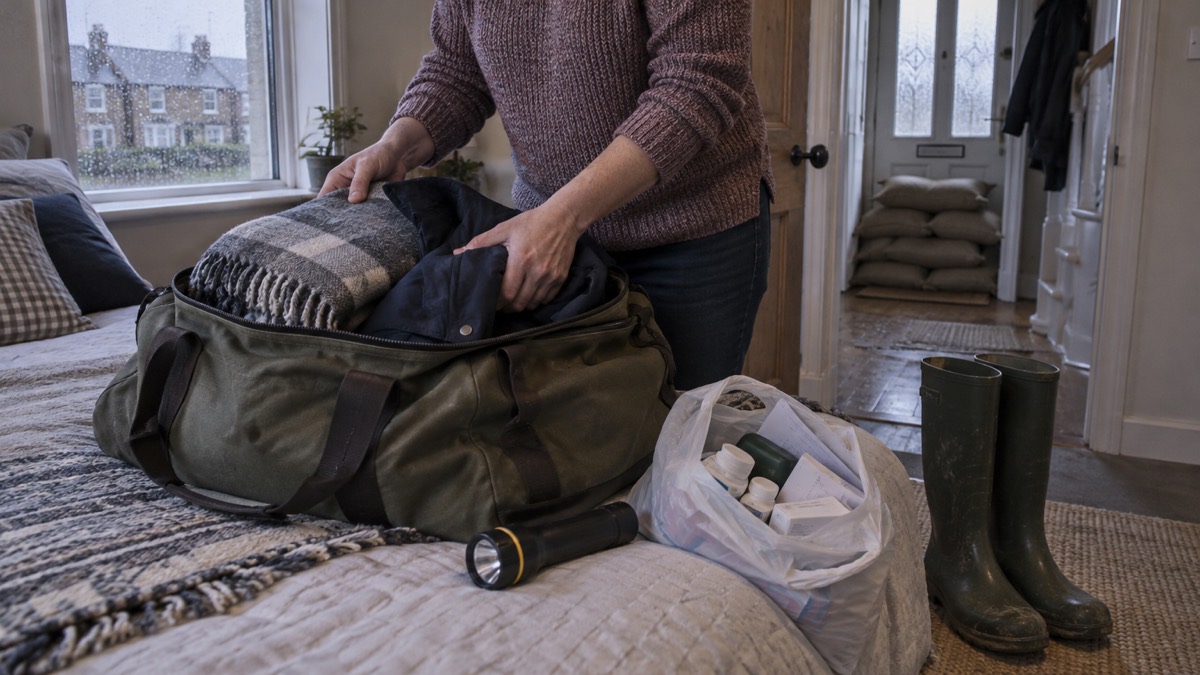
If a fire, flood or other emergency leaves you with nowhere to stay, your local council is the body with the duty to house you. Councils have responsibilities for people made temporarily homeless in an emergency and may open a rest centre or provide alternative accommodation1. If you need emergency housing because of flooding, contact your local council2. The emergency services decide whether an evacuation is necessary, and it is then the council's duty to ensure the welfare of those made unintentionally homeless3.
In the first hours, go where you are told to go. A rest centre is a temporary shelter for people who are evacuated and cannot stay with family and friends, where basic care and welfare support, information and advice are provided4. If you can stay with friends or family, that is usually simpler, and councils provide shelter for those who cannot5. If you rent, your landlord or housing association may have a duty to re-house you temporarily, and if you own your home your insurance company may3.
The sections below take you through the first hours, what a rest centre gives you, when the council must find you temporary accommodation, how insurance and landlords fit in, and where to turn if you are left without a place to stay.
Your local council is responsible for emergency housing
The lead responsibility for housing people made homeless by an emergency sits with your local council. The 1989 Local Government Housing Act and the 1996 Housing Act place statutory duties on local authorities to provide temporary accommodation for residents rendered homeless because of an emergency8. In practice that means a council has a duty to respond to emergency homelessness, and may open a rest centre or arrange alternative accommodation1.
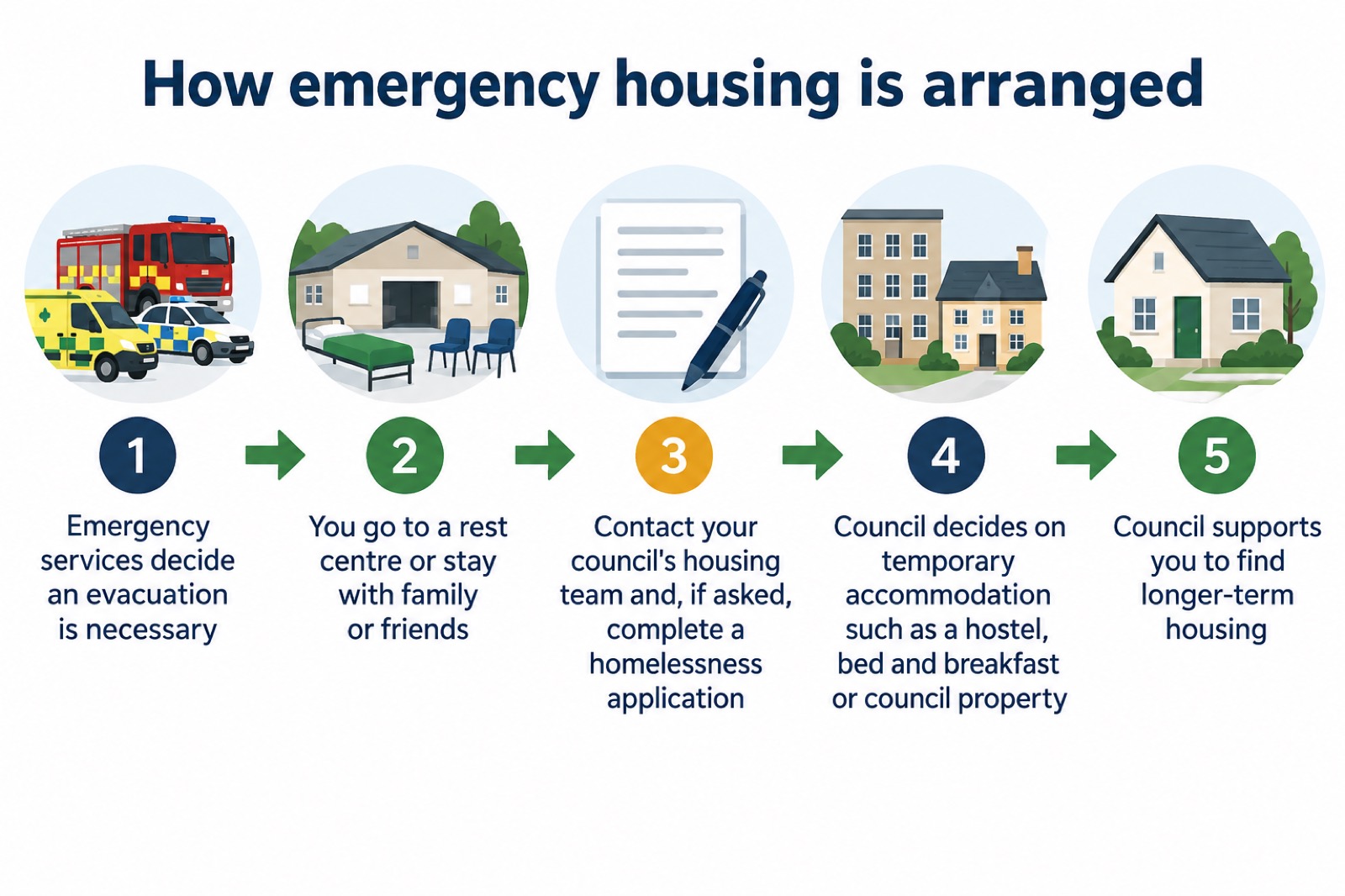
The sequence matters. The emergency services decide whether an evacuation is necessary; it is then the council's duty to ensure the welfare of those made unintentionally homeless3. Until the council becomes involved, lead responsibility sits with the emergency services, normally the police4. So if you are evacuated, the police or fire service may move you to safety, but it is the council that arranges where you sleep.
Which council you deal with depends on where you live. Housing advice and services are delivered by district and borough councils, so anyone with concerns should contact their district or borough council9. In a two-tier county area, that means the district or borough, not the county council. In London, the boroughs hold the housing role.
The duty is not limited to floods. After a fire, if you are uninsured and in immediate hardship, accommodation help is available from the local authority10. Councils also help to rehouse vulnerable people made homeless where there is no alternative solution11. If you are stranded in a major incident, the council will provide basic accommodation at a welfare or rest centre12.
What to do in the first hours after losing your home
Get safe first, then make contact. If there is a fire, get out, stay out and call 99913. Do not go back inside for belongings, documents or pets once you are out.

Once you are safe, the priorities are shelter, warmth and letting people know where you are. If you have been evacuated, follow the instructions you are given about where to go. If you are not in an evacuation but cannot stay in your home, contact your local council's housing team. If you need emergency housing because of flooding, contact your local council2.
If you rent, contact your landlord or housing provider early. If you are in rented or social housing, contact your housing provider as a priority to ensure you have somewhere to stay14. If you have flood damage, ask your insurance company or landlord if they will provide you with temporary accommodation15.
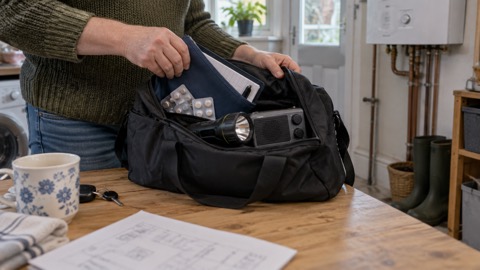
Have a small set of essentials ready to take with you. Official advice is to take suitable clothes if you have to leave your home16. Keep identification, insurance details, medication and your landlord's or housing provider's contact details together so you can pick them up in seconds.
Rest centres: where you go first and what they provide
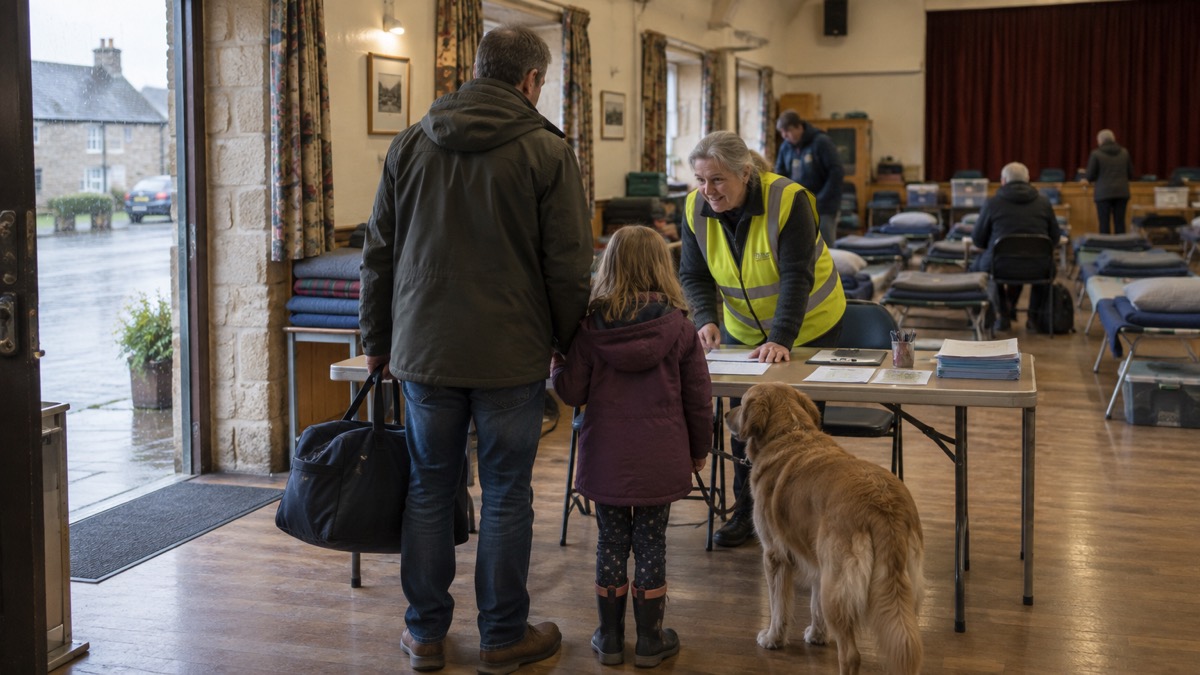
A rest centre is a building designated or taken over by the local authority for the temporary accommodation of evacuees and homeless survivors, with the potential for overnight facilities8. It is a temporary shelter for people who are evacuated and unable to stay with family and friends, where basic care and welfare support as well as information and advice is provided17. Rest centres can provide short-term shelter, warmth, food and refreshment12.
The council leads on running a rest centre, with assistance from adult care, health and wellbeing services, children's services and local health partners, and contributions from the police, the NHS, the voluntary sector and faith communities18. That is why you may be greeted by several different organisations at one site.
| What a rest centre gives you | What it does not |
|---|---|
| Short-term shelter, warmth, food and refreshment12 | A permanent home |
| Basic care and welfare support17 | Your own belongings |
| Information and advice17 | A guarantee of space for pets12 |
| Potential overnight facilities8 | Repairs to your property |
Pets are the question councils get most. Rest centres will have a limited capacity to house pets, but every effort will be made to accommodate your pets12. Westminster City Council says that where necessary it will use contractors and local animal welfare volunteers to assist pet owners at reception and rest centres, as deemed necessary by the Local Authority Liaison Officer on duty19.
If you can avoid needing a rest centre, do. Councils provide temporary shelter and welfare for evacuees unable to stay with friends and family, which implies that staying with people you know is the first option20. Plan that in advance: contact family or friends you do not live with to see if you could stay with them in an emergency, or if they could look after your pets if you were unable to21. Write who you would stay with into a household emergency plan22.
When a council must offer you temporary accommodation
A rest centre is short term. Temporary accommodation is the next step, and the council arranges it when other options are exhausted. Somerset Council, for example, may help find temporary or permanent accommodation if you are homeless or threatened with homelessness because of a flood, possibly emergency accommodation such as a hostel, bed and breakfast or council property, and you may have to pay rent or a contribution5. Ashford Borough Council will arrange temporary housing for anyone unable to return home17. If lots of people have to leave their homes, the local authority will provide temporary emergency accommodation23.
The route in is usually a homelessness application. You may need to complete a homelessness application so the council can decide if you need temporary accommodation such as a hotel or bed and breakfast, then support you to find longer-term housing5. Do not wait to be offered it: ask for the housing options team and say you are homeless because of the emergency.
Who provides it depends on your tenure. If you rent from the council or a housing association, they should provide temporary accommodation if you have to move out5. If you are a private tenant, your landlord does not usually have to, but may have insurance that covers it, so contact them to check5. If you own your home, your insurance company may cover temporary re-housing3.
Be ready for a contribution. Somerset Council notes that you may have to pay rent or a contribution towards emergency accommodation5. Ask what the charge is before you accept a placement.
Insurance, landlords and your own arrangements
Before the council's duty is triggered, your own arrangements come first. It is the responsibility of your landlord or housing association, if you rent, or your insurance company, if you own your property, to re-house you temporarily if your property is damaged and not fit to live in3. The council steps in where those routes fail or where you are uninsured.
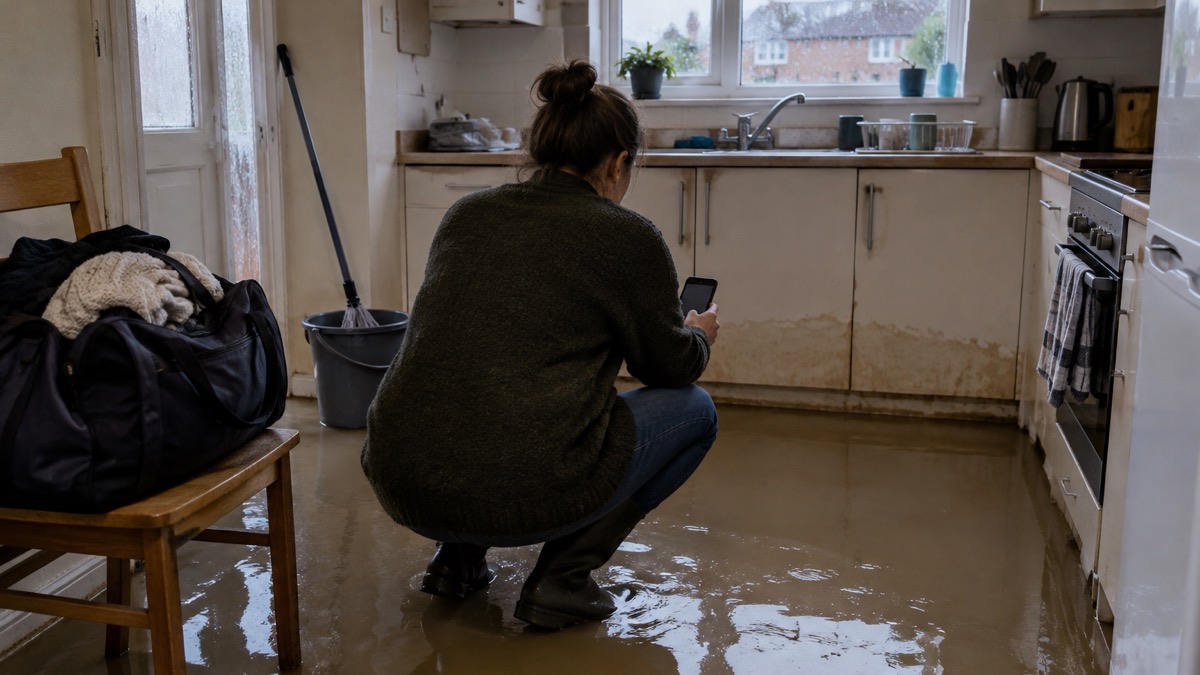
For renters, the split is clear. Your landlord is responsible for repairs if flooding from rain affects your rented home, including fixing damage to the structure and making sure water, gas, electricity, sanitation and heating are working5. The same applies after flood damage generally: your landlord is responsible for repairs to your home2. Private landlords do not usually have to find you alternative accommodation if you need to move out due to flooding, but may have insurance that covers this, so contact the landlord to check5.
For homeowners, insurance is the main route. If your property is damaged and not fit to live in, your insurance company is responsible for re-housing you temporarily3. If you are a commercial leaseholder, the building should be covered by the landlord, while your contents are covered by your own insurance, and you should contact your insurance company10.
Burst pipes are a common cause of sudden homelessness, and responsibility is allocated the same way. If you own your home, you are responsible for insulating and protecting all inside pipework; in rented accommodation, landlords are responsible24. Landlords and housing associations also have a responsibility to their tenants8.
Where to get help if you are refused or left without a place to stay
If you are turned away or left without anywhere to go, go back to the council and ask again, in writing if you can. Somerset Council directs people who are homeless due to flooding and who are uninsured or in council-owned property to its housing teams on 0300 123 222425. Your own council's housing team is the equivalent first call.
There are other routes. If you live in social housing, you may be able to get help and support for your home from your local council, an accredited home improvement agency or handyperson service, your social letting agency, or your social housing provider26. If you have been affected by a terror attack, the Support Hub for victims and survivors of terrorism, commissioned by the Home Office, provides specialist support27.
If you cannot evacuate your home without help, tell the people who run your building before an emergency, not during one. In England, residents who are unable to evacuate the building without assistance should be offered support by their housing provider or managing agent28. The legal basis is the Fire Safety (Residential Evacuation Plans) (England) Regulations 202528. If you think you may need help to evacuate safely, contact the Responsible Person for your building, which might be your landlord, a managing agent, a housing provider or the building owner23. Responsible Persons must take reasonable steps to identify residents who may need help to evacuate safely, offer those residents a person-centred fire risk assessment, agree an emergency evacuation statement where the resident chooses to take part, and keep records up to date23.
Once you are back, seek support if you need it7. Check on elderly relatives or neighbours who might need help29. If you live in social housing, you may be able to get help and support for your home from your local council, an accredited home improvement agency or handyperson service, your social letting agency, or your social housing provider25.
Sources (29)
- Emergency planning and response, London.gov.uk, 2026-10-26
- After a flood, GOV.UK, 2026-10-25
- Are You Ready booklet, Culham Parish Council, 2025-09
- Reception centres, Cornwall Council, 2026-10-29
- Housing help if your home is flooded, Somerset Council, 2026-06-04
- Are you ready, Birmingham City Council, 2026-06-05
- Step 3: recovering from an emergency, Essex Prepared, 2026-10-29
- Emergency plan, Reigate and Banstead Borough Council, 2026-10-29
- Communities affected by flooding, Derbyshire County Council, 2026-10-29
- After the fire booklet, Mid and West Wales Fire and Rescue Service, 2019
- Flooding advice, Mid and West Wales Fire and Rescue Service, 2026-10-29
- Pets, West Yorkshire Prepared, 2026-10-29
- Know your escape plans, Greater Manchester Fire and Rescue Service, 2026-10-29
- Recovering from a flood, Wiltshire and Swindon Prepared, 2026-10-25
- Before, during and after a flood, Suffolk County Council, 2021-05
- Emergency kit checklist, Neath Port Talbot Council, 2026-10-29
- Flood support, Ashford Borough Council, 2026-10-29
- Terrorist attack, Lancashire Prepared, 2026-10-29
- Pet welfare in an emergency, Westminster City Council, 2025-09-24
- What happens in an emergency? | Shropshire Council, Shropshire Council
- Looking after your pets in an emergency, Medway Council, 2026-10-29
- Preparing for an emergency, Nottinghamshire County Council, 2026-10-29
- Evacuating your home, Nottinghamshire County Council, 2026-10-29
- Steps to reduce risk of burst pipes, nidirect, 2025-10-23
- During flooding, Somerset Council, 2026-10-01
- Beat the heat: keep cool at home checklist, GOV.UK, 2026-07-21
- Be informed about hazards: terrorism, Prepare, 2026-10-12
- Fire safety information for residents living in flats, Greater Manchester Fire and Rescue Service, 2026-10-29
- Keeping warm, Cumberland Council, 2026
 30-Day Household Checklist
 Emergency Plan Template
 Supply Interruption Checklist
 Humanitarian Assistance Centre
 School Emergency for Parents
 Be Ready Campaign