
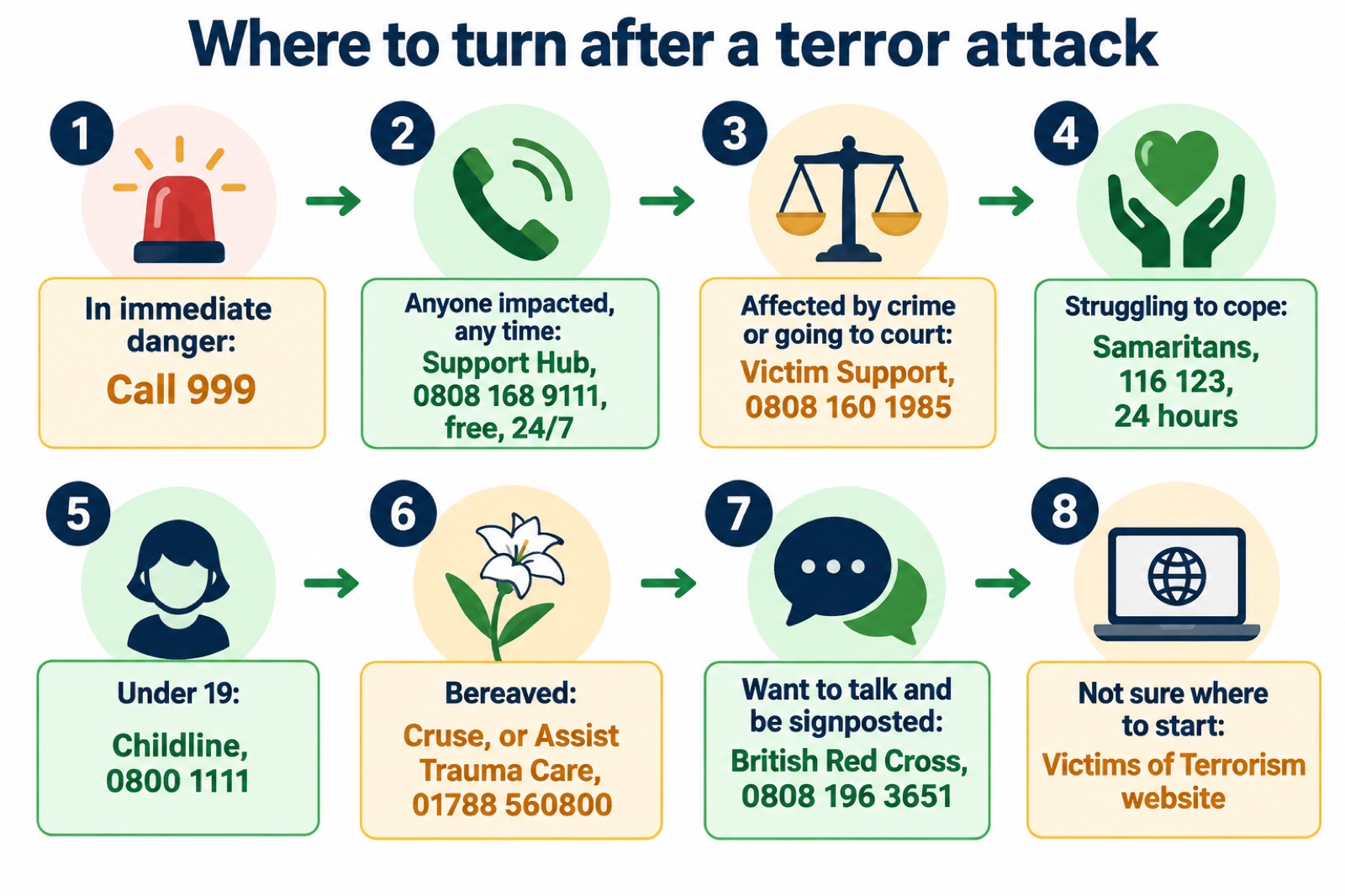
If a terror attack has affected you, your family or someone you know, help exists and much of it is free, confidential and available at any hour. The single most important number is the Support Hub, a free 24/7 support line on 0808 168 9111, commissioned by the Home Office for victims and survivors of terrorism1. Beyond it sit Victim Support on 0800 160 1985 for anyone affected by crime or facing court2, Samaritans on 116 123 for anyone struggling to cope3, Childline on 0800 1111 for under-19s4, and the British Red Cross support line on 0808 196 36513.
You do not have to have been physically hurt to deserve help. Support is available for anyone who has been affected by a terrorist incident5, and the fire and rescue services' own guidance on major incident support is explicit that you do not need to have been directly involved to ask for help: support is available for witnesses, relatives and anyone struggling with the emotional impact of what has happened6. This page sets out what each service does, who can use it, and how to reach it, so you can find the right help at the right time.
The Support Hub: help day or night, whoever you are
The Support Hub for victims and survivors of terrorism is commissioned by the Home Office and provides specialist support around the clock1. Its purpose is practical as much as emotional: the 24/7 Support Hub provides immediate emotional and practical support and helps people access the right help at the right time, without having to navigate complex support pathways alone1. That last part matters. After a major incident, help can be scattered across the NHS, local councils, charities and the police, and one of the hardest things for an affected household is simply working out who to ring. The Support Hub exists so you do not have to work that out yourself: you make one free call, at any hour, and are guided from there.
The line is free and open 24 hours a day, 7 days a week, on 0808 168 91111. You can call it in the immediate aftermath, in the following weeks, or later still. There is no requirement to have reported anything to the police, and no test of how badly affected you were.
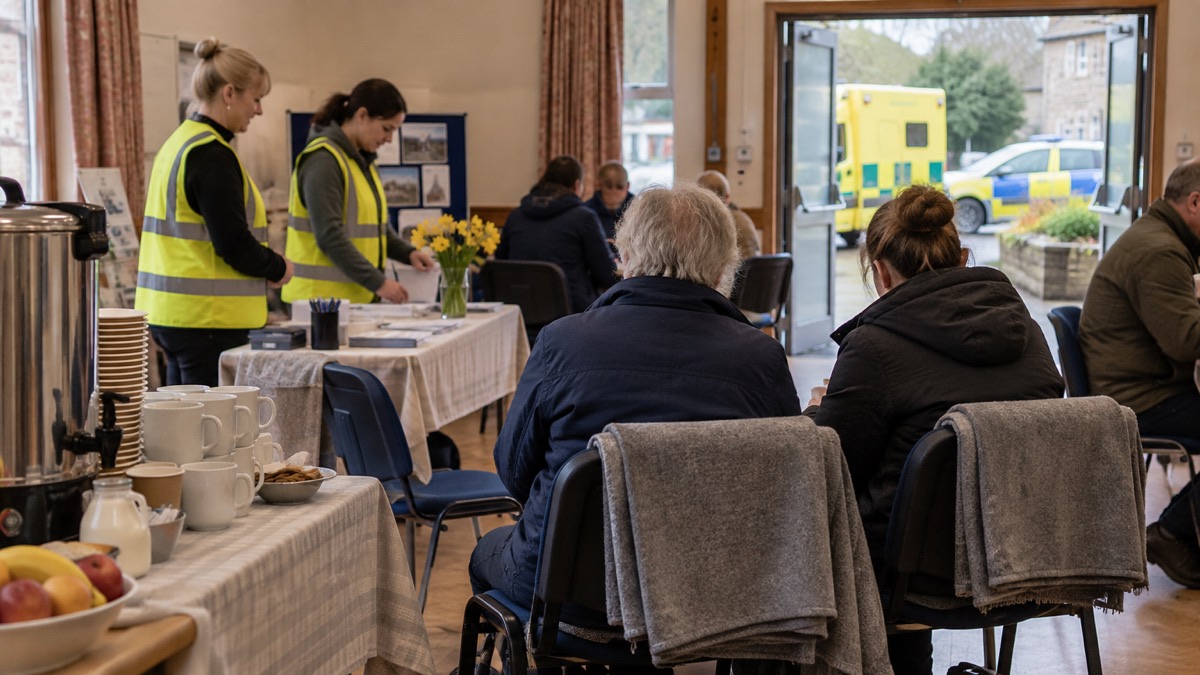
If you are reading this in the first hours or days after an incident, it also helps to know what happens on the ground. A Friends and Family Reception Centre may be set aside as a secure area for the interviewing of family and friends arriving at the scene, or at a location associated with the incident such as an airport or port8. In the days that follow, assistance centres act as a focal point for information and assistance to families and friends of those missing, injured or killed, and to survivors9. These are one-stop-shops through which those impacted can access support, care and advice8. You do not need to know the names of any of these centres: if one is running, the Support Hub and the police will direct you to it.
Who can use the Support Hub
The Support Hub's support is available to anyone impacted by a terror attack in the UK, and to British nationals returning from an attack abroad1. That breadth is deliberate and covers more people than many assume:
- People who were at the scene, whether physically injured or not
- Witnesses, including people who saw the attack or its aftermath from nearby, or through footage6
- Relatives and friends of those killed, injured or missing6
- People who were not there at all but are struggling with the emotional impact of what has happened6
- British nationals caught up in an attack overseas and returning home1
The National Risk Register describes the reasonable worst-case scenario for an international terrorist attack as a large-scale attack overseas involving a significant number of British nationals, with casualties and fatalities including a diverse range of tourist nationalities10. Planning for such events includes reception and integration arrangements for British nationals arriving from overseas11. If you are a British national affected abroad, call the Support Hub on 0808 168 9111; you are within its remit1.
It is also worth knowing that the guidance used by emergency planners on identifying and supporting vulnerable people in an emergency was written with English local resilience forums in mind, though there may be elements relevant to responders in Scotland, Wales and Northern Ireland subject to devolution variations12. In practice, the Support Hub line itself is not restricted by nation: it is a UK-wide service for anyone impacted by a terror attack in the UK or British nationals returning from abroad1.
What the Support Hub does for you
When you call 0808 168 9111, you get two things at once: immediate emotional support from someone trained for these conversations, and practical help to reach the services you need1. The practical side can include connecting you to health services, victim services, bereavement support and the processes that follow an incident, without you having to identify and chase each one separately. The emotional side means someone listens, in the middle of the night if that is when you need it.
The Support Hub sits alongside, rather than replaces, the other services on this page. Some households will use it once and be pointed to a local service; others will keep in touch over a longer period. Either is a normal way to use it. If you are unsure whether your situation "counts", call anyway: the service is for anyone impacted, and deciding who qualifies is not your job1.
For households that want to be ready before anything happens, the same principle of one clear point of contact runs through UK preparedness advice. The government's terrorism preparedness pages set out what to do in an attack and where support sits afterwards1, and our pages on Run, Hide, Tell, the terrorism threat in the UK and threat levels cover the response side in detail.
Victim Support: help for victims and witnesses in England and Wales
Victim Support is the leading independent charity supporting victims of crime and traumatic events in England and Wales. Its service is free, confidential and available to anyone affected by crime or traumatic events, regardless of whether it was reported and how long ago it happened13. That last condition is important after a terror attack: you may not have reported anything, there may be no crime number attached to your experience, and you may be coming forward months or years later. None of that bars you from the service.
Victim Support is a charity that provides free and confidential help to victims and witnesses of crime in England and Wales2. If you are called as a witness, or asked to give a statement, the charity can explain what will happen and support you through the process. Its independence from the police and the courts is part of the point: it works for you, not for the investigation.
In Northern Ireland, the equivalent service is Victim Support NI, an independent charity offering a free and confidential service to people affected by crime4. In Scotland, Victim Support operates as part of the wider landscape of victim services; the Support Hub on 0808 168 9111 remains the UK-wide entry point and can direct you to the right service for where you live1.
| Service | Area | Number | Who it is for |
|---|---|---|---|
| Support Hub | UK-wide, plus British nationals abroad | 0808 168 9111, 24/71 | Anyone impacted by a terror attack1 |
| Victim Support | England and Wales | 0808 160 19852 | Anyone affected by crime or going to court2 |
| Victim Support NI | Northern Ireland | via its own service | People affected by crime4 |
| Samaritans | UK-wide | 116 123, 24 hours3 | Anyone in emotional distress or struggling to cope14 |
| Childline | UK-wide | 0800 11114 | Young people under 194 |
| British Red Cross support line | UK-wide | 0808 196 36513 | Anyone who wants to talk about their experience3 |
Emotional support when you are struggling to cope
Distress after a terror attack is a normal response to an abnormal event, and most people who have been through trauma benefit from informal support: sharing feelings with others with similar experiences, speaking with people they trust, sticking to a routine and paying attention to healthy living10. That finding, from the National Risk Register's work on emergencies, is worth taking seriously. It does not mean professional help is unnecessary; it means the first layer of help is often the people and habits already around you.
Official health guidance after emergencies gives a consistent set of steps. Contact family and friends, your doctor, or an organisation like the Red Cross or the Samaritans if you need support15. If you are feeling down or anxious, speak to friends or family or contact your GP, and organisations like Mind or the CALL helpline can also provide support in Wales16. If your distress continues over an extended period, visit your GP or call NHS 111; specialist mental healthcare can be accessed through GPs or by self-referring to a local NHS Talking Therapies service14. Some areas bring these together: Surrey's Mental Health Hub, for example, gathers information on local mental health support services, self-help tools and resources, NHS Talking Therapies and crisis support in one place17.
There are also things you can do yourself. Starting a support group to help others, or making something creative out of bad experiences by writing, painting or singing, can help you express pain and get through hard times; the NHS sets out its approach at its five steps to mental wellbeing pages18. Local councils' wellbeing services can include bereavement support and mental wellbeing support for adults and children17.
In Wales, there is a dedicated route for urgent mental health support: call NHS 111 and press option 2, and you will be placed in direct contact with a mental health worker in your area19. The Welsh Ambulance Service can also use a secure telephone interpreting service, Language Line, when a 999 caller does not speak English or Welsh, so language is not a barrier to emergency help20.
Samaritans: free and available 24 hours a day
The Samaritans free helpline is available 24 hours a day on 116 1233. It is free to call, and official guidance describes its purpose plainly: helplines such as Samaritans can provide support to anyone in emotional distress or struggling to cope3. The National Recovery Guidance lists Samaritans as offering a 24-hour helpline for those in crisis21. You do not have to be suicidal to call, and you do not have to be in the middle of a crisis. Many people call in the days and weeks after an incident because they cannot sleep, cannot stop thinking about it, or simply need to say it out loud to someone outside their family.
If you would rather write than talk, you can email Samaritans at jo@samaritans.org7. If you are in Scotland, there is a dedicated section of the Samaritans website at www.samaritans.org/scotland7. The service covers the whole of the UK, so the phone number and email address work wherever you live.
The number to use is 116 123.
Support for children and young people under 19
Children and teenagers are often affected by an attack even when adults assume they are coping. If a young person under 19 in the UK wants to talk about any issue they are going through, they can contact Childline free on 0800 1111, any time day or night4. Childline is confidential and run for young people, which matters for teenagers who will not confide in a parent about what they saw or how they feel.
For those who prefer not to speak at all, Kooth offers safe and anonymous online support for young people aged 11 to 257. It sits between Childline and adult services, which is useful for 19 to 25 year olds who are too old for Childline but not ready for adult helplines.
Parents and carers should also watch for behaviour, not just words. The fire and rescue services' safety guidance advises that if you are concerned about repeated unsafe behaviour, you should seek support early through schools, youth services or local safeguarding partners22. Our page on what young people should do in a terror attack covers the practical side for young readers.
Bereavement support after an attack
Losing someone to a terrorist attack is a bereavement like no other, and specialist services exist for exactly this. Cruse Bereavement Care offers counselling, advice and support throughout the UK21. Assist Trauma Care offers telephone counselling and support to individuals and families in the aftermath of trauma, with a helpline on 01788 56080021.
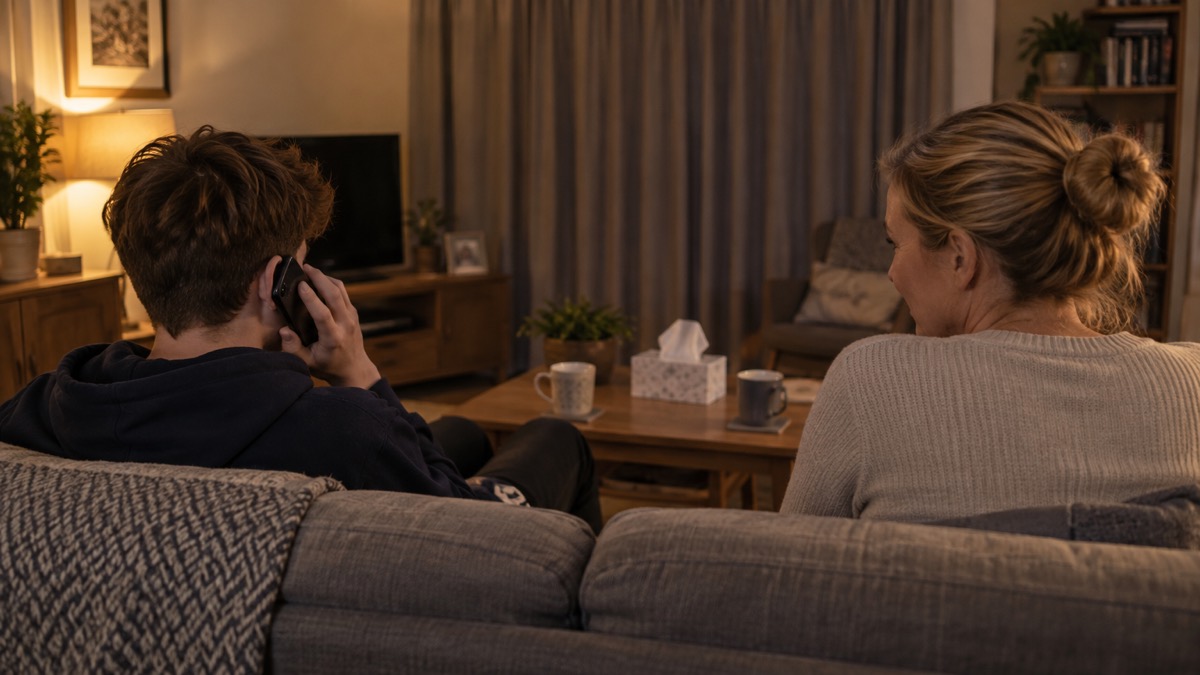
Bereaved families are also the core users of the assistance centres described above: their purpose is to act as a focal point for information and assistance to families and friends of those missing, injured or killed, and to survivors9. If you are searching for someone after an incident, these centres, and the police, are where information about missing people is coordinated.
Practical needs do not pause for grief. Official preparedness guidance advises supporting affected people and alerting the local council if further help and support is required, such as transport, medication, temporary accommodation and medical attention18. After an attack, an attack may temporarily impact utility supply, transport services and put pressure on emergency services10, so ordinary problems like getting to a hospital or filling a prescription can become hard precisely when a family is least able to deal with them. The council and the Support Hub are the routes to raise these1.
British Red Cross support line: when it is open
You can call the British Red Cross support line on 0808 196 3651 to speak to someone about your experience3. The team can offer emotional support as a friendly and understanding listener, suggest organisations which may be able to help you, and discuss steps you can take to start or continue your recovery3. It is a good choice when you want to talk but are not sure what you need: the listener supports you, and the signposting points you onward.
The Red Cross also works physically at incidents. Its emergency response support service is designed to meet the needs of people who have suffered damage to their home following a fire, flood or similar incident, and its volunteers can provide emotional support and care for those affected while the emergency services manage the incident6. After a major incident, you may meet Red Cross volunteers at a survivor reception centre or rest centre; the same organisation stands behind the phone line3.
Finding the right help through the Victims of Terrorism website
The Victims of Terrorism website provides information on how to get help and advice following a terrorist attack5. It signposts to official helplines and support services available to victims, survivors, witnesses, family members, and all those affected5. If you are reading this before any incident, or trying to help someone else, it is the reference point that gathers these services in one place, alongside the Support Hub line itself1.
The website and the Support Hub together cover the aftermath. For the response side of a terror attack, the police's RUN HIDE TELL guidance applies during an incident, and TELL means telling the police by calling 9991. If anyone is acting suspiciously, it is essential to report them5: in an emergency always dial 9995, and you can contact the anti-terrorist hotline on 0800 789 321 or online at Action Counters Terrorism5. Your call to the anti-terrorism hotline will be handled by specially trained officers who will treat it in confidence1. Our pages on reporting suspicious activity and Run, Hide, Tell cover these steps in full.
Sources (22)
- Terrorism: be informed about hazards, Prepare campaign (UK government), 2026
- Advice on major events, Police Scotland, 2026
- How to prepare for flash flooding, Greater London Authority, 2026
- Protect Yourself booklet, Police Service of Northern Ireland, 2024
- Protect yourself: terrorist attack, Lancashire Prepared, 2026
- Steps after a fire, North Yorkshire Fire and Rescue Service, 2026
- Your Health Guide, Winter 2025-6, West of Scotland Innovation Hub, 2025
- Emergency plan, Reigate and Banstead Borough Council, 2026
- Our role in emergency planning, Nottinghamshire County Council, 2026
- National Risk Register extract, UK government, 2023
- London Risk Register v14, Greater London Authority / London Resilience Unit
- Identifying and supporting persons who are vulnerable in an emergency: Supporting guidance for Local Resilience Forums in England (HTML) - GOV.UK, Cabinet Office (GOV.UK)
- Community involvement, Dorset Prepared, 2026
- Flooding and health: advice for the public, UK government, 2024
- Emotional support after a flood, Herefordshire Council, 2026
- What to do after a flood, Natural Resources Wales, 2026
- Wellbeing and safety, Surrey County Council, 2026
- Are You Ready booklet, Culham Parish Council, 2025
- Call NHS Direct Wales, NHS 111 Wales, 2021
- Additional support when accessing 999, Welsh Ambulance Services University NHS Trust, 2026
- National Recovery Guidance: humanitarian aspects, UK government, 2013
- Light Nights Campaign - North Yorkshire Fire & Rescue Service, North Yorkshire Fire & Rescue Service
 Bomb Threat Calls
 Radiation Checklist First Hour
 Power Cut Kit Checklist
 UK Terrorism Threat
 Terrorism Threat Levels
 Reporting Suspicious Activity
 Unattended or Suspicious Items
 Radicalisation Concerns
 CBR Attack Signs
 Chemical Releases Near Home
 Radiation Emergency
 Site Sirens and Warnings
 Stable Iodine Tablets
 Radiation Dose Levels