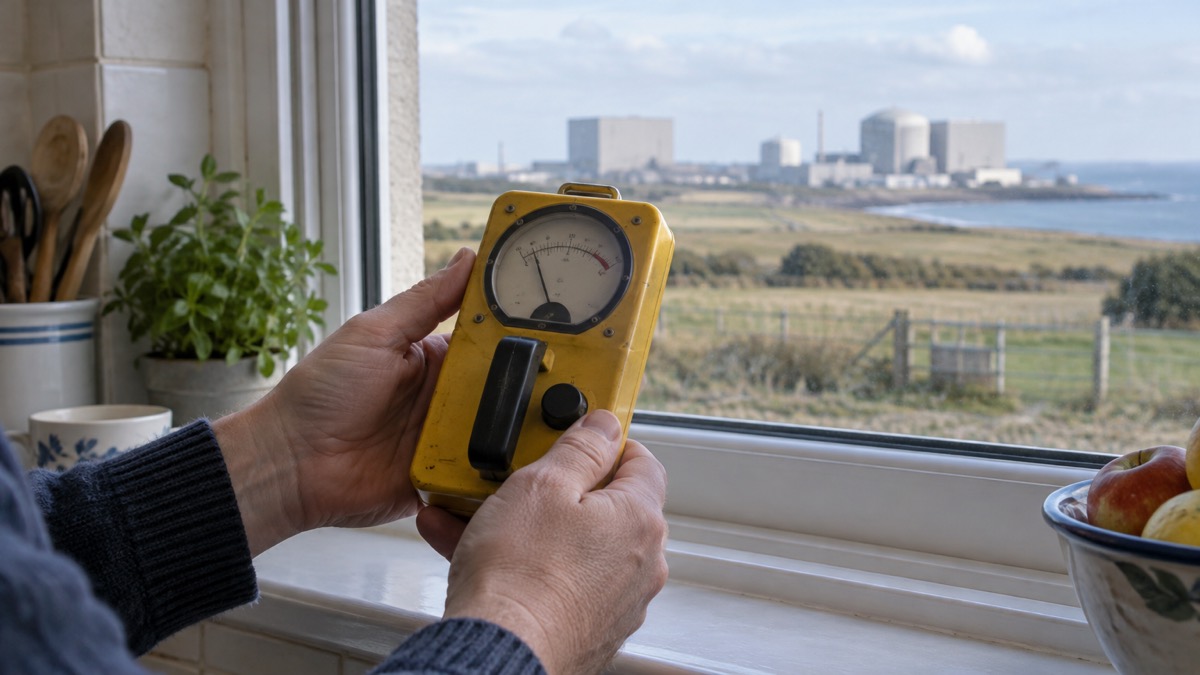
If a radiation emergency happens in the UK, the advice you receive, go indoors, evacuate, take iodine tablets, stop drinking the milk, is not issued at random. Each instruction is triggered by a set of numbers called Emergency Reference Levels, or ERLs. Sheltering is advised when the dose it averts falls between 3 and 30 mSv. Evacuation is advised between 30 and 300 mSv averted dose. Stable iodine tablets are advised at 30 to 100 mSv averted dose to the thyroid1.
You will never be asked to measure these numbers yourself. They are planning figures used by the government and local authorities to decide, in advance and during an incident, which protective actions to recommend and when1. But knowing roughly what they are, and why they are set where they are, makes the advice you hear easier to follow and easier to trust. This page explains the levels, the units they use, who they are designed to protect, and what happens to food and drink limits afterwards. For the practical steps themselves, see what to do in a radiation emergency and Go In, Stay In, Tune In.
Radiation emergencies are rare events2. They include an incident at a nuclear power plant or an incident during the transport of radioactive material2. The legal framework that requires operators to plan for them and to inform the public is the Radiation (Emergency Preparedness and Public Information) Regulations 2019, known as REPPIR, which aims to establish a framework for the protection of members of the public and workers from, and in the event of, radiation emergencies that originate from premises3.
What emergency reference levels mean for your household
Emergency Reference Levels are dose bands, not single trigger points. Each protective action has a lower and an upper reference level. Below the lower level, the disruption of the action is judged to outweigh the radiation it would prevent, so it is not advised. Above the upper level, the action should certainly be taken. Between the two, the decision takes account of the circumstances of the release, the weather, the time of day and how practical the action is for the people affected1.
The key thing to understand is that these figures are expressed as averted dose: the dose the action is expected to prevent, not the dose you have already received. Officials forecast how much radiation people in each area would receive over the first 7 days after a release if nothing were done, then compare that with how much each action would prevent. If sheltering would avert a dose in the 3 to 30 mSv band, sheltering is the advice given; if evacuation would avert 30 to 300 mSv, evacuation comes into consideration1.
ERLs have been implemented in UK emergency plans for nuclear sites since the 1990s1. The current set comes from Public Health Protection in Radiation Emergencies, published in 2019, which superseded a number of earlier publications by the National Radiological Protection Board from 1990 and 19971. When that review was carried out, the levels for sheltering and evacuation were carried forward unchanged, with one exception: a reduction in the upper ERL for administration of stable iodine1.
For your household, the practical effect is simple. You do not need to know the numbers to act. The numbers exist so that when you are told to go in, stay in and tune in, that instruction has already been weighed against the radiation it is expected to prevent. Your job is to follow the official advice broadcast to you, and to know where to find it. If you hear of a radiation incident in your area, the standing instruction under REPPIR is Go in, Stay in, Tune in to local radio or television for information and advice about what actions to take5.
Sheltering indoors: advised between 3 and 30 mSv averted dose
Sheltering is the first and most common protective action, and it has the lowest reference level band: 3 to 30 mSv averted effective dose1. It is used early in an incident because it is fast, needs no travel, and works while the radioactive plume is still passing overhead.
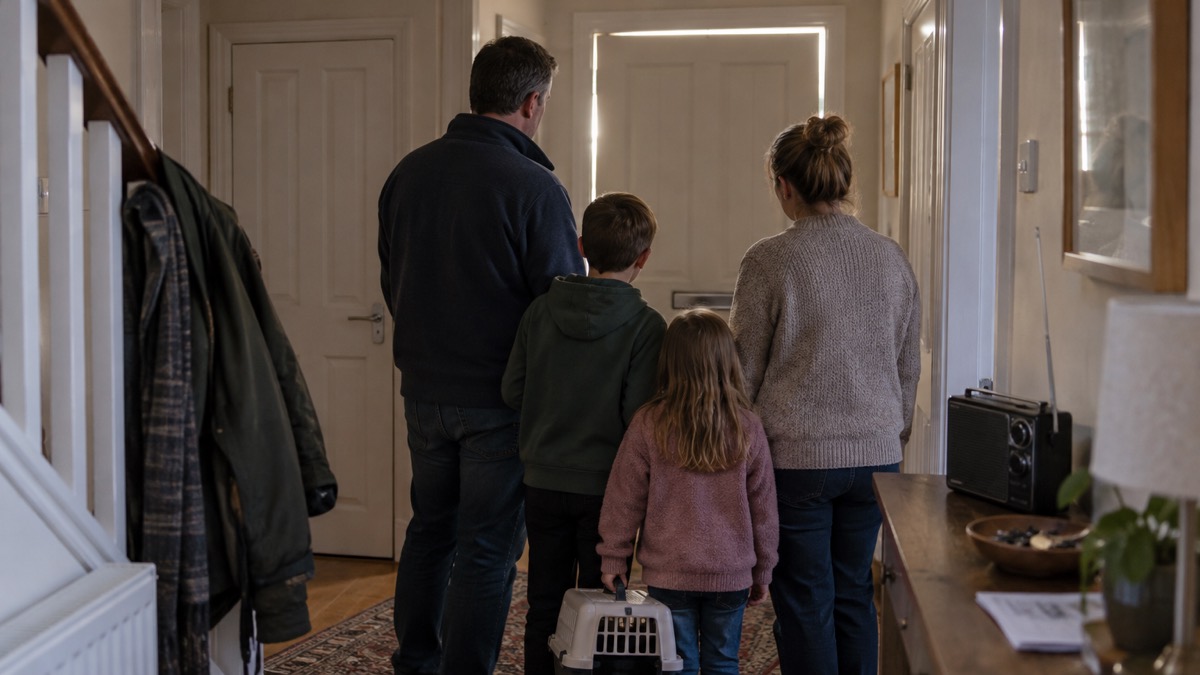
It works better than many people expect. For a typical house, sheltering in place reduces the exposure from breathing in radioactive material by 40%, and reduces direct exposure by 85% compared to being outside2. The 2019 review gives dose reduction factors for external gamma radiation of 0.15 for typical residential brick-built houses, meaning a brick home blocks roughly 85% of the outside gamma dose, and 0.05 for multi-storey buildings, which block even more1.
Two rules matter here. First, vehicles and tents do not provide sufficient shelter from significant radiation, so if you are out when an incident begins, get inside a building as soon as possible2. Second, keep pets indoors to stop them bringing possible contamination into the house6.
You may need to stay indoors for one to two days8. That is long enough for heating, food, water and medicines to matter, so the ordinary household preparations covered in emergency kit, water and staying informed apply directly. Keep listening to local radio or television, because the advice can change as the picture develops: monitor the news and follow official advice on GOV.UK for what to do next, and changes to advice may be communicated via the radio, television, internet, social media or the police8.
Evacuation: advised between 30 and 300 mSv averted dose
Evacuation carries a higher reference level band, 30 to 300 mSv averted effective dose1, because it is far more disruptive than sheltering. Moving people out of their homes creates its own risks, especially for those who are frail, dependent on medical equipment or hard to reach, so it is reserved for situations where the dose it prevents is large enough to justify it.
Notice how the bands meet: the upper sheltering level, 30 mSv, is the lower evacuation level1. In practice this means that as the forecast averted dose rises, the advice escalates from sheltering towards evacuation, and in a real incident the two may be used together, with people in the closest areas evacuated while those further out are told to shelter. The question of which applies to you is covered in more detail on should you shelter or evacuate.
If you are told to evacuate, the local booklet for your area sets out what to take. The Portsmouth guidance, for example, advises packing warm clothing and bedding, medicines or special food, baby food, clothes, nappies, toys and books, private documents and valuables, making sure fires are out and appliances are switched off and unplugged, then locking up and leaving6. Households that would need help to evacuate, including older, disabled and medically dependent people, should arrange that support in advance, as covered in extra help in an emergency.
Stable iodine tablets: 30 to 100 mSv thyroid dose
Stable iodine tablets have their own reference level, expressed differently: 30 to 100 mSv averted equivalent dose to the thyroid1. The thyroid is singled out because radioactive iodine, released in certain reactor accidents, concentrates there. Taking stable iodine speeds the removal of radioactive iodine from the body, resulting in a reduced radiation dose to the thyroid gland3.
The tablets only make sense in specific circumstances. Radiation emergencies at nuclear reactors that are operational, or have recently, within 90 days, shut down, may result in releases of radioactive iodine2. A reactor that has been shut down for longer poses much less iodine risk, which is why the advice can differ between sites. At Hinkley Point B, Somerset Council, Public Health experts and EDF Energy agree that the levels of radioactive iodine have been declining since the end of generation in August 2022, and are now at negligible levels5.
Dosage is set out in the local booklets. Adults, including pregnant women and women who are breastfeeding, take two tablets6. A single dose provides protection for 24 hours2, so repeat doses are only given if official advice says so. Full details of doses for children and where tablets are held near nuclear sites are on stable iodine tablets. Near Portsmouth, some schools and nurseries hold tablets for all children and staff and will look after children in an incident, which is one reason the official advice is not to rush to collect them, as explained on children at school.
The levels are set for young children and cover the first 7 days
Two features of the reference levels shape everything else. First, they apply over a period of up to 7 days following a release1. That window matters because the decisions taken in the first hours and days, whether to shelter, evacuate or take stable iodine, are judged against the dose that could be avoided across that whole period, not against a moment-by-moment reading. When you hear a threshold of 3 mSv or 30 mSv, it is this averted dose over those first 7 days that the level refers to.
Second, the levels cover a period of up to 7 days following a release1. The early phase of a radiation emergency, the time when sheltering, evacuation and iodine decisions are made, is measured in hours and the first few days, and the reference levels are calibrated against the dose a person would receive over that first week if nothing were done. This is also why the advice can change after the first day or two: once the plume has passed, the calculation moves from emergency protective actions to longer-term measures.
For context, the UK average annual radiation dose from all sources is 2.6 mSv, a figure updated in September 2026 from the previous 2.7 mSv4. One millisievert is less than half the average annual dose from natural radiation in the UK9. So the lower sheltering level, 3 mSv averted over up to 7 days, is in the same order of magnitude as a year of ordinary background exposure, while the upper evacuation level, 300 mSv, is far above it. The bands are wide precisely because the decision between them depends on circumstances, not on the number alone.
Pregnancy and unborn babies
Pregnant people are listed as a higher-risk group in emergency planning. If you are pregnant, treat every protective action the authorities advise, whether sheltering, evacuation or stable iodine, as applying to you, and follow the specific instructions issued with any tablets rather than assuming the general adult guidance covers your circumstances.
If you are pregnant and live near a nuclear site, the useful preparation is the same as for any household, with one addition: know where your local booklet is and check what it says about pregnant residents before an emergency, not during one. The booklets distributed near naval berths and nuclear sites are produced by the local councils in consultation with the NHS and the site operators6, and they are the most specific source of advice for your address.
Reference levels after the first week and during recovery
The emergency reference levels apply to the early phase. Once the release has stopped and the first week has passed, the framework shifts from emergency protective actions to recovery, and the timescales change completely. Depending on the nature of the radiation emergency, recovery may take a few weeks or could last for many decades2.
During recovery, the doses that matter are smaller and are managed differently, through controls on food, restrictions on access to contaminated land, and monitoring rather than sheltering and evacuation. One planning threshold from the 2019 review illustrates the scale: a dose of 1 Gy to the lung, from inhaling alpha-emitting radionuclides, evaluated over up to 1 year from acute inhalation1. That is a specialist figure used in planning for specific scenarios, not something a household will be told to calculate, but it shows that the longer-term thresholds are set against different organs, different pathways and much longer time windows than the 7-day emergency levels.
You will know the emergency has ended because you are told. Information concerning the end of the emergency will be broadcast on local radio and television9. After that, keep listening and looking for announcements and updates on the news, watch for long-term safety information in the news and in leaflets, and wait for the all clear announcement6. Long-term information about food, water and land restrictions is issued through the same channels, and the annual Radioactivity in Food and the Environment report, published each year by the UK Government for the previous calendar year, records the monitoring results10.
Food and drink limits after a release
Food controls are where most households will feel the longer-term effects of a release. The limits on radioactivity in food are deliberately low to reduce radiation dose to minimal levels, and this may result in a wide area being subject to food controls3. It might be necessary to ban milk or other foods containing radioactive material following an emergency3.
The legal limits are the Maximum Permitted Levels of radionuclides in marketed foods and animal feed, set in European Union regulations (Euratom 2016) for application in the immediate aftermath of a radiation emergency1. MPLs are expressed in terms of activity concentrations, in becquerels per kilogram (Bq kg-1) and becquerels per litre (Bq l-1), and are divided into four groups of radionuclides, radiostrontium, radioiodine, alpha-emitting radionuclides, and other radionuclides with relatively long half-lives, and five food categories: baby foods, dairy foods, other major foods, minor foods and liquid foods1.
| Food category | What it covers |
|---|---|
| Baby foods | Foods for infants |
| Dairy foods | Milk and dairy products |
| Other major foods | Main foodstuffs |
| Minor foods | Smaller contributors to the diet |
| Liquid foods | Drinks, including water-based products |
Restrictions can come quickly. Restrictions on food and water may be implemented on a precautionary basis, that is within 24 hours, following an airborne release, advising people not to eat unwashed fresh fruit and vegetables that have been outside, or not to drink rain water1. The food standards agencies may place precautionary restrictions within a defined area on the sale of crops, livestock and animal products such as milk harvested after the release2.
Who issues the advice depends on where you live. Advice on food in England, Wales and Northern Ireland is issued by the Food Standards Agency, and in Scotland is issued by Food Standards Scotland11. Food Standards Scotland works closely with local authorities and the food industry, and publishes food alerts on its website and social media channels12. At the local level, council trading standards departments act on the Food Standards Agency's instruction: Westmorland and Furness Council's Trading Standards Department, for example, will, if required by the Food Standards Agency, take appropriate action to prevent the sale of contaminated foodstuffs to the public9. More detail is on will food and milk be restricted after a nuclear accident and is tap water safe after a release.
Who monitors radiation and food after a release
Several bodies share the monitoring role. RIMNet, the UK's radiation monitoring network, monitors radiation levels in the UK and alerts from other countries, and advises the government and local authorities on appropriate action following a radiation incident10. The UK Health Security Agency's Radiation, Chemical and Environmental Hazards Division offers advice, monitoring, assessments and information3. Monitoring of radioactivity in food and the environment is conducted by the Environment Agency and the Food Standards Agency10.
If the emergency happens overseas, the UK Health Security Agency assesses the risks to public health following a radiation emergency abroad and works with government partners on monitoring and decontaminating people arriving in the UK2. The national response is organised in four levels working together to deliver an effective response13. In Scotland, the responders are defined in the Civil Contingencies Act 2004, with Category 1 responders including local authorities, Police Scotland, the Scottish Fire and Rescue Service, the Scottish Ambulance Service, Health Boards and the Scottish Environment Protection Agency, coordinated through Local Resilience Partnerships14.
Where to find your local radiation emergency booklet
If you live near a nuclear site or a naval berth, the detailed advice for your address is in a booklet produced under REPPIR. Legislation requires people living up to 1.5km away from an operational berth to be given prior information about a nuclear emergency7. Near Portsmouth, the booklet is distributed to all households within a 1.5-kilometre radius of the nuclear berths6; near Southampton, the residents' leaflet covers households within 1.5km of the Docks nuclear vessel berth and is valid from July 2024 to July 20277. The Devonport booklet, What You Should Do if There Is a Radiation Emergency at the Devonport Site, is published every three years and distributed to households and businesses in the detailed emergency planning zones, with an Easy Read version available15.
If you have not received one, or need another copy, ask the council that produced it. Portsmouth's booklet, produced by Portsmouth City Council, Gosport Borough Council and Hampshire County Council in consultation with the NHS, the Royal Navy and the Ministry of Defence, is available from the Emergency Preparedness, Resilience and Response Team at Portsmouth City Council, by email at emergency.planning@portsmouthcc.gov.uk, or by calling 023 9268 805216. It is available on request in large print, Braille, audio or another language by calling 023 9284 13576. In an emergency, a telephone helpline number will be released, so check local news and social media for emergency helpline numbers7.
The national guidance, Radiation emergencies: information for the public, is available on GOV.UK in HTML and PDF formats, and can also be used by local authorities to support specific advice that they issue for nuclear emergency response plans17. If you need an accessible format, email publications@ukhsa.gov.uk17. For more on the zones these booklets cover, see living near a nuclear site, and for how warnings reach you, sirens and phone warnings near nuclear and chemical sites.
Sources (17)
- Public Health Protection in Radiation Emergencies: Advice for Radiation Emergencies 2019, UK Government, 2019
- What to do in a radiation emergency, GOV.UK, 2024
- Nuclear emergencies: information for the public, GOV.UK, 2026
- Nuclear emergencies: information for the public, dose update, GOV.UK, 2026
- Radiation emergencies, Somerset Council, 2025
- REPPIR Residents booklet 2024, Portsmouth City Council, 2024
- Radiation leaflet 2024, residents, Southampton City Council, 2024
- Hazardous materials incident, Prepare Campaign, 2026
- What to do in an Emergency booklet 2023 to 2027, Westmorland and Furness Council, 2023
- Radiation, environmental health, Nottingham City Council, 2026
- What to do in a chemical emergency, GOV.UK, 2024
- Why food is recalled, Food Standards Scotland, 2026
- National emergency arrangements, Office for Nuclear Regulation, 2026
- Foundations of Emergency Management in Scotland, Lesson 3: Who responds in Scotland, Ready Scotland, 2026
- Devonport offsite emergency plan, Plymouth City Council, 2026
- Radiation emergency guide, resident leaflet, Portsmouth City Council, 2023
- Radiation emergencies: information for the public, GOV.UK, 2024
 Bomb Threat Calls
 Radiation Checklist First Hour
 Power Cut Kit Checklist
 UK Terrorism Threat
 Terrorism Threat Levels
 Reporting Suspicious Activity
 Unattended or Suspicious Items
 Radicalisation Concerns
 Support for Attack Victims
 CBR Attack Signs
 Chemical Releases Near Home
 Radiation Emergency
 Site Sirens and Warnings
 Stable Iodine Tablets