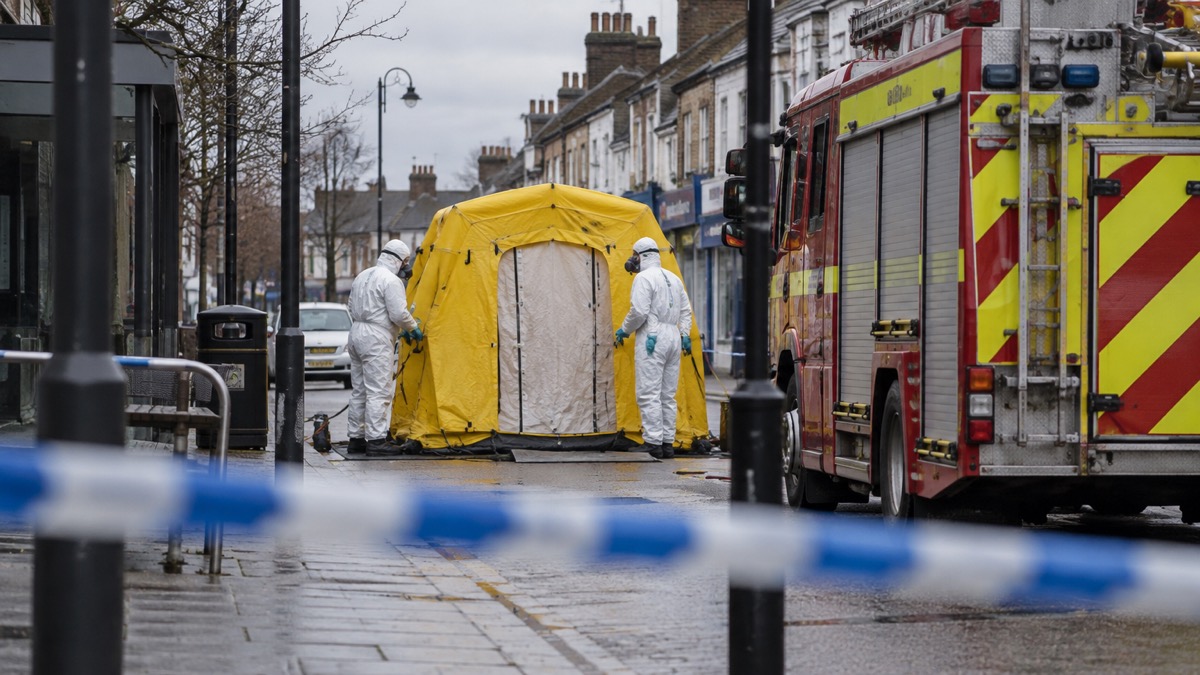
CBR stands for chemical, biological and radiological. A CBR attack is the deliberate use of corrosive or flammable chemicals, toxic industrial or biological materials, or radioactive sources to harm people1. The same signs and the same first steps apply whether a release is deliberate or accidental, so you do not need to know which it is before you act. Serious incidents involving hazardous chemicals or radiation are rare2, but knowing what to look for and what to do in the first minutes makes a real difference to how much harm is done.
If you think a harmful substance has been released, the national advice is Remove, Remove, Remove: remove yourself from the immediate area, remove outer clothing if it is affected, and remove the substance from your skin, then report to the emergency services by dialling 9993. This is the most effective method of limiting the health effects of a CBR incident, according to ProtectUK, the police counter-terrorism advice service4. It applies to a suspected deliberate or accidental exposure to a hazardous substance in vapour, powder or liquid form, including an acid attack5.
This page covers the signs to recognise in people and in your surroundings, how harmful substances can be spread, and the immediate steps to take. It sits alongside our guides to Run, Hide, Tell for a terrorist attack, Remove, Remove, Remove in full detail, and Go In, Stay In, Tune In for sheltering from a chemical or radiation release.
If you think a substance has been released: Remove, Remove, Remove
The Remove, Remove, Remove advice gives three early actions that anyone can take, whether the exposure was deliberate or accidental, and whether the substance was a vapour, a powder or a liquid5. It is the most effective method of limiting the health effects of a CBR incident4. Follow it in order:
- Remove yourself from the immediate area to avoid further exposure to the substance. Fresh air is important. If your skin is itchy or painful, find a water source. Report to the emergency services7.
- Remove outer clothing if it has been affected by the substance, trying to avoid pulling clothing over your head if possible1.
- Remove the substance from your skin using a dry absorbent material, rinsing continually with water if the skin is itchy or painful8.
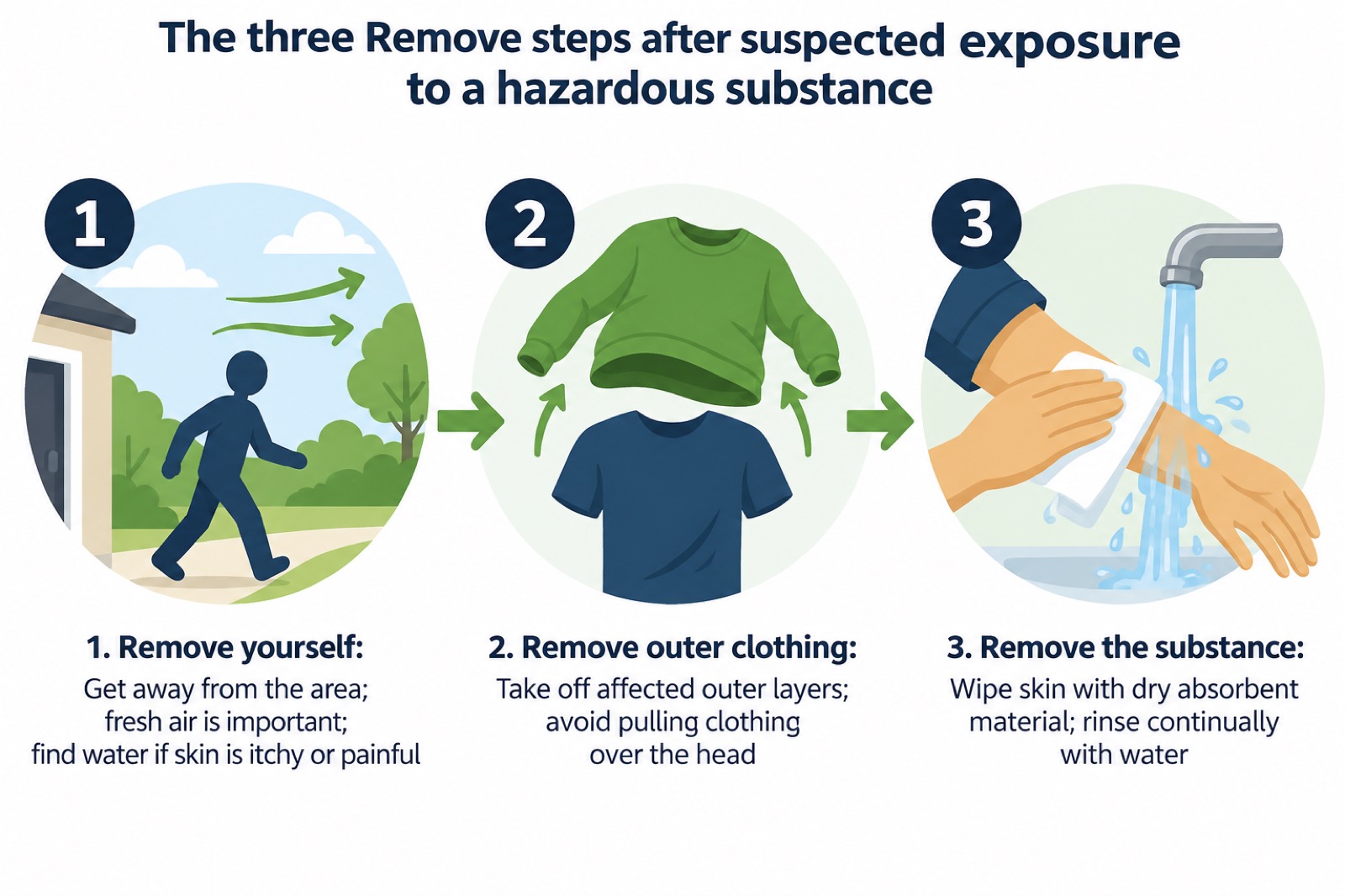
Report immediately to the emergency services by dialling 999, move into fresh air, rinse affected skin with water, remove outer clothing carefully, and do not smoke, eat or drink8. If you think you may have become contaminated, the City of Edinburgh Council advises contacting the emergency services for help on 9999.
Two points of care matter here. First, the discarded clothing may present a hazard to anyone nearby, as it may be covered in or have absorbed the substance and may give off harmful fumes or particles10. Put it down away from people rather than carrying it around. Second, if the exposure has caused an acid or chemical burn, dial 999, then carefully try to remove the chemical and any contaminated clothing and rinse the affected area using as much clean water as possible11. NHS guidance on chemical burns says to call 999 for emergency assistance immediately and to remove contaminated clothing carefully to prevent further exposure12.
In a radiation emergency, you might be asked to decontaminate, that is clean, yourself. The UK Health Security Agency provides advice on how to safely remove radioactive material from your skin and clothes, a process called self-decontamination6. The same three-step logic applies: getting away, taking off outer clothing and rinsing skin removes most of the contamination before it can do harm.
Keep your distance from anyone who may have been exposed
If you think someone else has been exposed to a hazardous substance, use caution and keep a safe distance to avoid exposure yourself1. This is repeated across official guidance: ProtectUK's advice on CBR incidents says the same, and so does its hazardous substances guidance10. The instinct to rush to help is natural, but a person covered in a chemical, or whose clothing has absorbed a powder, can transfer that substance to you. The London and South East Burns Network, which coordinates specialist burn care, warns responders to avoid chemical cross-contamination13.
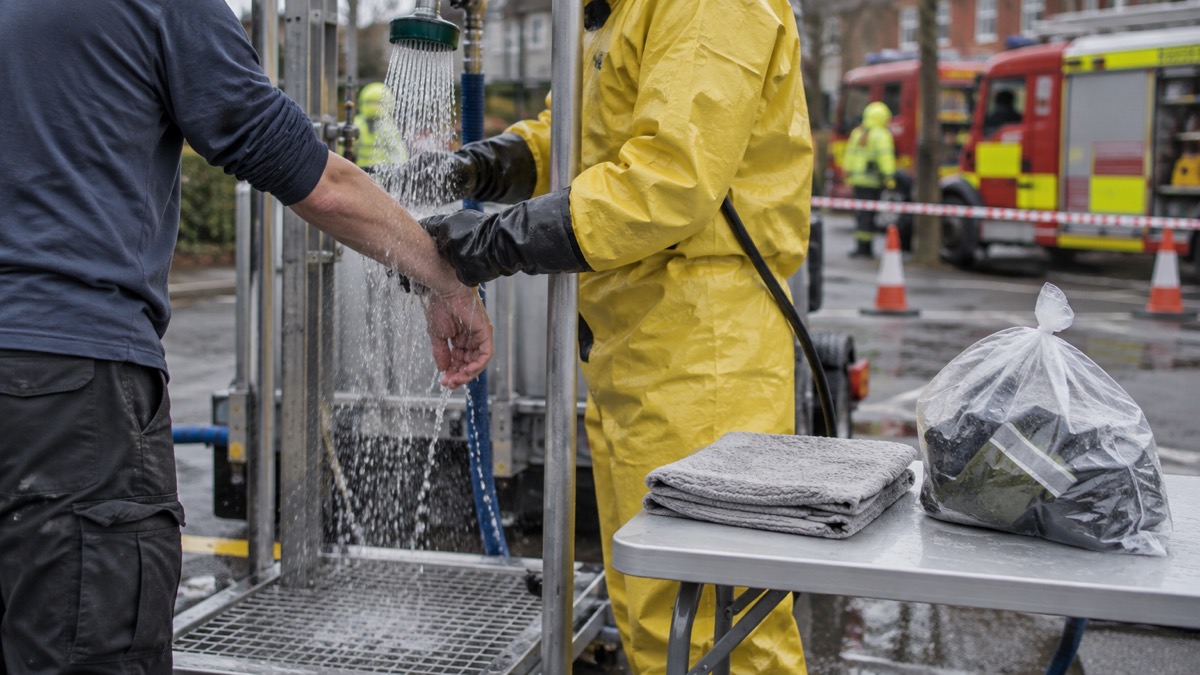
Helping safely means directing the exposed person through the Remove steps from a distance: telling them to move to fresh air, to take off affected outer clothing, and to rinse their skin, while you or someone else calls 999. Once the emergency services arrive they have the training and the protective equipment to take over.
If the release is in the open air near you, rather than on a person, stay away from the incident site to minimise the risk of contamination14. Where a chemical release affects your area, the advice is to go into a house or building straight away and stay indoors until you hear an all-clear message: close all external doors and windows, turn off central heating and ventilation systems, stay in a room away from the source of the release, preferably upstairs, and tune into local news15. Our guide to Go In, Stay In, Tune In covers this in full.
Signs on the body: irritation, nausea, twitching and breathing difficulty
The people affected are often the first indicator that something harmful has been released. ProtectUK lists the signs to watch for in individuals: unexplained skin, eye or airway irritation, nausea, vomiting, twitching, sweating, disorientation and breathing difficulties1. The same list appears in the national awareness guidance on physical threats, which stresses that exposure is not always obvious16. Several people showing the same unexplained symptoms at the same time, particularly indoors or in one area, is a stronger warning sign than one person feeling unwell.
Many of these signs overlap with ordinary illnesses and injuries, which is why the setting and the number of people affected matter. The NHS lists general symptoms of poisoning that may include feeling sick or being sick, diarrhoea, feeling sleepy, blurred vision, a high temperature or feeling hot, cold or shivery, confusion, difficulty breathing, seizures and loss of consciousness17. NHS inform lists the signs of shock as it develops: rapid, shallow breathing, a weak pulse, grey-blue skin especially inside the lips, weakness and dizziness, nausea and vomiting, and thirst18. Cheshire Fire and Rescue Service gives similar shock signs after burns: cold, clammy skin, sweating, rapid, shallow breathing, and weakness or dizziness19.
| Sign in the body | Where it is listed | What else to consider |
|---|---|---|
| Skin, eye or airway irritation | ProtectUK CBR recognition indicators1 | Several people affected at once strengthens suspicion |
| Nausea, vomiting, twitching, sweating | ProtectUK CBR recognition indicators1 | Twitching and sweating together are unusual in ordinary illness |
| Disorientation, breathing difficulties | ProtectUK CBR recognition indicators1 | Also signs of shock and of poisoning17 |
| Headaches, nausea, dizziness, confusion | Carbon monoxide poisoning symptoms20 | CO is a household risk as well as an attack risk |
| Rapid, shallow breathing, weak pulse, grey-blue skin | Shock, per NHS inform18 | Call 999; shock can follow burns and poisoning |
Some specific exposures have their own well-known symptom sets. Carbon monoxide poisoning causes headaches or dizziness, breathlessness, nausea, loss of consciousness, tiredness, chest or stomach pains, erratic behaviour and visual problems, according to the Health and Safety Executive20, and headaches, nausea, dizziness, confusion and flu-like symptoms according to Wiltshire and Swindon Prepared21. A drug overdose can cause unresponsiveness, breathing problems, skin colour changes, pupil changes, vomiting, seizures, confusion and chest pain22. A heart attack can cause central chest pain, pain down the left arm or both arms or to the neck, jaw, back or stomach, breathlessness, nausea or sweating23. Anaphylaxis can cause an itchy skin rash, swelling of the face, lips or eyes, and stomach symptoms, though NHS inform notes these are unlikely to be a sign of anaphylaxis on their own24. The point of knowing these is not to diagnose, but to recognise that a collapsed or unwell person needs 999 whatever the cause, and that if a hazardous substance may be involved you should keep your distance while help is summoned.
One myth is worth correcting. The cherry red skin colour sometimes described as a sign of carbon monoxide poisoning is not a common sign and is rarely seen in life; it is produced only when carboxyhaemoglobin concentrations exceed about 20%, according to the Chief Medical Officer's guidance25. Do not wait for it, and do not assume its absence means anything.
Signs around you: unusual materials, vapour, odours and residue
The surroundings can give warning before anyone falls ill. ProtectUK's recognition indicators for CBR incidents include the presence of hazardous or unusual materials or equipment, unexplained vapour, mist clouds, powder, liquids or oily drops, withered plant life or vegetation, distressed birds or other animals, and odd smells or tastes26. Distressed animals and withered plants matter because they show harm without a human having to be the first evidence of it.
Not every release announces itself. The City of Edinburgh Council warns that with some toxic fumes things will look normal and you will not see, smell or feel anything different9. An unfamiliar or burning smell when gas or oil appliances are on is a warning sign of carbon monoxide, as is increased condensation inside windows21. But the absence of any smell proves nothing, which is why the official advice is to follow instructions from the emergency services even when you cannot tell that anything has happened.
If you notice these signs, do not investigate. Move away, keep others away, and call 999. If you can do so safely from a distance, tell the operator what you saw: what form the substance took, where it was, and how many people appear affected. If the item concerned is an unattended package rather than a substance, follow the HOT protocol and the 4Cs, which our guide to unattended or suspicious items explains.
How a harmful substance can be spread
ProtectUK sets out four main dispersion methods for a CBR attack: spraying of liquids or powders, gas release such as from gas cylinders, contamination of food or drink, and materials left in situ, that is left in place to release harm later1. Knowing these helps you understand why the signs can appear where they do: a sprayed liquid affects people in one place at one moment, a gas drifts with the air, contaminated food appears as illness in people who shared a meal, and a device left in situ may have no effect until it is disturbed.
Perpetrators of crime or terrorism may use hazardous substances including corrosive or flammable chemicals, toxic materials or radioactive sources to conduct attacks, such as acid attacks26. The same materials exist legitimately in industry and in the home, which is why accidental releases are treated with the same response as deliberate ones. Exposure to toxic substances can cause acute injuries such as burns and poisoning, or long-term effects including cancer and respiratory conditions27.
The spread of a substance is not always dramatic. Carbon monoxide can seep into properties via shared flues and chimneys, so people may be poisoned by CO produced by an appliance in a neighbouring property; venting of gas fires into cavity walls can lead to poisoning of people living above; and integral garages can be a source if car engines are run without adequate ventilation25. This is a reminder that harmful substances move through buildings in ways that are hard to see, which is why official advice in a release is to shelter in a room away from the source, preferably upstairs15.
For household chemicals used normally, the niDirect guidance is to always read the warning label and follow the instructions, use only as much as you need, remove children, pets and their toys from the area for as long as the label recommends, ventilate by opening windows, wear gloves, long sleeves and a mask if recommended, and wash any part of you that came into direct contact with the substance with warm soapy water28. Cheshire Fire and Rescue Service adds a simple preventive step: store chemicals, cleaners and acids out of reach19.
What a CBR attack can involve
CBR attacks can involve the use of corrosive or flammable chemicals, toxic industrial, biological or radioactive materials, and the damage may not be immediately obvious1. ProtectUK's dedicated guidance breaks the three parts down: chemical means poisoning or injury caused by chemical substances, including traditional military chemical warfare agents and harmful industrial or household chemicals4. Biological and radiological materials complete the picture, and the same guidance notes that for further information on the strengths and vulnerabilities of a site or building in relation to CBR threats, you should contact a local police Counter Terrorism Security Advisor, or CTSA4.
The national risk assessment is measured on this point. It states that it is possible that a terrorist group may seek to use chemical, biological or radiological material against the West in the future, while also noting that such attacks are difficult for terrorists to carry out effectively and that weaponising these materials often requires specialist knowledge and expertise26. For households, the practical reading is this: the threat is taken seriously and planned for, but the most likely harmful-substance incident you will ever encounter is an accidental one, and the response steps are the same.
Alongside Remove, Remove, Remove, ProtectUK publishes guidance called Recognise, Assess, React, or RAR, for CBR incidents5. Recognise covers the signs described above; assess means judging what you are seeing and what the risks are to you and others; react means taking the protective action, whether that is Remove, Remove, Remove for exposure or Go In, Stay In, Tune In for a release in the open air. Our guide to ACT Awareness e-Learning covers the free training available to the public and to staff.
Exposure is not always obvious
The national awareness guidance is explicit: exposure is not always obvious16. Radiation cannot be seen, heard, smelt, tasted or felt, so it is important that you follow the advice given to you, even if you cannot tell that anything has happened2. Some toxic fumes give no visible, smellable or tangible sign at all9. And with contaminated food, you cannot tell by looking or tasting: even food which looks and tastes good can cause food poisoning29.
This has three practical consequences. First, do not wait for certainty before acting: if people around you are showing unexplained irritation, nausea or breathing difficulty, that is enough to move away and call 999. Second, follow official instructions even when nothing seems wrong, because the emergency services have detection equipment you do not. Third, treat food and drink with suspicion in any incident where contamination is plausible, and hand anything you suspect to the emergency services rather than testing it yourself.
CBR attacks are rare because they are hard to carry out
Every official source in this area makes the same point about frequency. Serious incidents involving hazardous chemicals or radiation are rare2. Radiation emergencies are rare events6. Hazardous substance incidents are rare26. CBR attacks can be difficult to conduct, often requiring expertise and resources1. Marauding terrorist attacks, the other main attack type households are asked to prepare for, are also rare16.
The reason is practical: ProtectUK notes that CBR attacks are difficult to conduct, often requiring expertise and resources, and that weaponising these materials often requires specialist knowledge and expertise26. This is why the government's preparedness advice asks households to know a small number of simple actions rather than to live in expectation of an attack. The same actions, Remove, Remove, Remove and Go In, Stay In, Tune In, cover accidental releases from industry and transport as well, which are the more likely scenarios. Our guides to chemical leaks and toxic smoke and to living near hazardous industrial sites cover those in detail.
Protecting a building's air intakes and ventilation
For those who manage or help run buildings, ProtectUK advises reviewing the design and physical security of air-handling systems, such as access to intakes and outlets, and avoiding the use of ground level or near ground level air intakes4. A substance introduced into an air intake can be distributed through a whole building by its own ventilation, which is why intake placement and access control matter more than most other measures. The same guidance advises reviewing the physical security measures relevant to areas of a building that, due to their function, such as entrances, exits and windows, may be at increased risk of attack26.
For householders, the equivalent points are simpler. Know where your home's ventilation points are, and in a chemical release in your area, close all external doors and windows and turn off central heating and ventilation systems15. If you are involved in running a community building, a school or a small business, you can ask your local police CTSA for site-specific advice on CBR strengths and vulnerabilities4.
Related situations: industrial leaks, food and suspicious packages
Chemical leaks at industrial sites. Industrial sites are equipped with safety systems like fire suppression, leak detection and emergency shutdown mechanisms30, but accidents involving hazardous chemicals during storage, processing or transport can contaminate land and water supplies30. If a release affects your area, go indoors, close doors and windows, turn off ventilation, stay in a room away from the source, preferably upstairs, and tune into local news until the all-clear15. Fareham Borough Council's emergency planning guidance adds: tune into local radio and/or television and listen for information30.
Contaminated food or drink. You cannot detect contamination by appearance or taste29. If food or drink is suspected of deliberate contamination, do not consume it, keep it for the emergency services and call 999.
Suspicious packages and left items. The PSNI's Protect Yourself booklet advises treating a letter as suspect if it is more rigid than expected, for example if it contains cardboard or metal, as it may explode on opening31. Do not open or move it. Our guides to suspicious items and the HOT protocol and suspicious letters and parcels at home cover the full procedure, and reporting suspicious activity explains what to tell the police when no attack has yet happened.
Where to get help
- In an emergency: dial 999. This applies if you think you have been exposed9, if someone shows signs of poisoning17, and for acid or chemical burns11.
- Sheltering advice: follow Go In, Stay In, Tune In during a release in your area15, and see our radiation emergency guide for that specific scenario.
- Site and building advice: contact your local police Counter Terrorism Security Advisor for CBR-related security questions about a building4.
- After an attack: support for those affected is covered in our guide to support for victims and families after a terror attack.
The signs and steps on this page take a few minutes to learn and no equipment to carry out. Recognise the signs in people and surroundings, keep your distance from anyone exposed, Remove, Remove, Remove if you are affected yourself, and call 999. That is the whole of the household response to a suspected CBR incident, and it is the same response the emergency services will build on when they arrive.
Sources (31)
- Chemical, Biological and Radiological Incidents (CBR), ProtectUK, 26 March 2024
- Hazardous materials incident, Prepare campaign, 13 October 2026
- What to do in a chemical emergency, GOV.UK, 10 October 2024
- Chemical, Biological and Radiological (CBR) attacks, ProtectUK
- REMOVE. REMOVE. REMOVE. guidance on hazardous substance exposure, ProtectUK, 10 August 2021
- What to do in a radiation emergency, GOV.UK, 10 September 2024
- Protect yourself: terrorist attack, Lancashire Prepared
- Hazardous substance exposure, Essex Prepared, 29 October 2026
- Release of gas, toxic chemical or radiation, City of Edinburgh Council, 29 October 2026
- Hazardous Substances, ProtectUK, 22 August 2024
- Burns and scalds, Andaman Surgery NHS
- Burns prevention and tips, Midlands Surgical Excellence NHS, 25 October 2026
- Burns first aid guidance, London and South East Burns Network NHS, 2026
- Chemical accidents and toxic fumes, Wandsworth Council, 13 April 2023
- Don't Panic, Prepare booklet, West Yorkshire Prepared, November 2020
- Physical threats, ProtectUK, 6 October 2022
- Poisoning, NHS, 12 June 2025
- Shock first aid, NHS inform, 24 July 2026
- Burn awareness, Cheshire Fire and Rescue Service, 10 September 2024
- Gas safety FAQs, Health and Safety Executive, 2026
- Carbon monoxide: the silent killer, Wiltshire and Swindon Prepared, 25 October 2026
- What to do in an emergency: drugs, Oxfordshire County Council, 2026
- Heart attack first aid, NHS inform, 24 July 2026
- Anaphylaxis first aid, NHS inform, 24 July 2026
- Carbon monoxide poisoning guidance, Chief Medical Officer for Scotland, 17 November 2011
- Chemical and Biological and Radiological (CBR) risk, ProtectUK, 1 March 2022
- Industrial Accidents & Environmental Pollution, Essex Prepared (www.essexprepared.co.uk)
- Chemical safety at home, nidirect, 14 April 2026
- Food poisoning and waterborne infections, Shropshire Council, 29 October 2026
- Chemical accidents: emergency planning, Fareham Borough Council, 29 October 2026
- Protect Yourself Booklet, Police Service of Northern Ireland, 2024
 Bomb Threat Calls
 Radiation Checklist First Hour
 Power Cut Kit Checklist
 UK Terrorism Threat
 Terrorism Threat Levels
 Reporting Suspicious Activity
 Unattended or Suspicious Items
 Radicalisation Concerns
 Support for Attack Victims
 Chemical Releases Near Home
 Radiation Emergency
 Site Sirens and Warnings
 Stable Iodine Tablets
 Radiation Dose Levels