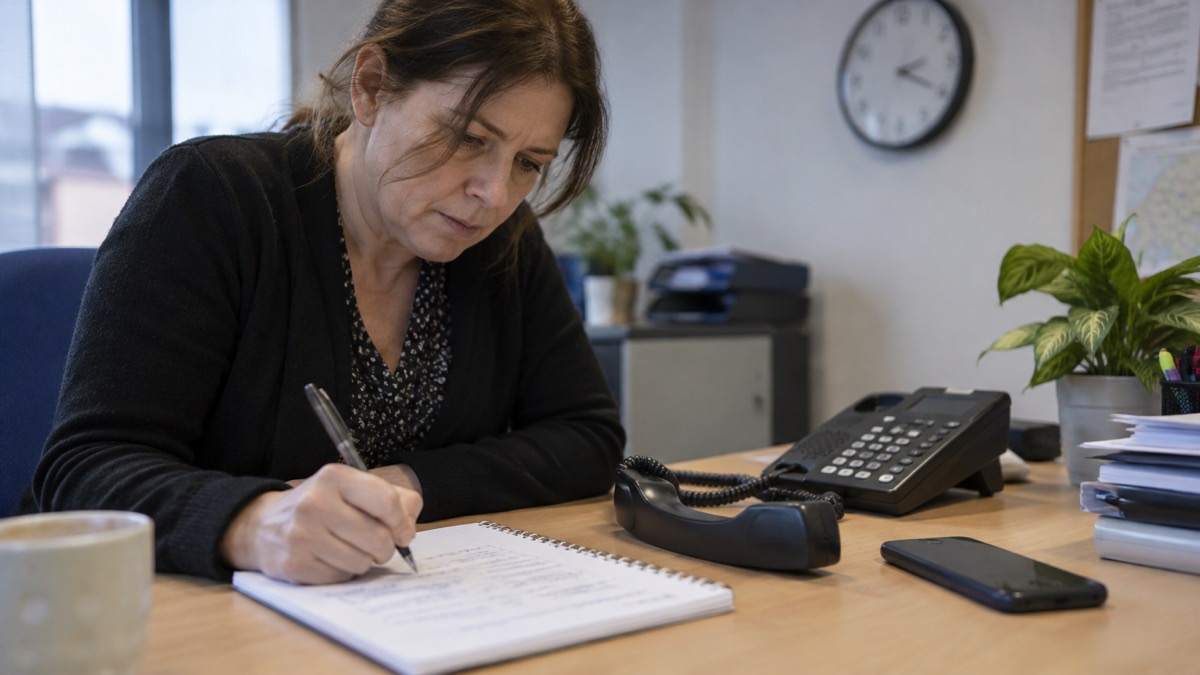
If someone calls your home or workplace and says there is a bomb, the first thing to do is stay calm and keep them talking. Official guidance is that you should listen carefully, record the call if you are able, and get someone else to dial 999 while you keep the caller on the line1. Write down everything you can as it happens, because the details you note in those few minutes are what the police will work from.
The vast majority of bomb threats are hoaxes designed to cause alarm and disruption, and instances of valid bomb threats are rare2. That does not make the call any less of a crime. All such communications are a crime and should be reported to the police by dialling 9992. Treat every threat as real until the police tell you otherwise, and let them make that judgement.
This page is a checklist you can print and keep by the phone. It sets out what to write down during the call, what to do with a recorded message, who to call afterwards, and how to keep the list ready so that you are not trying to remember it under pressure.
Bomb threat call checklist: what to write down
The official bomb threat checklist exists to help you record what you hear when a bomb threat comes in4. Keep a copy beside the phone and work through it in order. You will not manage every line, and that is fine: a partial record written at the time is worth more than a perfect one reconstructed an hour later.
- The exact words used. Write the threat down as closely as you can, in the caller's own phrasing.
- The time the call started and ended. Note both.
- The number that called, if it is displayed, and whether the caller withheld it.
- Background noise. What can you hear behind the voice: traffic, machinery, a public address system, other voices?
- The caller's voice. Whether it sounded male or female, calm or agitated, and any accent or speech pattern you noticed.
- Any other details the caller gives, such as a location, a time or a demand.
If the threat arrives in writing, by email, social media or a text message, the same principle applies: keep it. Official guidance is that if a threat is received by text message you should not reply to, forward or delete the message1. The same logic covers an email or a direct message: preserve it exactly as it arrived and pass it to the police.
An increasing number of bomb threats are sent electronically using email or social media rather than spoken by phone4. If that is how yours arrived, do not forward it on to colleagues or friends as a warning. Tell the police and let them take it from there.
Keep a recorded threat message for the police
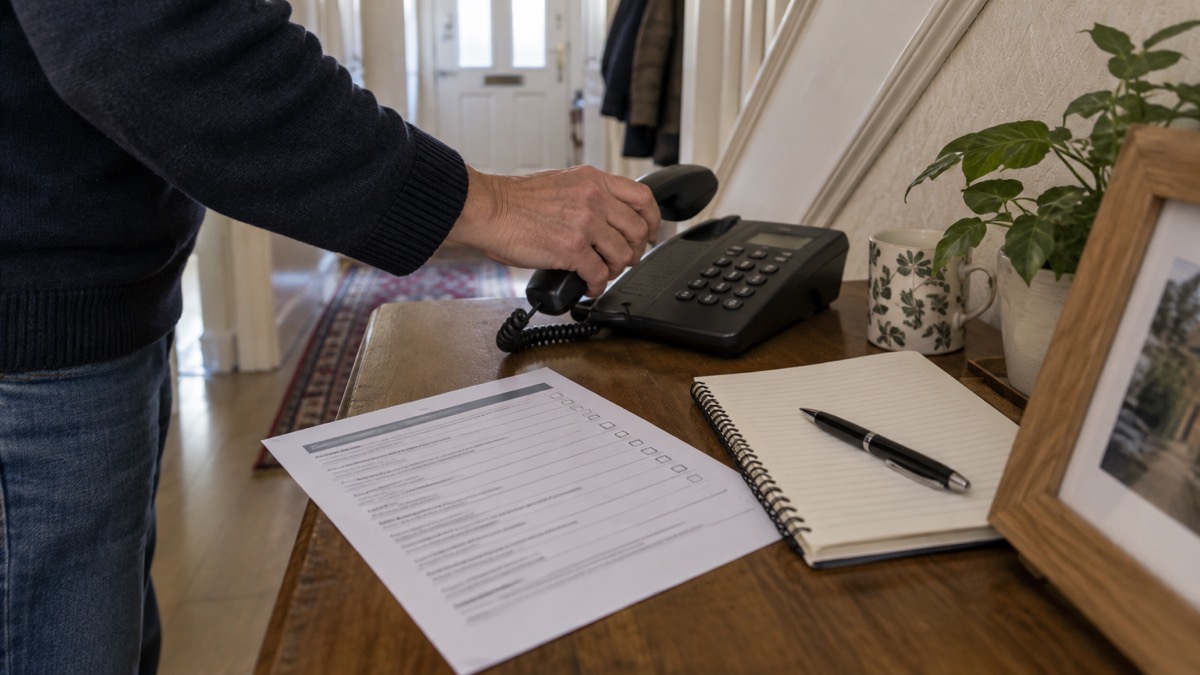
A recorded message is one of the recognised ways a bomb threat is delivered, alongside a written message, a face-to-face delivery, or one sent by email or social media2. It may use a text-to-speech synthesiser or a soundboard2. If you reach an answerphone message or a synthesised voice, do not hang up in frustration.
Official guidance is specific: if the threat is a recorded message, write down as much detail as possible and retain it for the police to secure2. In practice that means:
If you are able to record a live call, do so, but do not let recording stop you listening1. The written note and the audio work together: the note captures what you noticed, the audio captures what was actually said.
Who to call, and when
Dial 999. That is the instruction in the official guidance on bomb threats, which states that all such communications are a crime and should be reported to the police by dialling 9992. The same advice appears across official sources: report any activity you deem to be suspicious to your local police force using 9995, and call 999 or the police anti-terrorist hotline to report an immediate terrorist threat6.
| Situation | Who to contact |
|---|---|
| A threat is in progress, or you believe there is immediate danger | 9992 |
| An immediate terrorist threat, where 999 is not practical | Police anti-terrorist hotline, 0800 789 3216 |
| A possible terrorist threat you want to report online | Report a possible terrorist threat online through the police6 |
| A non-emergency matter on the rail network | British Transport Police on 610167 |
The anti-terrorist hotline number is 0800 789 3213. It is confidential, and the guidance is to trust your instincts and call it8. If you are in any doubt about whether something is worth reporting, report it: your information may be vital9.
If you are deaf, hard of hearing or have a speech difficulty, the emergencySMS service lets you contact 999 by text, but you must register your phone beforehand10. Registering takes a few minutes and is worth doing before you ever need it.
Threats received at work
If the call comes to your workplace, the same recording discipline applies, with one addition: tell whoever is responsible for the building and its evacuation straight away, while someone else dials 999. Do not assume that a colleague has already called.
An increasing number of threats arrive electronically, by email or social media4, and a workplace inbox is an obvious target. If a threatening email lands in a shared inbox, do not forward it around the office as a warning and do not delete it. Preserve it, tell your manager and the person responsible for building safety, and make sure the police are told.
If your workplace has a written bomb threat procedure, follow it. If it does not, the checklist on this page is a reasonable starting point, and the official checklist it is based on is designed for exactly this purpose4.
RUN HIDE TELL if the threat becomes an attack
A bomb threat call is usually a crime and a disruption, not the start of an attack. But if an incident does unfold around you, the official advice is to remember the words Run, Hide and Tell1. These steps can help save lives and prevent casualties in the event of an attack12.
- Run. Escape if you can. Consider the safest options, and if there is a safe route, run. Leave belongings behind, and do not attempt to film the incident11.
- Hide. If you cannot run safely, hide. Find cover from gunfire, such as substantial brickwork or heavy reinforced walls. Be aware of your exits, try not to get trapped, lock or barricade yourself in, move away from the door, be quiet, silence your phone and turn off vibrate11.
- Tell. Call 999 when it is safe to do so, and give the police what they need: the nature of the incident, the location, descriptions of any attacker, and information about casualties, entrances, exits and hostages11.
"be quiet, silence your phone and turn off vibrate"
Cover from view does not mean you are safe, so hide even behind a locked door11. When police arrive, follow their instructions immediately, put your hands on your head and avoid sudden movements until you are evacuated to safety13. Our guide to Run, Hide, Tell walks through each step in more detail, and Where to Hide During a Gun or Knife Attack covers choosing cover.
Keep the checklist by the phone and ready to use
A checklist only helps if it is there when the phone rings. The same official advice that applies to emergency contacts applies here: record emergency contacts in an easy-to-find place, keep a phone or alarm within reach, and discuss a safe emergency access plan with someone you trust14. Keep your mobile phone charged and make sure it has all your important phone numbers in it, and have a list on paper too15.
- Print the checklist and keep it beside the main phone, and a copy in your bag or wallet.
- Keep a pen with it. A checklist without a pen is decoration.
- Store the anti-terrorist hotline number, 0800 789 321, in your phone and on the paper list3.
- Make sure everyone in the household knows where the list is and what 999 is for.
- Keep a phone in the bedroom in case you need to make an emergency call, and if it is a mobile, keep it charged16.
Programme In Case of Emergency (ICE) contacts into your phone so that anyone can reach your loved ones without needing to unlock it17. Store one or more emergency contact numbers on your mobile phone or keep a written copy in your wallet or purse18. Keep extra batteries to charge your phone19, and keep a charged mobile phone with you in case of emergency10.
If someone in your household would struggle to act quickly under pressure, perhaps because of their age, a disability or a health condition, write the plan down with them and keep it where they can see it. Our guide to Extra Help in an Emergency covers the Priority Services Register and other support. For the wider picture on attack types and what households should know, start with Major Incidents and our guide to the terrorism threat in the UK.
Sources (19)
- Protect Yourself booklet, Police Service of Northern Ireland, 2024
- Bomb threats, ProtectUK, 2022-03-01
- Threat levels, ProtectUK, 2026-05-01
- Bomb threat checklist, ProtectUK, 2026-10-29
- Terrorism, Prepare campaign, 2026-10-12
- Contact the police, GOV.UK, 2026-10-29
- Bomb threat guidance, West Midlands Local Resilience Forum, 2023-12
- Terrorist attack, Lancashire Prepared, 2020
- Report suspicious activity, ProtectUK, 2026-06-01
- Smoke alarms, Cheshire Fire and Rescue Service, 2026-10-26
- RUN HIDE TELL, ProtectUK, 2026-05-21
- RUN HIDE TELL school teaching guide, ProtectUK, 2021-10-13
- RUN HIDE TELL guidance and lesson plans, Counter Terrorism Policing, 2017-11
- Stay Steady and Safe home safety checklist, NHS Norfolk and Suffolk ICB, 2026
- Weather and health, Public Health Wales, 2026-07-16
- Fire safety for people with hearing difficulties, Devon and Somerset Fire and Rescue Service, 2026
- Out and about, Wiltshire and Swindon Prepared, 2026-10-25
- Travel advice, Prepare campaign, 2026-10-06
- Yourself, Wiltshire and Swindon Prepared, 2026-10-25
 Radiation Checklist First Hour
 Power Cut Kit Checklist
 What to Keep Charged