
Stable iodine tablets are one of the protective actions the UK has ready for a radiation emergency. If a fault at an operating nuclear reactor releases radioactive iodine, that iodine can be breathed in or swallowed and concentrate in the thyroid gland, where it delivers a radiation dose. Taking stable iodine at the right time blocks the absorption of radioactive iodine by the thyroid gland and speeds up the body's ability to remove it1. The tablets do not protect against any other form of radiation, and they are not a substitute for sheltering or evacuation.
The single most important rule is this: take stable iodine only when the emergency services tell you to. It is most effective if taken between 24 hours before and 2 hours after exposure to radioactive iodine, and it must not be taken for the first time more than 24 hours after exposure, because at that point it can do more harm than good1. A single dose protects for 24 hours1. Adults, including pregnant and breastfeeding women, take two tablets; children aged three to twelve take one2.
If you live within an emergency planning zone around a nuclear site, you may already have a pack of tablets in a drawer, issued by the council or the site operator. This page explains when to take them, the exact doses by age, who should not take them, how tablets reach households near nuclear sites, and what to do if yours are lost or out of date. For the wider picture of what to do in a radiation emergency, see What to Do in a Radiation Emergency and Go In, Stay In, Tune In: Sheltering From a Chemical or Radiation Release.
Take stable iodine only when you are told to
Stable iodine is one of several countermeasures the emergency services can call on in a radiation emergency, alongside sheltering, evacuation, and restrictions on the consumption of locally grown produce, milk and water3. Which of these is used depends on the accident, the weather and how far you are from the site, and the decision is made by people monitoring the release, not by households. That is why the instruction to take the tablets comes to you through official channels: the government's emergency alerts service, which sends alerts to compatible mobile phones and tablets based on your current location4, local sirens and loudhailer announcements, local radio, and the police or other emergency services going door to door.
Taking the tablets when they have not been advised gives you no benefit and some risk. If there has been no release of radioactive iodine, there is nothing for the tablets to block. If there has been a release but you are outside the affected area, your exposure is too low to justify the dose. And if you take them too late, after more than 24 hours, they can actually increase the radiation dose to your thyroid1. Before taking the tablets, read the patient information leaflet that is issued with them1.
When you are told to take them, act promptly. The tablets work by "filling up" the thyroid gland with ordinary iodine so that it cannot take in the radioactive form3. The closer to the moment of exposure you take them, the more of the radioactive dose you prevent: if given early, 90 per cent or more of the dose will be prevented, but if delayed by 6 hours only 50 per cent will be prevented, and the benefit is virtually zero after a 24 hour delay5. Every hour of hesitation costs protection.
"Stable iodine must not be taken for the first time more than 24 hours after an exposure to radioactive iodine."
Timing: the window that decides whether the tablets work
The effectiveness of stable iodine is almost entirely a matter of timing. Official guidance states that stable iodine is most effective if taken between 24 hours before and 2 hours after exposure to radioactive iodine, and that it can still be useful up to 8 hours after exposure1. The 2019 official advice on radiation emergencies makes the same point: stable iodine is most effective when accompanied by either sheltering in place or evacuation, and if administered less than 24 hours prior to, or up to 2 hours after, inhalation of radioiodine released to atmosphere6.
The reason for the window is how the thyroid works. If the thyroid gland is flooded with ordinary iodine before the radioactive iodine arrives, it will not take up the radioactive form, and the radioactive iodine is quickly removed from the body5. Once the thyroid has already absorbed a dose of radioactive iodine, filling it with ordinary iodine afterwards helps far less, and after 24 hours the balance tips: the tablets can increase the radiation dose and cause more harm than benefit1.
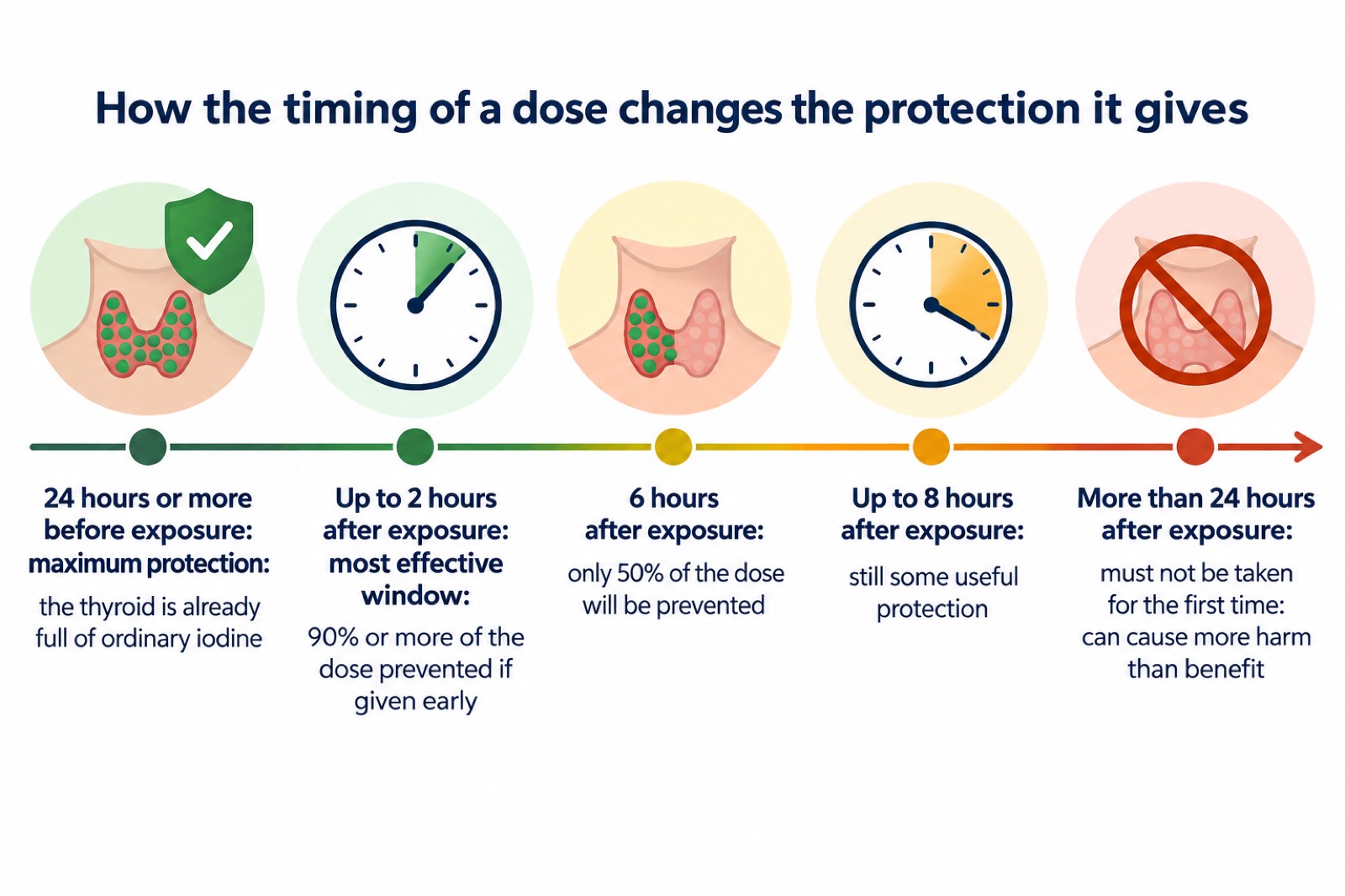
What this means in practice is that you should not wait for certainty before acting on an instruction. If the emergency services tell you to take the tablets, take them straight away, then follow the sheltering or evacuation advice that comes with the instruction. Do not take them "just in case" on the basis of a rumour or a news report, and do not take a second dose unless you are specifically told to. A single dose provides protection for 24 hours1, and repeat doses are not routine: dosages would not normally be repeated unless a significant hazard persists, and only with the authority of the Medical Director of Local Area Team NHS England5.
Doses by age: two tablets for adults, one for children aged three to twelve
The dose depends on the age of the person taking it, and the tablets issued to households are scored so that they can be broken or crushed for smaller doses. The doses below are as published in the official leaflets issued to households around UK nuclear sites.
| Age group | Dose | How to take it |
|---|---|---|
| Adults, including children over 12, pregnant women and women who are breastfeeding | Two tablets | Swallow the two tablets with water; if this is difficult, crush as for children2 |
| Children aged 3 to 12 years | One tablet | Crush and mix with a teaspoon of jam, honey or yoghurt if needed2 |
| Children aged 1 month to 3 years | Half a tablet | Crush and mix with a teaspoon of jam, honey or yoghurt, or with milk, water or jam2 |
| Newborn babies, birth to 1 month | Quarter of a tablet | Crush and dissolve in a small quantity of milk, formula or juice; shake well so the powder dissolves2 |
The same doses are expressed as the equivalent mass of iodine in the 2019 official advice on radiation emergencies: 100 mg for adults including the elderly and children over 12 years, 50 mg for children aged 3 to 12 years, 25 mg for children aged 1 month to 3 years, and 12.5 mg for newborn babies aged up to 1 month6. In the UK, no distinction is made on the basis of age when distributing stable iodine: tablets go to everyone in the affected area, and the dose is then adjusted by age6.
Two points about the adult dose are worth spelling out. First, children over twelve years take the full adult dose of two tablets5. Second, pregnant women and women who are breastfeeding also take the full adult dose2; protecting the mother's thyroid also limits the radioactive iodine that could reach a baby through breastfeeding, though repeat dosing should be avoided in pregnant or breastfeeding women and in newborn babies aged up to 1 month6.
Giving tablets to babies and young children
Babies and very young children are the group for whom the tablets matter most, and the group where the practicalities need a little thought. Children aged 0 to 15 years are most at risk of adverse effects from radioactive iodine5, which is why the whole scheme exists and why the smallest doses are worked out so carefully.
For a newborn baby, birth to one month, the dose is a quarter of a tablet, crushed up in a teaspoon of jam, honey or yoghurt, or dissolved in a small quantity of milk formula or juice2. Shake the milk or juice well to make sure the powder dissolves before giving it5. For a child aged one month to three years, the dose is half a tablet, crushed and mixed with a teaspoon of jam, honey or yoghurt, or with milk, water or jam2. For children aged three to twelve, one tablet, which can be crushed and mixed with a teaspoon of jam, honey or yoghurt if swallowing a tablet whole is difficult2.
Very young babies, less than three months old, and women more than six months pregnant should take the tablets as directed in the leaflet issued with the tablets, but should thereafter be seen by their GP, who will arrange for any necessary checks to be undertaken by a paediatrician3. This is a planned follow-up, not a sign that the tablets are dangerous: it is a precaution for the groups whose thyroids are most sensitive.
If you have questions about giving the tablets to a baby or child, contact the NHS Helpline on 1117. Do not guess at a dose: the leaflet issued with your tablets states the dose for every age group, and 111 can talk you through it.
Who should not take stable iodine

Most people can take stable iodine safely when it is advised, but there are specific groups who should not, and others who should take it with medical follow-up. The conditions involved are rare, and most people who have them will already know.
Do not take stable iodine tablets if you are allergic to iodine or any of the other ingredients in the tablets, or if you have one of the following rare medical conditions: hypocomplementaemic vasculitis, dermatitis herpetiformis, stage 4 or 5 kidney failure, and, for pregnant women, thyrotoxicosis3. The same warnings appear in the leaflets issued around other sites: if you are allergic to iodine or any of the other ingredients, or suffer from hypocomplementaemic vasculitis or dermatitis herpetiformis, consult your doctor before taking the tablets2. The full list of contraindications in the official guidance also includes medically treated thyrotoxicosis, asymptomatic nodular goitre, known iodine hypersensitivity, dermatitis herpetiformis, hypocomplementaemic vasculitis and renal failure5.
If any of these apply to you or a family member, the time to find out is now, not during an emergency. Check the patient information leaflet in your pack, and if you are unsure, phone NHS 1117 or ask your GP whether stable iodine is safe for you. In an emergency, the sheltering and evacuation advice still applies to you in full: the tablets are only one protective action among several, and for someone who cannot take them, sheltering indoors and following evacuation instructions matter even more.
One further caution applies to everyone. Repeat dosing should be avoided in pregnant or breastfeeding women and newborn babies aged up to 1 month6, and dosages would not normally be repeated for anyone unless a significant hazard persists and only with the authority of the Medical Director of Local Area Team NHS England5. If you have already taken a dose and are unsure whether you need another, wait for official instruction rather than taking a second dose on your own judgement.
How tablets reach households near nuclear sites
Stable iodine tablets are not something you need to seek out if you live in a planned emergency zone: they come to you. Around the naval berths in Portsmouth, for example, tablets are distributed to all households within a 1.5-kilometre radius of the nuclear berths in accordance with emergency regulations7. In Southampton, they are distributed to all households within a 1.5-kilometre radius of the section of the Docks where nuclear-powered vessels would berth2. Around BAE Systems in Barrow, tablets are distributed to all households and businesses in the mapped area, and to schools, care establishments and childcare facilities within a wider mapped area3.
How the delivery works in practice depends on the site. In Portsmouth and Southampton, most residential properties receive their tablets from Royal Navy personnel or council staff distributed to their door; if you are out when they call, the tablets will be left with a leaflet telling you what to do2. Elsewhere, tablets are issued through the council or the site operator as part of the off-site emergency plan. To find out whether your home is in a planning zone and how your area is covered, see Living Near a Nuclear Site: Emergency Planning Zones and Information Booklets and, for the naval sites, Radiation Emergency Plans at Portsmouth, Devonport and Southampton.
Schools and nurseries are covered separately, and this matters for parents. In Portsmouth, named schools and nurseries, including St George's Primary School, Portsmouth Grammar School and Top Tots Day Nursery in the John Pounds Centre, hold stable iodine tablets for all children and staff and will look after children in an incident7. In Southampton, students in schools well outside the 1.5-kilometre zone will be told about any incidents by the council, and the council will look after any pupils whose parents live within the zone and may not be able to collect them2. Where appropriate, children at school will be given stable iodine tablets8. The advice on whether to collect your children is covered in Should You Collect Children From School in a Radiation Emergency?.
If your tablets are lost or damaged, replacements are available. Around Barrow, additional supplies can be obtained by contacting BAE Systems Barrow5. Around other sites, contact the council's emergency planning team or the site operator named in your local booklet. Keep the tablets in their original packaging with the leaflet, somewhere you can find them quickly in the dark, and check the expiry date when you check the rest of your household's emergency preparations.
What stable iodine protects against, and what it does not
Stable iodine protects against exactly one thing: radioactive iodine, usually the isotope iodine-131, reaching the thyroid gland5. Faults at operating nuclear reactors can release radioactive forms of iodine, which can lead to radiation doses to the thyroid9. The tablets work by filling the thyroid with ordinary iodine so it cannot absorb the radioactive form, and taking stable iodine also speeds the removal of radioactive iodine from the body, reducing the radiation dose to the thyroid gland9.
They protect against nothing else. Potassium iodide offers no protection against other forms of radioactivity5. A radiation emergency can involve many other radioactive substances, and against those the protective actions are different: go indoors, close doors and windows, tune in to local radio and official alerts, and evacuate if and when you are told to. Taking stable iodine does not make it safe to go outside during a release, and it does not reduce any dose except the dose to the thyroid from radioactive iodine.
This is why the tablets are always issued alongside other instructions, never instead of them. Stable iodine is most effective when accompanied by either sheltering in place or evacuation6. If you are told to shelter, do that as well as taking the tablets. If you are told to evacuate, take the tablets if instructed and then leave as directed. For the decision between sheltering and evacuating, see Radiation Emergency: Should You Shelter or Evacuate?, and for what may happen to food and milk afterwards, see Will Food and Milk Be Restricted After a Nuclear Accident?.
The scheme has a real-world track record. Potassium iodide was used extensively following the Chernobyl disaster in Ukraine in the 1980s, and large numbers of people received the drug with very few adverse effects5. That experience underpins the confidence of the current arrangements, including the dose levels by age and the emphasis on timing.
Sites where tablets are no longer issued
The need for stable iodine depends on the hazard at a specific site, and it can change. Hinkley Point B stopped generating electricity in August 2022, and Somerset Council, Public Health experts and EDF Energy agree that the levels of radioactive iodine have been declining since the end of generation and are now at negligible levels10. On that basis, stable iodine tablets are no longer recommended as a protective action for the Hinkley Point B site10.
The reasoning is set out plainly by Somerset Council: stable iodine can only be prescribed and issued to individuals as part of nuclear off-site planning if there is evidence of a threat to health that requires this protective action, and this is no longer the situation at the Hinkley Point B site10. If you previously held tablets for that area and have wondered why they were withdrawn, this is why: the hazard they guarded against has faded as the spent fuel has cooled, not because the arrangements have lapsed.
The same logic works in reverse for households near sites that still hold nuclear fuel, including operating power stations and the naval berths. If your local booklet still tells you to keep tablets, keep them. If you are unsure what applies to your address, check your local council's radiation emergency pages or the information booklet for your nearest site.
Getting help and answers
If you have any queries about taking the tablets, contact the NHS Helpline on 1117. NHS 111 can answer questions about doses for your family, medical conditions that might affect whether the tablets are safe for you, and what to do if you are pregnant or breastfeeding. In an emergency, follow the instructions of the emergency services first, and use 111 for anything you are unsure about rather than guessing.
For the wider picture of how a radiation emergency unfolds and what your household should do hour by hour, see the Major Incidents guide, What to Do in a Radiation Emergency, Sirens and Phone Warnings Near Nuclear and Chemical Sites and How Radiation Is Monitored in the UK. If you want to be sure your household is ready for any emergency, nuclear or otherwise, start with Getting Started: Preparing Your Household for an Emergency.
Sources (10)
- What to do in a radiation emergency, UK Government, 2024
- Radiation emergency leaflet for Southampton residents, Southampton City Council, 2024
- What to do in an emergency booklet, BAE Systems Barrow, Westmorland and Furness Council, 2023
- Alerts and warnings, UK Government emergency preparedness campaign, 2026
- Potassium iodide tablets information for Cumbria residents, Cumbria County Council, 2018
- Advice for radiation emergencies, UK Government, 2019
- REPPIR residents booklet, Portsmouth, Portsmouth City Council, 2024
- Radiation emergency guide, resident leaflet, Portsmouth City Council, 2023
- Nuclear emergencies: information for the public, UK Government, 2026
- Radiation emergencies, Somerset Council, 2025
 Bomb Threat Calls
 Radiation Checklist First Hour
 Power Cut Kit Checklist
 UK Terrorism Threat
 Terrorism Threat Levels
 Reporting Suspicious Activity
 Unattended or Suspicious Items
 Radicalisation Concerns
 Support for Attack Victims
 CBR Attack Signs
 Chemical Releases Near Home
 Radiation Emergency
 Site Sirens and Warnings
 Radiation Dose Levels