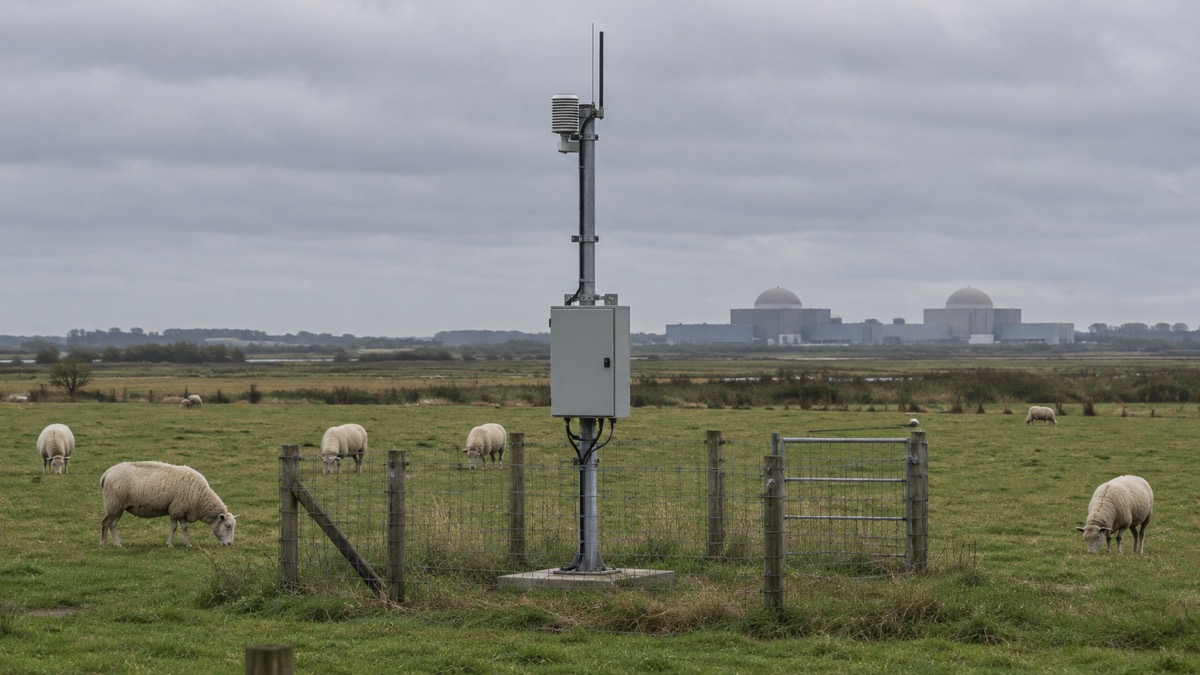
Radiation in the UK is watched around the clock by a national network called RIMNet, the Radiation Incident Monitoring Network. It monitors radiation levels across the UK and alerts from other countries, and it advises the government and local authorities on appropriate action following a radiation incident1. It exists because of a single event: the network was set up after the nuclear reactor disaster at Chernobyl in 1986, when radioactive material crossed Europe and arrived in Britain without any system in place to detect or track it here1.
For an ordinary household, the practical point is this: you do not need to measure radiation yourself, and you should not try to. Fixed radiation monitors around nuclear licensed sites would detect and measure abnormal radiation levels, and monitoring of the public near a site would be carried out to provide reassurance in an emergency2. Your job in a radiation emergency is to go in, stay in and tune in, and to follow the official advice that the monitoring makes possible. This page explains who takes the readings, who turns them into advice, and how that advice reaches you, including what happens to rainwater, garden vegetables and food supplies after a release.
RIMNet: the network set up after Chernobyl
RIMNet, the Radiation Incident Monitoring Network, is the UK's continuous watch on radiation. It monitors radiation levels in the UK and alerts from other countries, and it advises the government and local authorities on appropriate action following a radiation incident1. The network was set up after the nuclear reactor disaster at Chernobyl in 19861. That accident released radioactive material that travelled thousands of miles on the wind, and it showed that a release far outside the UK could still deposit material here. A detection network that runs all the time, rather than one assembled after the event, is the direct response to that lesson.
The network's second function matters just as much as its first. By international agreement the UK should receive warning of nuclear accidents abroad2. RIMNet therefore combines two streams of information: warnings passed between countries under international agreements, and the UK's own measurements of radiation levels on the ground. When something abnormal appears in either stream, the network's role is to advise the government and local authorities on appropriate action1. That advice is what eventually becomes the instructions you hear on the radio or see on your phone.
It is worth putting the risk in proportion. The possibility of a radiation emergency occurring at UK nuclear sites is described in official local plans as remote, with the design and operation of plants independently monitored by the Office for Nuclear Regulation (ONR) and, in England, the Environment Agency5. The average person in the UK receives a radiation dose every year from entirely ordinary sources: the UK average annual radiation dose is 2.6 mSv, a figure updated in September 2026 from the previous 2.7 mSv4. The largest single source of radiation exposure for the UK population is radon, a naturally occurring gas present in most parts of the UK, not anything from the nuclear industry1. Monitoring exists so that even a remote event would be caught early, not because high levels are expected.
Who advises government and local councils after a release
Readings on their own tell you nothing. They have to be interpreted, turned into protective advice and delivered to the right places. Several bodies share that work, and knowing the division of labour helps you judge where a message has come from and how much weight it carries.
The UK Health Security Agency (UKHSA) is the public health body at the centre. Its Radiation, Chemical and Environmental Hazards Division offers advice, monitoring, assessments and information2. Following a radiation emergency overseas, UKHSA assesses the risks to public health and works with government partners on monitoring and decontaminating people arriving in the UK3. The national guidance for the public, "Radiation emergencies: information for the public", is published by UKHSA, and it can also be used by local authorities to support the specific advice they issue for their own nuclear emergency response plans7.
Local authorities carry their own legal duty. Under the Radiation (Emergency Preparedness and Public Information) Regulations 2019, known as REPPIR, local authorities must plan for mitigating the consequences of a nuclear off-site emergency where there is a regulated nuclear establishment in their area5. Somerset Council, for example, states that it is responsible for maintaining these arrangements in accordance with REPPIR, and that its off-site emergency plan is regularly reviewed and tested by all agencies involved to make sure it is up to date and fit for purpose9. Plymouth City Council makes the same point for the Devonport site: REPPIR places a duty on local authorities to protect the public in the unlikely event of a radiation emergency8.
The booklets that households near nuclear sites receive are produced jointly. The Portsmouth booklet was produced by Portsmouth City Council, Gosport Borough Council and Hampshire County Council in consultation with the NHS, the Royal Navy and the Ministry of Defence10. Environmental protection advice is provided by the Environment Agency in England, by Natural Resources Wales in Wales, by SEPA in Scotland and by the Northern Ireland Environment Agency in Northern Ireland11. So a message in an emergency may come from more than one body, but each is working within the same tested plan.
A release overseas: how UKHSA assesses the risk to the UK
An accident at an overseas nuclear site is treated in UK planning as a real risk, not a hypothetical one. Surrey's community risk register lists "R053 Accidents & System Failures: Radiation release from overseas nuclear site" and rates it High12. The reason a distant accident can matter here is the weather. For large releases from overseas nuclear facilities, it is possible that, if certain weather conditions occur, radioactive material carried by the wind may land in some parts of the UK, especially where rainfall occurs3. Rain washes material out of the passing plume and deposits it on the ground below.
The assessment process starts with warning. By international agreement the UK should receive warning of nuclear accidents abroad2. From there, UKHSA assesses the risks to public health following a radiation emergency overseas, and works with government partners on monitoring and on decontaminating people arriving in the UK3. If you are returning from a country affected by a chemical or radiation emergency, the risk will be assessed by public health or government partners to decide whether you need to be monitored on arrival, and you should contact the local British Embassy, Consulate or High Commission when it is safe to do so11.
For households in the UK, the practical consequence of an overseas release is usually restrictions and monitoring rather than evacuation. The routes by which radioactive iodine can reach people, set out in official guidance, are: inhalation from a passing plume of radioactivity; eaten field grown crops contaminated by radioactive dusts; contaminated milk after a dairy herd eats contaminated grass; contaminated skin; and disturbed contaminated ground13. That list is why official advice after a release can touch on things as ordinary as garden vegetables and milk, and it is why the monitoring described later in this page covers food and water as well as air.
Information you are owed if you live near a nuclear site
If you live near a nuclear licensed site, you are owed specific information in advance, not just warnings on the day. The legal basis is REPPIR 2019, which establishes a framework for protecting the public and workers from radiation emergencies originating from premises2. Sites such as Heysham Power Station and Westinghouse Springfields are governed by these strict nuclear Radiation Emergency Preparedness and Public Information Regulations14.
What this means in practice is a printed booklet through your door on a fixed cycle. The Devonport off-site emergency plan booklet is published every three years and distributed to households and businesses in the detailed emergency planning zones8. In Portsmouth, the booklet is distributed to all households within a 1.5-kilometre radius of the nuclear berths, in accordance with emergency regulations10. Southampton's leaflet covers all households within a 1.5-kilometre radius of the section of the Docks where nuclear-powered vessels would berth, for the period July 2024 to July 202715. If you have moved house near a site, check whether you received one, and if not, ask your council.
The sites covered by this duty are the nuclear power stations and those ports where nuclear submarines are constructed or come into dock whilst they are powered up13. Beyond the booklets, there is continuous routine monitoring you never see: each year the UK Government publishes a Radioactivity in Food and the Environment report for the previous calendar year, with monitoring conducted by the Environment Agency and the Food Standards Agency near 39 nuclear sites in the UK, assessing the levels of radioactivity and the amount of radiation the public is exposed to1. Schools are planned for too. In Portsmouth, named schools and nurseries hold stable iodine tablets for all children and staff and will look after children in an incident10, and in Southampton, students in schools well outside the 1.5km zone will be told about any incidents by the council, which will look after any pupils whose parents live within the zone and may not be able to collect them15.
Where official messages come from during a radiation emergency
When a radiation emergency happens, the advice to the public is "go in, stay in, tune in". The tuning-in part has several channels, and it helps to know them in advance. Monitor the news and follow official UK advice on GOV.UK for what to do next; changes to advice may be communicated via the radio, television, internet, social media or the police3.
The Emergency Alerts system can reach your phone directly. A message is broadcast to a defined area, and any compatible device in or entering that area immediately receives the message detailing the emergency and the actions to take, with a loud siren-like sound and vibration; alerts may include a URL and a helpline number, and are always replicated on gov.uk/alerts16. Alerts can be sent by the UK Government, the devolved governments and other public bodies that deal with emergencies, for example the police or your local council17. In Scotland, the same applies: alerts can be sent by the UK Government, the Scottish Government or other public bodies such as the police or your local council17.
Local plans name the exact stations to tune to. In a radiation emergency affecting Southampton, information would be broadcast on TV on BBC1, BBC2 and ITV Meridian, and on radio on BBC Radio Solent (96.1 and 103.8 FM), Hits Radio South Coast (107.8 FM), Heart FM (96.7 FM), Greatest Hits Radio South Coast (105.2 FM) and Capital FM (103.2 FM), with updates on the council's and county council's social media accounts15. Your own site's booklet will name the equivalent stations for your area, which is one more reason to keep it.
The messages do not stop when the release stops. Keep listening and looking for announcements and updates on the news, watch for long-term safety information in the news and in leaflets, and wait for the all-clear announcement10. The UKHSA guidance on what to do in a radiation emergency also provides information related to evacuations, pets, the use of stable iodine, and safety advice related to food and water20. The Office for Nuclear Regulation's role in messaging is supportive rather than leading: in a radiation emergency the ONR would seek to support local and national messaging through the appropriate communication channels21.
Rainwater, water butts and garden vegetables after a release
This is the question households most often ask after news of a release: is the rain safe, and what about the vegetables. The answer is that official monitoring, not personal judgement, decides.
After an emergency, a wide range of food supplies and drinking water would be checked to see if they contained more radioactive materials than the allowed levels2. Those allowed levels are defined in law: maximum permitted levels (MPLs) of radioactive material per kilogram of food or per litre of milk, and action levels (ALs) for radioactive material in drinking water, apply in the UK in emergency situations only3. If a restriction is placed on a food or on water, it will be announced through the same official channels as everything else, and lifted the same way.
The reason rain and gardens are specifically at risk after an overseas release is deposition. For large releases from overseas nuclear facilities, radioactive material carried by the wind may land in some parts of the UK under certain weather conditions, especially where rainfall occurs3. The exposure routes for radioactive iodine include eaten field grown crops contaminated by radioactive dusts, and contaminated milk after a dairy herd eats contaminated grass13. A water butt filled during the passage of a plume, and salad vegetables growing in the garden, fall squarely within what the monitoring programme is designed to check.
What you should do, concretely:
- Do not decide for yourself that rainwater or produce is unsafe or safe; wait for official restrictions3
- Keep listening for announcements about food and water, which are part of the same official messaging as sheltering advice10
- Expect checks on a wide range of food supplies and drinking water against the legal maximum permitted levels2
- Watch for long-term safety information in the news and in leaflets after the immediate emergency has passed10
The routine version of this monitoring runs all the time. Each year the UK Government publishes the Radioactivity in Food and the Environment report for the previous calendar year, with monitoring by the Environment Agency and the Food Standards Agency near 39 nuclear sites in the UK1. An emergency simply intensifies the same system.
How the ONR checks emergency plans are adequate
The Office for Nuclear Regulation is the regulator that stands behind all of this. Its role is to assess formally whether the emergency arrangements are adequate: the ONR formally assesses the adequacy of these arrangements22. The requirement for off-site emergency plans is captured in the Radiation (Emergency Preparedness and Public Information) Regulations 2019 (REPPIR)22.
The ONR also monitors the sites themselves, continuously and independently. Lancashire's REPPIR plans stress that the possibility of such emergencies occurring is remote, and that the design and operation of all plants on all sites are independently monitored by the Office for Nuclear Regulation and the Environment Agency5. Cumberland's guidance says the same of Sellafield: the possibility of emergencies occurring is remote, and plants on the site are independently monitored by the ONR, the HSE and the EA23. The BAE Systems site at Barrow is independently monitored by the Office for Nuclear Regulation and the Ministry of Defence24.
Plans are not written once and filed. Somerset's off-site emergency plan is regularly reviewed and tested by all agencies involved to make sure it is up to date and fit for purpose9. Planning zones themselves are revised when lessons emerge: the revision of Detailed Emergency Planning Zones followed an ONR review in January 2014, drawing on lessons learnt from the Fukushima Daiichi Nuclear Power Plant incident in 201123. Operators have duties too: as required by the updated REPPIR 2019, EDF have published the Hinkley Point B Power Station Consequences Report, revised and updated9.
One point about the ONR worth knowing in advance: it does not run the public messaging. The ONR states that it does not have formal media-facing responsibilities in relation to incident response, though it may choose to comment publicly on relevant regulatory matters as required21. In a radiation emergency it would seek to support local and national messaging through the appropriate communication channels21. The advice you act on comes from the emergency services, your local authority and GOV.UK, not from the regulator's commentary.
The ONR also has a duty to provide prior information to members of the public who may be affected by a radiation emergency when radioactive material is transported by road, rail or inland waterway in Great Britain21. So even if you do not live near a fixed nuclear site, you may be in an area where prior information duties apply because of transport routes.
Checking radiation yourself: what is and is not available
There is no public dashboard of RIMNet readings, and household radiation meters are not part of official advice. The monitoring that matters is done for you: fixed radiation monitors around nuclear licensed sites would detect and measure abnormal radiation levels, and monitoring of the general public in the vicinity of a nuclear licensed site would be conducted to provide reassurance in the event of an emergency, with initial monitoring followed up, if necessary, to assess long-term doses to individuals2.
The one form of radiation you can meaningfully check at home is radon, because it is the largest source of radiation exposure for the UK population1. Radon is present in most parts of the UK6. It is possible to order a home measurement pack from UK Radon, and if you are buying a property and wish to know what levels of radon are present, you can purchase a radon risk report6. This is ordinary household safety, not emergency preparedness, but it is the honest answer to "can I test for radiation myself".
In an emergency, the right response to wanting a reading is to recognise that the state is already taking them, at fixed monitors, in food and water sampling, and through monitoring of people near affected sites2. Your own actions should follow the official advice those readings produce: go in, stay in, tune in20.
Sources (24)
- Radiation: monitoring and public information, Nottingham City Council, 2026
- Nuclear emergencies: information for the public, GOV.UK, 2026
- What to do in a radiation emergency, GOV.UK, 2024
- Nuclear emergencies: information for the public, GOV.UK, 2026
- REPPIR plans, Lancashire County Council, 2026
- Radon, Cornwall Council, 2024
- Radiation emergencies: information for the public, GOV.UK, 2024
- Devonport Off-site Emergency Plan, Plymouth City Council, 2026
- Radiation emergencies, Somerset Council, 2025
- REPPIR Residents booklet 2024, Portsmouth City Council, 2024
- What to do in a chemical emergency, GOV.UK, 2024
- Community Risk Register 2026, Surrey County Council, 2026
- Radioactive iodine: public information, Cumbria County Council, 2018
- Industrial incident, Lancashire Prepared, 2026
- Radiation leaflet 2024 for residents, Southampton City Council, 2024
- National Risk Register extract: Emergency Alerts, Parliament, 2023
- Find and share information in an emergency, Ready Scotland, 2026
- Get prepared for emergencies: alerts, Prepare (UK Government), 2026
- Be ready for emergencies: alerts and warnings, Be Ready (UK Government), 2026
- Hazardous substance exposure, Essex Prepared, 2026
- Public communications in an emergency, Office for Nuclear Regulation, 2026
- Local emergency arrangements, Office for Nuclear Regulation, 2026
- Chemical and nuclear sites, Cumberland Council, 2026
- What to do in an emergency booklet 2023 to 2027, Westmorland and Furness Council, 2023
 Run, Hide, Tell
 ACT Awareness Training
 Living Near a COMAH Site
 Air Quality After a Release
 Remove, Remove, Remove
 Go In, Stay In, Tune In
 Nuclear Site Planning Zones
 Naval Base Radiation Plans