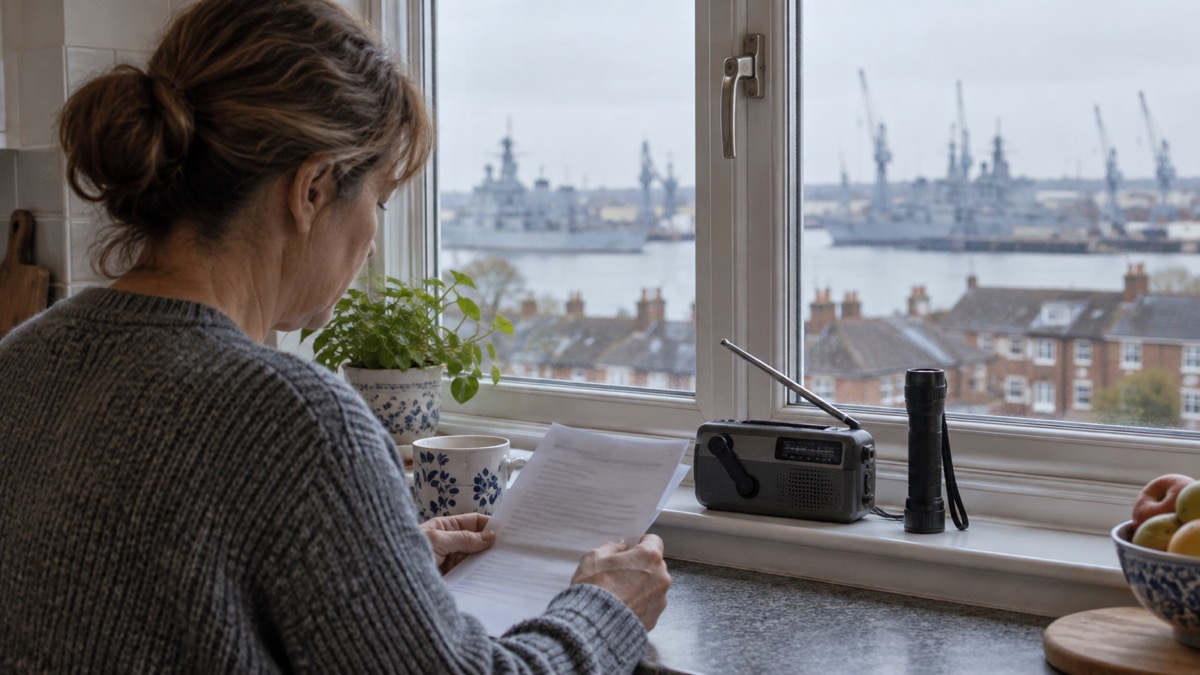
Nuclear-powered submarines berth at three places on the south coast and in Plymouth: Portsmouth naval base, a section of Southampton Docks, and the Devonport Site in Plymouth. Each berth has an official off-site emergency plan, and each is surrounded by a Detailed Emergency Planning Zone reaching 1.5km from the berth, with a wider Outline Planning Zone beyond it, at Portsmouth out to 5km (3 miles)1. If a radiation emergency were ever declared at one of them, the instruction to households is the same everywhere: go in, stay in, tune in1.
The plans exist because the law requires them, not because an incident is expected. The Southampton leaflet puts the risk in perspective: if an accident happened, it is unlikely to affect people more than half a kilometre (500 yards) from the vessel, and there is no possibility of a "nuclear bomb" type explosion2. What the plans prepare for is a release of very tiny radioactive particles into the air, carried by the wind, with the main concern being exposure to radioactive iodate particles2.
This page sets out what the official leaflets and plans for Portsmouth, Southampton and Devonport actually tell households to do, how far each zone reaches, what happens to children at school, and where to find the booklets and helplines. For the general principles of sheltering from any release, see Go In, Stay In, Tune In: Sheltering From a Chemical or Radiation Release and What to Do in a Radiation Emergency.
Go in, stay in, tune in
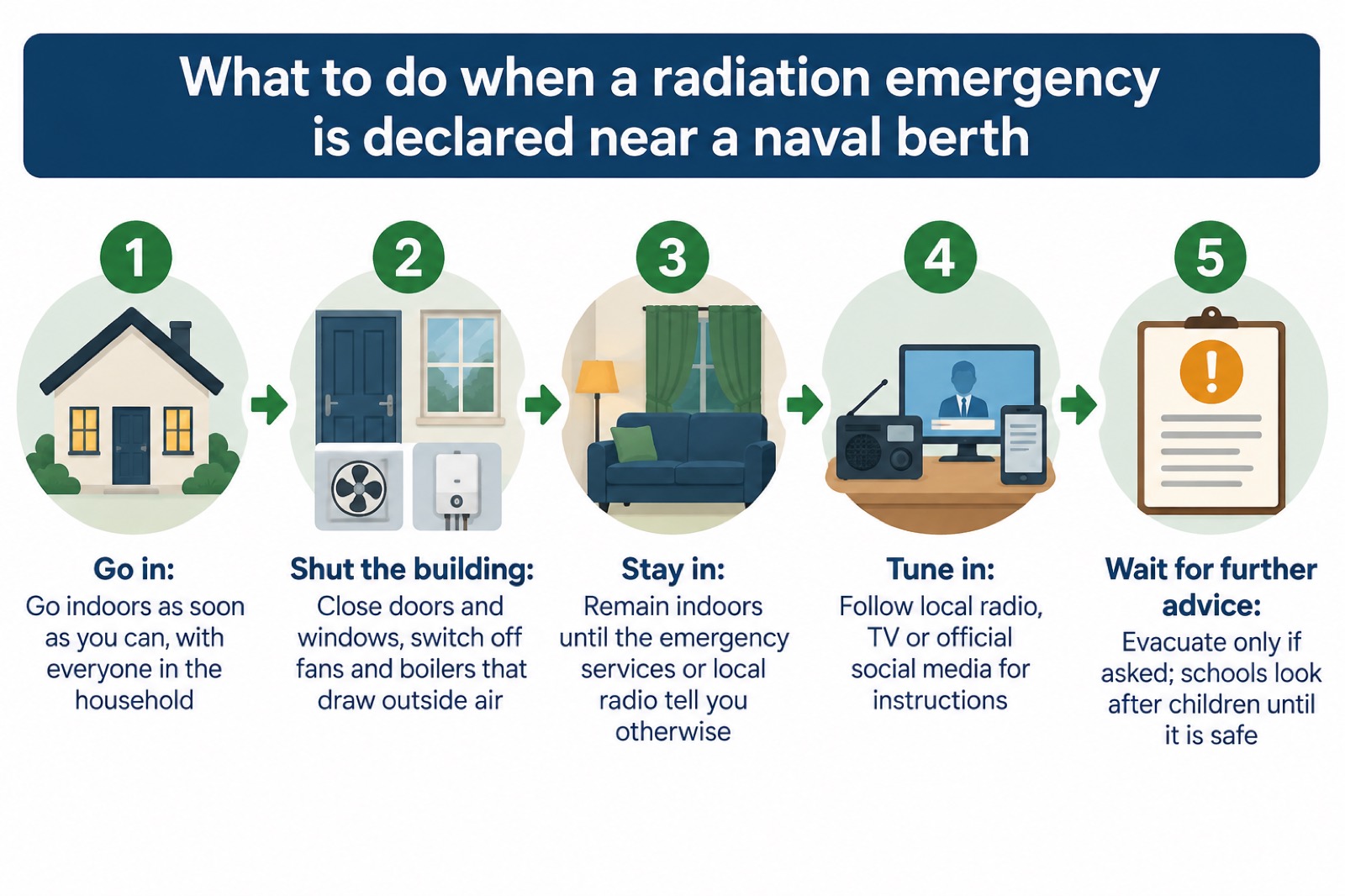
The drill in an emergency is simple, and every official source gives it in the same words: GO IN, STAY IN, TUNE IN2. Go indoors as soon as you can and stay there. Close the doors and windows and stay as far away from external walls as possible5. Stay in until you are told otherwise by the emergency services or local radio6. Tune in to local radio, TV or the internet, where public information and advice from the emergency responders will be broadcast7.
The UK Health Security Agency's advice, relayed by the government's Prepare campaign, is the same: go indoors as soon as you can, stay there, and monitor the news and follow official advice on GOV.UK8. The government's self-decontamination guidance for radiation emergencies puts it plainly: "The most important thing you can do if you are near a radiation emergency is go inside and stay inside with doors and windows closed, and tune in to news updates"9. Councils across the country, from Somerset to Carmarthenshire, give the identical instruction for any radiation incident in their area10.
Staying in is usually better than leaving. The Portsmouth booklet is direct about this: "The best thing to do is stay at home. You will be much safer indoors with your windows and doors shut"1. If you are eventually advised to leave, stay with friends or relatives outside the affected area if you can; the council will make special arrangements for those who cannot. Use your own transport if you have it, and transport will be provided for those who do not. Entry to evacuated areas is carefully controlled until the emergency has ended1.
The reason sheltering works is time and distance. A building with its windows and doors shut keeps most airborne particles out, and the dose from a passing plume falls sharply with distance and with the minutes you spend behind walls rather than out in it. The half-kilometre figure in the Southampton leaflet reflects how contained the realistic hazard is2. For a fuller explanation of sheltering versus evacuating, see Radiation Emergency: Should You Shelter or Evacuate?.
How to go in: shut the building down properly
Going in is more than pulling the front door behind you. The Portsmouth leaflet sets out the actions to take, and it is worth knowing before you need it3:
- Close all doors and windows to reduce the risk of contamination entering the building3.
- Switch off fans, ventilation equipment or appliances such as central heating boilers and gas fires which draw air from outside3.
- Put out or damp down open fires3.
- Stay as far away from external walls as possible5.
- Stay indoors until you know more, and tune in to a local radio or TV station11.
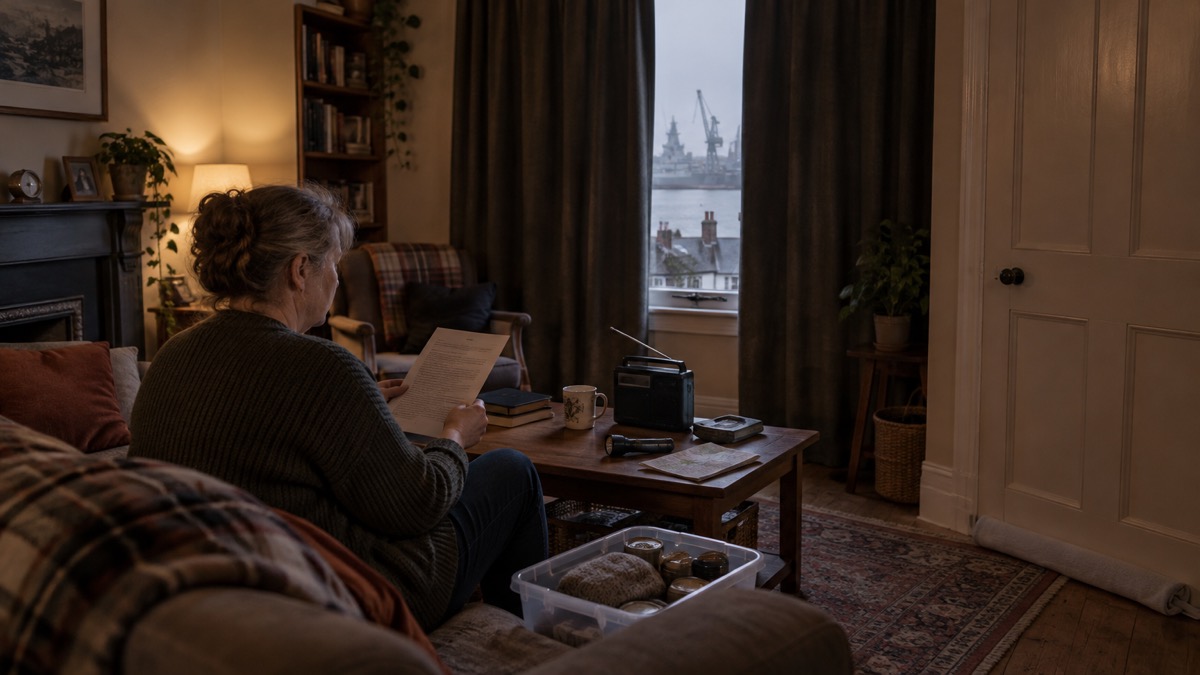
The same actions appear in official guidance across the UK. Edinburgh's advice for a release of gas, toxic chemical or radiation adds: put out all naked flames such as pilot lights, switch off gas supplies, put away or cover all fresh food, and have your emergency provisions ready11. Lincolnshire's guidance adds the detail of where to sit: bring your family and pets inside, lock doors, close windows and air vents, turn off fans, air conditioning and forced air heating systems, and go into an interior room with few windows if possible12.
Two points from the wider guidance are worth fixing in your mind now. First, the Portsmouth booklet warns not to use the telephone unless you urgently need help, because in an emergency the telephone system could become very busy; if you have to make a call, keep it short1. Mobile networks may be jammed and cordless telephones need power to work, so think in advance about how your family will stay in touch13. Second, if you are ever asked to evacuate, official guidance from several councils says to turn off or isolate electricity, gas and water supplies, unplug appliances and lock all doors and windows, but only if you have time and it is safe to do so14.
If you believe you were outside in the plume, the government's self-decontamination guidance explains how to remove radioactive material from your skin and clothes, and it is summarised on our page Remove, Remove, Remove: What to Do After Contact With a Harmful Substance.
Leave children at school: the school will look after them
This is the instruction parents find hardest, and every plan states it firmly. The Portsmouth leaflet says: "Don't go to collect children from school, as this may expose you and them to radiation. The school will look after them and contact you when it is safe for children to leave"3. The BAE booklet for the west Cumbria coast, which covers the same class of naval reactor sites, explains the arrangement: children "will be looked after as a priority group either at the school or evacuated to a safe place where they will be looked after by the school staff and those responding to the emergency"16. Cumbria's Sellafield guidance and Edinburgh's evacuation advice say the same: arrangements will be made to look after children at school or nursery within the affected zones17.
The reason is arithmetic as much as protection. A school is a building like any other: once its doors and windows are shut, the children inside are sheltered. A parent driving to the school is out in the open, in a car that draws in outside air, and then has to bring children back out through it. Wandsworth's guidance for toxic fumes puts the rule in general terms: do not try to collect your children from school unless told to do so, they will be looked after and the correct action taken19.
What you can do now, before anything happens, is check that your child's school has the correct contact numbers for you, and that it has plans for emergencies such as severe weather, loss of utilities and fire20. Lewisham's guidance for schools emergencies confirms the mechanism: if a school needs to be evacuated, children will be taken to a safe place nearby and the school will contact you to let you know what to do22. It is also useful to plan who you would ask to collect your children in an emergency if you are unable to do so yourself23. Letting children help with the household emergency plan and kit can help them remember the information and feel safer24. Our page Should You Collect Children From School in a Radiation Emergency? covers this in more detail.
Portsmouth naval base: the 1.5km and 5km zones
Portsmouth naval base means the areas at HMS Nelson owned by the Ministry of Defence and Her Majesty's Naval Base (HMNB) Portsmouth3. Around its operational submarine berths, the plan defines two zones3:
| Zone | Extent | What it means for you |
|---|---|---|
| Detailed Emergency Planning Zone | 1.5km from the berth3 | Detailed emergency plans exist for this area; households receive the full booklet1 |
| Outline Planning Zone | Within 5km (3 miles) of the operational berths, including anchorages in the Solent3 | Information is provided by law; protective actions would be activated only if the risk extended beyond the 1.5km area3 |
The zones are shown as circles on the council's maps, but the actual zone goes out to the nearest natural or landscape boundary, so your street may be inside the zone even if it looks outside the circle on the map3. Protective actions for people in the Outline Planning Zone would only be activated if it was determined that the risk from the event extended beyond the 1.5km area for which detailed emergency plans already exist3.
The booklet covering the Portsmouth berths was produced by Portsmouth City Council, Gosport Borough Council and Hampshire County Council in consultation with the NHS, the Royal Navy and the Ministry of Defence, and is valid from July 2024 to July 20271. It is distributed to all households within a 1.5-kilometre radius of the nuclear berths, in accordance with the emergency regulations1. By law, information is also provided to everyone who lives in the Outline Planning Zone, which is what the 2023 resident leaflet covers3. For the general framework, see Living Near a Nuclear Site: Emergency Planning Zones and Information Booklets.
Southampton Docks: households within 1.5km of the berths
Nuclear-powered vessels berth in a defined section of Southampton Docks, and the residents' leaflet issued by Southampton City Council, with New Forest District Council and Hampshire County Council, is distributed to all households within a 1.5-kilometre radius of that section2. Legislation requires people living up to 1.5km away from an operational berth to be given prior information about a nuclear emergency, and the current leaflet runs from July 2024 to July 20272.
The leaflet explains what the hazard actually is: if the reactor on board a vessel suffers a serious problem and begins to leak, radioactive particles might escape into the air, but there is no possibility of a "nuclear bomb" type explosion2. The main concern would be exposure to radioactive iodate particles, which could be inhaled, contacted on surfaces, eaten or drunk, or blown along in a plume2. If an accident happened, it is unlikely to affect people more than half a kilometre (500 yards) from the vessel2.
Schools are covered on both sides of the zone boundary. Named schools and nurseries just outside the incident area, including St John's Infant and Nursery School, Play Away Day Nursery, YMCA Nursery Woolston, Woolston Adventure Pre-school and Hythe Primary School, hold stable iodine tablets for all children and staff in their care2. Students in schools well outside the 1.5km zone will be told about any incidents by the council, and the council will look after any pupils whose parents live within the 1.5km zone and may not be able to collect them2. For what the tablets do and when they are taken, see Stable Iodine Tablets: When to Take Them, Doses and Where to Get Them.
Devonport and Plymouth: the council's duty under REPPIR
The Devonport Site in Plymouth is the third of the southern naval reactor sites, and its off-site plan is drawn up by Plymouth City Council4. The legal basis is the Radiation (Emergency Preparedness and Public Information) Regulations 2019, known as REPPIR, which places a duty on local authorities, where there is a regulated nuclear establishment, to protect the public in the unlikely event of a radiation emergency4. REPPIR also requires the Ministry of Defence and DRDL, the Devonport Site operators, to have emergency plans in place4.
The Devonport Off-site Emergency Plan, or DOSEP, gives details of the roles to be played by the MOD, DRDL, the emergency services and other responding agencies in the event of a radiation emergency4. Its zones mirror Portsmouth's: each detailed emergency planning zone is an area around the Devonport Site which extends to a minimum distance of 1.5km from the operational submarine berths, and an outline planning zone extends to a distance of 5km from a central point in the Devonport Site4. Plymouth City Council, Cornwall Council and Devon County Council have determined specific areas around the Devonport Site, the offshore berths and anchorages to which the arrangements apply4.
The prior information side is handled by a booklet, "What You Should Do if There Is a Radiation Emergency at the Devonport Site", which is published every three years and distributed to households and businesses in the detailed emergency planning zones, with an Easy Read version available4. The same legal framework applies across Great Britain: the Office for Nuclear Regulation confirms that GB law places a legal duty on the relevant local authority to produce plans to deal with off-site emergencies at nuclear sites, and that should a radiation emergency be declared, the local authority will activate its off-site emergency plan to protect the public within a pre-determined area known as the Detailed Emergency Planning Zone25.
How radioactive particles could reach you
All three plans describe the same mechanism. The main risk to the public would be if very tiny radioactive particles were released into the air, carried by the wind, and settled on people or objects; the main concern would be exposure to radioactive iodate particles3. Those particles could be inhaled, picked up from contaminated surfaces, or swallowed in food or drink, and the plume itself is blown along by the wind2.
This is why the sheltering instructions are what they are. Closing doors and windows stops particles drifting into the building; switching off fans, boilers and ventilation stops machinery actively pulling contaminated air inside; putting out open fires stops a chimney drawing air through the house3. It is also why children are kept at school rather than moved: a shut building anywhere in the zone protects better than a journey through it3.
The hazard is not unique to naval bases. Somerset Council notes that all civil and military facilities working with or transporting ionising radiation pose some risk, however remote, to the general public, and that as such a radiation emergency could occur anywhere in Somerset10. The naval berths are simply the sites where the law requires detailed prior planning and public information. How any release would be detected and measured is covered on our page How Radiation Is Monitored in the UK: RIMNet and Readings After a Release.
Why you get this information by law
The leaflets arrive on doormats because a regulation says they must. The Portsmouth leaflet states it directly: information is provided by law under the Radiation (Emergency Preparedness and Public Information) Regulations3. REPPIR 2019 is the same instrument behind the Devonport plan4 and behind the equivalent arrangements at other naval reactor sites: Argyll and Bute Council and the emergency services have statutory duties under REPPIR 2019 to plan and prepare for the unlikely event of a radiation emergency at HM Naval Base Clyde26, and the Clyde plan is informed by a series of consequences reports produced by the operator, the Royal Navy26.
The distribution rules follow the zones. At Portsmouth and Southampton, the booklet goes to every household within 1.5km of the nuclear berths1, and information is also provided by law to everyone who lives in the wider Outline Planning Zone3. At Devonport, the booklet is published every three years for households and businesses in the detailed emergency planning zones4. Councils elsewhere, such as West Berkshire and Lancashire, produce equivalent off-site plans under the same regulations for the nuclear sites in their areas27.
Where to get help and information during an emergency
During an emergency at the Portsmouth or Southampton berths, up-to-date information will be published on the Portsmouth City Council website and its social media channels, @PortsmouthToday on X and /PortsmouthCityCouncil on Facebook1. The booklet names the local radio stations that would carry public information1:
| Station | Frequency |
|---|---|
| BBC Radio Solent | 96.1 and 103.8 FM1 |
| Hits Radio South Coast | 107.8 FM1 |
| Heart FM | 96.7 FM1 |
| Greatest Hits Radio (South Coast) | 105.2 FM1 |
| Capital FM | 103.2 FM1 |
A telephone helpline number will be released in the event of an emergency, and the councils advise checking local news and social media for it1. Portsmouth City Council's Emergency Preparedness, Resilience and Response Team can be reached on 023 9284 1357 for non-emergency queries only, or by email at emergency.planning@portsmouthcc.gov.uk1. The council's information is available on request in large print, Braille, audio or another language by calling that same number1.
For health issues, the Portsmouth leaflet advises calling NHS 111 on telephone number 111, or going to www.111.nhs.uk3. Basingstoke and Deane's emergency guidance gives the same route for health concerns: NHS, dial 11127. Keep calls short and make them only if you need help, so the system stays available for people who do1.
Before anything happens, the ordinary preparedness advice applies: keep a household emergency plan with the contact details of the family members you would need to inform and your local doctor's number13, and think through how you would stay informed if mobile networks were jammed. The government's Prepare and Be Ready campaigns set out the basics20, and our Emergency Kit: What a UK Household Should Keep Ready page lists what to have in the cupboard so that staying in for hours is comfortable rather than stressful.
Sources (28)
- REPPIR Residents Booklet 2024, Portsmouth naval base, Portsmouth City Council, 2024
- Radiation leaflet 2024 for residents, Southampton Docks, Southampton City Council, July 2024
- What to do in a radiation emergency, resident leaflet, Portsmouth City Council, November 2023
- Devonport Off-site Emergency Plan, Plymouth City Council, 2026
- Hazardous substance exposure: protecting your family, Essex Prepared, 2026
- Emergency advice for residents, Warwickshire County Council, 2026
- Get prepared for an emergency, Carmarthenshire County Council, 2026
- Hazardous materials incident, Prepare campaign, 2026
- How to remove radioactive material from your skin and clothes, GOV.UK, 2024
- Radiation emergencies, Somerset Council, 2025
- Release of gas, toxic chemical or radiation, City of Edinburgh Council, 2026
- Get help and advice in an emergency, Lincolnshire County Council, 2026
- Preparing for an emergency, Nottinghamshire County Council, 2026
- Step 2: during an emergency, Essex Prepared, 2026
- Protecting yourself, West Northamptonshire Council, 2024
- What to do in an emergency booklet 2023 to 2027, BAE Systems and Westmorland and Furness Council, 2023
- Sellafield emergency information for residents, Cumbria County Council, 2023
- Evacuation advice for residents, City of Edinburgh Council, 2019
- Chemical accidents and toxic fumes, Wandsworth Council, 2023
- Get prepared for emergencies, Prepare campaign, 2026
- Be ready for emergencies, Be Ready campaign, 2026
- Emergencies at school, Lewisham Council, 2026
- Emergency planning, Belfast City Council, 2026
- Home emergency plan, Ready Scotland, 2026
- Local emergency arrangements, Office for Nuclear Regulation, 2026
- Preparing for civil emergencies in Argyll and Bute, Argyll and Bute Council, 2026
- Emergency information, Basingstoke and Deane Borough Council, 2026
- REPPIR plans, Lancashire County Council, 2026
 Run, Hide, Tell
 ACT Awareness Training
 Living Near a COMAH Site
 Air Quality After a Release
 Remove, Remove, Remove
 Go In, Stay In, Tune In
 Nuclear Site Planning Zones
 UK Radiation Monitoring