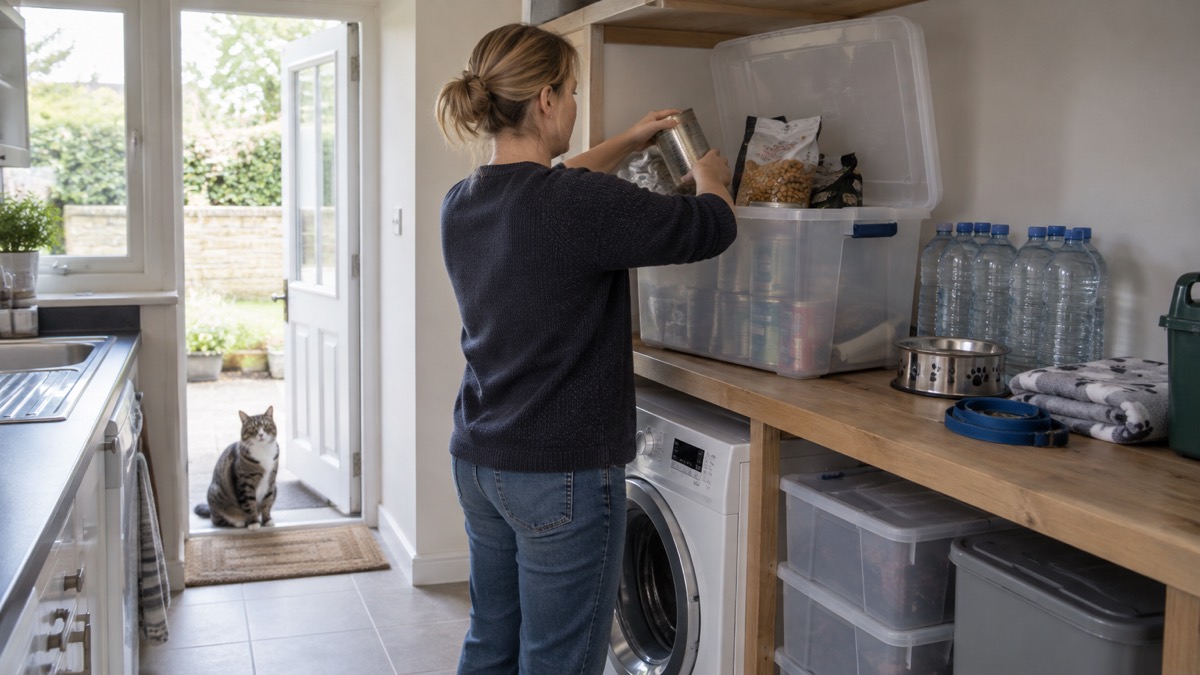
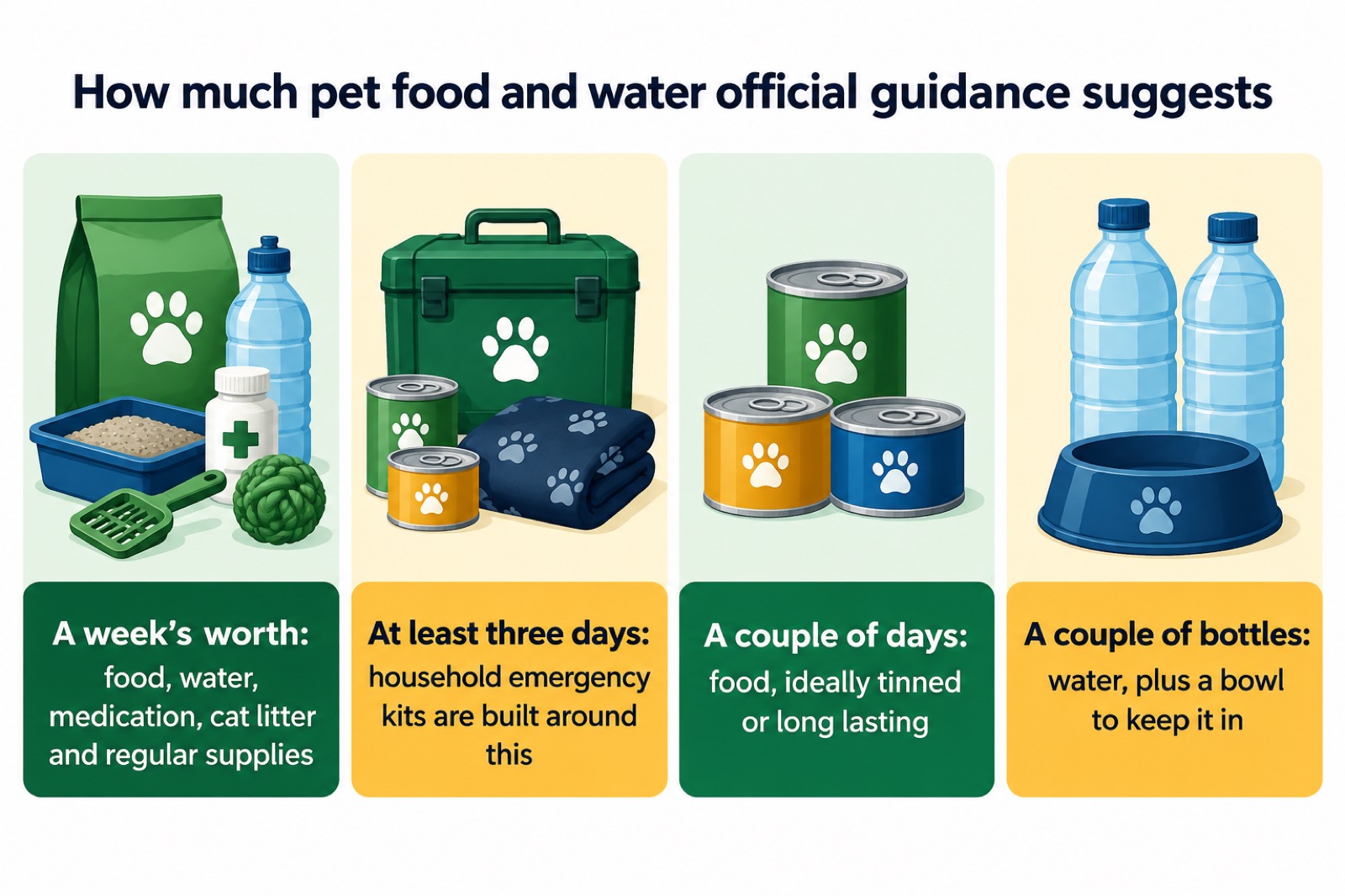
If the power goes off, a storm closes the roads or floodwater cuts your street off, your pet still needs feeding and fresh water. The question is how much to keep in. Official UK guidance gives a range rather than one figure: one council guide advises a week's worth of food, water, medication, cat litter and any other regular supplies your pet needs1, while another suggests a couple of days' supply of food, ideally tinned or long lasting, and a couple of bottles of water with a bowl to keep it in2. Household emergency kits more generally are built around three days3.
For most households the sensible approach is to store at least three days' worth and build towards a week, kept in a waterproof container, with a bowl, medication and litter alongside. Store it where you can reach it quickly, and check the dates as you would your own food store.
Pet emergency checklist: a week's supply of everything your pet needs
Work through this list once, then check it every few months. Each item is something an official guide names for pets in an emergency.
Food: several days' supply in an airtight, waterproof container
Food is the item you will get through fastest, so it sets the size of the store. The figures in official guidance vary. Wiltshire and Swindon's pet guidance suggests a couple of days' supply of food, ideally tinned or long lasting2. Medway Council goes further and advises a week's worth of food, water, medication, cat litter and any other regular supplies1. Household emergency kits more generally are built around three days3.
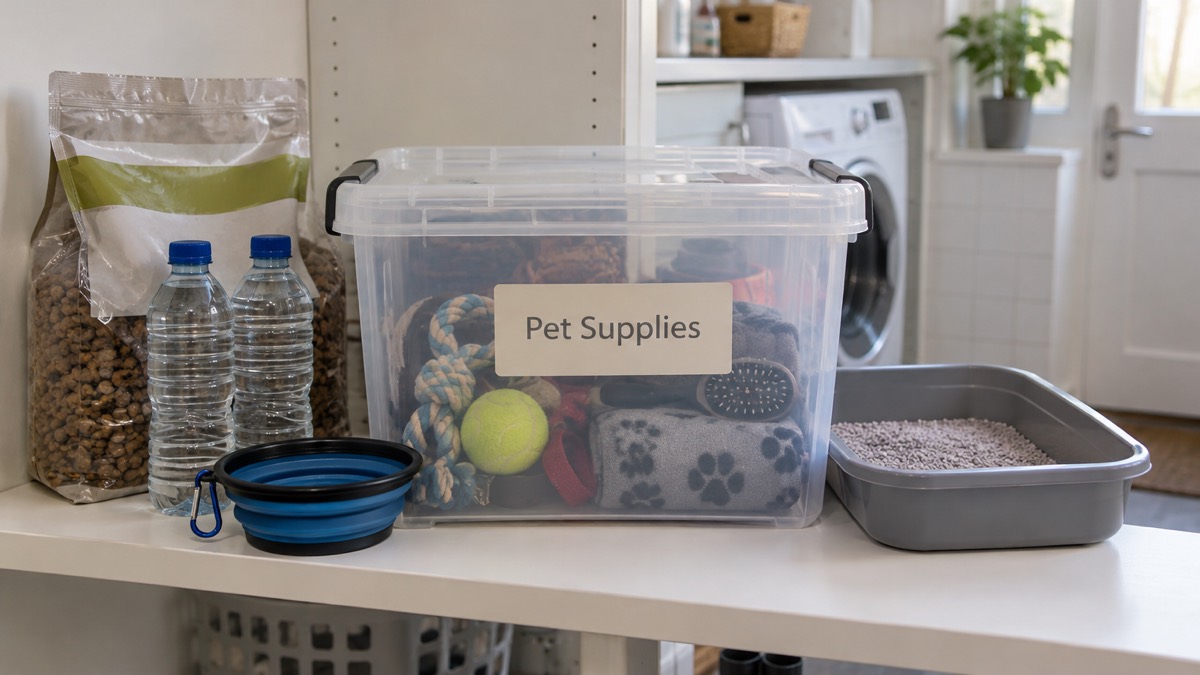
Choose food that keeps. Tinned and long lasting food is what the guidance names2, and household emergency advice more widely favours tinned and dry foods that store safely without electricity8. If your pet is on a specific diet, store that food rather than switching in an emergency, because a sudden change of diet upsets many animals.
The container matters as much as the contents. Council guidance encourages a waterproof container or bag for the emergency pack, kept in an easily accessible place4. For dry food, an airtight tub with a secure lid keeps it fresh and keeps damp out. Tinned and pouched food already comes in water-resistant packaging, and food safety guidance for Scotland says undamaged metal cans, sealed pouches and tetra packs can be kept after a flood, provided the outside of the packaging is cleaned and sanitised first to avoid cross-contamination9.
Water and a bowl to drink from
Water is the item people most often underestimate. Wiltshire and Swindon's pet guidance suggests a couple of bottles of water and a bowl to keep it in2. That is a starting point, not a calculation: a large dog drinks far more than a cat, and animals drink more in warm weather.
Keep your pet's water separate from your household drinking water. Household emergency kits are built on bottled water for people, with the Be Ready checklist giving 3 litres per person per day for drinking, and more needed for cooking and washing3. North Hertfordshire Council notes that additional water might be needed for pets, to make baby formula and for medical devices10. Greater Manchester's resilience advice makes the same point: additional water might be needed to make up baby formula, for medical devices and for pets11. Storing pet water in its own labelled bottles means you can see at a glance how much is left and do not eat into the household supply by accident.
A bowl is part of the kit, not an afterthought. Several council pet lists name a water bowl alongside food and medication12. Keep a bowl in the store rather than relying on the one in the kitchen, so the kit works if you have to leave in a hurry.
Medication, cat litter and other daily supplies
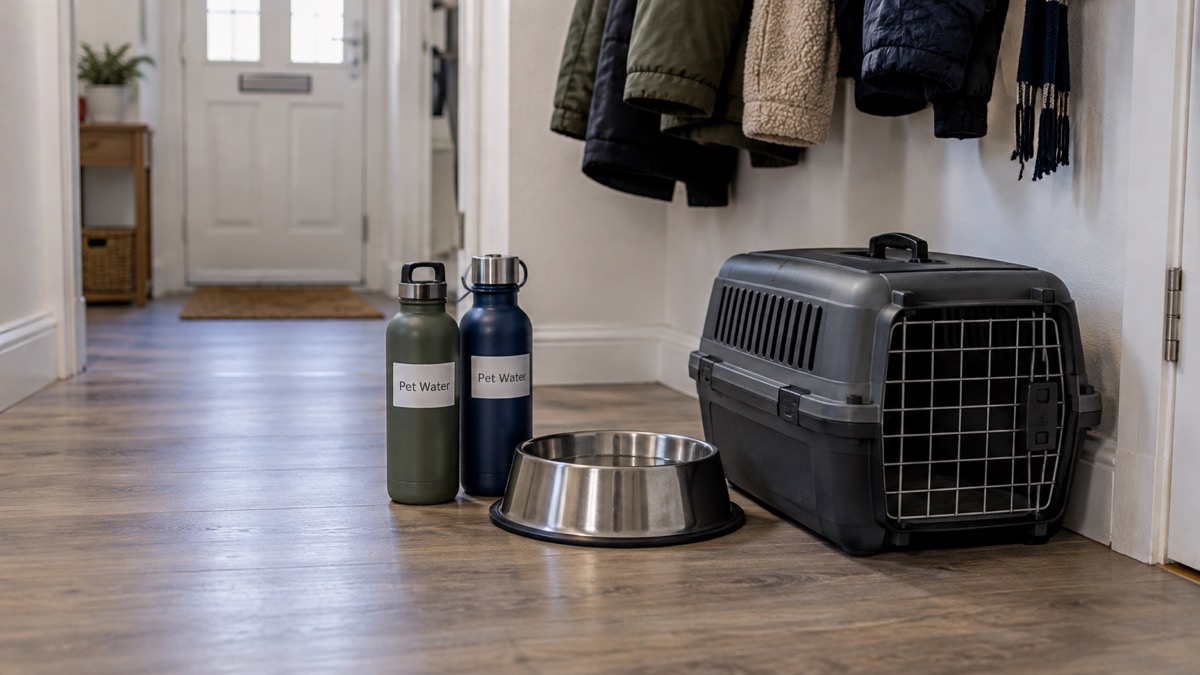
Anything your pet uses every day belongs in the store, because an emergency does not pause a regular routine.
Medication. Wiltshire and Swindon advises a small extra supply of any required medicine, kept in a waterproof cover2. The RSPCA's seasonal advice is to stock up before the holidays so you are not caught out14. Ask your vet in good time about a repeat prescription, keep a written note of doses with the medicine, and store it in the waterproof container with the food.
Cat litter. Medway advises a week's worth of cat litter among the regular supplies1, and South Gloucestershire's pet guidance says to provide a litter tray and litter, including poop bags6. If you have to stay indoors, or move to a rest centre and back, a cat still needs somewhere to go, and a familiar tray is far less stressful than an improvised one.
Other daily supplies. Think about what your animal uses in a normal week: bedding, paper towelling, toys, and for dogs a collar or lead. Northern Ireland's household emergency kit guidance says to put some food in your kit for your pet and anything else they might need, such as a collar or lead, water bowl or medication13. West Yorkshire's pet essentials list adds sturdy leashes, harnesses and carriers, current photos, and pet beds and toys if there is room15.
Keeping supplies in a grab bag
A store at home covers you if you have to stay put. A grab bag covers you if you have to leave. Medway Council defines a grab bag as a small bag light enough for anyone to carry that will hold the essential items for your animals1.
For pets, the same guidance lists a lead or carrier for every animal, any medications your animals need, pet food, vaccination certificates, litter, paper towelling or bedding if needed, and toys1. If leads or carriers will not all fit in the bag, keep them as close to it as possible1. North Yorkshire Fire and Rescue Service advises putting together a grab bag with food, insurance documents and any other essentials your pet may need16.
Household grab bag lists make room for pets too. Hillingdon's list includes pet items among the contents17, Basingstoke's includes spare pet supplies18, and Slough's emergency kit checklist includes pet supplies7. Lancashire Prepared's emergency pack guidance includes pet care items if required19.
How much is enough, and how to keep it ready
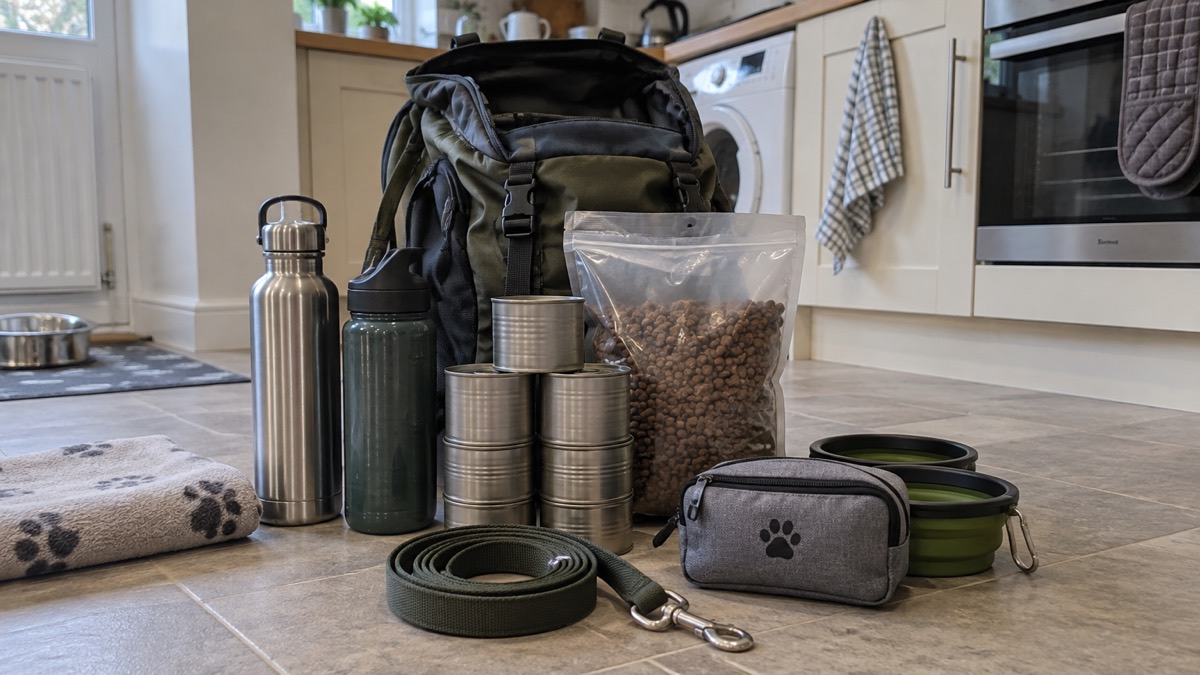
The honest answer is that official guidance gives a range. Three days is the common household benchmark3, a couple of days is the minimum some pet guidance suggests2, and a week is the fuller figure for pets specifically1. Build to three days first, then extend towards a week as storage allows. If you have more than one animal, or a large dog, scale up.
Keep the store in one place, in a waterproof container, somewhere you can reach quickly4. Check it every few months: rotate food and water by date, replace medication before it expires, and make sure the carrier still fits a growing animal.
For the wider picture, see Pets and Animals in an Emergency: A Household Guide and Including Your Pets in a Household Emergency Plan.
Sources (19)
- Looking after your pets in an emergency, Medway Council, 2026-10-29
- Your pets, Wiltshire and Swindon Prepared, 2026-10-25
- Be Ready Checklist, UK Government, 2026-10-21
- Emergency kits and grab bags, Central Bedfordshire Council, 2026
- Emergency advice, Lincolnshire County Council, 2026-10-29
- Preparing your pets for an emergency, South Gloucestershire Council, 2010
- You prepare for emergency, Slough Borough Council, 2026-10-29
- Be prepared at home and in your community, Argyll and Bute Council, 2026
- Flooding, Food Standards Scotland, 2026-10-25
- Preparing for emergencies, North Hertfordshire Council, 2026-10-29
- Loss of essential services, Greater Manchester Combined Authority, 2026-10-29
- Be prepared for emergencies, North Devon Council, 2026-10-29
- Household emergency kit, nidirect, 2026-07-06
- Christmas, RSPCA, 2026-10-29
- Pets, West Yorkshire Prepared, 2026
- Stay safe during Storm Babet, North Yorkshire Fire and Rescue Service, 2023-10-19
- Household emergency plan, Hillingdon Council, 2026-10-29
- Emergency, Basingstoke and Deane Borough Council, 2026-10-29
- Emergency pack, Lancashire Prepared, 2026-10-29
 Pet Emergency Documents
 Carer's Emergency Plan
 Herbert Protocol Form