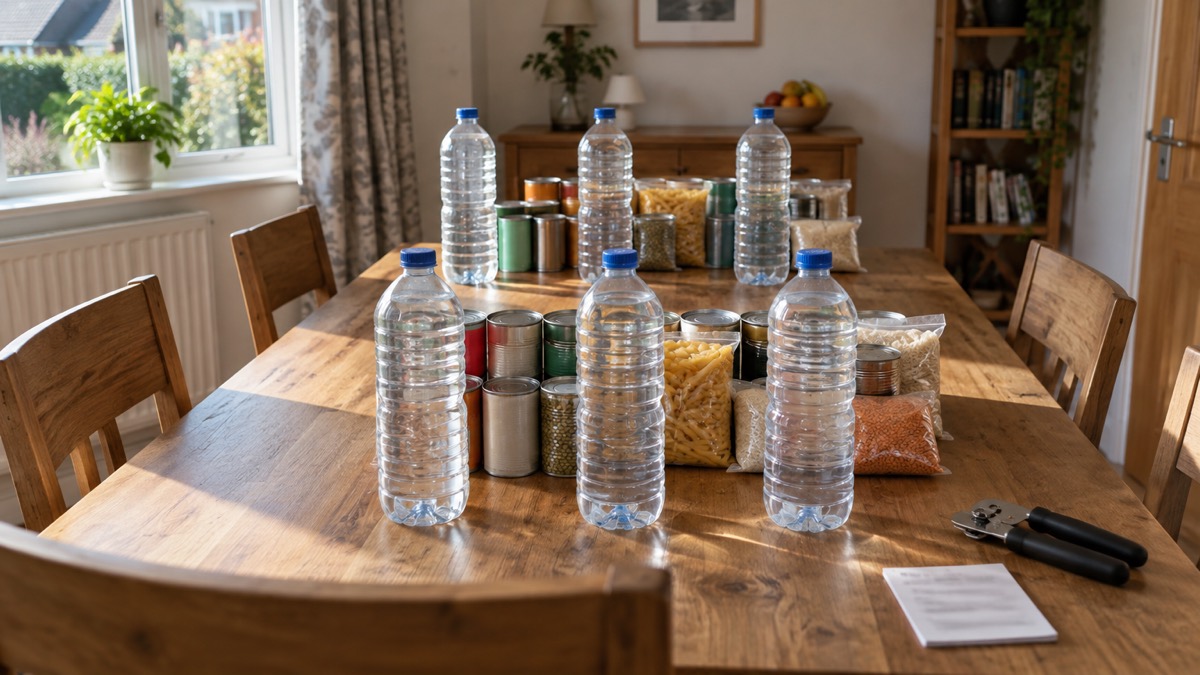
The short answer for a UK household is three days. The government's Be Ready campaign, launched as national advice in October 2026, tells households to keep 3 days' worth of supplies at home, including non-perishable food and bottled water1. Councils and local resilience partnerships across England, Scotland and Wales give the same figure: enough food and bottled drinking water to last three days2.
Three days is a starting point, not a ceiling. Some local authorities go further: Central Bedfordshire recommends a home emergency kit that can look after your family for at least 7 days of disruption5, and one community resilience booklet advises enough emergency reserves in the house for up to ten days, including essential medications, food and water6. This page explains what three days actually means in litres and tins, when it is sensible to plan for longer, and how to build the store up gradually without overspending.
What the government advises households to plan for
The government's household resilience advice has been published since May 2024, and in October 2026 it was reinforced with a campaign encouraging households to take small, simple steps to stay prepared, including keeping a small supply of non-perishable food and bottled water at home11. The Be Ready campaign puts a number on it: 3 days' worth of supplies1. Greater Manchester's resilience guidance frames it the same way, asking households to consider what supplies they might need during an emergency lasting a few days, such as a power cut12.
The reasoning behind the figure is straightforward. Emergency services and councils plan to reach people and restore services quickly, but they may not manage it instantly. Lancashire's emergency pack guidance is blunt about this: the emergency services might not be able to reach you straight away, and you may have to support yourself and your family for some time3. Government plans exist to keep essential services like food, water, transport, health and financial services working in an emergency13, but those plans operate at a national and regional level. Your three-day store is the bridge between the moment something goes wrong and the moment help or restoration arrives.
The advice is consistent across the UK's nations. In Scotland, Ready Scotland and Dumfries and Galloway Council both advise supplies for at least three days14. In Wales, Anglesey's home emergency plan tells households to have sufficient food in the house for three days16. English councils from Renfrewshire's neighbours to Lincolnshire give the same duration17. Wherever you live, three days is the baseline to work from.
Start with three days, then build towards longer
Three days is the floor, and it is deliberately achievable. Renfrewshire Council advises keeping a range of supplies that can meet essential household needs for at least 3 days17. Lincolnshire's emergency advice says at least three days' supply of non-perishable food18. West Yorkshire's household emergency plan suggests food and bottled water for 3 days, and specifically warns not to rely on your fridge or freezer for food19, because a power cut or a water supply failure takes both out of the picture.
Once three days is in place, some households choose to extend it. Central Bedfordshire Council recommends a home emergency kit sufficient for at least 7 days of disruption5. A community resilience booklet produced for Culham goes further still, advising enough emergency reserves in your house for up to ten days, including essential medications, food and water6. Neither figure is a national requirement; they reflect the reality that some disruptions, particularly severe weather in rural areas, can last longer than three days.
How far you go depends on your circumstances rather than on a rule. Argyll and Bute Council, whose area includes remote communities, advises keeping at least three days' supply of food, bottled water and other essentials, including medicines, and tinned and dry foods which store safely without electricity20. Households in isolated places, those with someone medically dependent on equipment or medication, and those who experienced long outages in past storms may reasonably work towards the 7-day or ten-day figures. Everyone else can stop at three days and be confident that they meet the national advice.
Water: how much per person per day
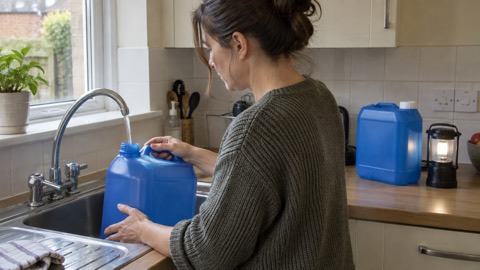
The government's Be Ready checklist gives the working figure: bottled water for 3 days, at 3 litres per person per day for drinking, with more needed for other tasks such as cooking and washing7. The accompanying household emergency plan repeats the same amount, 3 litres per person per day for at least 3 days8. Multiply that by the number of people in your household and you have your drinking-water total for three days.
The 3-litre figure sits at the top of a survival minimum. North Devon Council notes that a minimum of 2.5 to 3 litres of drinking water per person per day is recommended by the World Health Organisation for survival22. The UK guidance rounds up to 3 litres and then adds that cooking and washing need more, so treat 3 litres as the drinking-only floor, not the total.
For planning beyond drinking water, the Drinking Water Inspectorate sets out what public water companies are required to plan for: alternative supplies of at least 10 litres per person per day for the first 24 hours, and for a prolonged event, 20 litres per person per day23. Those are the companies' obligations, not yours, but they give a sense of scale: if you want your store to cover washing and cooking as well as drinking, working towards those amounts per person is a reasonable ambition.
How long could a water outage actually last? The London Risk Register records that a failure of water supply infrastructure could affect up to 350,000 people for between 24 hours and two weeks24. That range is exactly why some households extend beyond three days. Bradford Council's flood pack advice is simpler and applies whatever the cause: keep at least a three-day supply of water for each person in your household25.
| Purpose | Amount per person | Source |
|---|---|---|
| Drinking, survival minimum | 2.5 to 3 litres per day (WHO) | 22 |
| Drinking, UK official advice | 3 litres per day for 3 days | 7 |
| Cooking and washing as well | More than the drinking figure | 7 |
| Water companies' planning duty, first 24 hours | 10 litres per day | 23 |
| Water companies' planning duty, prolonged event | 20 litres per day | 23 |
Bottled water carries its own date. Wiltshire and Swindon Prepared, advising on national power outages, suggests holding a small amount of bottled water at home but making sure it is not past its expiry date26. Buy sealed bottles, note the dates, and rotate them as you would food. For everything else about storing and treating water, see our water guide.
Food that keeps without power or cooking
The food in your three-day store has one job: to be edible when the power is off and the cooker is cold. The Be Ready checklist specifies non-perishable food for 3 days: food with a long shelf life that does not need refrigeration or cooking, such as tinned meat, fish or vegetables, dried fruit and nuts, and it is best to buy food you would usually eat27. The household emergency plan version adds the detail that catches many people out: include a tin opener8.
Birmingham's loss-of-utilities guidance compresses it to three days' supply of bottled water and ready-to-eat food that will not spoil28. Denbighshire's emergency supplies kit goes into the most detail on what "ready to eat" means: foods you can readily eat without heating or water, such as ready-to-eat meats or tuna, fruits, vegetables, canned or boxed juices, UHT milk, soup, high energy foods like crackers or cereal bars, vitamins, food for infants or persons on special diets, biscuits, boiled sweets and powdered milk29.
The common thread across every list is that nothing depends on electricity. West Yorkshire's plan makes the point directly: do not rely on your fridge or freezer for food19. A full freezer is a useful buffer in a short power cut, but it is not an emergency store, because it fails exactly when the emergency begins. Build the store from the cupboard instead:
- Tinned meat, fish, fruit and vegetables, with a manual tin opener8
- Dried fruit, nuts, cereal bars and crackers27
- UHT milk, powdered milk, canned or boxed juices and soup29
- Biscuits and boiled sweets29
- Food for infants and anyone on a special diet29
For a full treatment of storing food, eating safely without power and planning meals, see our emergency food guide.
Building a longer food store
If you decide to move from three days towards seven or ten, the same principles apply, just multiplied. The Be Ready checklist's advice does not change with duration: long shelf life, no refrigeration or cooking, food you would usually eat27. Denbighshire's kit guidance offers a practical method for the longer term: replace the whole food side of the kit every six months and live off the replaced food for a few days, rather than making constant small changes29. That has two benefits: nothing expires unnoticed, and your household finds out which stored foods it actually enjoys eating.
A longer store also earns its keep in scenarios where resupply is genuinely slow. The London Risk Register's water infrastructure scenario, with effects lasting between 24 hours and two weeks24, is the kind of event a ten-day store covers comfortably and a three-day store does not. Severe snow, which can close rural roads for days, is another. Against those, set the NHS's reminder that you do not need to stockpile21: a store is a buffer, not a bunker, and ten days of food you will eventually eat anyway is the sensible upper end for an ordinary household.
Budget need not be an obstacle. Ready Scotland states plainly that you can build up a home emergency kit over time and keep it in a safe place, and that you do not need to buy all the items at once14. Add a few tins and a bottle of water to the weekly shop, and the store assembles itself over a month or two. North Hertfordshire's checklist, which plans for at least three days, is built from exactly these ordinary items30.
Medicines, baby needs and pets: what runs out first
Food and water can be improvised from what is in the house; prescription medicines cannot. Wiltshire Council's emergency kit list includes spare medication31, and Dumfries and Galloway's household emergency pack includes medication as standard32. Norfolk and Suffolk NHS guidance adds the reassuring note that many people keep a small supply of long-life food, drinking water, toiletries and prescription medicines at home, and that if you have babies, young children or pets, you should think about the additional supplies they need21.
The NHS's own rules on emergency medication matter here. A community pharmacist can make an emergency supply of medication when you have run out, and the pharmacist will decide how much to supply, up to a maximum of 30 days9. But the same guidance stresses that this is for urgent need only, and that you should always order repeat medication from your GP practice in good time so that you never run out9. In other words, the emergency supply is a backstop, not a plan: your plan is ordering repeats early and keeping a small buffer at home.
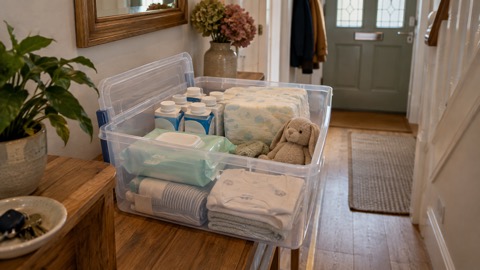
Babies and pets need their own lines in the store. North Hertfordshire's specific-needs list includes baby supplies such as nappies and ready-made formula, alongside toiletries and sanitary items, a change of clothes, waterproof clothing and boots, eating utensils, paper cups and plates, disinfectant, cash, and books and games for children30. Birmingham's household emergency supplies list adds pet food, water and routine medication for animals33. Ready-made formula is the item to note: it needs no boiled water, which matters when the power or the water supply is off.
- Prescription medicines: order repeats early, keep a small buffer9
- Baby supplies: nappies and ready-made formula30
- Pets: food, water and routine medication33
- Toiletries and sanitary items30
- Books and games for children30
For more on looking after medically dependent household members, see our guide to extra help in an emergency, and for animals, our pets guide.
Rotating stock so supplies stay in date
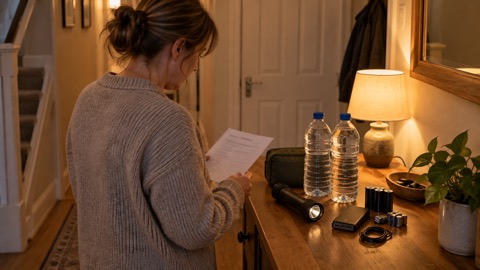
A store only works if it is still edible when you need it. Lancashire's industrial incident advice is to keep a stock of essential supplies and remember to check the use by dates of perishable items regularly34. North Devon's guidance generalises it: check your plan and supplies periodically, replacing expired items and keeping devices charged22. Denbighshire suggests a concrete system: make a list of all the kit's contents, put it outside the kit or in a prominent place, and write all the expiry dates on the list with when they need changing29.
Knowing which date you are looking at matters as much as checking it. Food Standards Scotland explains the difference plainly:
"A use-by date is about food safety. After this date the food is not safe to eat."
Food Standards Scotland35
Use-by dates apply to foods that go off quickly. Best-before dates are about quality instead, and some milk and dairy products carry a best-before rather than a use-by date because of the technologies used in production and the testing applied35. One condition applies to every date on the label: a best-before date is only valid if the food is stored according to the instructions on the label35, so a cool, dry, sealed cupboard is not just tidy, it is what keeps your dates honest.
The simplest rotation method is the one Denbighshire describes: eat the store, then refill it29. When you replace the food side of the kit every six months and live off the replaced food for a few days, nothing sits until it expires, and you learn what your household will actually eat. Our guide to checking and restocking supplies walks through the process in detail.
Where to store supplies, and where not to
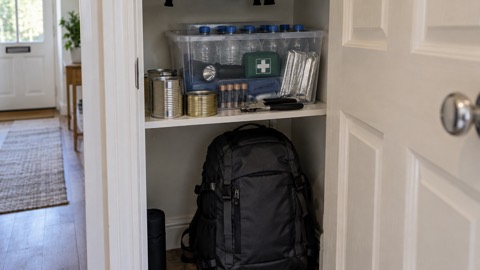
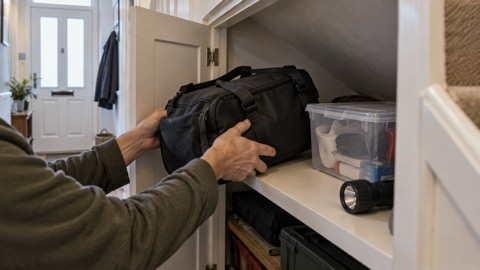
Storage comes down to three rules: accessible, appropriate to the food, and not a stockpile. Dorset Prepared advises that a grab bag should be stored somewhere easily accessible in an emergency10, and the same logic applies to the home store: if it is buried behind the Christmas decorations, it may as well not exist. Ready Scotland says to keep the kit in a safe place14, which in practice means cool, dry and off the floor.
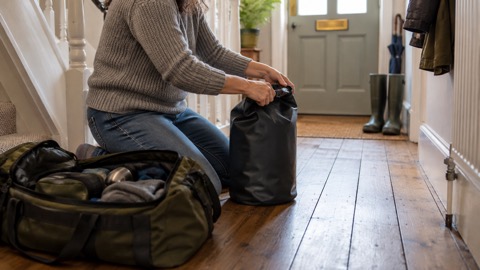
The food itself should be long-life by design. Wiltshire and Swindon Prepared advises that the food you have does not need to be fresh or perishable, and that it is better to avoid these and keep longer lasting products such as tinned food for emergencies26. That aligns with the label rule from Food Standards Scotland: dates are only valid if storage instructions are followed35. A garage that freezes in winter and bakes in summer will shorten the life of anything stored in it.
Finally, keep the scale sensible. The NHS is explicit that you do not need to stockpile food or medicines21. A three-day store that fits in one cupboard, or a seven-to-ten-day store that fills a shelf, is well within the official advice; a room full of goods is not what any of this guidance asks for. Our page on where and how to store your supplies safely covers the practicalities.
When to stay put and when to leave with what you have
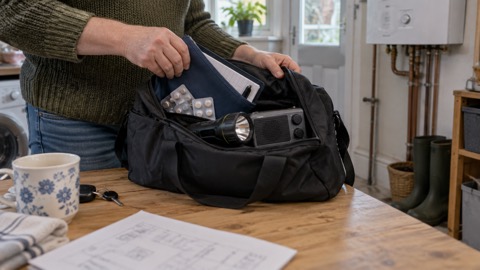
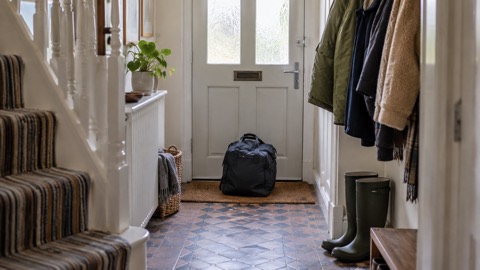
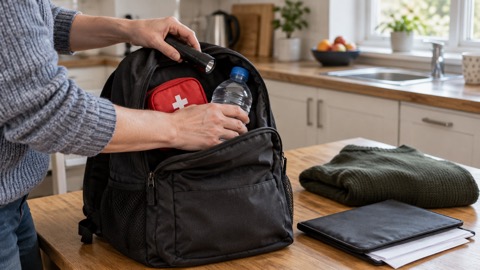
Most emergencies that stretch supplies are stay-at-home events: storms, power cuts, water supply failures. For those, the home store does its job where it sits. But some emergencies mean leaving, and the two stores are different. Wiltshire Council notes that emergency kits are sometimes called "grab bags"31, and Greater Manchester advises packing an emergency grab bag that includes your basic necessities12. Dorset Prepared defines its purpose: a bag stored somewhere easily accessible, containing all the items that are important to you and your family, with items that will keep you safe for up to 48 hours10.
So the shape of your preparation is a pair, not a single item: a home store measured in days, and a grab bag measured in hours. North Devon suggests keeping essential items in a small, easy-to-carry bag such as a rucksack in case you are advised to leave home22. What goes in it is covered in our grab bag guide; the essentials on the move are the ones that cannot be replaced elsewhere, and Neath Port Talbot's kit checklist includes essential medication and spare batteries among them33.
If you are told to evacuate and have time, Scottish Borders' emergency planning guidance sets out the order of business: make sure that fires are out, your water, gas and electricity are switched off, and your property is locked up; and take along medicines, warm clothes, any special foods, and personal documents29. The safety warning comes first, though. North Devon's guidance is unambiguous:
"If there is a fire or another immediate danger, leave straight away, follow the emergency services' instructions and do not delay to collect a bag."
North Devon Council22
No store is worth that delay. The grab bag exists so that, in a calm evacuation, you have what matters; in an immediate danger, you have only to leave.
Where to get help if supplies run out
Help exists at several levels, and knowing the sequence saves scrambling. For medicines, the community pharmacy emergency supply is the first stop: the pharmacist will decide how much to supply, up to a maximum of 30 days, and will make a record of the supply; the prescriber must then supply a prescription within 72 hours9. This service is for urgent need only, which is why the same guidance insists on ordering repeats from your GP practice in good time9.
For food and essentials, the practical backstop is the people around you. The Culham resilience booklet advises identifying at least one emergency friend who lives nearby and a second one who lives further away, and arranging to swap house keys, provide places to stay, look after each other's children and keep copies of important documents safe for each other6. That arrangement is worth making before any emergency, and it costs nothing. Our community resilience guide covers how neighbourhoods organise this.
Beyond that, government plans exist to keep essential services like food, water, transport, health and financial services working in an emergency13, and councils and the emergency services coordinate local response. Your three-day store is not a substitute for that system; it is the margin that lets the system reach everyone in time. If you or someone in your household needs extra support because of age, disability or medical dependence, ask your energy and water suppliers about their priority services registers, covered in our extra help guide.
Sources (35)
- Be Ready campaign, UK Government, 2026
- Households encouraged to take small, simple steps to stay prepared in an emergency, GOV.UK, 2026
- Be Ready Checklist, UK Government, 2026
- Be Ready Household Emergency Plan, UK Government, 2026
- Prepare yourself, Greater Manchester Combined Authority, 2026
- National emergencies, GOV.UK, 2026
- Prepare your home for emergencies, Renfrewshire Council, 2025
- Emergency pack, Lancashire Prepared, 2026
- Get help and advice in an emergency, Lincolnshire Council, 2026
- Household Emergency Plan, West Yorkshire Prepared, 2020
- Prepare for emergencies, Dumfries and Galloway Council, 2026
- Preparing for emergencies, North Hertfordshire District Council, 2015
- Be prepared at home and in your community, Argyll and Bute Council
- Emergency kit, Ready Scotland, 2026
- Emergency kits and grab bags, Central Bedfordshire Council, 2026
- Are You Ready booklet, Culham Parish Council, 2025
- Be prepared for emergencies, North Devon Council, 2026
- Managing insufficiency of private water supplies, Drinking Water Inspectorate, 2025
- London Risk Register v14, Greater London Authority, 2025
- Create a flood pack, Bradford Council, 2026
- Loss of utilities, Birmingham City Council, 2026
- Be prepared for winter emergencies, NHS Norfolk and Suffolk, 2026
- Planning for an emergency kit, Wiltshire Council, 2026
- Emergency supply of medication, NHS Nottingham and Nottinghamshire, 2026
- Use-by and best-before dates, Food Standards Scotland, 2026
- Industrial incident advice, Lancashire Prepared, 2026
- What is a national power outage, Wiltshire and Swindon Prepared, 2026
- Emergency supplies kit, Denbighshire County Council, 2020
- Emergency planning, Scottish Borders Council, 2026
- Protect yourself and your family, Dorset Prepared, 2026
- Create a household emergency lifesaving plan, Dumfries and Galloway Council, 2026
- Birmingham Prepared: Are you ready, Birmingham City Council, 2026
- Emergency kit checklist, Neath Port Talbot Council, 2026
- Gavinton, Fogo and Polwarth Resilient Community Plan, Scottish Borders Council, 2018
- Home Emergency Plan, Isle of Anglesey County Council, 2020
 30-Day Household Checklist
 Emergency Plan Template
 Supply Interruption Checklist
 Home Emergency Pack
 Grab Bags
 What to Keep in Your Car
 Important Documents
 Cash to Keep at Home
 Storing Your Supplies Safely
 Checking and Restocking Supplies
 Rucksacks and Holdalls
 Keeping Supplies Dry
 Foil Blankets
 Portable Jump Starters
 Supplies for Babies and Children