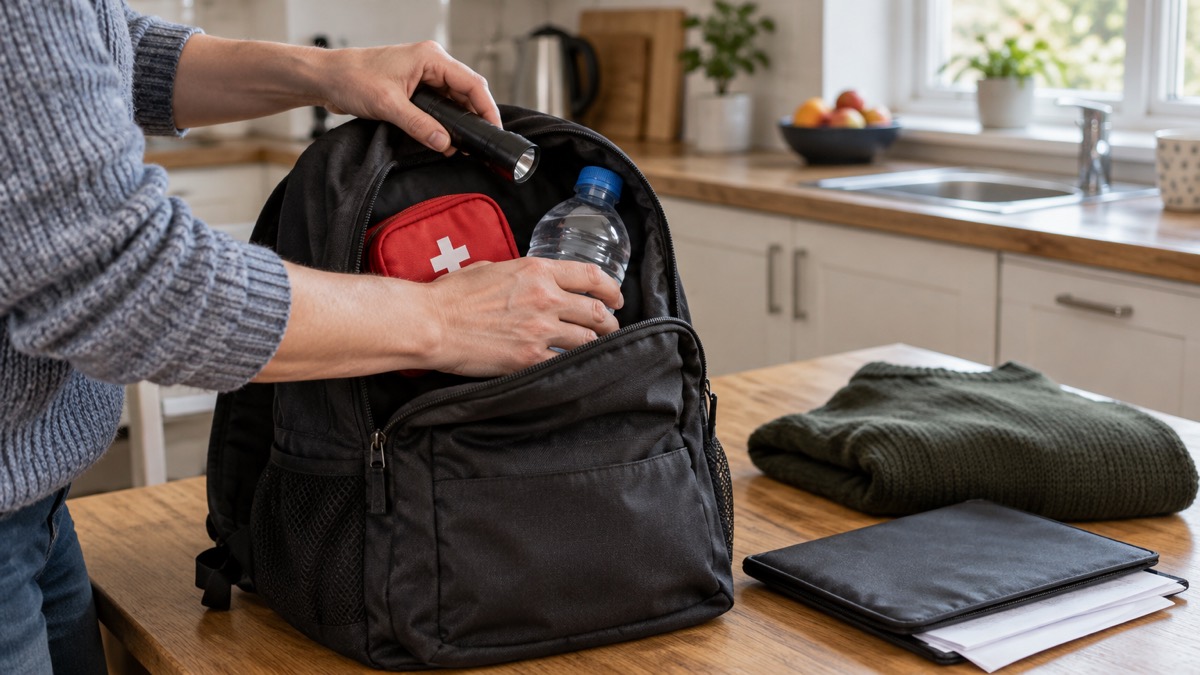
A grab bag is only as good as the bag you put it in. Official guidance across the UK is consistent about what the bag should hold: bottled water, medicines, a torch, a radio and batteries, copies of important documents and a change of clothes, so you can cope if you have to leave home quickly or your power and water are disrupted1. But that guidance says less about the container itself, and the container is what you will actually be carrying, in the dark, possibly in the rain, possibly for longer than you expect.
The good news is that you do not need a specialist product. Councils and resilience partnerships describe the container in plain terms: a sturdy waterproof bag, kept somewhere you can reach quickly2. An old rucksack, a holdall or a wheeled case can all work, depending on your household and how far you might have to walk. What matters is that the bag is big enough for your household's contents, comfortable enough to carry, keeps those contents dry, and sits in a place every member of the household knows about.
This page is about choosing and placing that bag. For what goes inside it, see Grab Bags: What to Pack If You Have to Leave Home, and for the wider household pack, What to Keep in a Household Emergency Pack at Home.
What a grab bag needs to do for your household
Before choosing a bag, be clear about the job. The Met Office's seasonal advice is typical of official guidance: put together a grab bag with bottled water, medicines, a torch, radio and batteries, copies of important documents and a change of clothes, in case you have to leave home quickly or your power and water are disrupted1. The same advice appears in the summer version: the bag helps if you have to leave home quickly in an emergency, or if your power or water are disrupted7. So the bag has to do two jobs, and they place different demands on it.
The first job is evacuation: you may be walking out of your home at short notice, possibly in bad weather, possibly to a rest centre or to family. The London Resilience guidance describes it simply as packing "a 'grab bag' of essential items that might be helpful if you have to leave your home at short notice"8. For that job the bag needs to be comfortable to carry, keep water out, and be light enough that the weakest person who might carry it can manage it.
The second job is sheltering in place during a disruption, when the bag is more of a store than a carry-all. Here the contents list grows. Hillingdon's guidance is one of the fullest: a copy of your household emergency plan, long life food and snacks, bottled water, prescription medications, seasonal clothes, a wind up or battery powered radio, cash in small bills, important documents including insurance papers and ID, a torch, phone charger, power bank, first aid kit, basic toiletries, a blanket, baby food and care items, pet items, a map, a whistle, pen and notepad, and home and car keys9. North Yorkshire Fire and Rescue Service, writing after Storm Babet, adds the same core list: medication, a torch, important documents such as insurance details and utility information, warm clothing, spare keys, a first aid kit, baby milk and nappies, water, snacks, and a fully charged mobile with a spare battery if possible10.
That is a lot to carry, and it is why bag choice matters. A bag that is too small forces you to leave things behind; a bag that is too big invites you to fill it until it is too heavy to carry. Size the bag around your own household's list, not around a generic one. A single adult's list is short. A household with a baby, a pet and an older relative needs more volume, and probably more than one bag, which is covered below.
Comfort features are worth more than they sound. A rucksack with padded shoulder straps and a chest strap spreads the weight across your body and leaves your hands free, which matters if you are holding a child's hand, a pet lead or a torch. A holdall with both a shoulder strap and short handles can be carried two ways and handed between people. Grab handles matter too: one maker of waterproof backpacks fits a top grab handle specifically for "quick lifting and moving your backpack with ease"11, and that is the right instinct even in an ordinary bag, because in an evacuation you may be lifting the bag off a high shelf or out of a car boot in a hurry.
Keeping the contents dry
Water is the most likely thing to ruin a grab bag's contents, whether you are evacuating through rain or your bag is stored somewhere damp. Several UK councils make waterproofing part of the instruction itself. Dumfries and Galloway Council's household emergency plan encourages "the use of a waterproof container or bag" for the pack, kept in an easily accessible place4. Argyll and Bute Council says the same in plainer words: put your emergency kit "in a safe place which you can reach quickly, in a sturdy waterproof bag"2. So a waterproof outer bag, or a waterproof liner inside an ordinary bag, is not an optional extra; it is what the guidance asks for.
There are two ways to achieve it, and they suit different households.
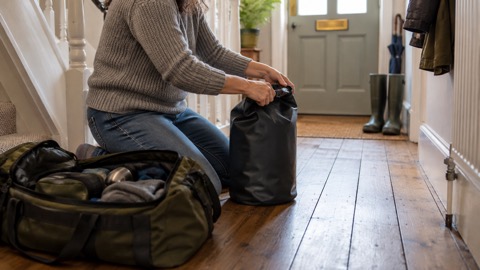
A waterproof bag as the grab bag itself. Some makers build rucksacks and holdalls that are waterproof throughout. Aquapac makes a heavyweight waterproof backpack with a top grab handle for quick lifting11. OverBoard makes a waterproof dry tube bag with a fold-seal closure, a sealing stiffener bar, a toughened base, a top carry handle and a removable adjustable shoulder strap, which the maker says makes it easy to carry even when fully packed12. Ortlieb's dry bag uses a roll closure with a single stiffener bar, which the maker says ensures "absolute waterproofness, protection and optimal packing volume"13. A bag like this is the simplest answer for a flood-prone household, because the whole bag can be carried through standing water or heavy rain.
Dry bags and pouches as liners inside an ordinary bag. If you already have a serviceable rucksack, line it. Ortlieb's own datasheet describes its dry bag as "ideal for waterproof packing (e.g. sleeping bags) in backpacks"14, which is exactly this use. Aquapac makes a lightweight dry sack with grab handles at both ends, which the maker says makes pulling it in and out of packs easy even with gloves or wet hands15, a small but real advantage in a winter evacuation. Aquapac also makes a waterproof first aid kit bag whose roll-top straps double as a carry handle16, so a vulnerable item can be protected individually. Steroplast's WaterStop emergency bag has long shoulder strap and short handles, with zippers the maker describes as powerful enough for use in heavy rain17.
| Approach | What it is | Who it suits |
|---|---|---|
| Waterproof rucksack or holdall | The grab bag itself is waterproof, e.g. a heavyweight waterproof backpack11 or a dry tube bag with fold seal and shoulder strap12 | Flood-prone households; anyone evacuating on foot in bad weather |
| Dry bags as liners | Roll-closure dry bags packed inside an ordinary rucksack14 | Households with a good bag already; lets you keep using it day to day |
| Small dry sacks and pouches | Dry sacks with grab handles15; waterproof first aid pouch16 | Protecting individual items: documents, first aid kit, medicines |
| Water-resistant holdall | Bag with rain-resistant zips, e.g. long strap and short handles17 | Car-based households, short evacuations, sheltering in place |
For documents specifically, waterproofing is not optional. The Scottish Government's grab bag list includes copies of insurance documents among the contents8, and paper that has sat in a damp cupboard for a year is not a copy you can rely on. See Important Documents: Which to Keep Ready and How to Store Copies for what to include, and Keeping Supplies Dry: Dry Bags, Pouches and Waterproof Cases for a fuller treatment of the options.
One related point from the flood guidance: if you use sandbags or gel bags to protect the home itself, Somerset Council advises drying them out for reuse, raised off the ground while they dry to help prevent mould forming18. A grab bag stored in the same porch as damp sandbags will not stay dry for long, so store the two separately.
One bag per person, or one for the household?
Official guidance points both ways, and the honest answer is that it depends on your household.
The clearest statement for individual bags comes from Hillingdon's household emergency plan: "It's a good idea to make a grab-and-go bag for your home, workplace and vehicle. Each member of the household should have their own bag"3. That approach has real advantages. Each bag is light enough for its owner to carry. Nobody's medication, clothes or comfort items are separated from them in a crowded evacuation. Children can carry their own small bag, which gives them something to hold and a job to do. And a bag that lives with a person can go with them to work or school, which is where Hillingdon's advice about a workplace bag connects to the idea of a work bag kept at your desk.
The case for a single household bag is simplicity. One packed bag by the door is easier to check, easier to grab and easier to keep in date than four, and a shared bag can still hold per-person items in separate labelled dry sacks. That is the pattern that works for most households: one main bag holding the shared items, with per-person items either inside it in separate labelled dry sacks or in small individual bags.
A practical split looks like this:
- Main household bag: water, food, first aid kit, torch, radio, documents, toiletries, blankets, pet supplies, the household emergency plan9
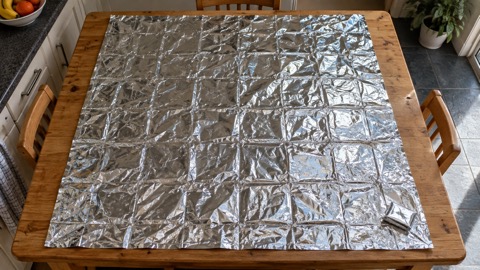
- Per-person items: medication, glasses or contact lenses, a change of seasonal clothes, foil blanket (one per household member)19, comfort items for children
- Per-person small bags, if you use them: light enough for the owner to carry, kept with or beside the main bag
Anglesey's home emergency plan adds a useful discipline whichever route you take: the bag should be checked regularly, and it lists the special items that vary by person, such as glasses, contact lenses and items for babies, children and the elderly21. A per-person check is easier to keep current than a single shared one, because each owner notices when their own medication or clothes size changes. See Checking and Restocking Supplies: Expiry Dates and Replacing Items for a routine.
Where to keep the bag so you can reach it fast
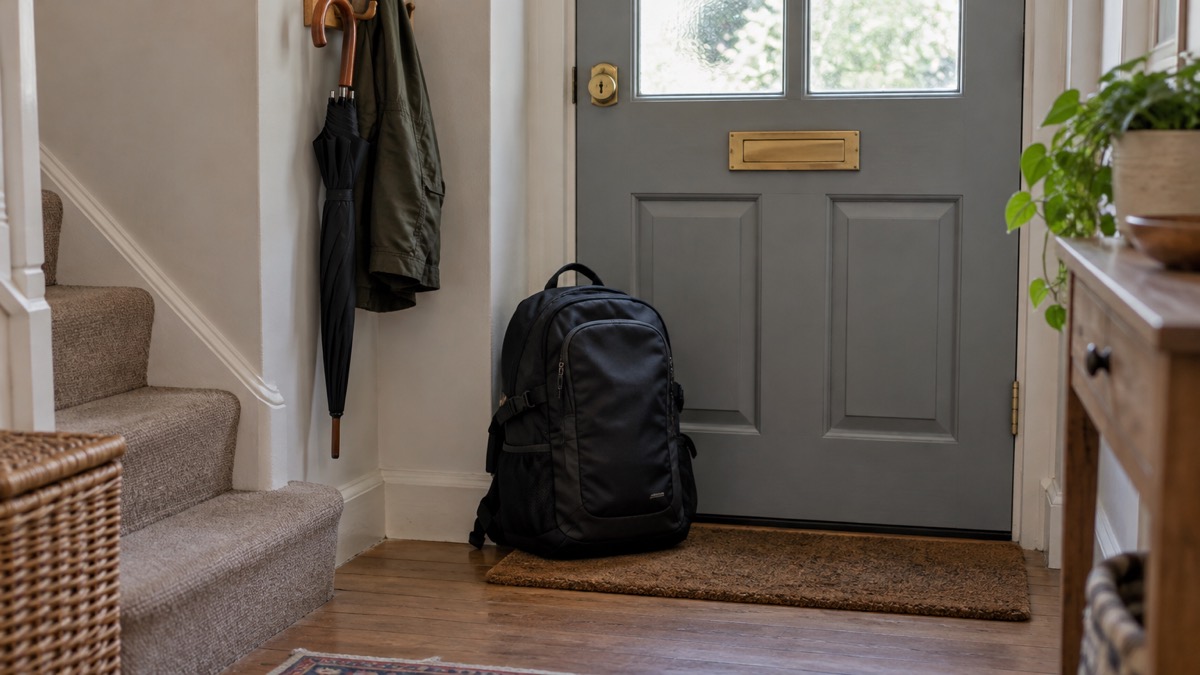
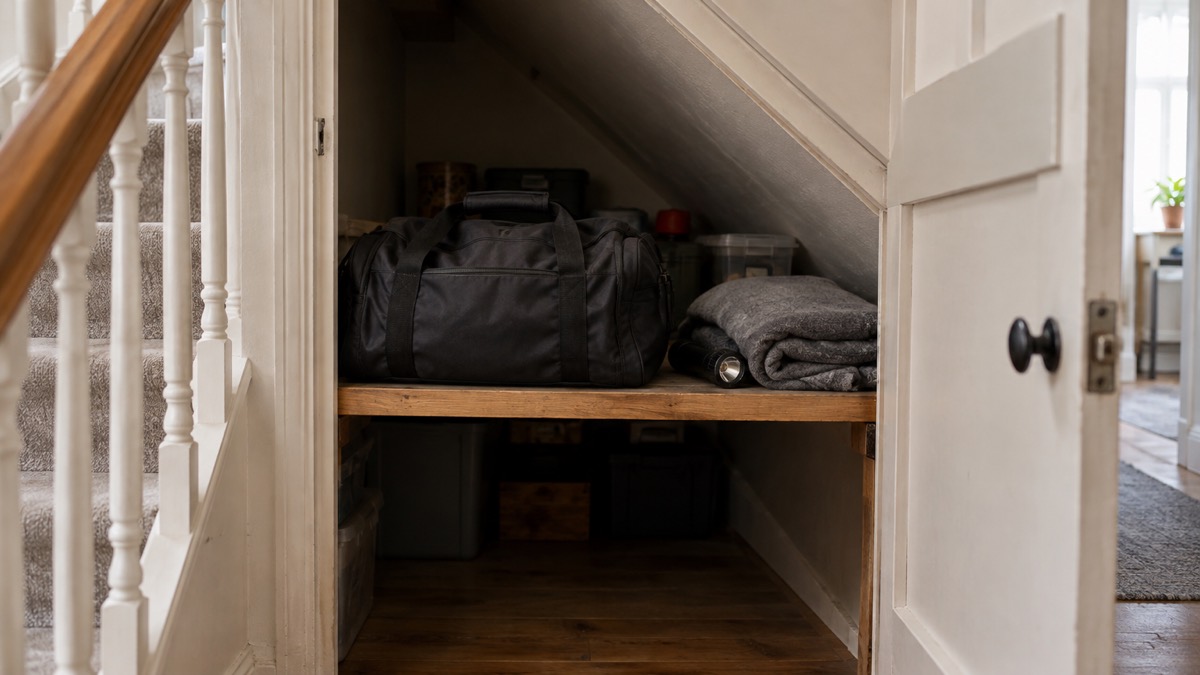
A grab bag you cannot reach quickly is not a grab bag. Basingstoke and Deane Borough Council puts the instruction in two parts: "Keep this bag in an easy to reach place and let your household know where it is"5. Both parts matter. A bag at the back of the loft fails the first; a bag only one adult knows about fails the second, because that adult may be at work when the emergency happens.
For flood-prone households, Harborough District Council's flood grab bag guidance is more specific still: keep it upstairs or near your door6. Upstairs protects the bag from floodwater itself; near the door makes it fast to take. Which of those matters more depends on how floods behave where you live: if water rises slowly, upstairs wins; if you may be told to leave at short notice, by the door wins. The government's flooding guidance says to store the bag somewhere you can easily get to, and lists medication, a first aid kit, important documents, a torch, bottled water, warm waterproof clothing and baby care items among the contents22.
The same principle applies to pet supplies. Medway Council's pet emergency guidance says to make sure you store the bag in an easy to reach place23, and if leads and carriers will not fit in the bag, keep them as close to the bag as possible23.
A few placement points worth checking:
- Everyone in the household, including children old enough to understand, knows where the bag is5
- The bag is reachable without moving furniture, climbing ladders or searching
- It is not in a garage, shed or outbuilding you may not be able to reach in a flood or storm
- Pet leads and carriers sit beside it, not in another room23
- A second bag in the car covers the journeys where you are not at home, see What to Keep in Your Car in Case of a Breakdown or Storm
Bags for particular households
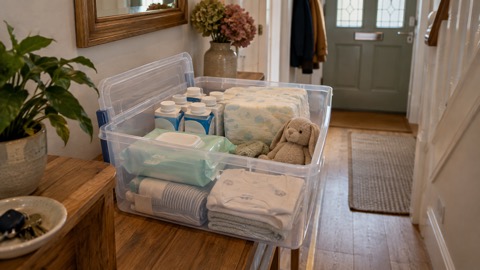
Children and babies. Official flood guidance for households with children lists nappies and wipes, baby food, milk and bottles, spare clothes and comfort items such as a toy or book6. Northern Powergrid's preparedness blog adds, for parents, "maybe something to entertain the kids"24. A child's own small bag can hold their comfort item, spare clothes and a book, leaving the main bag for the heavier shared items. See Supplies to Pack for Babies and Young Children for the full list.
Medication and medical needs. Prescription medications appear on every official contents list1, and Anglesey's plan adds prescription details as a written item21. The NHS Torbay and South Devon carers' service, writing about hospital grab bags, suggests small comforts that also serve a waiting household: drinks or sweets such as mints or gum to keep the mouth moist and fresh, a small amount of cash, and plastic bags for dirty laundry25. If your medication cannot be packed in advance, keep it in one place beside the bag so the grab is still one movement.
Disabled people and carers. The government's advice for disabled persons and carers covers assistance animals too: their grab bag should contain important documents and veterinary records, supplies of food and water, a lead or harness, necessary medicines, toys and blankets26. For the person's own bag, choose around how they move: a small rucksack with a grab handle can be lifted one-handed and hung from a wheelchair; a cross-body bag keeps hands free. More help is set out in Extra Help in an Emergency: Older, Disabled and Medically Dependent Households.
Pets. Medway's guidance lists a lead or carrier for every animal, any medications your animals need, pet food, vaccination certificates, litter, paper towelling or bedding if needed, and toys23. Lincolnshire's emergency advice adds a can opener for canned food27, and South Gloucestershire's pet guidance says to place copies of your pet vaccination certificates in your grab bag28. North Yorkshire Fire and Rescue Service's advice after Storm Babet is the same in outline: a grab bag with food, insurance documents and any other essentials your pet may need10. Leads and carriers rarely fit inside a bag, so the instruction to keep them close to it23 is the practical one. See Pets and Animals in an Emergency: A Household Guide.
Water on the move. If your emergency plan includes collecting water from a river, lake or stream, some kit is designed to be carried folded and filled on arrival. LifeSaver's Lifeline Gravity Bag can be filled with water from a river, lake or stream29, and the maker says it folds down small and travels with its hose and clips in the waterproof drawstring bag supplied30. That is a different job from a grab bag, but it shows the pattern: kit that packs flat and has its own waterproof pouch earns its place in a bag that has to stay light.
Checking the bag, and the rest of your kit
The bag is one part of a wider set of choices, and it is worth making them together. The Met Office's WeatherReady campaign summarises the whole task: put together a grab bag with bottled water, medicines, a torch, radio and batteries, copies of important documents and a change of clothes31. Essex Prepared's emergency grab bag list adds the seasonal items that change the bag's bulk through the year: sun hats and sunscreen for summer, blankets and sleeping bags and thermos flasks for winter32. Northern Powergrid's blog adds hand warmers, blankets, thermal socks and gloves, charged power banks for mobile phones, and a wind up or battery powered radio24. A bag packed for July is wrongly packed for January, so re-check it with the seasons.
The Essex Prepared list also includes rubbish bags, toilet paper, anti-bacterial hand wipes and gel, and pet supplies32, which are covered in more detail in Hygiene and Sanitation Supplies: Wipes, Bags and Toilet Needs. For the whole task in order, see the Household Preparedness Checklist: Home, Grab Bag and Car and The Government's Be Ready Checklist Explained.
To choose the bag itself, work through these in order:
- Write your household's contents list first, then size the bag to that list rather than to a generic volume.
- Decide one bag or one per person, weighing the simplicity of a single shared bag against the certainty of everyone having their own essentials to hand.
- Choose the carrying style you can actually manage: rucksack for walking, holdall for short carries, wheeled case only where the route allows.
- Make it waterproof, either a waterproof bag or dry bags as liners, so the contents survive rain, flooding and damp storage.
- Place it in an easy to reach place, upstairs or near the door in flood areas5, and tell everyone in the household where it is5.
- Check it regularly and re-pack it with the seasons, so food, water and medicines stay in date and the clothing suits the time of year.
Sources (32)
- 10 things you should do now to prepare for winter, Met Office, 2026-10-25
- Winter weather: ready and be prepared, Argyll and Bute Council, 2026
- Household emergency plan, digital version, London Borough of Hillingdon, 2025-08
- Create a household emergency lifesaving plan, Dumfries and Galloway Council, 2026
- Emergency advice, Basingstoke and Deane Borough Council, 2026-10-29
- Resident grab bags, Harborough District Council, 2026-10-29
- 10 things you should do now to prepare for summer, Met Office, 2026-10-25
- Preparing for emergencies, Greater London Authority, 2026-10-26
- Household emergency plan, London Borough of Hillingdon, 2026-10-29
- Stay safe during Storm Babet, North Yorkshire Fire and Rescue Service, 2023-10-19
- 28L Heavyweight Waterproof Backpack, Aquapac, 2026-10-28
- 40 Litre Waterproof Dry Tube Bag, OverBoard, 2026-10-28
- Dry-Bag, Ortlieb, 2026-10-28
- Dry Bag datasheet, Ortlieb, 2025
- PackDivider Ultra Lightweight Drysack 4 Litres, Aquapac, 2026-10-28
- Waterproof First Aid Kit Bag, Aquapac, 2026-10-28
- WaterStop FREE Emergency Bag, Steroplast, 2026-10-28
- After flooding, Somerset Council, 2026-10-28
- Flooding Checklist, West Yorkshire Prepared, 2026
- Household Emergency Plan, West Yorkshire Prepared, 2026
- Home Emergency Plan, Isle of Anglesey County Council, 2020
- Flooding, Prepare campaign, 2026-10-12
- Looking after your pets in an emergency, Medway Council, 2026-10-29
- Are you ready for big coat weather?, Northern Powergrid, 2024-11-08
- Carers service: planning ahead, Torbay and South Devon NHS, 2025-10-21
- Advice for disabled persons and carers, Be Ready campaign, 2026-10-20
- Get help and advice in an emergency, Lincolnshire County Council, 2026-10-29
- Preparing your pets for an emergency, South Gloucestershire Council, 2010
- LifeSaver Lifeline Gravity Pouch, LifeSaver, 2026-10-28
- LifeSaver Lifeline Gravity Pouch, LifeSaver, 2026-10-28
- Top tips to be WeatherReady, Met Office, 2026-10-25
- Step 1: Preparation, Essex Prepared, 2026-10-29
 30-Day Household Checklist
 Emergency Plan Template
 Supply Interruption Checklist
 Home Emergency Pack
 Grab Bags
 What to Keep in Your Car
 Important Documents
 Cash to Keep at Home
 How Many Days Supplies Last
 Storing Your Supplies Safely
 Checking and Restocking Supplies
 Keeping Supplies Dry
 Foil Blankets
 Portable Jump Starters
 Supplies for Babies and Children