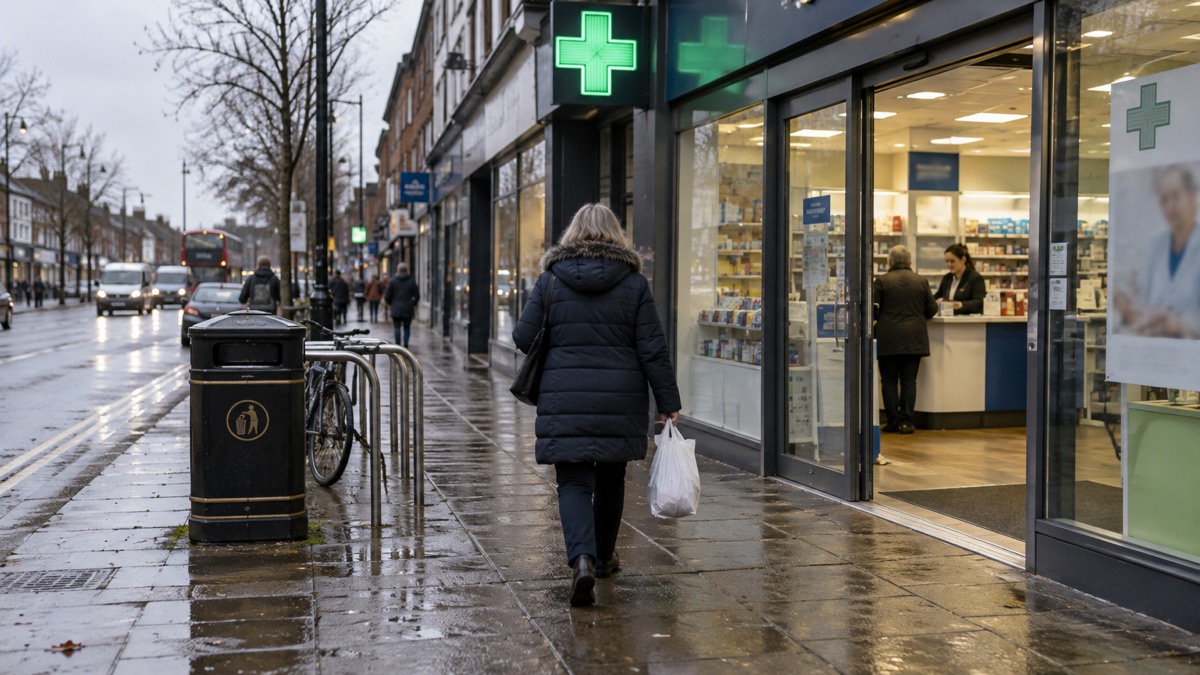
If you take regular prescription medicine, the single most useful thing you can do is order your repeat prescription early, while you still have medicine left. The NHS advises that if you get your medicine with a repeat prescription, you should usually allow 5 working days to request your prescription and collect your medicine1. Over the winter period, ordering in advance saves time, minimises delays and ensures you have the medicine you need2. Make sure you collect your prescription medicines before your pharmacy or GP practice closes for the holidays2.
The NHS App is one way to order a repeat prescription, and in October 2025 alone, 6.35 million prescriptions were ordered through it3. If you do run out unexpectedly, there are ways to get an emergency supply, including out of hours, from NHS 111 online and from a pharmacist1. For minor illnesses, pharmacists can give treatment advice for a range of conditions and can tell you if you need to see a doctor1.
Order your repeat prescription early
The habit that matters most is timing. Order your medicine or repeat prescription in advance, ideally while you still have medication, so your pharmacist can source your medicine in good time7. NHS winter guidance is consistent on this point: order repeat prescriptions in good time, particularly before bank holidays or periods of severe weather8, and make sure you order prescriptions in advance of any bank holiday9. GP practices and pharmacies both close or run reduced services over holiday periods, and demand rises in winter, so a request that would normally take a day or two can take longer.
Numbered steps for a smooth repeat prescription:
- Check how much medicine you have left, and note the date you will run out.
- Request your repeat prescription while you still have medication remaining, allowing 5 working days1.
- Order earlier still before bank holidays, severe weather or the holidays, when services close8.
- Collect your medicine before your pharmacy or GP practice closes for the holidays2.
- Keep an up-to-date list of your medication, repeat prescriptions and any allergies at home, so it is ready if you ever need urgent care10.
In Northern Ireland, the arrangement for ordering differs slightly: some surgeries provide a separate phone number or an online ordering facility for repeat prescriptions, so check your own GP surgery's website for details11.
Nominating a pharmacy
Through the NHS App you can order repeat prescriptions and nominate a pharmacy of your choice, so your prescriptions go straight to a branch that suits you9. Nominating one pharmacy means your medicine is waiting for you rather than being dispensed from scratch each visit, and it helps the pharmacy plan its stock. You can change your nominated pharmacy if your circumstances change, for example if you move house or start using a pharmacy nearer to work.
If a medicine is in limited supply in England, there may be a limit, called a quota, on the quantity pharmacies can order each month, but another pharmacy may still have it in stock7. This is one situation where being able to collect from a different branch, or asking your nominated pharmacy where else to try, makes a real difference. Our page on medicine shortages explains what causes these limits and what to do about them.
Who can use the NHS App
To use the NHS App you must be aged 13 or over and registered with a GP surgery in England3. The App is available on iOS and Android and can be downloaded to your smartphone or tablet3. It is one of the most widely used NHS services: there are over 38.5 million registered users, with 14 million distinct users logging in during October 2025 alone3.
If you are not able to use the App, or you live outside England, the alternatives still work. You can request repeat prescriptions through your GP practice directly, and in Northern Ireland some surgeries offer a separate phone line or online ordering for repeats11. NHS 111 online, which can help with urgent medical needs and emergency medicine supplies, is for people in England aged 5 and over4, and it can be reached through the website 111.nhs.uk or via the NHS App on a smartphone or tablet4. Our guide to ordering repeat prescriptions online covers the options in more detail.
When GP or pharmacy systems are down
GP and pharmacy systems occasionally go offline, whether because of a cyber attack, a major IT failure or a national supply problem. Our page on cyber attacks and major IT failures explains what these events mean for households. The reassuring part is that the system has backstops for medicine.
When there is a shortage of a medicine across the whole country, the government works with medicine suppliers and the NHS to manage national supply issues and ensure shortages have as little impact on patients as possible7. Medicine suppliers are legally required to report any medicine shortages to the government in good time7. NHS doctors and pharmacists can access a Medicine Supply Tool that is regularly reviewed and kept up to date7.
During a national shortage in England, you might be asked to go to another pharmacy to collect your medicine, receive a different formulation such as a tablet instead of a capsule, receive a smaller quantity so you need to collect more frequently, or be asked to go back to your GP for a new prescription for an available medicine if this cannot be organised by the pharmacy and GP over the phone7. None of these is a cause for alarm, but they are a reason to order early and not leave yourself with days of medicine left.
If you run out: emergency supplies
If you have run out of prescribed medicine and need some urgently, there are a few ways to get an emergency supply, including out of hours1. The route you use depends on how urgent it is and where you are.
NHS 111 online. People can get an emergency supply of regularly prescribed medicine for someone of any age on NHS 111 online4. Use the 111 online emergency prescription service at 111.nhs.uk/emergency-prescription: they will ask some questions, including where you are and when you are due to take your medicine, so they can suggest the best option, and they may refer you to a pharmacy to get your medicine1. It is intended for people who get their medicine with a repeat prescription, who have completely run out and cannot wait the usual 5 working days1. Note that 111 online does not issue a prescription: it sends a request to a local pharmacy for a limited supply of medicine until you can organise your regular repeat prescription12. Our page on NHS 111 explains the service more fully.
From a pharmacist. You may be able to obtain an emergency supply from a pharmacist without a prescription if you run out of prescription medicine and do not have a prescription with you. Take an old prescription or repeat slip, or the medicine packaging, if you have it13. The pharmacist will assess whether you need the medicine immediately, who previously prescribed it, and what dose would be appropriate, and they keep a record of your details, the medicine provided and the nature of the emergency13. In some cases pharmacists can also help get you emergency medicine in this way14.
In Wales. You can visit some pharmacies in Wales for an Emergency Medicines Supply Service, free of charge, when your GP surgery is closed, for example Monday to Friday 6.30pm to 8.00am, Saturday, Sunday and bank holidays15. The service is only for patients who have an immediate need and cannot wait until their GP surgery reopens, and availability depends on which Health Board area you live in15. It applies to most prescription drugs but not controlled drugs, and supply is at the pharmacist's discretion using their professional judgement16.
Controlled medicines. Many controlled medicines, such as morphine or diamorphine, cannot be supplied without a prescription by a pharmacist in an emergency6. In Wales, only a limited range of controlled medicines can be prescribed in an emergency, such as those for epilepsy (phenobarbital)13. If you take a controlled medicine, this is a strong reason to order early and never let your supply run low.
Emergency supply is for urgent need only, so it is important to always remember to order repeat medication from your GP practice in good time so that you never run out6. Our page on running out of prescribed medicine goes through the emergency routes step by step.
Your pharmacist: advice and over-the-counter help
Your community pharmacist is the easiest NHS professional to reach, with no appointment needed. Your local community pharmacist can give expert healthcare advice as well as over-the-counter medicines that can help with common conditions such as diarrhoea, a runny nose, a cough or a headache17. For minor illnesses like coughs and colds, your local pharmacist can provide expert advice and over-the-counter remedies18, and pharmacists can give treatment advice for a range of minor illnesses and can tell you if you need to see a doctor19. Visit your local pharmacy for headaches, upset stomachs, aches and pains20.
Pharmacists can also help when medicine runs short. Speak to your local pharmacy for advice about minor illnesses, treatments and medication21, and if you have questions about a medicines shortage, speak to your pharmacist or doctor or contact NHS 1117. Ask your pharmacist what medicines, including paracetamol and ibuprofen, should be in your cabinet to relieve symptoms of common winter illnesses such as colds, sinusitis or ear infections22.
Some pharmacies offer Pharmacy First, where you can get treatment for certain conditions by walking into the pharmacy or contacting them virtually; GP receptionists, NHS 111 and emergency care providers can also direct you to pharmacies offering the service17. Our page on Pharmacy First lists what it covers.
Pharmacies open late, at weekends and on bank holidays
Some pharmacies are open until late in the evening, as well as at weekends and bank holidays23. If you already have a prescription and urgently need the medicine, you can get it from any pharmacy as long as they have it in stock, and some pharmacies are open until midnight or later, even on public holidays22.
One caution from NHS 111 Wales: pharmacies may close at short notice, and you should check they are open and have what you require before travelling16. This matters most on bank holidays, when opening hours are reduced and demand is high.
| When you need medicine | Where to try |
|---|---|
| Usual hours, routine repeat | Your nominated pharmacy, ordered in advance9 |
| Evenings, weekends, bank holidays | Pharmacies open until late; some until midnight or later22 |
| GP surgery closed, run out, Wales | Emergency Medicines Supply Service at some pharmacies, free of charge15 |
| Completely run out, cannot wait 5 working days | 111 online emergency prescription service, any age1 |
| Non-prescription medicine, no pharmacy open (Wales) | Supermarkets, newsagents and petrol stations often stock a basic range and open longer13 |
GP appointments are also available seven days a week in the evening, on weekends and on bank holidays in many areas, and GP practices can offer appointments out of hours14, so a closed surgery does not always mean no appointment. Our page on what to do when your GP is closed covers the out-of-hours routes.
When to contact your GP
For less urgent health needs, contact your GP or visit your local pharmacy in the usual way24. If you have any queries about a prescribed medication you are taking, contact your GP or pharmacist21. Contact a GP if symptoms of cold, flu or respiratory infections are prolonged, or if you have a chronic condition that is getting worse18, and call your GP for symptoms that will not go away20. If your symptoms do not improve, contact your GP25.
For children, your GP is the first port of call for non-urgent illnesses and injuries that will not go away, including high temperatures, persistent coughs and ear aches, eczema, severe tummy aches, vomiting and diarrhoea26. A major part of helping your child to recover from minor illness is to get them to rest and drink plenty of fluids26.
If someone takes your medicine by accident, call NHS Direct, a doctor or the Patient Services Team immediately for advice27. If the situation is life-threatening, that is a 999 emergency: NHS 111 should be used by all patients who have an urgent medical need, rather than calling 999 or going to your local A&E23, and our page on when to call 111 and when to call 999 sets out the difference.
Storing medicines safely at home
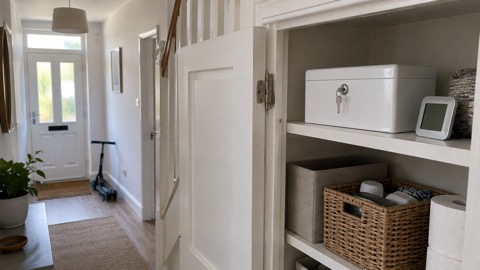
Keeping a supply of medicine only helps if it is stored safely and stays in date. Always follow the directions on medicine packets and information leaflets, and never exceed the stated dose28. Store medication as per the manufacturer's instructions, and keep medicines out of sight and reach of children whatever their age29. A high, lockable cupboard in a cool, dry place is ideal30, and all medicines should be stored in a box or cupboard with a lock and kept well out of the reach of children31. Keep medicine in a childproof place and out of reach of children and pets27.
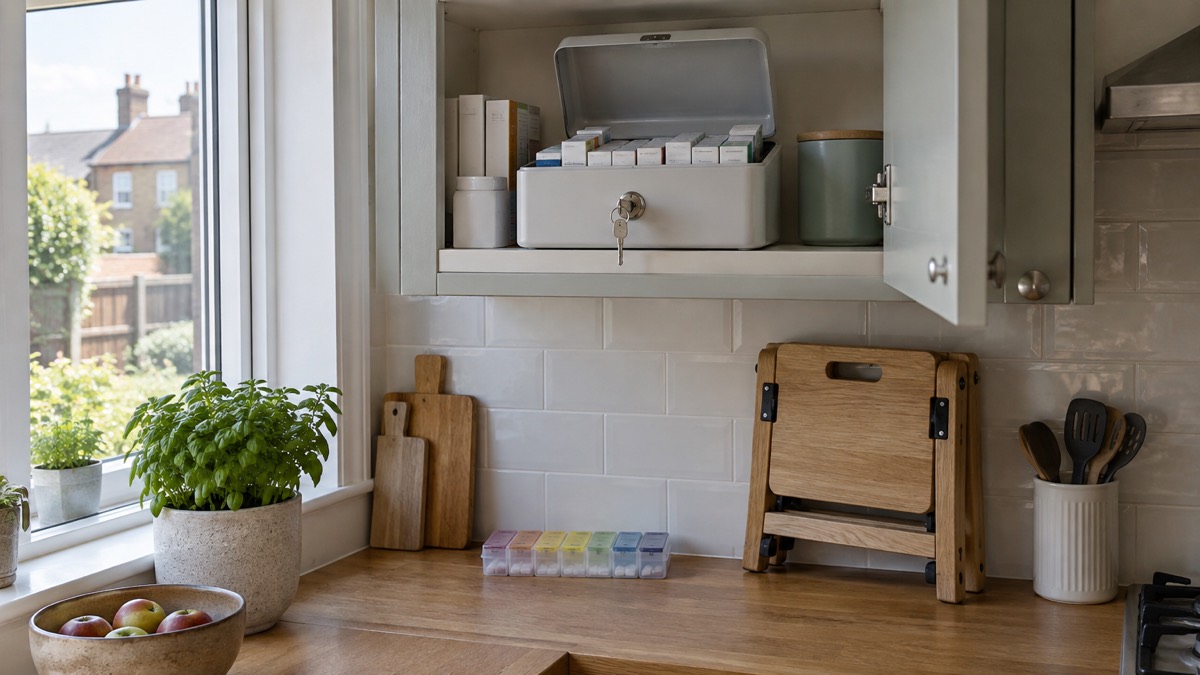
Check medicines regularly to make sure they are within their use-by dates3. If you have medicines that need refrigeration, keep them away from water drips and possible food contamination, ideally in a clean, dry plastic container27. Return out-of-date or no longer used prescribed medicines to your GP practice or local pharmacy for safe disposal21; our page on disposing of unused medicines explains how.
If anyone in your household takes rescue medicine, whether for epilepsy, allergies or another condition, keep it with you or in a known, safe place so it can be reached quickly when needed, and always have the right medicine in hand before giving any medicine29. Keep an up-to-date list of medication, repeat prescriptions and allergies ready to hand to ambulance or hospital staff10. Our page on storing medicines safely covers temperature, expiry dates and child safety in more detail.
Minor illness remedies to keep at home
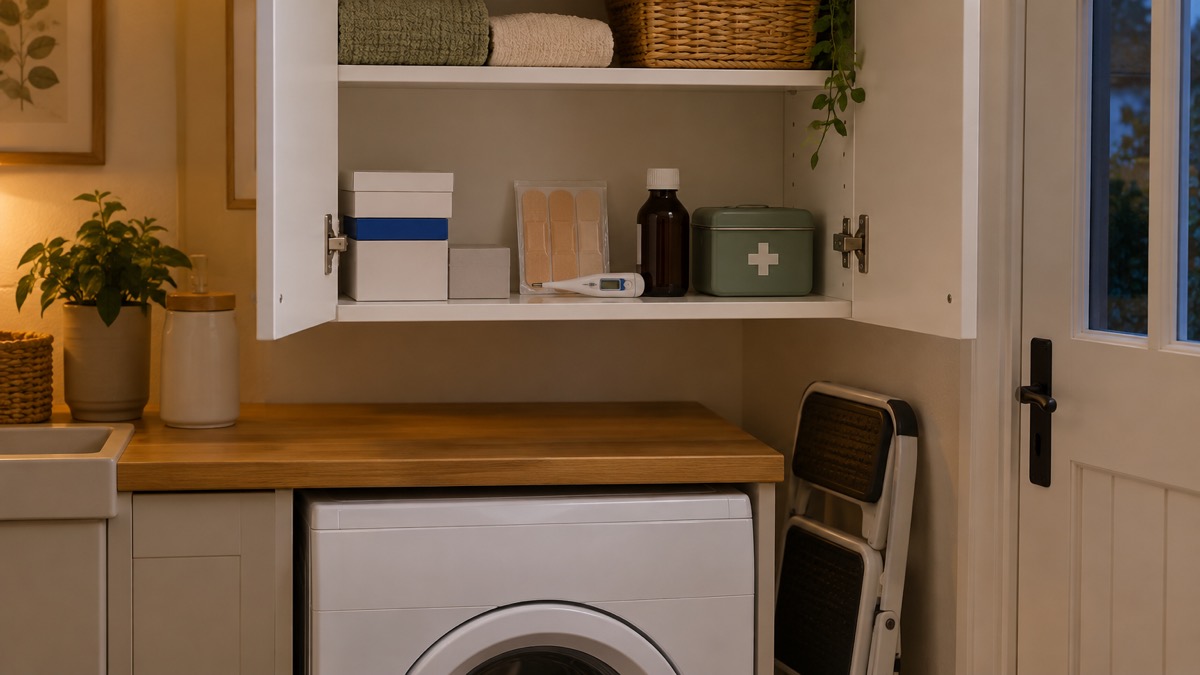
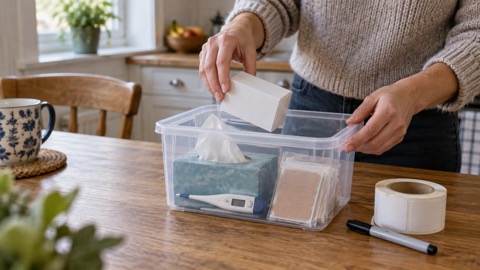
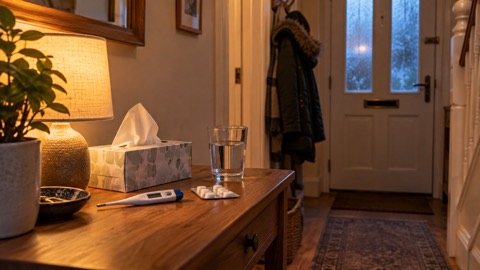
Alongside your prescription medicines, a well-stocked medicine cabinet lets you treat minor ailments at home without needing to see anyone. You can treat many minor ailments such as colds, coughs and indigestion by keeping a well-stocked medicine cabinet at home32. Official guidance suggests keeping essential medicines at home such as painkillers, upset stomach relievers, antihistamines, plasters and bandages3, and it is a good idea to keep an anti-diarrhoea medicine at home, as remedies can quickly control the symptoms of diarrhoea although they do not deal with the underlying cause30.
For households with children, plan ahead by stocking up on essentials including liquid paracetamol or ibuprofen, a thermometer, antiseptic cream and plasters26. These children's medicines are all available over the counter from a pharmacist33. Make sure you have some over-the-counter remedies for common seasonal illnesses in your medicine cabinet, and your pharmacist can advise on the most suitable ones to keep in the house21.
Keep any medicine in a safe place and well out of the reach of children, and check medicines regularly to make sure they are within their use-by dates3. Ensure you have a first aid kit at home and ask a pharmacist for advice on what over-the-counter medication they recommend having available23. Our medicine cabinet checklist lists the over-the-counter medicines worth keeping, and the wider prescription medicine supply checklist pulls together everything on this page into a single list to work through.
Sources (33)
- Emergency prescriptions, NHS, 2024-01-15
- Stay Well This Winter 2025, NHS England, 2025
- Use the right service this winter, Hampshire Hospitals NHS Foundation Trust, 2026-10-29
- NHS 111 online, NHS England, 2026-10-29
- What-should-you-have-in-your-medicines-box-LLR-edited-170925.pdf, NHS Leicester, Leicestershire and Rutland (created by Midlands & Lancashire CSU for West Leicestershire CCG)
- Emergency supply of medication from a community pharmacy, NHS Nottingham and Nottinghamshire ICB, 2026-10-29
- Advice for patients during a medicines shortage, NHS Specialist Pharmacy Service, 2025-11
- Be prepared for winter emergencies, NHS Norfolk and Suffolk ICB, 2026-10-01
- Get the right help and support, South Western Ambulance NHS Foundation Trust, 2026-10-29
- Planning ahead: carers service, Torbay and South Devon NHS Foundation Trust, 2025-10-21
- COVID-19 information, Health and Social Care Northern Ireland, 2024-07-11
- When to use 111, NHS, 2022-11-14
- Out of hours: emergency supply from a pharmacist, NHS 111 Wales, 2021
- Urgent care services, NHS North East London ICB, 2026-04-14
- What service do I need?, NHS 111 Wales, 2021
- Pharmacy FAQ, NHS 111 Wales, 2021
- In an emergency, Medway NHS Foundation Trust, 2026-10-29
- Winter health hub, South Western Ambulance NHS Foundation Trust, 2026-10-29
- Staying well in winter, Derbyshire County Council, 2026-10-29
- When to call 999, South Western Ambulance NHS Foundation Trust, 2026-10-29
- Your Health Guide Winter 2025, NHS Western Isles Health Board, 2025-12
- When you need urgent healthcare, NHS North Cheshire and Mersey ICB, 2026-08-11
- Alternatives to 999, South Central Ambulance NHS Foundation Trust, 2026-10-29
- NHS 111, Yorkshire Ambulance Service NHS Trust, 2026-10-29
- Medicine cabinet and self care, NHS Shropshire, Telford and Wrekin ICB, 2023-08-15
- What to do if your child is unwell, NHS North East London ICB, 2024-10
- Storing medicines at home, United Lincolnshire Hospitals NHS Trust, 2026
- Which NHS service should I use?, NHS Somerset, 2026-01-13
- Medication safety, Worcestershire County Council, 2026-10-29
- Keep a well stocked medicine cabinet at home, NHS Black Country ICB, 2026-10-28
- The Family Medicine Chest, Vallance Medical Centre, 2026
- Self care: medicine cabinet, Heaton Road Surgery, 2023-08-21
- What to keep in your medicine cabinet, Healthier Together, 2026-10-28
 Medicine Cabinet Checklist
 Sick at Home Supplies Kit
 Caring for Someone Ill at Home
 Pandemics and UK Household Plans
 Outbreaks Near You
 UK Health Security Agency
 Staying Home When Ill
 Stopping Infections at Home
 Caring for a Sick Person at Home
 Medicine Shortages Explained
 Storing Medicines Safely
 Urgent Care and A&E
 Vaccines Against Outbreaks
 Flu Symptoms and Getting Help
 COVID-19 Symptoms and Testing