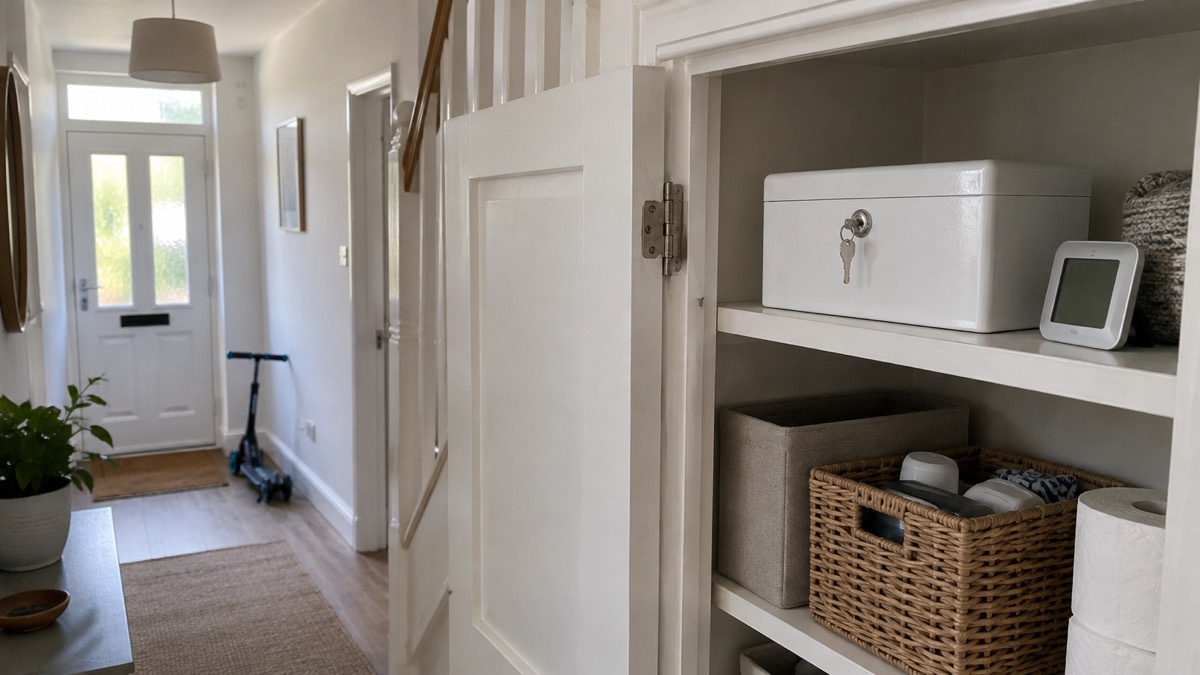
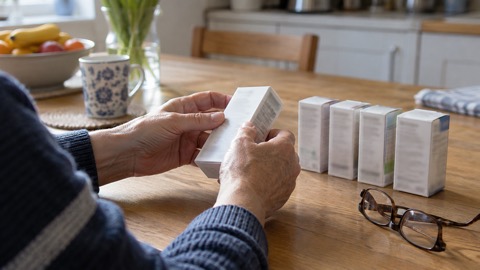
Storing medicines safely at home comes down to four habits. Store every medicine as the packaging or label tells you, and never remove it from its original packet or container1. Keep most medicines below 25°C, somewhere cool, dry and out of direct sunlight2. Keep everything out of the sight and reach of children, ideally in a high, lockable cupboard3. And check your medicines regularly to make sure they are within their use-by dates4.
These rules matter most in the situations households actually meet: a heatwave that pushes room temperatures past 25°C, a curious toddler, a winter bug that arrives when the pharmacy is shut, or an adrenaline auto-injector carried for a severe allergy. This page covers each of them, plus what a sensible home supply looks like and what to do with medicines that have gone out of date.
Follow the label: where each medicine belongs
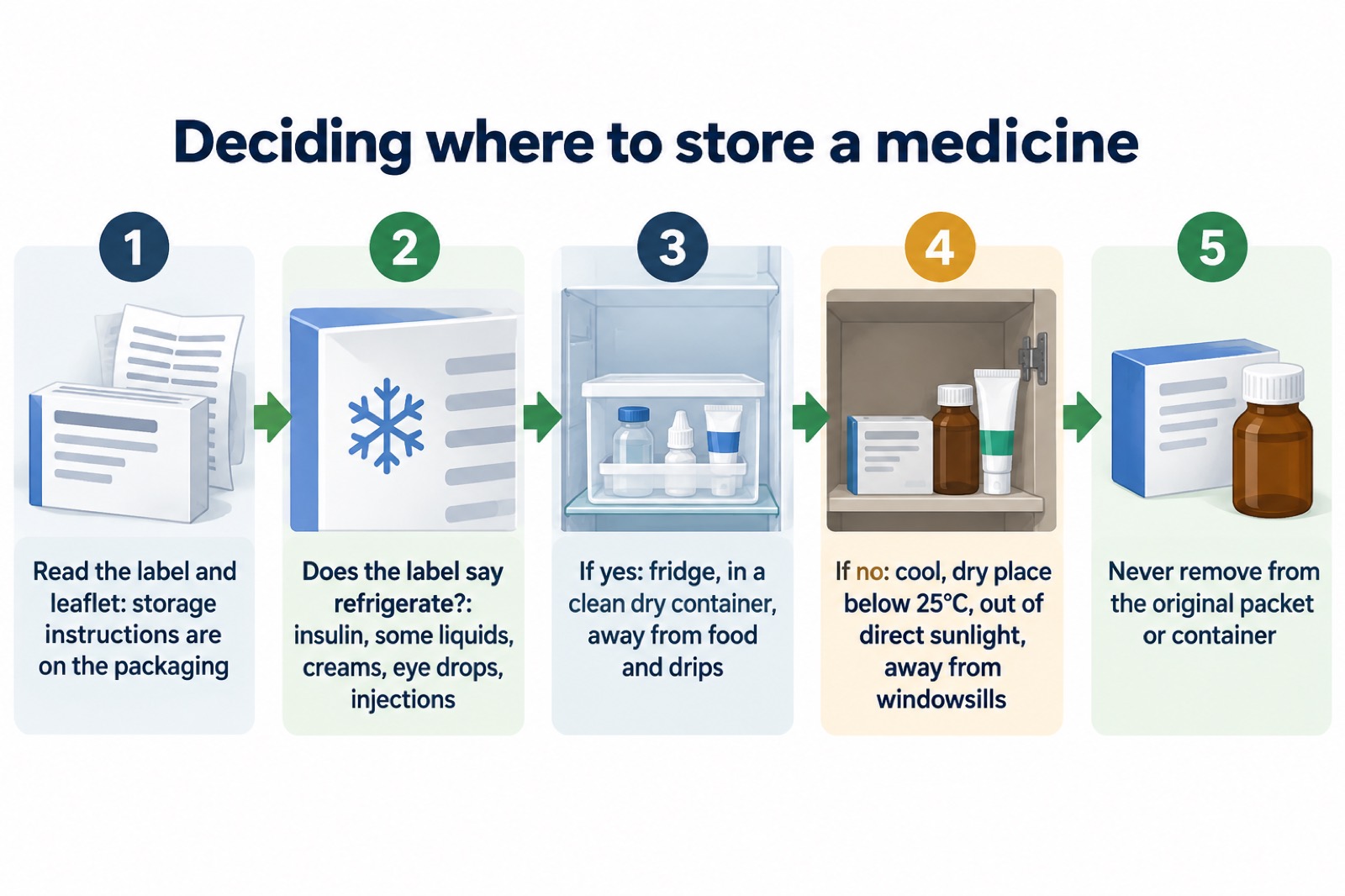
The starting point for every medicine is its own packaging. NHS guidance is direct: ensure medicines are stored correctly as indicated on the packaging or label1. The label or patient information leaflet tells you the temperature range, whether the medicine belongs in the fridge, and how long it keeps after opening. When you are preparing your home for hot weather, the UK Health Security Agency's advice includes checking that medicines can be stored according to the instructions on the packaging6.
For most medicines, the rule is simple: keep them below 25°C, somewhere cool, dry, out of direct sunlight, and away from windowsills2. Berkshire Healthcare gives the same figure and adds the reason it matters in practice: a windowsill, a car dashboard or a room that heats up in the afternoon can all push a medicine past its limit7. Birmingham Women's and Children's Hospital advises people with health problems to keep medicines below 25°C or in the refrigerator, reading the storage instructions on the packaging8.
A minority of medicines need the fridge. These include insulin and some liquid medicines, which can be damaged if they get too warm2. Refrigerated medicines can also include creams, ointments, eye drops and injections1. If a medicine lives in the fridge, keep it away from water drips and possible food contamination, ideally in a clean, dry plastic container1. In Northern Ireland, the guidance adds a practical detail for fridge storage: a childproof medicine box9.
Heat and travel deserve particular care. When travelling, do not leave medicines in a parked car or a hot bag; use a cool bag if needed2. A parked car in summer sun can far exceed 25°C, and heat damage is not always visible. If a heatwave is forecast, check your storage arrangements before it arrives rather than after, and see our page on medicines in a heatwave for what to do about taking them.
Keeping medicines away from children
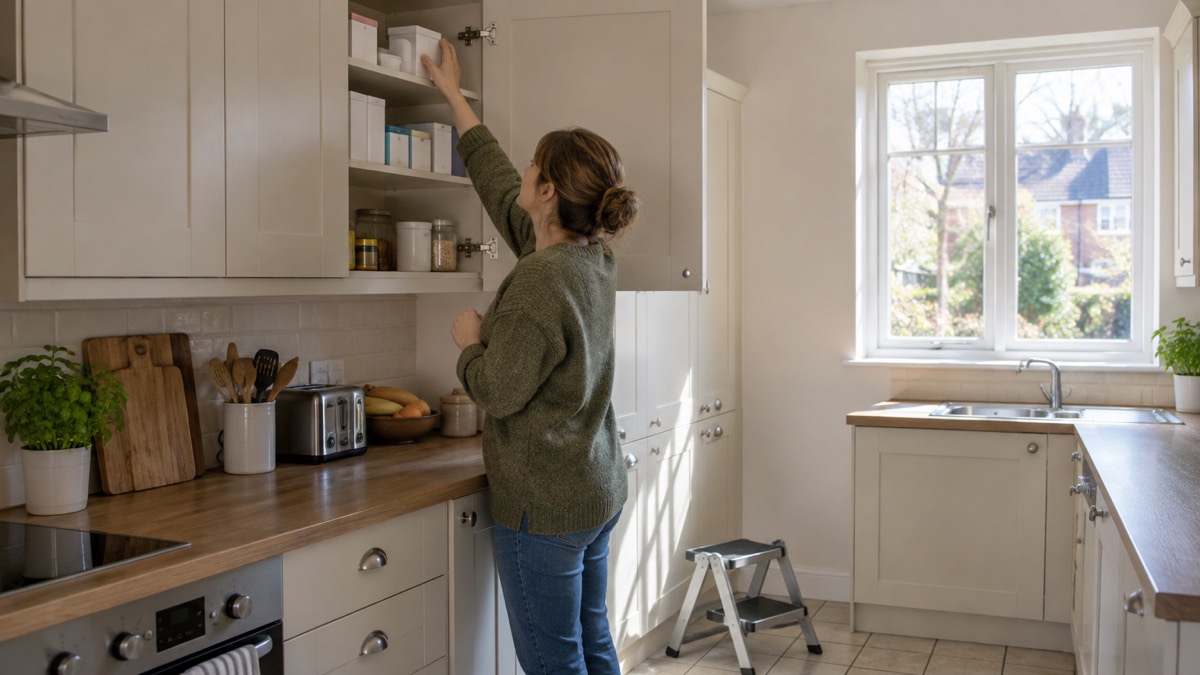
Medicines are one of the most common causes of accidental poisoning in the home, and every UK nation's guidance converges on the same rules. Always keep medicines out of the sight and reach of children; a high, lockable cupboard in a cool, dry place is ideal3. Worcestershire County Council adds that medicines should be out of sight and reach of children whatever their age10. The Family Medicine Chest guidance from Vallance Medical Centre puts it plainly: all medicines should be stored in a box or cupboard with a lock and kept well out of the reach of children11.
The "Keep SAFE 6" rule, used by NHS child health services across England and Wales, breaks safe storage into six habits13:
- Safe Storage: keep things out of reach and out of sight, including medicines, oils, vape liquids, perfumes and laundry products13
- Safe Containers: store medicines in locked containers and always use safety caps13
- Safe Labels: always keep medicines in their original packaging so you know what they are14
- Safe Disposal: take medicines and other products to the pharmacy for proper disposal, or follow instructions on the packaging13
Original packaging does more than one job. It keeps the dose instructions and the use-by date with the medicine, it keeps the child-proof cap, and it prevents mix-ups between similar-looking tablets. Just One Norfolk's advice to families is to keep medicine in its original child-proof packaging15, and Lincolnshire's medication safety campaign says the same: keep medication in original packaging with clear labels and instructions16. Public Health Agency guidance in Northern Ireland adds that products should stay in their original containers, with labels read and safety instructions followed17.
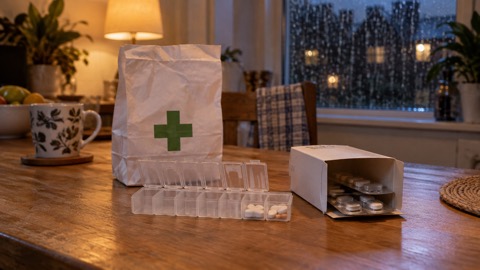
Two further habits close the gaps. First, handbags and bedside tables count as within reach: a box left out for a visiting grandchild, or a weekly dosette box left on a table, is the classic route to an accident. Store them safely in a well-lit, dry and cool place, and a dosette box will help you organise your medication18. Second, dispose of unwanted medicines promptly: return unused or out-of-date medicines to your pharmacy9. For more detail, see our page on disposing of unused and out-of-date medicines.
A small home supply of everyday medicines
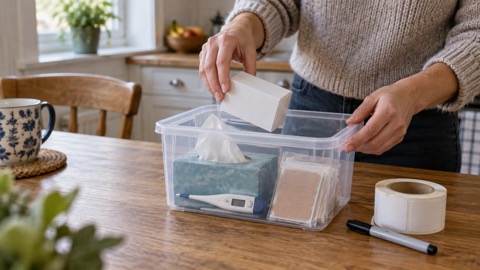
Alongside safe storage, NHS bodies across the UK recommend keeping a modest stock of over-the-counter medicines at home. Staffordshire's winter advice is typical: keep a small supply of over-the-counter medicines at home, covering pain relief, cold remedies and oral rehydration salts19. Hampshire Hospitals lists the essentials as painkillers, upset stomach relievers, antihistamines, plasters and bandages4. The reasoning is simple: many common illnesses and injuries can be treated at home, and a well-stocked medicine cabinet means you can cope when a minor ailment arrives in the evening or over a weekend5.
What that supply contains is fairly consistent across the guidance:
| Category | What the guidance names | Why a household keeps it |
|---|---|---|
| Pain relief | Paracetamol and ibuprofen20 | Colds, flu, fever and everyday pain |
| Cold and flu remedies | Cold remedies19 | Managing symptoms at home |
| Stomach remedies | Anti-diarrhoeals, indigestion remedies such as an antacid, mild laxatives20 | Diarrhoea, indigestion, constipation |
| Rehydration | Oral rehydration salts19 | Replacing fluids and salts lost to fever, diarrhoea and vomiting |
| Allergies | Antihistamines4 | Allergic symptoms |
| First aid | Plasters, bandages, antiseptic wipes20 | Minor cuts and grazes |
| Children | Medicines for children20 | Age-appropriate doses at home |
| Checking | A thermometer to check for fever20 | Knowing when to seek help |
Oral rehydration salts earn their place for a specific reason. They do not treat the diarrhoea itself, but they replace the salts and water that are lost, and so reduce the effects of dehydration18. Somerset NHS Foundation Trust describes them as an easy way to help restore your body's natural balance of minerals and fluid lost through fever, diarrhoea and vomiting, while being clear that they do not fight the underlying cause of your illness, such as a virus or bacteria5. They are available at local pharmacies. Our page on treating dehydration at home covers when they matter most.
If you have babies, young children or pets, think about the additional supplies they need21. For a baby's first aid kit, the Welsh NHS 111 guidance adds a maintenance habit: replace items when stocks run low, check use-by dates of all medicines, throw away anything past its use-by date, and take out-of-date medicines to a pharmacy for safe disposal22.
Prescription medicines are a separate matter, and the same principle of a small, in-date supply applies. Many people find it reassuring to keep a small supply of long-life food, drinking water, toiletries and prescription medicines at home21. Our pages on keeping enough prescription medicine at home and the medicine cabinet checklist set that out in detail.
Don't overstock: medicines go out of date
The other half of the storage advice is a limit. NHS inform in Scotland puts it directly: remember that medicines go out of date, so don't overstock your medicine cabinet23. Winter health guidance in Scotland repeats it: always follow the advice on the pack, and do not get too much medicine as it can go out of date24. A bulk supply you will not use before its dates is not a reserve, it is future waste.
The habit that keeps this right is a regular date check:
- Check your home medicines cabinet: is everything in date?25
- Regularly check the expiry dates on a medicine26
- Watch expiry dates: don't keep or use medicines past their sell-by date27
- Check medicines regularly to make sure they are within their use-by dates4
When a medicine has passed its date, the instruction is consistent across England, Scotland and Wales: if a medicine is past its use-by date, don't use it or throw it away; take it to your pharmacy, where it can be disposed of safely5. The same rule appears in Leicester, Leicestershire and Rutland's medicines box guidance26, in Shropshire's self-care advice28, and in nidirect's guidance for Northern Ireland, which says to return unused or out-of-date medicines to your pharmacy9. Scottish winter guidance adds that those with quantities of out-of-date or no longer used prescribed medications are encouraged to return them to their GP practice or local pharmacy24.
The reason not to throw medicines in the bin or flush them is safety as well as the environment: pharmacies dispose of them properly, and the Keep SAFE 6 rule makes pharmacy disposal one of its six habits13. A date check twice a year, at the clock changes for example, is enough to keep the cabinet honest. When you restock, Somerset's guidance suggests the standard list: cold remedies, pain killers, indigestion tablets and diarrhoea and constipation remedies25.
Adrenaline auto-injectors: what they are and who has them
Adrenaline auto-injectors (AAIs) are in a different category from the medicine cabinet, because they are emergency devices carried by a person rather than stored on a shelf. They deliver adrenaline by means of an auto-injector device for the emergency treatment of anaphylaxis, a severe allergic reaction29. They are prescribed to people with allergies who are at risk of having a severe allergic reaction30. There are three types of AAI available in the UK: EpiPen, Emerade and Jext30.
| Brand | Status in the UK | Notes from the guidance |
|---|---|---|
| EpiPen | Available in the UK30 | Check the liquid is clear and colourless before use |
| Emerade | Available in the UK30 | Subject to recalls in 2019 and 2023, see below |
| Jext | Available in the UK30 | Check the liquid is clear and colourless before use |
The government's AAI safety campaign, aimed at patients, healthcare professionals and the wider public, exists to help people better understand the importance of AAIs31, and video guidance on their use was added to the campaign page on 19 June 202331. The core carrying rule comes from the campaign itself: AAIs are intended for self-administration by a patient, or administration by a carer, and should be always carried by patients considered to be at risk of anaphylaxis29.
Storage of an auto-injector follows the same temperature logic as other medicines, with one addition: do not leave your adrenaline auto-injectors anywhere too hot or cold, such as in the fridge or outside in the sun32. That means the fridge door is as wrong as the car dashboard. The general travel rule applies here too: do not leave medicines in a parked car or a hot bag, and use a cool bag if needed2.
Two further habits from NHS guidance on anaphylaxis and from the quick guide used in East Sussex:
- Teach friends, family, colleagues or carers how and when to use your adrenaline auto-injector32
- Do not rely on someone else picking it up for you, or there being one available30
The second point matters for households as well as individuals. If a family member is at risk of anaphylaxis, the household's plan should assume the auto-injector travels with that person, and that at least one other person at home, at school or at work knows how to use it. For schools, the 2023 national patient safety alert set a rule that families should know: if the adrenaline auto-injectors are not carried by the pupil, then they should be kept in a central place in a box marked clearly with the pupil's name, but not locked in a cupboard or an office where access is restricted33.
Check your EpiPen or Jext: the liquid must be clear and colourless
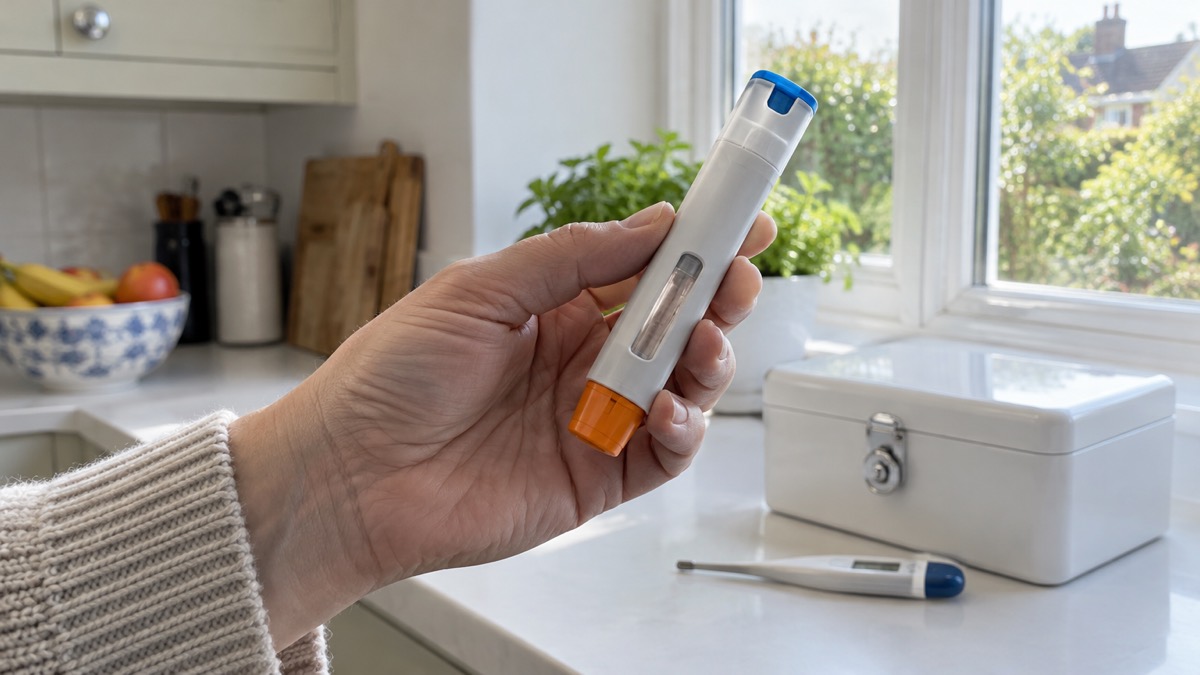
An auto-injector is a device, and like any device it can fail. The Medicines and Healthcare products Regulatory Agency (MHRA) has stated that the risk of device mishandling or device failure exists with all adrenaline auto-injectors34. That is why the carrying advice is paired with a checking habit: look through the viewing window of the device regularly. The liquid inside must be clear and colourless; if it is not, the device must be replaced. This check applies to EpiPen and Jext, and to any brand where a window lets you see the solution.
The check matters because adrenaline solution degrades, and because the consequences of a failed device at the moment of anaphylaxis are severe. Combine the check with the expiry date check you already do for the rest of the cabinet: the same rule, regularly check the expiry dates, applies18. If the liquid is discoloured, contains particles, or the device is past its expiry date, take it to a pharmacy and get a replacement before you need it, not after.
The MHRA's warning about device failure with all auto-injectors34 is also the reason for the carrying rule above: carry your own, teach others, and do not assume a spare will be to hand30. If you use an auto-injector in an emergency, the NHS guidance on anaphylaxis is that this is a 999 situation; our page on when to call 111 and when to call 999 sets out the difference.
The Emerade recalls: what they meant for owners
Emerade auto-injectors have been recalled twice, and the two episodes show how a recall works from the owner's side.
The first was on 28 November 2019, when Pharmaswiss Česka republika s.r.o., an affiliate of Bausch & Lomb UK Limited, issued a Class 2 medicines recall of all unexpired batches of Emerade 150, 300 and 500 microgram auto-injectors, after identifying a component error that can cause some pens to fail to activate and deliver adrenaline34. A previous drug alert about Emerade activation failures had been issued on 3 October 201934. On that occasion, Emerade stock held by patients was not being recalled, and patients and caregivers in possession of Emerade pens were to be informed of updated safety information instead34. Healthcare professionals were told to stop supplying the product immediately and quarantine all remaining stock34.
The second was on 9 May 2023, when the MHRA issued a National Patient Safety Alert, a Class 1 medicines recall, for all unexpired batches of Emerade 500 micrograms and Emerade 300 micrograms auto-injectors due to the potential for device failure33. That recall also applied to Emerade 500 micrograms and Emerade 300 micrograms auto-injectors in emergency anaphylaxis kits held by healthcare professionals, such as dental surgery kits33.
The lesson for any household carrying an auto-injector, of any brand, is to keep an eye on drug device alerts. Recalls are published on the MHRA's pages on GOV.UK, and pharmacists will know the current position. The 2019 episode also shows why the "carry your own" rule exists: a device that fails to activate is the worst possible moment to discover a problem, and the MHRA's statement that the risk of device failure exists with all adrenaline auto-injectors34 is the reason to check the window, check the date, and carry a spare where prescribed.
Where to get help
For everyday questions about storing, checking and replacing medicines, the pharmacist is the first port of call. Many common illnesses and injuries can be treated at home, and Somerset's guidance is to talk to your pharmacist about remedies and keep a well-stocked medical cabinet5. A pharmacist can tell you whether a medicine should be in the fridge, take back out-of-date stock for safe disposal9, and advise on children's doses from the label.
For urgent questions when the pharmacy is shut, NHS 111 is available, and our page on NHS 111 explains what it can help with. If your GP practice is closed, see what to do when your GP is closed. For a suspected anaphylaxis, use 999. For the wider picture of medicine supplies at home, see prescription medicines and medicine shortages.
Sources (34)
- Storing medicines at home, United Lincolnshire Hospitals NHS Trust, 2026
- Weather safety guidance, Oxford Health NHS Foundation Trust, 2026-09-18
- Keep well stocked: a medicine cabinet at home, NHS Black Country Integrated Care Board, 2026-10-28
- Use the right service this winter, Hampshire Hospitals NHS Foundation Trust, 2026-10-29
- Which NHS service should I use?, NHS Somerset, 2026-01-13
- Beat the heat: keep cool at home checklist, UK Health Security Agency, 2026-07-21
- Staying well in hot weather, Berkshire Healthcare NHS Foundation Trust, 2026-10-29
- Heatwaves, Birmingham Women's and Children's NHS Foundation Trust, 2026-10-29
- Chemical safety in the home, nidirect, 2026-04-14
- Medication safety, Worcestershire County Council, 2026-10-29
- The Family Medicine Chest, Vallance Medical Centre, 2026
- Child safety, Berkshire Healthcare NHS Foundation Trust, 2026-10-29
- Poisoning and accidental swallowing, ABB Healthier Together, 2026-10-29
- Poisoning: accidental swallowing, Healthier Together, 2026-10-29
- Medicines and tablet safety, Just One Norfolk, 2026-10-29
- Medication safety campaign, NHS Lincolnshire Integrated Care Board, 2026-10-29
- Home accident prevention, Public Health Agency Northern Ireland, 2026
- What to keep in your medicine cabinet, HWE Healthier Together, 2026-10-28
- Take care of yourself this winter, Staffordshire County Council, 2026
- Prepare for winter, King Street Surgery, 2026-01-20
- Be prepared for winter emergencies, NHS Norfolk and Waveney Integrated Care Board, 2026-10-01
- Newborn essentials and first aid, NHS 111 Wales, 2021-04-19
- Health advice for public holidays, NHS inform, 2026-09-15
- Your Health Guide, Winter 2025, Winter and Health Board, 2025-12
- Winter top tips and advice, South Western Ambulance NHS Foundation Trust, 2026-10-29
- What should you have in your medicines box, NHS Leicester, Leicestershire and Rutland Integrated Care Board, 2025-09
- Self care: medicine cabinet, Heaton Road Surgery, 2023-08-21
- Self care: medicine cabinet, NHS Shropshire, Telford and Wrekin Integrated Care Board, 2023-08-15
- Adrenaline auto-injector safety campaign, UK government, 2023-10-17
- Your quick guide to Adrenaline Auto-Injectors, East Sussex Healthcare NHS Trust, 2022-02
- Adrenaline auto-injectors (AAIs) safety campaign, UK government, 2023-04-24
- Anaphylaxis, NHS, 2023-06-21
- NatPSA/2023/004/MHRA: recall of Emerade 500 and 300 micrograms auto-injectors, Medicines and Healthcare products Regulatory Agency, 2023-05-09
- Class 2 medicines recall: Emerade 150, 300 and 500 microgram auto-injectors, Medicines and Healthcare products Regulatory Agency, 2019-11-28
 Medicine Cabinet Checklist
 Sick at Home Supplies Kit
 Caring for Someone Ill at Home
 Pandemics and UK Household Plans
 Outbreaks Near You
 UK Health Security Agency
 Staying Home When Ill
 Stopping Infections at Home
 Caring for a Sick Person at Home
 Keeping Prescription Medicine
 Medicine Shortages Explained
 Urgent Care and A&E
 Vaccines Against Outbreaks
 Flu Symptoms and Getting Help
 COVID-19 Symptoms and Testing