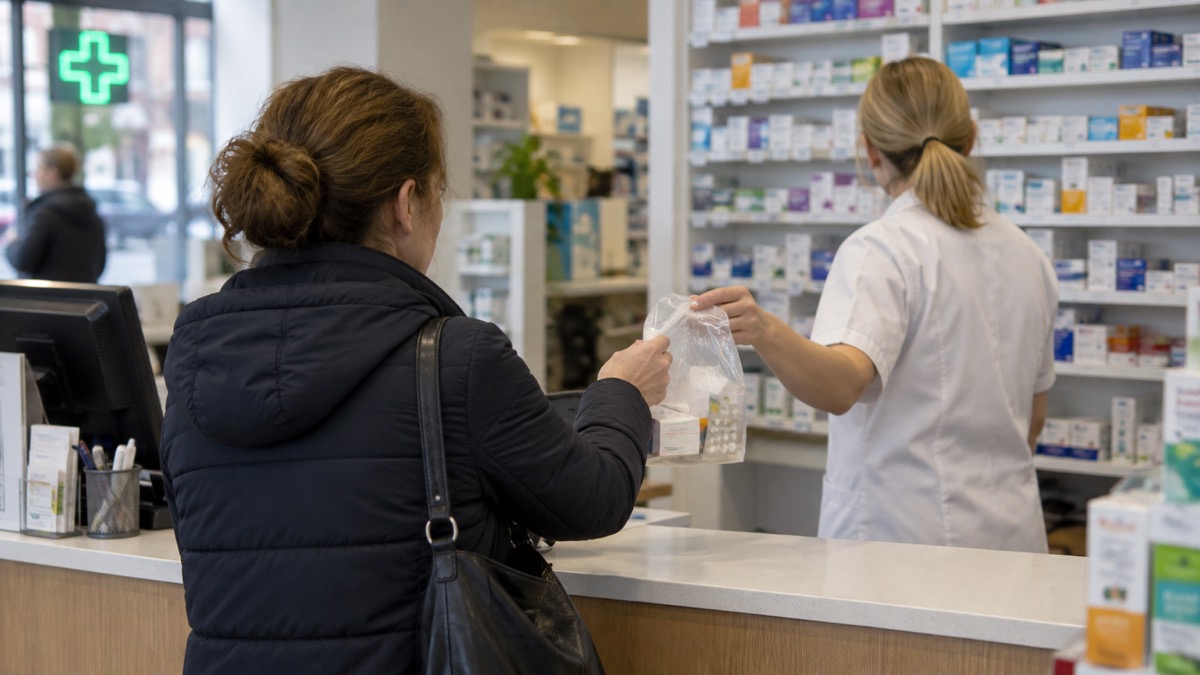
If you have a drawer of half-used packets, old tablets or a course of antibiotics you never finished, the answer is simple: take them back to a pharmacy. Pharmacies accept unwanted and out-of-date medicines, including prescribed ones, and dispose of them safely, and many offer this free of charge1. You do not need an appointment and you do not need to explain yourself.
Before you go, check the dates. Official NHS guidance is clear that if a medicine is past its use-by date you should not use it or throw it away, but take it to your pharmacy, where it can be disposed of safely2. The same advice applies to medicines you simply no longer need, such as leftover antibiotics: return them to your pharmacist, who will dispose of them safely3.
The one thing not to do is put them in the bin or wash them down the sink. Bag them up in a sealed clear plastic bag, keep them in their original packaging, and hand them over at the counter. This page sets out how to do that, what to do with liquids and inhalers, and how to keep your medicine cabinet in order so the problem does not build up again.
Take unwanted and out-of-date medicines back to your pharmacy
The pharmacy counter is the route for almost everything. NHS and local authority guidance across the UK repeats the same instruction: return unused or out-of-date medicines to your pharmacy7. Fire and rescue services giving medication safety advice say the same, telling households to take any old or unused medication back to a pharmacy or GP surgery so that it can be disposed of safely8. A home safety checklist used in Norfolk and Suffolk puts it as a simple habit: "I return unwanted or out-of-date medicines to a pharmacy"9.
If you have quantities of out-of-date or no longer used prescribed medications, you can also return them to your GP practice as well as your local pharmacy4. That is useful when you are handing back several boxes at once rather than a single packet.
What you cannot do is pass them on. Unused medications cannot be recycled, so they are not able to be reissued to another person; even if you never open them, once medicines have left the pharmacy they cannot be recycled or reused by anyone else4. That is why returning them matters: it is the only safe end for a medicine that has left the shelf.
| What you have | Where it goes |
|---|---|
| Out-of-date tablets or capsules | Your local pharmacy10 |
| Medicines you no longer need | Your local pharmacy11 |
| Leftover antibiotics | Your pharmacist, for safe disposal12 |
| Large quantities of prescribed medicine | Your GP practice or local pharmacy4 |
| Medicine contaminated by flood water | Your pharmacy; a vet can dispose of contaminated pet medicine13 |
If you are clearing a cupboard after a flood, do not keep anything that has been in contact with flood water. Official after-flood guidance says to dispose of contaminated food or medicines safely, and that you can take your medicine to a pharmacy for disposal, or your vet can dispose of any contaminated medicine for your pet13.
How to pack medicines for return: a sealed clear plastic bag
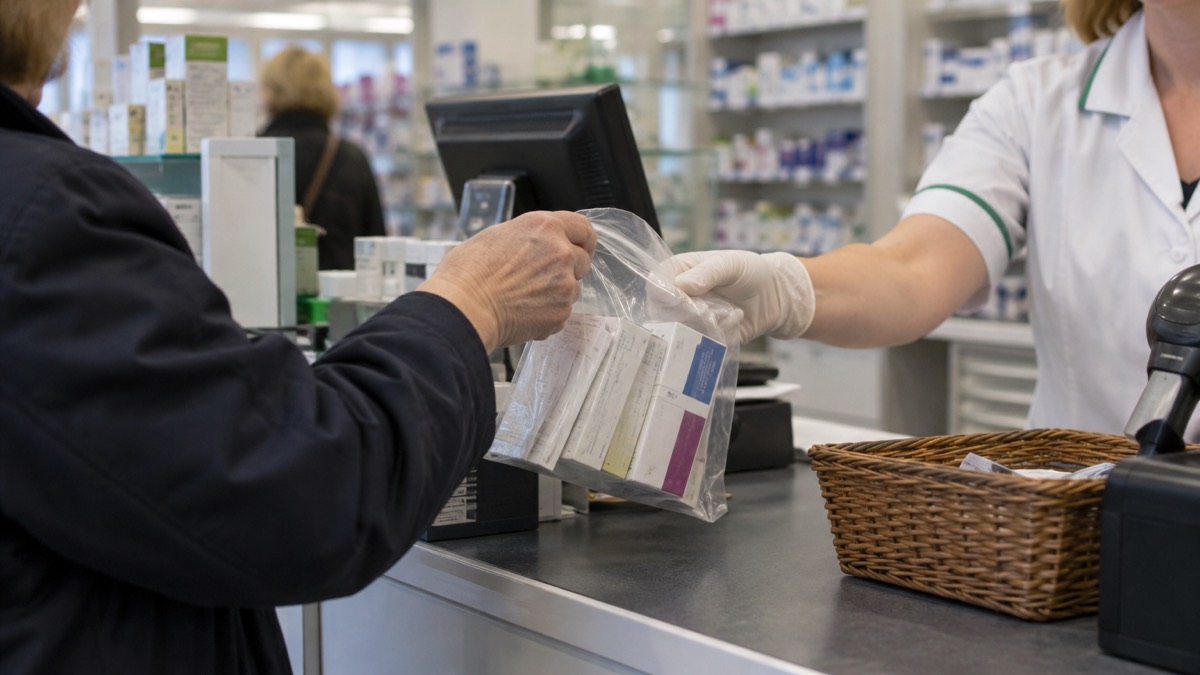
Packing is straightforward, but it protects the people handling your bag and keeps the medicine identifiable. Hospital guidance on storing medicines at home says that to get rid of damaged, expired or old medicines, you should place them in a clear plastic bag, seal it and take them back to your local pharmacy, where staff can safely dispose of it5.
Keep medicines in their original packets and containers. The same guidance is explicit: never remove medicines from their original packets or containers5. The label carries the name, the dose and the instructions, and pharmacy staff need it to deal with the medicine correctly. Do not tip loose tablets into an unlabelled tub or a freezer bag.
A few practical points:
- Seal it. A clear bag that closes keeps liquids contained and stops anything spilling in a bag or car5.
- Keep the labels. Leave tablets in their blister strips inside their boxes, and leave bottles labelled5.
- Keep it dry and clean. When you store medicines at home, keep them away from water drips and possible food contamination, ideally in a clean, dry plastic container5.
- Do not hoard. The Royal Society for the Prevention of Accidents advises returning leftover medicines to the pharmacist for destruction and not hoarding them14.
Where old medicines should not go
The bin and the drain are the two places old medicines most often end up, and both are wrong. Official guidance is blunt: if a medicine is past its use-by date, do not use it or throw it away, but take it to your pharmacy, where it can be disposed of safely6. The same message comes from a children's poisoning safety page, which sets out safe disposal as taking medicines and other products to the pharmacy for proper disposal, or following the instructions on the packaging16.
There is a second reason not to flush them. Guidance on chemical safety in the home says that for leaking or expired chemical products you should follow the advice on the label and take them to your local civic amenity site (waste and recycling centre), where they can be disposed of safely, and never pour products down the drain unnecessarily, as drainage ends up in seas and rivers7. Medicines are not household chemicals, and the pharmacy is their route, but the principle is the same: what goes down the drain does not disappear.
Storing medicines safely is part of the same job. Guidance for parents and carers on accidental swallowing lists storing medicines and chemicals safely and securely, keeping products in their original containers, reading labels and following safety instructions, and disposing of unwanted medicines safely as the four habits that prevent poisoning at home17. If you have children in the house, that last step matters as much as the first three.
Keeping your medicine cabinet in order
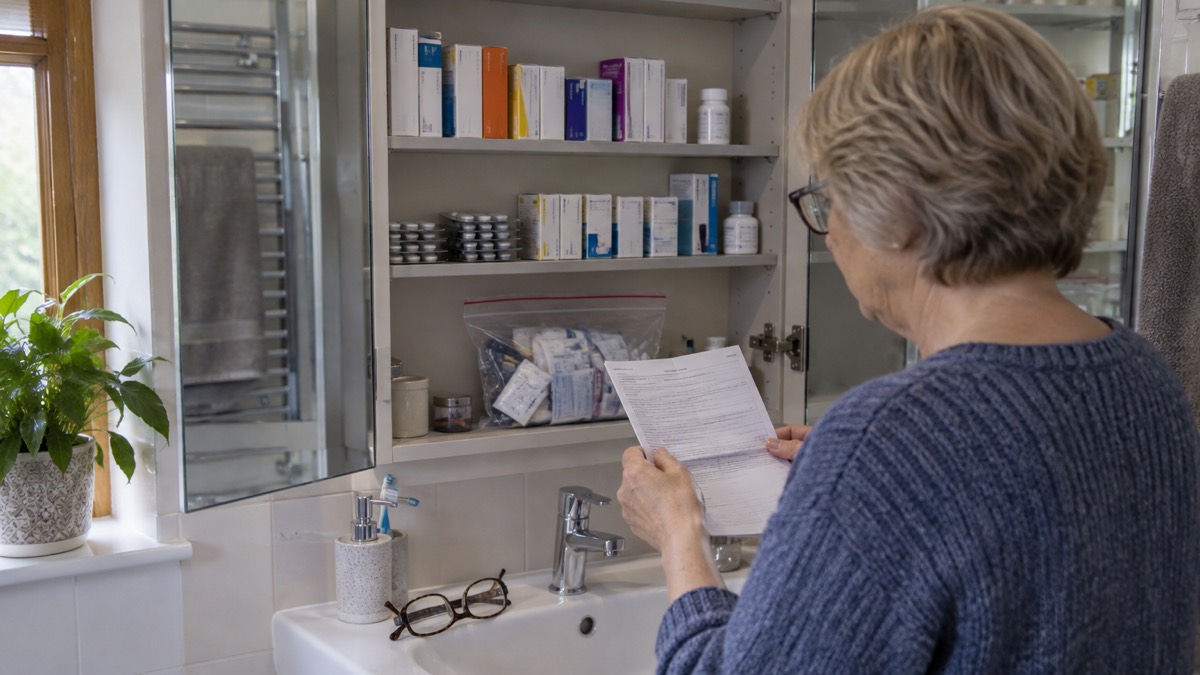
The best way to avoid a drawer full of out-of-date packets is to check dates regularly and only keep what you will use. NHS winter advice is to check expiry dates regularly and replace items when needed18. A medicine box leaflet puts it as a routine: regularly check the expiry dates on a medicine, and if a medicine is past its use-by date, do not use it or throw it away, but take it to your pharmacy, where it can be disposed of safely2.
Do not overstock. Guidance from NHS Western Isles is that medicines go out of date, so do not overstock your medicine cabinet, and always follow the advice on the pack4. NHS inform makes the same point for over-the-counter medicines19, and NHS Tayside advises following the instructions on the pack and only buying what you need, to save medicines going out-of-date and being wasted20.
A simple routine works well:
- Pick a date. Check your cabinet when you restock, or when the seasons change, and check the expiry date on every item21.
- Sort as you go. Put anything out of date or no longer needed into a clear plastic bag as you find it5.
- Replace what you use. Restock with essentials such as cold remedies, painkillers, indigestion tablets and diarrhoea and constipation remedies22.
- Take the bag back. Hand it in at the pharmacy on your next visit11.
The same discipline applies to first aid kits and children's medicines. Medicines in a first aid kit should be checked regularly to make sure they are within their use-by dates23, and children's medicines should be checked in the same way24. A first aid kit for a new baby should have items replaced when stocks are depleted, with use-by dates checked and anything past its date thrown away and taken to a pharmacy for safe disposal25.
For a fuller list of what to keep, see the medicine cabinet checklist, and for how to store what you keep, see storing medicines safely. If you are managing repeat prescriptions, the prescription medicine supply checklist and keeping enough prescription medicine at home cover ordering and holding enough without overstocking.
Sources (25)
- Medication safety, NHS Lincolnshire ICB
- What should you have in your medicines box, NHS Leicester, Leicestershire and Rutland ICB, 2025
- Health protection, Devon County Council
- Your Health Guide Winter 2025, NHS Western Isles, 2025
- Storing medicines at home, United Lincolnshire Hospitals NHS Trust
- Which NHS service, NHS Somerset
- Chemical safety in the home, nidirect
- Medication and medical devices, West Yorkshire Fire and Rescue Service
- Stay Steady and Safe Home Safety Checklist, NHS Norfolk and Suffolk ICB, 2026
- Medication safety, Worcestershire County Council
- Medicines and tablet safety, Just One Norfolk
- Health protection, Devon County Council
- After a flood, London Fire Brigade
- Preventing accidents in the home, RoSPA
- Weather safety, Oxford Health NHS Foundation Trust
- Poisoning and accidental swallowing, Aneurin Bevan University Health Board
- Home accident prevention, Public Health Agency Northern Ireland
- Be prepared for winter emergencies, NHS Norfolk and Suffolk ICB
- Health advice for public holidays, NHS inform
- Your health and wellbeing, NHS Tayside
- Keep well stocked medicine cabinet at home, NHS Black Country ICB
- Winter top tips and advice, South Western Ambulance Service NHS Foundation Trust
- First aid kit, NHS 111 Wales
- Medicine cabinet, Heaton Road Surgery
- Newborn essentials first aid, NHS 111 Wales
 Medicine Cabinet Checklist
 Sick at Home Supplies Kit
 Caring for Someone Ill at Home
 How Long to Stay Home With COVID
 Time Off After Sickness
 Stopping Flu Spreading at Home
 How Long to Wash Your Hands
 When to Call 111 or 999
 When Your GP Is Closed
 Medicines in a Heatwave
 Taking Someone Else's Medicine
 Ordering Repeat Prescriptions
 Treating Dehydration at Home
 Cold-Health Alerts Explained
 The Glass Test for Meningitis