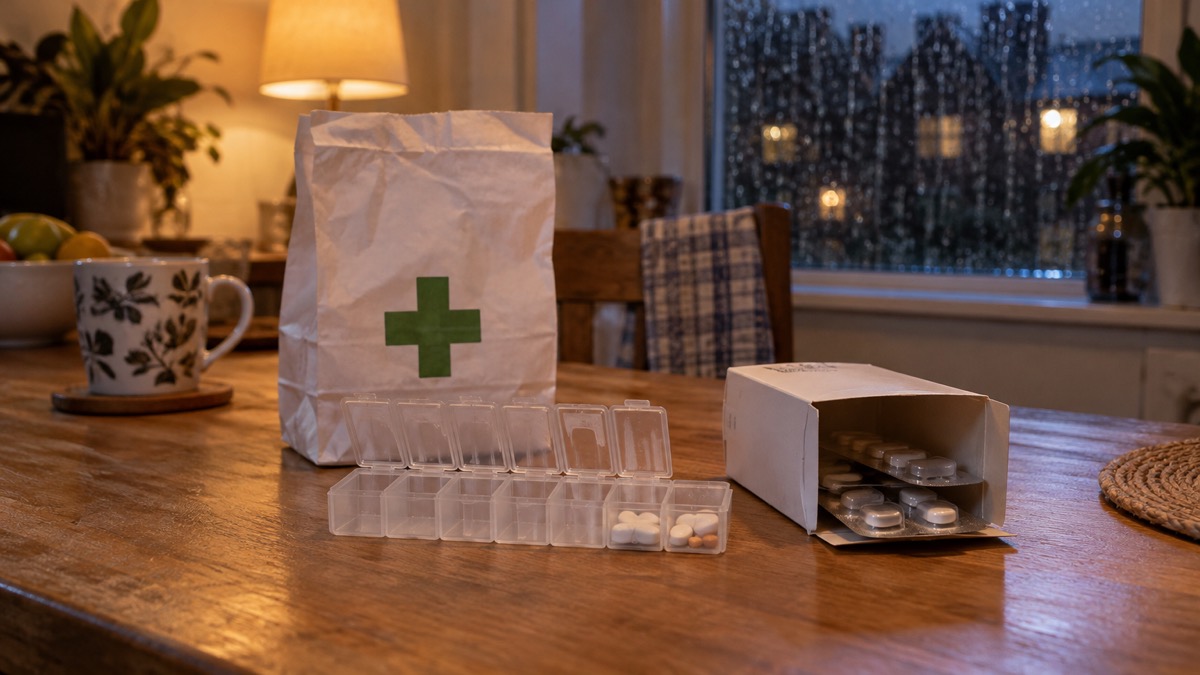
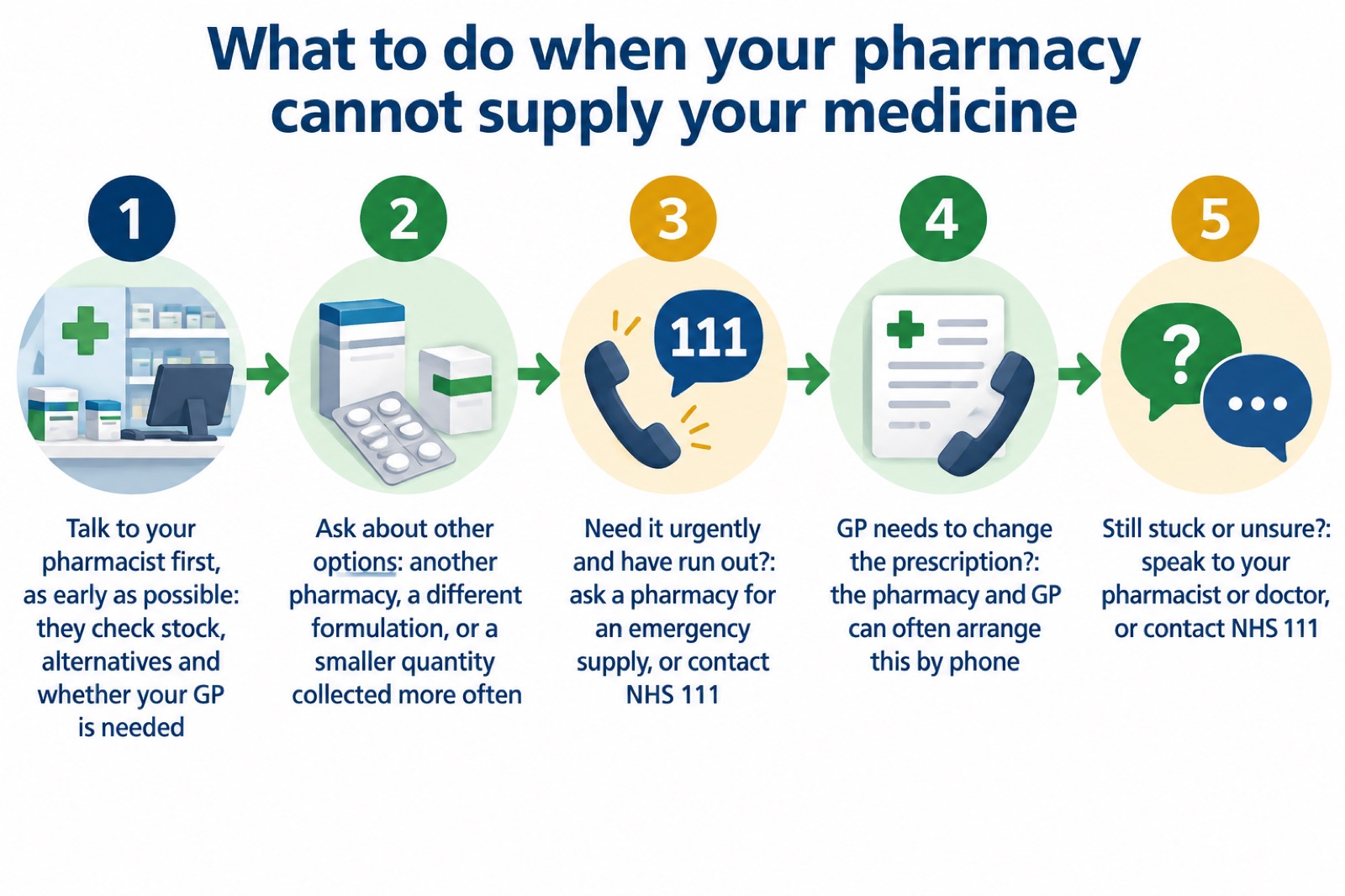
If your pharmacy cannot get your medicine, the first thing to know is that this is usually temporary and usually fixable. NHS advice for patients in England is to talk to your pharmacist in the first instance, and as early as possible: they can see whether another pharmacy has stock, whether a different formulation is available, and whether your GP needs to be involved1. Most local stockouts are resolved quickly, often as soon as the pharmacy receives its next daily delivery1.
If you have run out of prescribed medicine and need some urgently, there are ways to get an emergency supply, including out of hours: pharmacies can provide certain emergency medicines even if you do not have a prescription with you, though you may need to pay2. You can request an emergency supply either by contacting NHS 111 by telephone or online, or by contacting a community pharmacy directly3.
Your pharmacist is the first person to ask
For minor illnesses like coughs and colds, your local pharmacist can provide expert advice and over-the-counter remedies, which makes them a good first port of call if you or your child is ill but does not need a GP4. That access matters during a shortage, because the pharmacist is the person who can actually see the stock position: what is on the shelf, what is on order, and what an alternative would be.
NHS guidance for patients in England during a medicines shortage is explicit about the order of contacts: "Talk to your pharmacist in the first instance, and as early as possible"1. Speaking early gives the pharmacy time to act before you actually run out, rather than after. If you have questions about a shortage, or are unsure whether a medicine is appropriate for your condition, ask your local pharmacist the same way6.
If the pharmacist cannot resolve it, speak to your doctor or contact NHS 1111. NHS 111 can also help directly with medicines: if your call is about a prescribed or non-prescribed medicine, your local pharmacist may be able to issue a small supply until your GP practice reopens5. Our page on NHS 111 explains what the service can and cannot do, and Running Out of Prescribed Medicine covers emergency supplies in detail.
What actually happens during a shortage
Medicine shortages are usually caused by shortages of the ingredients needed to make medicines, sudden spikes in demand for treatments, issues with manufacturing capacity, or unexpected global events1. When a medicine is in limited supply nationally, there may be a limit, or quota, on the quantity pharmacies can order each month, which is why your usual pharmacy may be out while another nearby still has it in stock1.
The government works with medicine suppliers and the NHS to manage national supply issues, aiming to ensure shortages have as little impact on patients as possible1. NHS doctors and pharmacists can access a Medicine Supply Tool that tracks shortages1. Usually the disruption is temporary and resolved quickly, and patients get the medicine as soon as the pharmacy receives its next daily delivery1.
If your usual medicine is not available, NHS guidance says you might experience one of the following:
- Be asked to go to another pharmacy to collect your medicine1
- Receive a different formulation, for example a tablet instead of a capsule1
- Receive a smaller quantity, so you will need to collect more frequently1
- Be asked to go back to your GP for a new prescription for an available medicine, if this cannot be organised by the pharmacy and GP over the phone1
The practical point behind that list is that a shortage rarely means going without treatment. It usually means a small change: a different brand or form, an extra trip, or a new prescription. If you are prescribed a medicine that has been reformulated or switched, ask the pharmacist to explain how the new version differs, particularly if the dose or timing has changed.
Pharmacies open late and at weekends
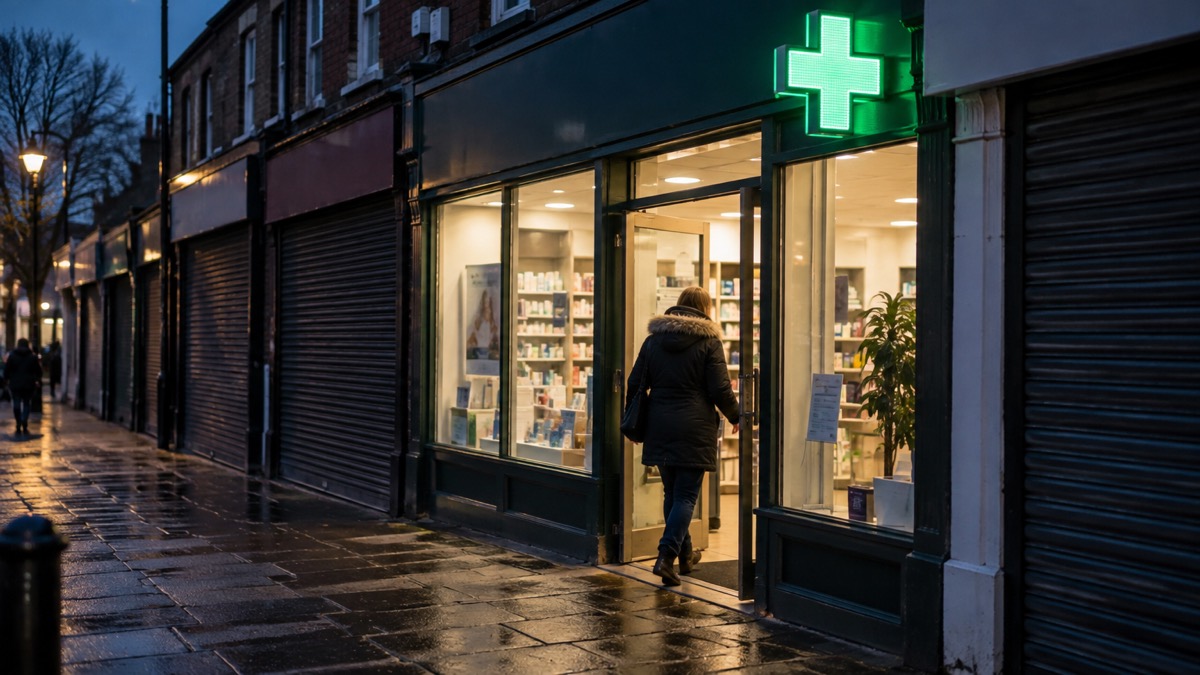
If you already have a prescription and urgently need the medicine, you can get it from any pharmacy as long as they have it in stock, and some pharmacies are open until midnight or later, even on public holidays7. That flexibility is worth knowing during a shortage: if your usual pharmacy is out, another one a short distance away may have it, and you do not need to return to the pharmacy attached to your GP practice.
Opening hours vary, and pharmacies may close at short notice, so check they are open and have what you require before travelling8. If you run out of your regular medicine and your GP practice is closed, there are still ways to get an emergency supply9. If you need help over a holiday period when the GP surgery or pharmacy is closed, or you are not sure what to do, go to 111.nhs.uk or call 11110. If your GP is closed, call NHS 111 and they will tell you where to go11.
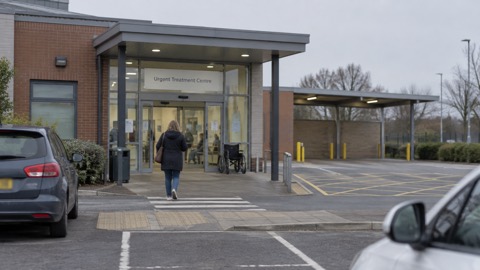
GP appointments are also available seven days a week in the evening, on weekends and on bank holidays, so a closed surgery on a Monday does not mean no appointment until Tuesday4. Urgent Treatment Centres offer another option: for example, the centres at Barking Community Hospital and Harold Wood Polyclinic are open 8am to 10pm, seven days a week, and you can call NHS 111 to book or walk in and wait12. Our page on urgent care options compares them.
The arrangements differ in Wales. Some pharmacies in Wales offer an Emergency Medicines Supply Service, free of charge, when the GP surgery is closed: Monday to Friday 6.30pm to 8.00am, Saturday, Sunday and bank holidays13. The service is only for patients who have an immediate need and cannot wait until their GP practice reopens, and availability depends on which Health Board area you live in13. If you need a non-prescription medicine such as paracetamol or an antacid and cannot find an open pharmacy in Wales, supermarkets, newsagents and petrol stations may stock a basic range and often have longer opening hours than high-street pharmacies14.
Planning ahead removes most of the out-of-hours problem. Order repeat medications well in advance of planned public holiday closures, but only if these medications are needed over the festive period15. Make sure you have enough medication available in case you cannot get out in icy or cold weather or over the Christmas holiday period16. If you support an older neighbour, help them refill prescriptions before pharmacies close for holidays17.
Minor illnesses a pharmacy can treat without a GP appointment
A large share of GP appointments for minor illnesses can be avoided entirely, which also takes pressure off the system during a shortage. Your local community pharmacist can give expert healthcare advice as well as over-the-counter medicines for common conditions such as diarrhoea, a runny nose, a cough or a headache, without an appointment18. Pharmacists can give treatment advice for a range of minor illnesses and can tell you if you need to see a doctor16.
In England, the Pharmacy First service goes further: community pharmacists can supply prescription medicines, without a GP appointment, for seven common conditions19. The conditions and age ranges are:
| Condition | Who can be treated |
|---|---|
| Earache | Children aged 1 to 17 |
| Impetigo | Aged 1 and over |
| Infected insect bites | Aged 1 and over |
| Shingles | Aged 18 and over |
| Sinusitis | Aged 12 and over |
| Sore throat | Aged 5 and over |
| Urinary tract infections | Women aged 16 to 64 |
Treatment can include antibiotics and antivirals where clinically appropriate, without a GP appointment or prescription18. You can walk in and be seen the same day19. Our page on Pharmacy First explains the service in full.
Scotland and Wales have their own versions. In Scotland, the Pharmacy First Service means a pharmacist can provide non-prescription medicines for a minor illness free of charge9. In Wales, the common ailments service lets participating pharmacies offer a free NHS consultation and free over-the-counter medicines for 26 common ailments that cannot be managed by self-care, as an alternative to a GP appointment13. Suitably qualified pharmacist independent prescribers in Wales can also prescribe for a range of minor illnesses not covered by the common ailment service, and for routine contraception8.
Pharmacists can also help if you run out of a repeat prescription, and can advise on coughs and colds, sore throat, indigestion, diarrhoea or constipation, and aches and pains20. Pharmacies can provide certain emergency medicines even without a prescription, though you may need to pay2.
When a pharmacist will tell you to see a doctor
Pharmacists treat minor illness, but part of their job is recognising what is not minor. They will tell you if you need to see a doctor, and that judgement is part of the service rather than a sign you have gone to the wrong place16. If you are worried about someone else's health, contact your local pharmacist, your GP or NHS 111, who will all be able to offer advice and support21.
Some situations always go beyond the pharmacy. If a child has swallowed something potentially harmful, urgent help means going to an emergency department or calling 999; if it is non-urgent, speak to your local pharmacist or health visitor22. For suspected poisoning, the same split applies: urgent cases go to hospital, non-urgent questions go to the pharmacist23. If you are unsure whether a symptom is urgent, NHS 111 will assess and direct you, and our page on when to call 111 or 999 sets out the difference.
During a national shortage, the same rule applies to your regular medicine: if stopping it suddenly could make you seriously unwell, do not wait for stock to return. Speak to your pharmacist or doctor, or contact NHS 1111. For everyday winter illness, keep a stock of over-the-counter remedies at home so a minor illness does not become a trip out when you feel at your worst15.
Recalls can take a medicine off the shelf
As well as shortages, a medicine can disappear from pharmacies because it has been recalled: the regulator, the Medicines and Healthcare products Regulatory Agency (MHRA), orders it withdrawn when there is a safety problem. The clearest recent example is the adrenaline auto-injector Emerade, used for life-threatening allergic reactions (anaphylaxis).
The MHRA issued a Class 1 Medicines Recall for all unexpired batches of Emerade 500 micrograms and Emerade 300 micrograms auto-injectors, because of the potential for device failure: some pens failed to activate as required24. A Class 1 recall is the most serious kind, and this one reached patients directly, because the MHRA judged that there were sufficient supplies of alternative auto-injectors to allow a recall at patient level25. Patients prescribed Emerade 500 or 300 micrograms pens were told to contact their doctor or pharmacist by telephone now to get replacements, to obtain two replacement pens in an alternative brand, EpiPen or Jext25. No further supplies of Emerade would be available, and patients would need to be switched to an appropriate alternative25.
The recall also applied to Emerade pens held in emergency anaphylaxis kits by healthcare professionals, such as dental surgery kits24. This matters to households because it shows a recall can reach beyond the dispensary into every place a medicine is stored.
Emerade had been recalled before. On 28 November 2019, a Class 2 medicines recall was issued for all unexpired batches of Emerade 150, 300 and 500 microgram auto-injectors, after a component error was identified that could cause some pens to fail to activate and deliver adrenaline26. The two recalls illustrate the difference in severity: the 2019 Class 2 recall was precautionary, while the 2023 Class 1 recall required urgent action at patient level.
| Class 2 recall, November 2019 | Class 1 recall, May 2023 | |
|---|---|---|
| Products | Emerade 150, 300 and 500 microgram auto-injectors26 | Emerade 500 and 300 micrograms auto-injectors24 |
| Reason | Component error that could cause some pens to fail to activate26 | Some pens failed to deliver the product or activated prematurely in testing24 |
| Level | Precautionary recall of unexpired batches26 | Urgent recall at patient level, with replacements arranged25 |
| Outcome | Pens remained in use while alternatives were limited26 | Patients switched to EpiPen or Jext25 |
Why a recall only goes ahead when other supplies exist
A recall of a life-saving medicine has to be weighed against the danger of leaving patients with nothing. In May 2023 the MHRA judged that "there are sufficient supplies of alternative auto-injectors to allow for a recall at patient level"25. That judgement is what made the Class 1 recall possible: patients could be switched to EpiPen or Jext without a gap in protection25.
The 2019 recall shows the other side of the same calculation. At that time, in the UK there were insufficient supplies of alternative brands to replace all the Emerade pens held by patients26. The regulator could not simply withdraw every pen, because doing so would have left people with severe allergies unprotected. This is why recall notices are sometimes precautionary and partial rather than total, and why the wording of an alert matters: read what it actually asks you to do.
The same supply constraint shapes government action on medication shortages more widely. The UK government currently has few legislative means through which to deliver rapid, non-consensual interventions in cases of company behaviour which may give rise to an emergency, and the Cabinet Office will consider additional options as part of the Civil Contingencies Act Review27. In practice, the government manages shortages by working with suppliers and the NHS rather than by directing them1.
For your household, the lesson is to act on recall notices promptly but calmly: the regulator has checked that a safe alternative exists before asking you to hand anything back. A list of recalled products is available on the gov.uk Product Recall page, so you can check there if you hear that something you own has been recalled.
Carry two auto-injectors, and what to do after using one
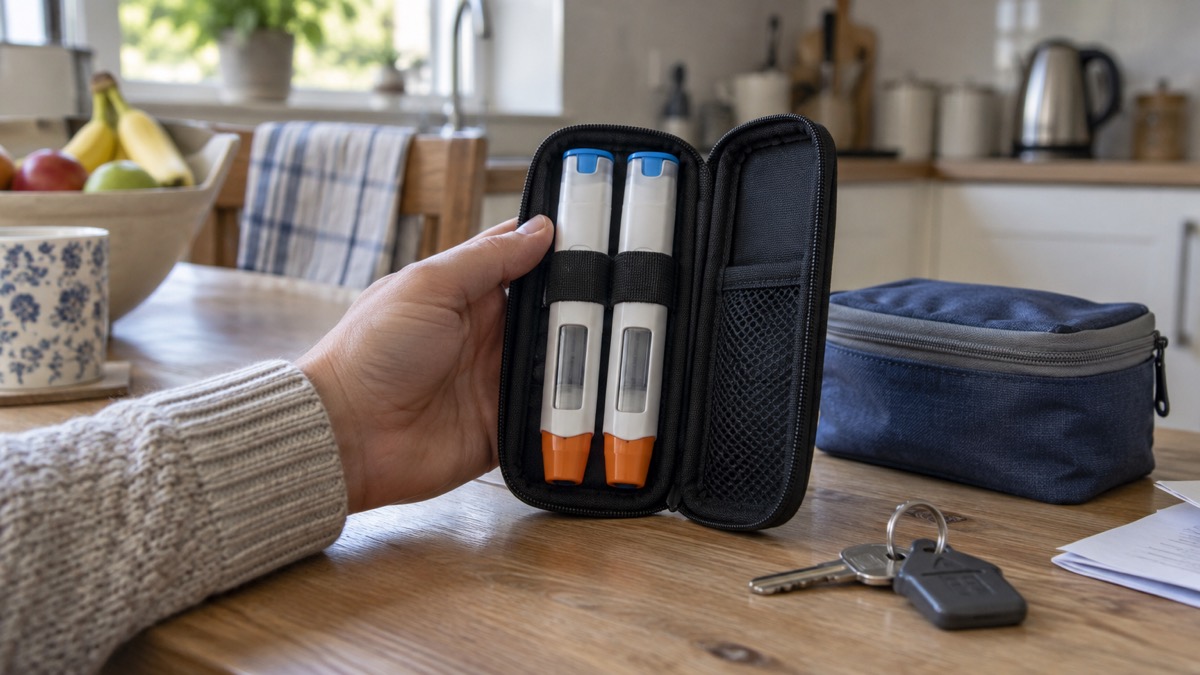
If anyone in your household carries adrenaline auto-injectors for anaphylaxis, official advice is consistent and simple: "always carry two AAIs with you"28. The MHRA's own recall notice repeated it: "Patients should continue to carry two devices at all times"25. Two pens, not one, because a second dose may be needed if symptoms return.
After using an auto-injector, the instruction is equally clear. NHS inform's anaphylaxis first aid guidance says: "Phone 999 and tell the call handler that you think someone has anaphylaxis"29. The MHRA safety notice from May 2023 says the same in more detail: "call an ambulance (999) immediately after giving the injection and say this is an emergency case of anaphylaxis"24. The reason for calling 999 even when the person seems to recover is that symptoms can return, and more than one dose of adrenaline may be needed.
"Phone 999 and tell the call handler that you think someone has anaphylaxis."
If you do not have access to an auto-injector when a reaction happens, tell the emergency services when you call29. In Scotland, the Scottish Ambulance Service's guidance on 999 covers life-threatening emergencies including anaphylaxis20. The national adrenaline auto-injector safety campaign, backed by the Commission on Human Medicines, exists to support the effective and safe use of these devices, including through patient advice on carrying two pens and using them correctly28.
Cyber attacks on the NHS: how ready the system is
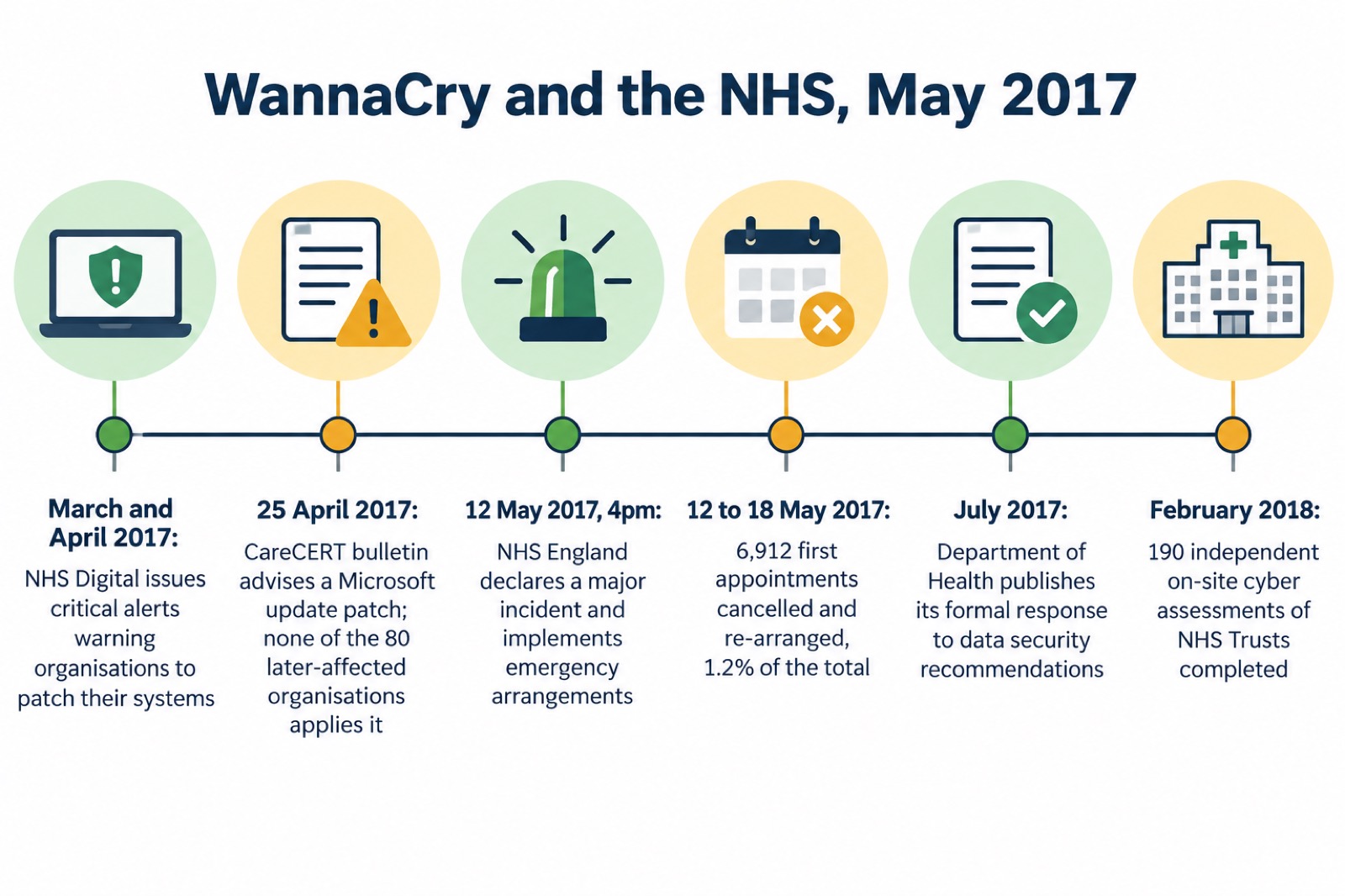
Medicine supply depends on IT: prescriptions, stock systems, deliveries and patient records all run on networks, and a cyber attack can disrupt them as effectively as a physical shortage. The clearest example is WannaCry. On 12 May 2017, a ransomware attack spread across the world and infected at least 80 NHS organisations in England; at 4pm that day NHS England declared the cyber attack a major incident and implemented its emergency arrangements to maintain health and patient care30.
The disruption was real but bounded. 6,912 first appointments were cancelled and re-arranged between 12 and 18 May, 1.2 per cent of the total31. 1,220 pieces of diagnostic equipment, about 1 per cent across the NHS, were affected31. Devices in an additional 21 NHS organisations made calls to the WannaCry "kill switch", meaning they were exposed but not encrypted31. No patient data was compromised30.
The attack was also preventable. In March and April 2017, NHS Digital had issued critical alerts warning organisations to patch their systems to prevent WannaCry30. None of the 80 NHS organisations affected by WannaCry had applied the Microsoft update patch advised by NHS Digital's CareCERT bulletin on 25 April 201731.
Since then, the NHS has done work to be readier. By February 2018, 190 independent on-site cyber assessments of NHS Trusts had been undertaken31. The lessons-learned review also recommended that NHS England develop scenarios to manage a coordinated or multiple attack, for instance a terrorist bombing combined with a cyber attack31. At government level, the UK has announced the upcoming Cyber Security and Resilience Bill, which will ensure that critical infrastructure and the digital services UK citizens and businesses rely on are secure27.
For households, the practical read-across is on our cyber attacks page: keep a written copy of your prescriptions and medicines, know your pharmacy's phone number, and be ready for services to fall back to paper and telephone if systems go down.
First aid kits in public places
One piece of health emergency infrastructure worth knowing about is the Public Access Trauma (PAcT) first aid kit. The Department of Health and Social Care and the National Counter Terrorism Security Office recommend its adoption32. A PAcT kit supports the treatment of immediate, life-threatening injuries such as major bleeding and someone not breathing on their own32. It is for use by any person, regardless of their level of training33.
The kits are designed to be easily identifiable: a coloured, sealed pack or container, clearly labelled "Public Access Trauma First Aid Kit" with a clearly visible white cross on the front, and they must be located in publicly accessible locations people can easily reach33. The sign can be obtained with the kit from first aid suppliers33. The aim is to increase first aid resilience among the general public and improve the survivability of a person with life-threatening injuries33.
At home, the equivalent is simpler. A basic first aid kit can be bought over the counter, or you can create one yourself34. A well-prepared first aid kit can help treat minor cuts, sprains and bruises, and reduce the risk of cuts becoming infected6. Replace items when stocks run low, check the use-by dates of all medicines, and throw away anything past its date35. Our first aid guide covers what to keep and how to use it, and the medicine cabinet checklist lists the over-the-counter medicines worth having at home.
Where to get help, at a glance
| Situation | Who to contact |
|---|---|
| Pharmacy cannot supply your usual medicine | Your pharmacist first, as early as possible; then your doctor or NHS 1111 |
| Run out of prescribed medicine, need it urgently | Any pharmacy with stock, or NHS 111 online or by phone3 |
| GP surgery closed (Wales) | An Emergency Medicines Supply Service pharmacy, free of charge13 |
| Minor illness | Walk in to a pharmacy; Pharmacy First can treat seven common conditions19 |
| Unsure if it is urgent | NHS 111, online or by phone10 |
| Anaphylaxis, after using an auto-injector | 999, and say it is anaphylaxis29 |
The consistent thread through all of this is that the pharmacist is the front door. Whether the problem is a national shortage, a local stockout, a recall, a bank holiday or a minor illness, the pharmacy is where to start, and NHS 111 is the backup when it is closed. Keep enough of your regular medicines at home to ride out a few days of disruption without stockpiling, carry two auto-injectors if you need them, and act on recall notices as soon as they appear.
Sources (35)
- Advice for patients during a medicines shortage, NHS Specialist Pharmacy Service, November 2025
- Emergency prescriptions, NHS, 15 January 2024
- Emergency supply of medication, NHS Nottingham and Nottinghamshire ICB, 29 October 2026
- Urgent care services, NHS North East London ICB, 14 April 2026
- 111 service information, NHS 24, 22 December 2023
- Keep a well stocked medicine cabinet at home, NHS Black Country ICB, 28 October 2026
- When you need urgent healthcare, NHS Cheshire and Merseyside, 11 August 2026
- Pharmacy frequently asked questions, NHS 111 Wales, 2021
- Health advice for public holidays, NHS inform, 15 September 2026
- Stay well this winter, NHS Cheshire and Merseyside, 28 October 2026
- Health emergencies, Somerset Council, 28 October 2026
- Winter Wellness 2025-26 leaflet, NHS North East London ICB, November 2025
- What service do I need?, NHS 111 Wales, 2021
- Out of hours services, NHS 111 Wales, 2021
- Your Health Guide, Winter 2025-6, NHS Western Isles Integration Joint Board, December 2025
- Staying well in winter, Derbyshire County Council, 29 October 2026
- Neighbour and vulnerable people support, South Western Ambulance NHS Foundation Trust, 29 October 2026
- In an emergency, Medway NHS Foundation Trust, 29 October 2026
- Use the right service this winter, Hampshire Hospitals NHS Foundation Trust, 29 October 2026
- When should you call 999?, Scottish Ambulance Service, 29 October 2026
- Cold weather, snow and ice, UK Prepare Campaign, 2 October 2026
- Poisoning and injuries, Frimley Healthier Together, 29 October 2026
- Poisoning: accidental swallowing, Healthier Together Wales, 29 October 2026
- National Patient Safety Alert: Class 1 Medicines Recall, Emerade 500 and 300 micrograms auto-injectors, MHRA, 9 May 2023
- Class 1 Medicines Recall notification: Emerade 500 and 300 micrograms, MHRA, 9 May 2023
- Class 2 Medicines Recall: Emerade 150, 300 and 500 microgram solution for injection, MHRA, 28 November 2019
- UK Government Resilience Action Plan, UK Government, 14 July 2025
- Adrenaline auto-injector safety campaign, UK Government, 17 October 2023
- Anaphylaxis first aid, NHS inform, 24 July 2026
- Investigation: WannaCry cyber attack and the NHS, National Audit Office, October 2017
- Lessons learned review of the WannaCry ransomware cyber attack, NHS England, 1 February 2018
- First aid provisions, ProtectUK, 1 June 2026
- Standards for Public Access Trauma (PAcT) first aid kits and equipment, ProtectUK, 1 June 2026
- What to keep in your medicine cabinet, Healthier Together, 28 October 2026
- Safety first aid kit for your baby, NHS 111 Wales, 19 April 2021
 Medicine Cabinet Checklist
 Sick at Home Supplies Kit
 Caring for Someone Ill at Home
 Pandemics and UK Household Plans
 Outbreaks Near You
 UK Health Security Agency
 Staying Home When Ill
 Stopping Infections at Home
 Caring for a Sick Person at Home
 Keeping Prescription Medicine
 Storing Medicines Safely
 Urgent Care and A&E
 Vaccines Against Outbreaks
 Flu Symptoms and Getting Help
 COVID-19 Symptoms and Testing