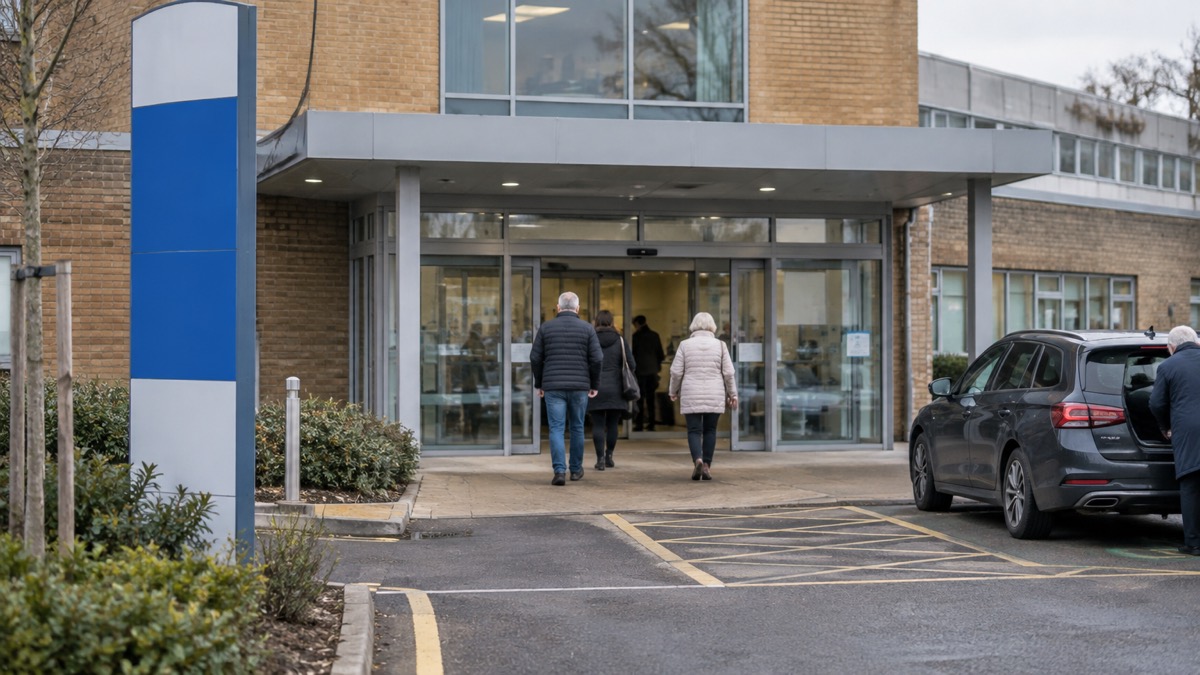
When an NHS cyber attack makes the news, the first question most households have is a simple one: is my appointment still on? The answer, based on how past attacks have actually played out, is that most care continues. During the WannaCry attack of May 2017, the largest cyber attack to affect the NHS in England, 1.2 per cent of first appointments, 6,912 in total, were cancelled and rearranged between 12 and 18 May1. During the Synnovis ransomware attack in June 2024, all urgent and emergency services such as A&E, urgent care centres and maternity departments remained open as usual2.
So the working rule is this: attend your appointment, operation or test unless you are contacted and told otherwise. Hospitals and GP practices contact patients directly when something is cancelled, and unaffected hospitals create capacity to take patients from those that are disrupted2. If you are unsure, call the number on your appointment letter, use the NHS App to book and manage appointments2, or call NHS 111, which is available 24 hours a day, seven days a week3.
This page explains what happened to appointments, A&E and blood tests in the real NHS cyber attacks, how long the disruption lasted, and what to do about the scam calls and texts that tend to follow any data breach. For the wider picture of how a major incident is handled, see our guide to how the NHS, government and regulators respond.
Most appointments go ahead unless you are told otherwise
The clearest evidence for this comes from WannaCry, the ransomware attack that hit the NHS in England on 12 May 2017. It affected at least 80 out of 236 hospital trusts across England, and 595 out of 7,454 GP practices, 8 per cent, were infected1. Yet the effect on planned care was small relative to the NHS's normal workload. The NHS cares for over 1 million patients every 24 hours, and in total 1 per cent of NHS activity was directly affected by the attack1.
Of the appointments that were disrupted, NHS England identified 6,912 first appointments as cancelled and rearranged between 12 and 18 May, which was 1.2 per cent of the total1. NHS England estimated the overall number of cancelled appointments at around 19,494, based on the normal rate of follow-up appointments that would have accompanied them6. The review also found that at least 139 patients had an urgent referral for potential cancer cancelled as at 18 May6. Those patients were re-contacted and their appointments rearranged, which is the pattern the NHS follows: the organisation that booked your care contacts you if it cannot go ahead.
Two things are worth knowing about how this works in practice. First, the NHS was not a specific target of WannaCry; the attack particularly affected the NHS, but the ransomware spread opportunistically, including through the broadband network connecting NHS sites in England1. Second, national systems held up: NHS Digital's national IT systems, including the NHS Spine, which holds secure databases of demographic and clinical information, and NHSmail, the NHS email system, were not infected6. That is one reason disruption stayed local rather than becoming national.
If you hear about an NHS cyber attack in the news and have something booked:
- Check the NHS App2
- Look for a text, call or letter from the hospital or practice that booked you, since cancellations come from them directly
- Call the number on your appointment letter if you have heard nothing and want certainty
- Call NHS 111 if you cannot reach your practice and need urgent advice7
If your concern is getting medicines while GP or pharmacy systems are down, see our separate guide to prescriptions during an IT outage.
What A&E does when one hospital is hit
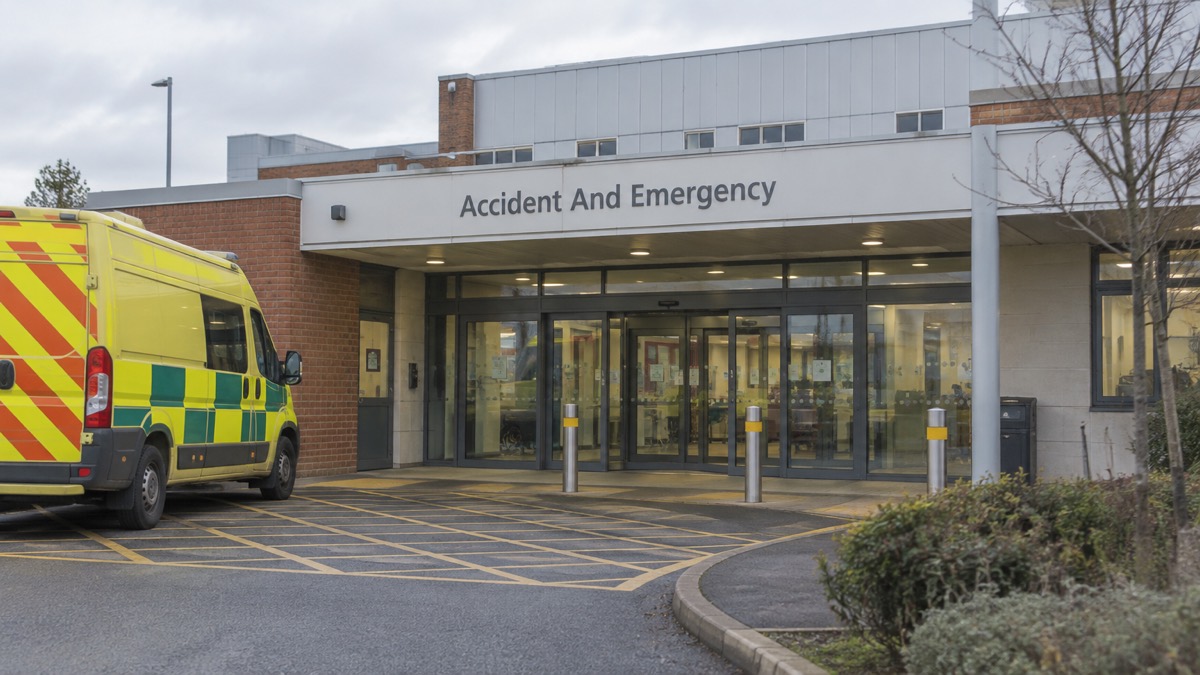
A&E departments do not close because of a cyber attack. During the Synnovis incident, NHS England stated plainly that all urgent and emergency services, including A&E, urgent care centres and maternity departments, remained open as usual2. The same applied to emergency care during WannaCry, though a handful of departments came under real strain.
On 13 May 2017, five acute trusts, in London, Essex, Hertfordshire, Hampshire and Cumbria, were operating some diverts from their A&E departments, and a further two needed outside help to continue treating patients6. The diverts were lifted on 16 May1. A divert means ambulances are sent to a different emergency department for a period, and the NHS used its "mutual aid" processes: where one A&E could no longer take patients, nearby A&Es stepped up to take their demand, and some patients from five hospitals travelled further for emergency treatment than normal1. Hospitals not affected by an attack create capacity to take patients from those that are2.
What this means for you as a patient:
- In a genuine emergency, call 999 or go to A&E. NHS guidance is explicit that people should still call 999 and go to A&E when someone is seriously ill or injured and their life is at risk3
- If your need is urgent but not life-threatening, call NHS 111 first. In Surrey and Sussex, patients who need urgent NHS care are asked to call NHS 111 before they decide to walk into the local A&E8
- If you do arrive at A&E without contacting NHS 111, you will still receive medical care, with emergency treatments prioritised9
- Some visits to A&E and calls to 999 could be resolved by other NHS services, so if the condition is not critical, choose another service7
Blood tests and pathology: what the Synnovis attack meant
The Synnovis attack in June 2024 is the clearest example of a cyber attack disrupting tests rather than emergency care. Synnovis provides pathology services, including blood, urine and specimen testing, to a number of healthcare organisations in south-east London5. On 3 June 2024 it was the victim of a ransomware cyber-attack5, which significantly reduced its capacity to process tests and caused significant disruption across a range of treatments in south-east London2.
The numbers for patients were substantial. As a result of the attack, 10,152 acute outpatient appointments and 1,710 elective procedures were postponed at King's College Hospital NHS Foundation Trust and Guy's and St Thomas' NHS Foundation Trust10. The impact was greatest in south-east London, within Synnovis's partner trusts and their local boroughs, and appointment cancellations were confined to that area5. Elsewhere in the country, blood tests and other services continued as normal.
| What was affected by the Synnovis attack | What happened |
|---|---|
| Area | South-east London, within Synnovis's partner trusts and their boroughs5 |
| Blood tests | Capacity to process tests significantly reduced; urgent samples still processed within appropriate timeframes2 |
| Appointments | 10,152 acute outpatient appointments postponed at two trusts10 |
| Operations | 1,710 elective procedures postponed at the same two trusts10 |
| Urgent and emergency care | A&E, urgent care centres and maternity remained open as usual2 |
| Restoration | All services fully restored by December 20245 |
Two reassurances came out of the incident. Synnovis put additional resources in place so that urgent samples received from GPs or hospitals could still be processed within appropriate timeframes2. And the disruption was time-limited: services were fully restored by December 2024, and NHS England now states the incident is no longer causing disruption to patient appointments or services5. The re-booking of tests and appointments meant some disruption was still felt over the coming months after the attack itself2, so if you had a test postponed and have not been re-contacted, chase it with your GP or hospital.
For the full story of that incident, see our page on the Synnovis ransomware attack and London pathology.
NHS 111 and other ways to get help when systems are down
NHS 111 is the service to use when you need urgent medical help but it is not an emergency. It is the NHS non-emergency number: call 111 or visit 111 online, and advisers assess your symptoms and direct you to the best medical care7. The service is available 24 hours a day, seven days a week3, by phone, online or via the NHS App11.
111 online can be reached through the website 111.nhs.uk or the NHS App on a smartphone or tablet, and there are accessible routes too: British Sign Language via signvideo, and text relay on 18001 11112. It helps people with an urgent medical need to get assessed and directed to the right care, especially if they cannot contact their GP or their GP is closed12.
Depending on what you need, you might be advised to12:
- Call 999 or go to A&E in an emergency
- Go to an urgent treatment centre
- See an evening and weekend GP, the out-of-hours service
- Book a callback from a nurse
- Get urgent specialist support, for dental or mental health problems
- Contact your own GP surgery
- See a pharmacist for help with a minor illness
- Look after yourself safely at home
You might also be referred to other urgent care services you can visit yourself, such as A&E, an urgent treatment centre, a walk-in centre or evening and weekend GPs13. NHS 111 can book you an appointment at an urgent treatment centre, an emergency dental service or a GP, and can even book you an appointment at A&E if necessary11. GP appointments are available seven days a week in the evening, at weekends and on bank holidays; call your practice, or if your practice is closed, call NHS 111 to book11.
Calls to 111 are recorded, and the records are maintained securely and only shared with others directly involved with your care3. If you rely on other services during a wider outage, our guide to staying informed and in touch in an emergency covers keeping phones and radios working, and our page on when banks, shops and public services go offline covers the rest of the household picture.
How long NHS IT outages actually last
The honest answer is that it varies considerably with what has been hit, and past incidents give a realistic range.
The WannaCry emergency response lasted one week6. NHS England declared the cyber attack a major incident at 4 pm on 12 May 2017 and implemented its emergency arrangements to maintain health and patient care6, and it stood down the incident on Friday 19 May6. Recovery of general practice was fast: 95 per cent of infected GP practices were re-installed and patched by 17 May, with the remaining 5 per cent completed by Friday 19 May1.
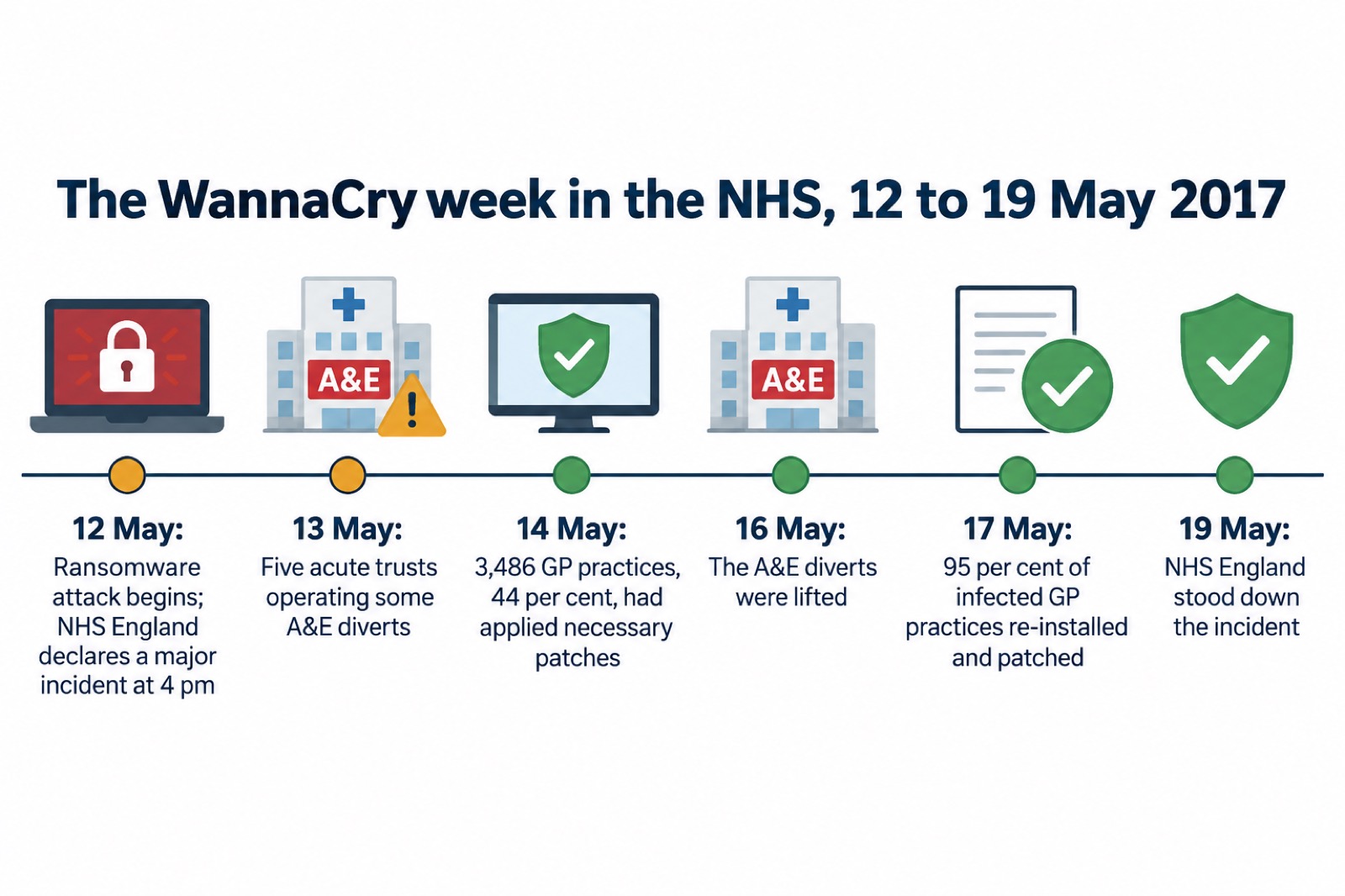
The WannaCry attack of May 2017 shows how the timelines differ. NHS England's emergency response lasted one week6, and the incident was stood down on Friday 19 May6. Most GP practices recovered quickly: 95% of infected practices were re-installed and patched by 17 May, with the remaining 5% completed by Friday 19 May4. But disruption to planned care lasted beyond the response itself: NHS England identified 6,912 appointments that had been cancelled, and at least 139 patients had an urgent referral for potential cancer cancelled, as at 18 May6. So: emergency arrangements are usually stood down within days or a week, but disruption to planned care, tests and routine systems can last longer.
One point of context for households planning ahead: the National Risk Register notes that in a severe nationwide loss of power scenario, full restoration could take up to 7 days, with restoration of critical services potentially taking several months10. An NHS IT outage is not the same as a power cut, but the lesson for households is similar: keep a week's resilience in your planning. Our getting started guide and emergency kit pages set out the basics.
Scam calls and emails after a data breach
After any cyber attack in which data may have been stolen, criminals follow up with scam messages, sometimes weeks later. NHS England's advice after the Synnovis incident is that you will never be asked for personal or financial information when contacted about the incident, and Synnovis will not contact patients directly: any notification will come from an NHS organisation, as determined by UK data protection laws1. Be alert to suspicious messages, which may be sent some time after a breach is made public, and remember that your bank or any other official organisation will never ask you to supply personal information by email1.
The single most useful rule is this: the NHS will never ask you for personal or financial information when contacting you about an incident. NHS England's own words on the Synnovis incident:
"You will never be asked for personal or financial information."
The National Cyber Security Centre (NCSC) gives the same warning for banks and other official organisations: your bank, the police, or real companies will never ask for your details in an email, text, or phone call, and caller ID can be spoofed easily, so do not trust a displayed telephone number14. If you are contacted about an NHS incident, do not use an address or phone number given in the message itself; use the contact details from the official organisation's website5.
Warning signs the NCSC lists for scam messages following a breach include official-sounding messages about "resetting passwords", "receiving compensation", "scanning devices" or "missed deliveries", emails full of technical jargon, and being urged to act immediately or within a limited timeframe15. Ofcom's guidance on scam calls and texts describes phishing emails that claim to be from the NHS but are in fact sent by scammers: they can be quite convincing at first glance, but by checking the sender you can see where they have come from, and you should not click on any links in them16.
If you think an account of yours has been accessed, the NCSC has guidance on recovering a hacked account15, and if your email address was hacked, check for any "auto forwarding rules", which criminals add to retain access to your inbox even after you change passwords14. Our pages on spotting scam messages after a data breach, telling whether an NHS email or text is genuine and recovering a hacked email account go through the steps in detail.
Where to report a scam or a cyber crime
Reporting takes a minute and costs nothing, and it lets the authorities investigate and block the senders.
Suspicious texts: forward the message to 7726. It is free4. 7726 is a spam-reporting service provided by phone operators; reporting costs nothing and can reduce the amount of scam texts you receive17. Most phone providers are part of the scheme, and your provider can investigate the origin and block or ban the sender if it is malicious18. With scam "missed parcel" texts in particular, the NCSC's instructions are: do not click the link in the message, do not install any apps if prompted, forward the message to 7726, then delete it17. If 7726 does not work, contact your phone provider to find out how to report a text message18.
Suspicious emails: forward them to report@phishing.gov.uk, the NCSC's Suspicious Email Reporting Service, which will investigate them4. The NCSC's advice on phishing is not to engage with the phisher: forward the email, then delete it20. NHS England gave the same instruction to patients during the Synnovis incident: send suspicious emails to report@phishing.gov.uk or texts to 77265.
Fraud and cyber crime: if you think you have been the victim of a cyber crime or fraud, call Action Fraud, the UK's national reporting centre for fraud and cybercrime, on 0300 123 2040, or textphone 0300 123 2050, or report online at www.actionfraud.police.uk5. NHS England directed patients targeted by fraud after the Synnovis incident to Action Fraud5.
Scam websites: you can also report suspicious websites to the NCSC21.
If you received the message on a work laptop or phone, contact your IT department and tell them what has happened21. Our narrow guides on reporting a scam text and reporting a phishing email walk through each step with screenshots of the process.
Did the NHS pay a ransom?
No NHS organisation paid the WannaCry ransom. The Department of Health and Social Care, NHS England and the National Crime Agency all confirmed this22, and the NHS's own lessons learned review states the same, noting that standing advice not to pay was re-circulated by the NCSC during the incident1. NHS Digital advised the trusts it spoke to not to pay, and wrote to all trusts on 14 May 2017 advising against the payment of ransoms6.
The reasoning behind that advice applies to households as much as hospitals. The NCSC's guidance for home users explains that paying a ransom gives no guarantee you will get access to your data, your computer will still be infected unless you complete extensive clean-up activities, and you will be paying criminal groups23. The NCSC's annual review makes the same point bluntly: after paying, computer or networks will still be infected24.
Ransomware attacks on the NHS were not a one-off. Before WannaCry, Northern Lincolnshire and Goole NHS Foundation Trust had been subject to a ransomware attack in October 2016, which led to the cancellation of 2,800 appointments6, and Barts Health NHS Trust suffered a cyber attack in January 20176. Between September 2021 and August 2022 the NCSC co-ordinated the national response to 18 ransomware attacks24. For what ransomware is and how it reaches households, see our ransomware guide, and for the 2017 attack itself, our page on WannaCry.
Sources (24)
- Lessons learned review of the WannaCry ransomware cyber attack, NHS England, February 2018
- Synnovis ransomware cyber attack: frequently asked questions, NHS England (London), 2024
- NHS 111: your local services, NHS Lancashire and South Cumbria Integrated Care Board
- Report suspicious emails, websites and phishing, GOV.UK
- Synnovis cyber incident: questions and answers, NHS England, November 2025
- Investigation: WannaCry cyber attack and the NHS, National Audit Office, October 2017
- In an emergency, Medway NHS Foundation Trust
- Emergency care and 999, NHS Surrey and Sussex Integrated Care Board
- What care services can NHS 111 put you in touch with, North West Ambulance Service NHS Foundation Trust, August 2024
- National Risk Register 2025, Cabinet Office, 2025
- Urgent care, NHS North East London Integrated Care Board, April 2026
- NHS 111 online service, NHS Digital
- NHS 111 online: what happens next, North East Ambulance Service NHS Foundation Trust
- Preparing for an emergency: be ready, stay safe, act now, Sussex Resilience Forum, October 2025
- Guidance: data breaches, National Cyber Security Centre, January 2021
- Coronavirus scam calls and texts, Ofcom, March 2022
- Scam missed parcel SMS messages, National Cyber Security Centre, April 2021
- Report a scam text message, National Cyber Security Centre, November 2021
- Advice on avoiding malware from scam missed parcel SMS messages, National Cyber Security Centre, August 2026
- Sextortion scams: how to protect yourself, National Cyber Security Centre, November 2018
- Phishing: respond and recover, National Cyber Security Centre
- Investigation: WannaCry cyber attack and the NHS (report page), National Audit Office, October 2017
- Ransomware and WannaCry: guidance for home users and small businesses, National Cyber Security Centre, July 2026
- Annual Review 2022: cyber crime, National Cyber Security Centre, November 2022
 Accounts to Protect With 2-Step
 After Fixing an Infected Device
 Home Online Security Checklist
 Antivirus Software
 Backing Up Files and Photos
 Council Online Services Down
 Your Details in a Data Breach
 FluBot Fake Parcel Texts
 Hacked Online Accounts
 How Services Respond
 Malware Signs and Removal
 National Cyber Security Centre
 Keeping Key Records Offline
 Shopping Online Safely
 Paying for Essentials