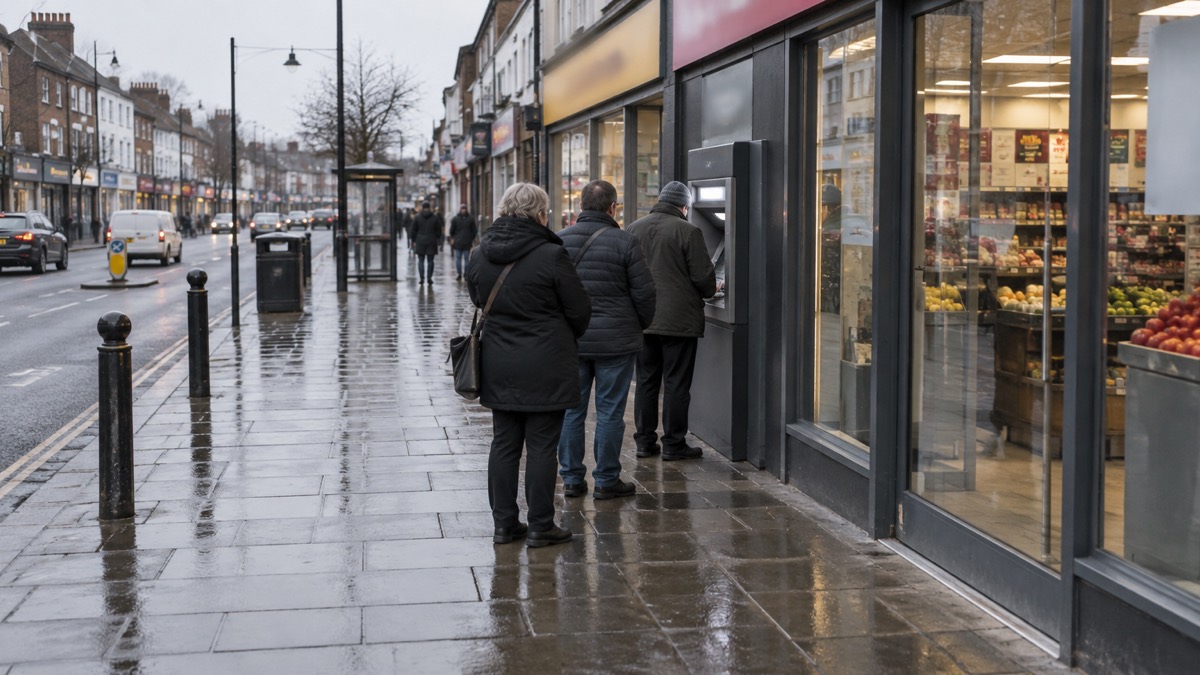
When card payments stop working, the first thing to understand is what has actually failed. A card payment needs several systems to work at once: the shop's card terminal, a network link to your bank, electricity at the shop, and your bank's own systems. If any one of them fails, contactless, chip and PIN and phone wallets all stop together. Official guidance on power outages is blunt about how wide the effects can be: an outage may close retail businesses, grocery stores, petrol stations, cash machines and banks, as well as disrupting communications, water and transport1.
Your immediate priorities are simple. Pay with cash where the shop is still open and trading, use another payment route if only one system is down, and keep your phone charged and used sparingly so you can reach help. Do not assume you can withdraw cash during the outage, because cash machines depend on the same power and networks. If you have already shared bank details with someone during the confusion, contact your bank immediately; you can cancel your cards online if you use online banking2.
This page covers what to do in the first hour, how much cash to keep at home, what to do if the outage lasts days, and how to avoid the scam messages that reliably follow. It sits alongside our wider guide to cyber attacks and major IT failures and our page on when banks, shops and public services go offline.
What to do when card payments stop working
Work through the situation in order. First, check whether it is your card or the whole system. Try a different card, and watch what happens to other customers at the till. If everyone's card is being declined, the shop's terminal, its network or its power has failed, and no card of yours will work. If only your card fails, the problem is with your account or your bank, and you should contact your bank when you can.
Second, ask what the shop will accept. Many shops will carry on trading and take cash. Third, do not plan on getting cash out during the outage: cash machines need power and network connections, and official guidance warns they can be among the services that close1. Fourth, use your phone sparingly. Official guidance for phone and broadband outages says to use your devices sparingly to conserve battery power until you can charge them again7.
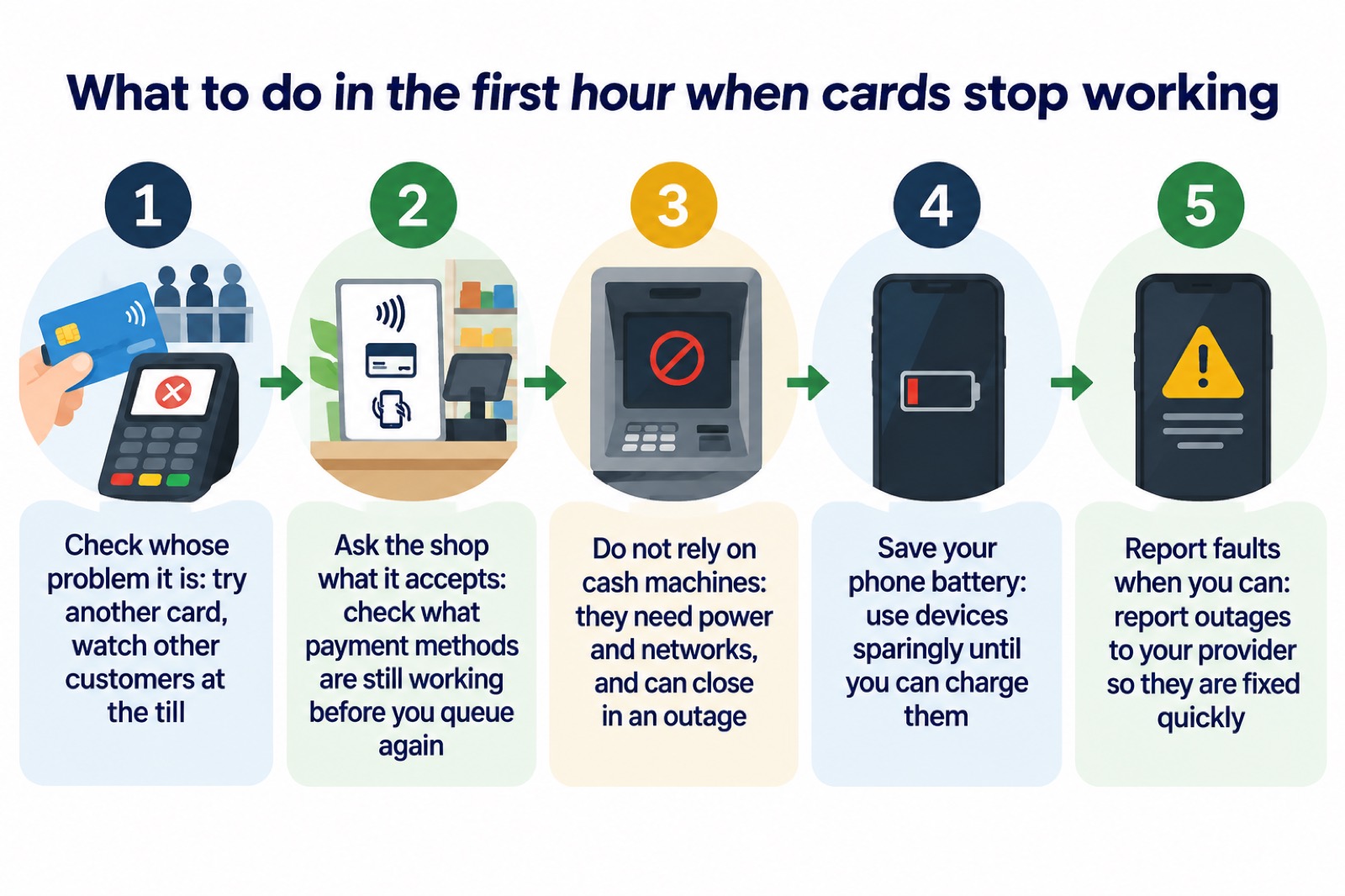
If the outage follows severe weather, report it to your provider when you are able. Ofcom guidance says that if your mobile, broadband or landline is unavailable after a severe weather event, you should report this to your provider if you can, because it helps make sure faults are fixed as soon as possible8. If phone calls will not connect even though your phone shows signal, try sending a standard text message: these can still get through when the mobile network is extremely busy, and using texts also reduces pressure on the network8.
Keep a sense of what is behind the outage, because it changes what you should do. A power cut closes card terminals and cash machines at the same time, so cash only helps where a shop is still open and willing to trade. A cyber attack on a bank or a payments processor may leave shops powered and cash machines working, so withdrawing cash may still be possible. Our page on when banks, shops and public services go offline goes into what a major IT failure means for each service.
Pay with cash where you can
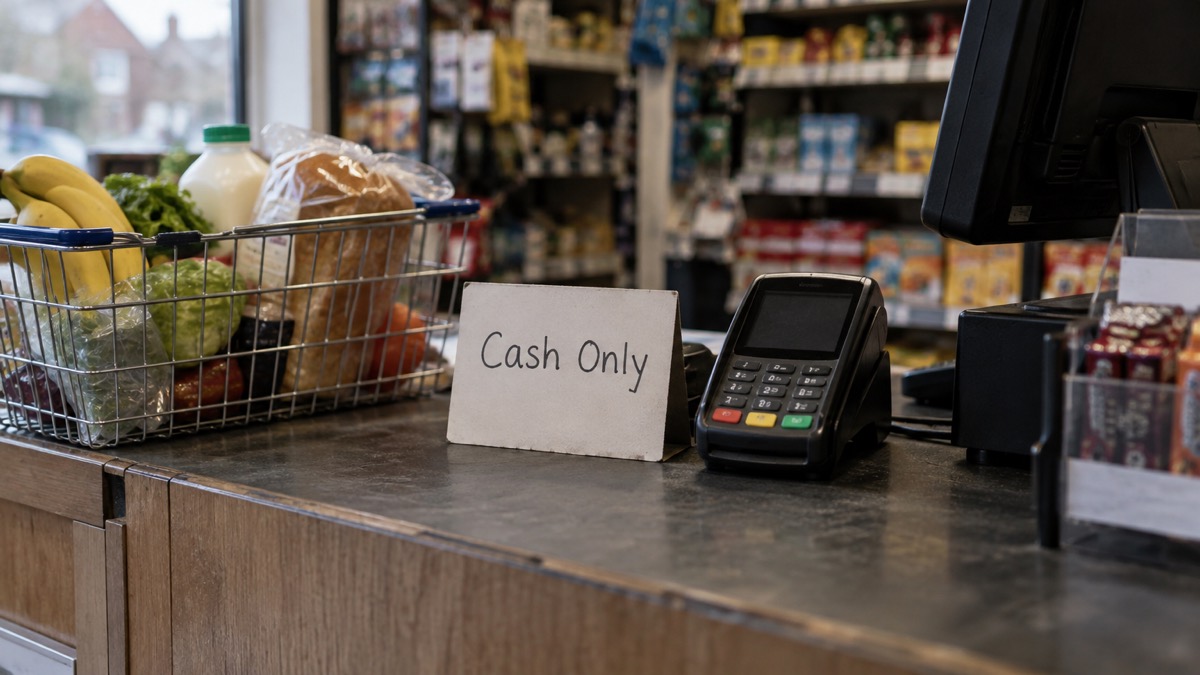
Cash is the one payment method that works when networks, banks and card terminals fail, provided the shop is open and has change. That is why the guidance on phone and broadband outages tells households to keep a small amount of cash for essential purchases if mobile payment apps are disrupted7, and the power cut guidance gives the same advice for the case where electronic payments or ATMs are disrupted9.
Where you can, keep a mix of coins and notes rather than a few large notes. Small shops, market stalls and buses may not be able to break a large note, and in a widespread outage they may have no way to give change at all if their tills are electronic. Coins let you pay exact amounts when change is limited.
Two cautions from official sources are worth holding in mind. Surrey County Council advises that when hiring a tradesman, you should if at all possible pay by credit card, because there is protection if things go wrong10. Cash has no such protection, so during an outage be careful about large cash payments for work you would normally pay by card; if you cannot wait, get a receipt and the trader's details. Counter-terrorism guidance from ProtectUK also asks the public to report unusual bank transactions, or someone who has suddenly come into a lot of money for no reason, because cheque and credit card fraud are ways of generating cash11. If you notice unusual transactions on your own account, that is a matter for your bank, covered later on this page.
How much cash to keep at home, and how to store it
No official source gives a single figure for every household, and you should be wary of any that claims to. A practical way to reach your own figure is to add up what a few days of food, fuel top-ups, medicines and travel would cost your household at normal prices, and hold that in notes and coins. The aim is a small amount for essential purchases, not a substitute for your bank account.
The wider preparedness advice gives you the time period to plan for. Birmingham City Council's preparedness guidance says to keep enough supplies to meet your household's needs for at least 72 hours4, and a community risk register for West Yorkshire makes the same point about money specifically: keep a small amount of money at home in case cash points and electronic payment systems stop working12. Birmingham's guidance on loss of utilities likewise says to keep some emergency cash accessible13.
Store it where you can reach it quickly. Carmarthenshire County Council's guidance on household emergency kits says to keep your kit in a safe place at home where you can reach it easily, and to keep it in a waterproof bag14. That applies to the cash in it as much as to anything else: a waterproof bag protects notes and coins from burst pipes and flooding as well as from damp.
| Question | Official answer |
|---|---|
| How much cash? | A small amount, for essential purchases |
| How long should supplies cover? | At least 72 hours4 |
| Where should it be kept? | In a safe place at home, easily reachable, in a waterproof bag14 |
If money itself is the problem rather than the payment system, help exists. Somerset's guidance on its Crisis and Resilience Fund describes assessing households with savings between £3,000 and £10,000, to establish whether using those savings would lead to financial hardship in the near future15. In Northern Ireland, after a flood, a householder could receive £1,000 under the Scheme for Emergency Financial Assistance, to make a home fit to live in as quickly as possible; the guidance is clear that it is not compensation16. These are hardship schemes rather than payment-outage measures, but they are the right place to turn if an emergency leaves you unable to pay for essentials.
Other ways to pay when one system is down
A payments outage is rarely total. One system failing often leaves others working, and knowing which is which lets you keep buying essentials.
If your bank's app or card is the problem but the card network is fine, another card from a different bank, or a prepaid card loaded in advance, may still work. If the card network is down but shops are open, cash and shop vouchers are the routes left. Government guidance from the coronavirus period, when access to shops was disrupted, notes that most of the major supermarkets have alternative ways you can pay for your shopping, such as e-vouchers or gift cards17. The same guidance says that if you are having difficulty shopping, you can contact your local authority to find out what support services are available in your area17.
Energy bills have their own fallback routes, set out in the Utility Regulator's consumer guide for Northern Ireland. On a credit meter you receive a bill and can pay by direct debit, or by cash, cheque or card at your local post office18. On a keypad meter you top up with cash from the Post Office, or using PayPoint or Payzone at your local outlet, by phone with your supplier, or through some suppliers' apps18. Ofgem's consumer advice for England and Wales describes the same network of outlets for fuel vouchers: you can use them at a PayPoint shop, Payzone shop or Post Office to add credit to your gas card or electricity key19.
| If this fails | Try this | Where it comes from |
|---|---|---|
| Your bank's app or card | A card from a different bank, or a prepaid card loaded in advance | General practice; no single official source |
| The card network in shops | Cash, or supermarket e-vouchers and gift cards | 17 |
| Your energy direct debit | Cash, cheque or card at the post office (credit meter) | 18 |
| Your energy top-up app | Cash at the Post Office, PayPoint or Payzone (prepayment meter) | 18 |
| Fuel voucher redemption | PayPoint shop, Payzone shop or Post Office | 19 |
If you use fuel vouchers, Ofgem's advice is to take the code and instructions with you, and some form of ID, for example your passport or a bill with your name and address, and to use the voucher within its validity period19. The Fuel Bank Foundation provides emergency financial support through a network of partners, identifying people who cannot afford to pre-pay for their fuel or energy19.
Get ready before payments fail
The best time to prepare for a payments outage is before anything goes wrong, and the official preparedness material treats this as part of ordinary household planning rather than anything dramatic.
Start with the grab bag. The Royal Borough of Windsor and Maidenhead's home emergency plan lists money and credit cards among the essentials for an emergency grab bag3, and the national Be Ready household emergency plan says to keep a portable power bank to charge your phone and medical devices if they are compatible20. A charged phone is what lets you check whether an outage is known, contact your bank and reach help, so the power bank matters as much as the cash.
Then charge ahead of foreseeable events. Cornwall Council's storm advice says to charge your phone, power banks and any essential medical equipment before the storm arrives21. Mersey Care's community equipment service asks users of devices such as hoists, bath lifts, suction machines and powered wheelchairs to prepare in advance of any pre-planned outages by fully charging the item for usage22. If a storm warning names electric gates, nidirect's strong winds advice says to make sure electric gates are open before it arrives23.
- Keep some emergency cash for essentials in a waterproof bag you can reach easily14
- Keep a portable power bank for your phone and compatible medical devices20
- Charge phones, power banks and essential medical equipment before a storm21
- Keep enough household supplies for at least 72 hours4
- Keep a small supply of over-the-counter medicines at home, such as pain relief, cold remedies and oral rehydration salts24
- If you have a care alarm or telecare kit connected to your landline, tell your landline provider in advance so they can check whether the device will work and make any necessary arrangements25
That last point matters more than it used to. As landlines move to digital, if you tell your landline provider in advance about a care alarm, they can help check whether your device will work and make any necessary arrangements, including pausing the change until a safe solution is in place if needed25. If your landline will not work during a power cut, your landline provider might offer you a free solution, such as a back-up battery unit, for a minimum of one hour, to enable you to call the emergency services if you needed to9. Ofcom guidance goes further for some households: if you do not have a working mobile phone or a reliable mobile signal, your landline provider must offer you a free solution such as a battery back-up unit8.
When payments are down for days
A short outage is an inconvenience. One that lasts days starts to affect bills, benefits and compensation, and there are official routes through each.
For power cuts, compensation is automatic. Ofgem says you will automatically be paid by your local network operator if you do not have power for a certain number of hours, and you claim the repeated-cuts payment with your local network operator6. You do not need to make a claim; payment could be through a cheque, cash or bank transfer, and your network operator will pay automatically if they have your bank details26. In normal weather, network operators will normally send payment within 10 working days of becoming aware of the failure; in severe weather this can take up to 3 months19. If you did not receive a payment automatically and it has been a few months, contact your network operator directly27. Two things to know: you will not be paid for blackouts caused by a national power shortage, damage to electrical equipment or appliances, or a low supply after a power cut26; and if your supply is cut off because of a faulty energy meter, contact your energy supplier rather than the network operator6. To report a power cut, use your local network operator's website or call 1056.
For energy bills you cannot pay, contact your supplier early. Derbyshire County Council's advice is that if you are unable to pay your bill, contact your supplier and let them know28, and Ofgem's consumer advice says that if you are struggling to pay your bills you should contact your energy supplier in the first instance, as they may be able to help19. On prepayment meters, if you are running out of gas and electricity, your supplier provides an emergency credit facility which you can access via your meter, and suppliers are required in certain situations to offer additional credit, including Emergency credit, Friendly-hours credit and Additional Support Credit19. If a supplier moves you to a prepayment meter against your will, they should immediately offer you £30 credit, or an equivalent non-disconnection period, which will have to be repaid19. A supplier cannot move you to a prepayment meter without your consent if your outstanding debt is less than £200 per fuel, or the debt has been outstanding less than three months after the bill was issued, or you are on or moving to a repayment plan19.
For cold weather, payments exist that need no claim from you. If you get certain benefits, you may get £25 when the weather is very cold for 7 days in a row, and these payments are automatic29. Nottinghamshire County Council's guidance describes the same scheme as a payment of £25 for every week the temperature falls below zero degrees celsius for seven consecutive days30.
If your energy supplier itself fails, Ofgem's advice is to take regular meter readings and a photo of them if you can, keep old bills, download bills from your app, and note your account balance19. Once Ofgem chooses a new supplier, they will contact you to tell you what has happened, explain how they will manage your account and Direct Debit payments, let you know about any credit or debit balance, and how you will get a refund on any money owed to you31. If you have a prepayment meter, the new supplier will give you information on how to get new key cards and tokens31. Any extra money you pay for your energy bills is kept in your account as credit, and is usually paid back to you when your energy account closes31.
Where shops and banks may not help
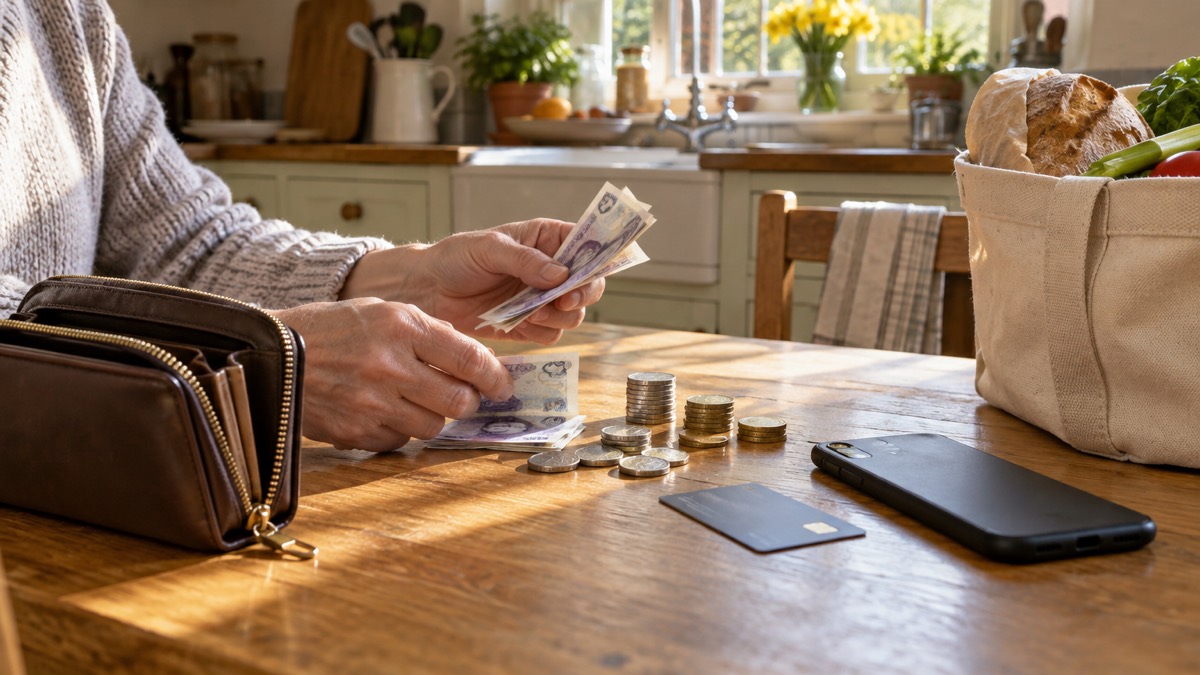
There are limits to what shops and banks will do during an outage, and knowing them in advance saves wasted journeys.
Shops are under no obligation to keep trading when their tills fail. Many will close, and in a power outage the guidance is clear that retail businesses, grocery stores and petrol stations can all close1. Fuel is a particular case: in a national power outage, fuel would not be available, because all filling stations are operated by electricity1. Do not set out during a widespread outage expecting to fill up.
Banks will not always be reachable. Branches can close in a power outage alongside other services1, and a cyber attack on a bank may take down its app, its phone lines and its card processing at once. What banks and other providers must do is communicate clearly: when broadband and mobile firms committed to helping customers during the coronavirus disruption, the commitments included communicating any decision not to pay compensation clearly to customers, and stopping charging customers who are without service32. Providers also committed to working with customers who were finding it difficult to pay their bills, making sure customers were treated fairly32. Those commitments were made in a specific crisis, but they are a fair statement of what to expect and demand from any provider during a prolonged outage: clear information, no charges for service you cannot use, and willingness to work with you on bills you cannot pay.
If you are on the Priority Services Register, extra help is available for power cuts. Ofgem says that for both planned and unplanned power cuts, network operators must offer customers on the Priority Services Register extra help, for example giving them battery packs so they can still charge phones or medical equipment, and that what each company offers will be different26. If you or someone in your household needs this, contact your energy network operator and ask to be added to the register. Our page on extra help in an emergency covers who qualifies and how to apply.
Scam messages during a payment outage
Every major outage is followed by scam messages, because criminals know people are anxious, expecting messages from banks, and checking their accounts more often than usual. The National Cyber Security Centre's phishing guidance and its advice on scam parcel texts set out both what to do and what to avoid.
The rules during an outage are the same as at any other time, but the pressure is higher. Do not click links in unexpected messages, and do not install any apps if prompted. If you get a scam text, forward the message to 7726, then delete it5. Keep your device up to date by installing the latest software and patches, and only install apps from official app stores such as Google Play, the Apple App Store or the Samsung Galaxy Store5. On Android devices, make sure Google's Play Protect service is enabled; some Huawei devices provide a similar tool to scan devices for viruses5.
If you have entered personal details or passwords, the NCSC says you should change the passwords on any of your accounts where you use the same password, and if you have entered banking or card details, contact your bank straight away and cancel the card there if you use online banking2. If you have lost money, tell your bank and report it as a crime to Report Fraud for England, Wales and Northern Ireland, or to Police Scotland for Scotland2.
One scam to know by name is courier fraud, described in a Wiltshire Police case study: a caller persuades you to reveal bank details or hand over your card to a courier. The advice if it has happened is to call your bank straight away to cancel the card33. A genuine bank will never ask you to hand over a card or cash to a courier. Our pages on how to check a message from your bank is genuine and phishing cover the checks in detail, and what to do if you replied to a scam text and gave your bank details to a scammer cover the aftermath.
Where to get help and updates
During the outage itself, your sources of help and information are the emergency helplines, your providers and your local authority.
For power cuts, call 1053. This is the single number that connects you to your local network operator, and it is the route both for reporting an outage and for chasing compensation that has not arrived6. If the supply problem is a faulty energy meter rather than a network fault, contact your energy supplier instead6.
For phone, broadband and landline problems, report to your provider as soon as you can so faults are fixed quickly8. If a complaint about a digital landline is not resolved, you can take it to an alternative dispute resolution scheme if the issue is not resolved within six weeks, or if you receive a deadlock letter25. For households that depend on a landline, remember the back-up entitlements: a free solution such as a battery back-up unit for a minimum of one hour if your landline will not work in a power cut9, and a mandatory free solution if you have no working mobile phone or reliable mobile signal8.
For difficulty getting food or essentials, contact your local authority to find out what support services are available in your area17. For hardship, the schemes described earlier, such as Somerset's Crisis and Resilience Fund15 and Northern Ireland's Scheme for Emergency Financial Assistance16, are the routes to ask about.
After the event, keep records. Photograph your meters, keep old bills and note your account balance if your supplier is in difficulty19, and report unusual bank transactions to your bank11. If you lost money to a scam, Report Fraud covers England, Wales and Northern Ireland, and Police Scotland covers Scotland2. Our pages on staying informed and in touch in an emergency and keeping key records offline take those two subjects further.
Sources (33)
- What is a national power outage, Wiltshire and Swindon Prepared, 2026-10-25
- Phishing: how to respond and recover, National Cyber Security Centre, 2026
- Emergency home emergency plan, Royal Borough of Windsor and Maidenhead, 2025-10
- Are you ready, Birmingham City Council, 2026-05-06
- Scam missed parcel SMS messages, National Cyber Security Centre, 2021-04-23
- Help with a power cut, Ofgem, 2026
- Be informed about hazards: phone and broadband outages, Prepare campaign, 2026-10-12
- Stay connected in severe weather, Ofcom, 2026-10-13
- Be informed about hazards: power cuts, Be Ready campaign, 2026-10-21
- Getting back into your home following flooding, Surrey County Council, 2026-10-28
- ACT: report suspicious activity, ProtectUK, 2026-06-01
- Community Risk Register, West Yorkshire Prepared, 2025
- Loss of utilities, Birmingham City Council, 2026-10-29
- Get prepared for emergencies, Carmarthenshire County Council, 2026-10-25
- Help with heating costs and staying warm, Somerset Council, 2026-10-28
- After a flood: clearing up, nidirect, 2026-05-06
- Coronavirus: accessing food and essential supplies, GOV.UK, 2020-04-29
- Consumer Guide, Utility Regulator Northern Ireland, 2020
- England and Wales energy domestic consumer advice, Ofgem, 2024-11
- Be Ready Household Emergency Plan, Be Ready campaign, 2026
- Storm preparation advice, Cornwall Council, 2026-10-29
- Equipment services: what to do in a power cut, Mersey Care NHS Foundation Trust, 2026-10-25
- Strong winds weather warning: information and advice, nidirect, 2026-10-24
- Take care of yourself this winter, Staffordshire County Council, 2026
- Future of landline calls, Ofcom, 2026-08-26
- Check if you can get payment for a power cut, Ofgem, 2026
- Plan for a power cut, Ofgem, 2026
- Keeping warm in winter, Derbyshire County Council, 2026-10-29
- Keeping warm and well in winter, University Hospitals Liverpool, 2026-10-28
- Top tips for keeping warm, Nottinghamshire County Council, 2023
- What happens if your energy supplier goes out of business, Ofgem, 2026
- Broadband and mobile firms commit to helping customers during coronavirus, Ofcom, 2020-04-01
- Spotlight on Wiltshire Police: courier fraud, Wiltshire and Swindon Prepared, 2026-10-25
 Accounts to Protect With 2-Step
 After Fixing an Infected Device
 Home Online Security Checklist
 Antivirus Software
 Backing Up Files and Photos
 Council Online Services Down
 Your Details in a Data Breach
 FluBot Fake Parcel Texts
 Hacked Online Accounts
 How Services Respond
 Malware Signs and Removal
 National Cyber Security Centre
 NHS Services During an IT Outage
 Keeping Key Records Offline
 Shopping Online Safely