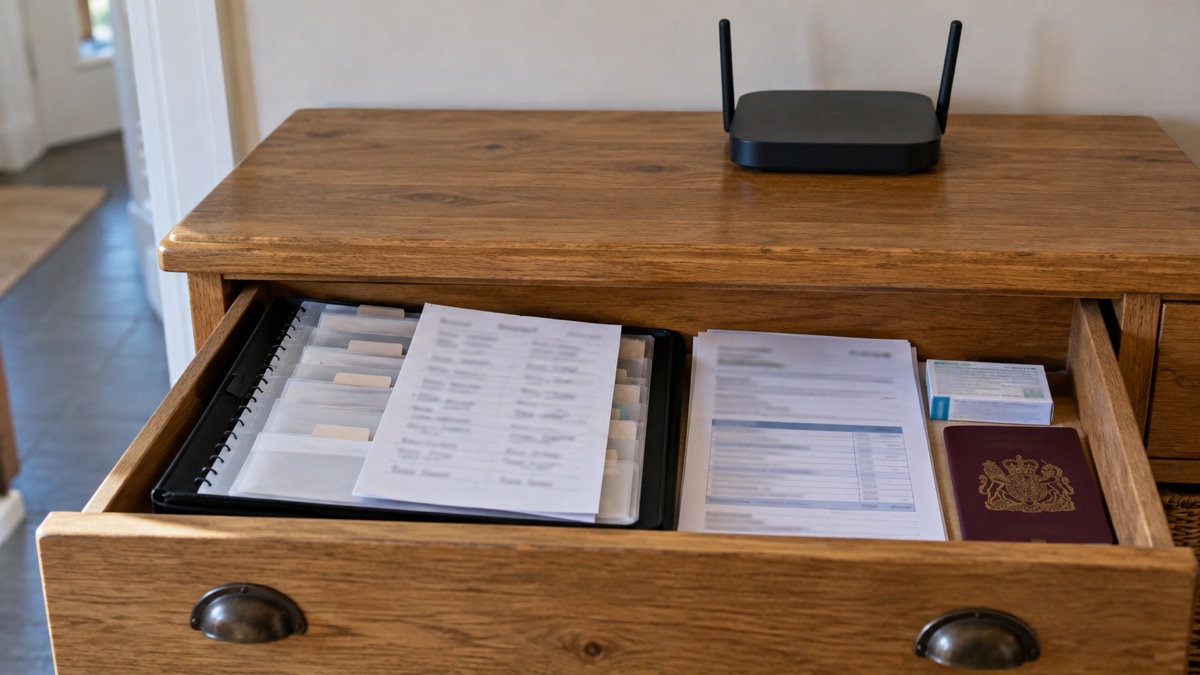
Most of the details a household runs on now live behind a screen: the medication list in the GP app, the insurance schedule in an email, the plumber's number in a phone that needs charging. When a power cut, a flood or a cyber incident takes those services offline, the households that cope are the ones that can still put a hand on the information that matters. The government's Be Ready campaign puts it plainly: write down important phone numbers on paper and store them somewhere easy to find in a power cut, along with your medication list and insurance policy details1.
This page sets out what to keep offline, on paper or on removable storage, and how to keep those records safe, private and current. The National Risk Register, the government's own assessment of risks to the UK, advises storing important documents such as insurance papers and key contact numbers, together with medication and identification, in an easily accessible location in case of an emergency or an evacuation at short notice2. That single sentence is the whole idea of this page: the right records, in the right place, reachable when the systems are not.
What to keep on paper: the short list
Start small. A household that keeps a single folder or wallet of paper records can cover most of what an outage takes away. The Be Ready checklist names the core items: printed copies of important documents such as passports, birth certificates, insurance policy details and instructions for any medical equipment you rely on1. Surrey's emergency contacts template adds a practical rule: store these details on your mobile device as well as keeping a paper copy, so you have both a fast route and a fallback6.
A useful paper set covers five things: who you are (identification and key documents), what you take (medicines and doses), who to ring (family, services and insurers), what you own (account and policy details) and how things work (instructions for equipment). Power cut preparation advice is to keep important documents safe and handy7, so gather these papers in one place you can reach quickly, and apply that test to every item: if you needed it in the next hour, could you find it?
- Identification: passport, birth certificates, marriage certificate8
- Financial and legal: insurance policy details, wills, deeds9
- Health: medication list, instructions for medical equipment1
- Contacts: family, work, school, GP, insurers, utilities10
- Household extras: an emergency friend, home breakdown services, an extra set of house and car keys10
The National Risk Register adds one caution that is easy to forget in the moment: if it becomes dangerous to retrieve these items, do not attempt it. Records are for the emergencies you can walk away from with a folder in your hand, not for the ones where you should leave immediately2.
Medicines and prescriptions: names, doses and repeat details
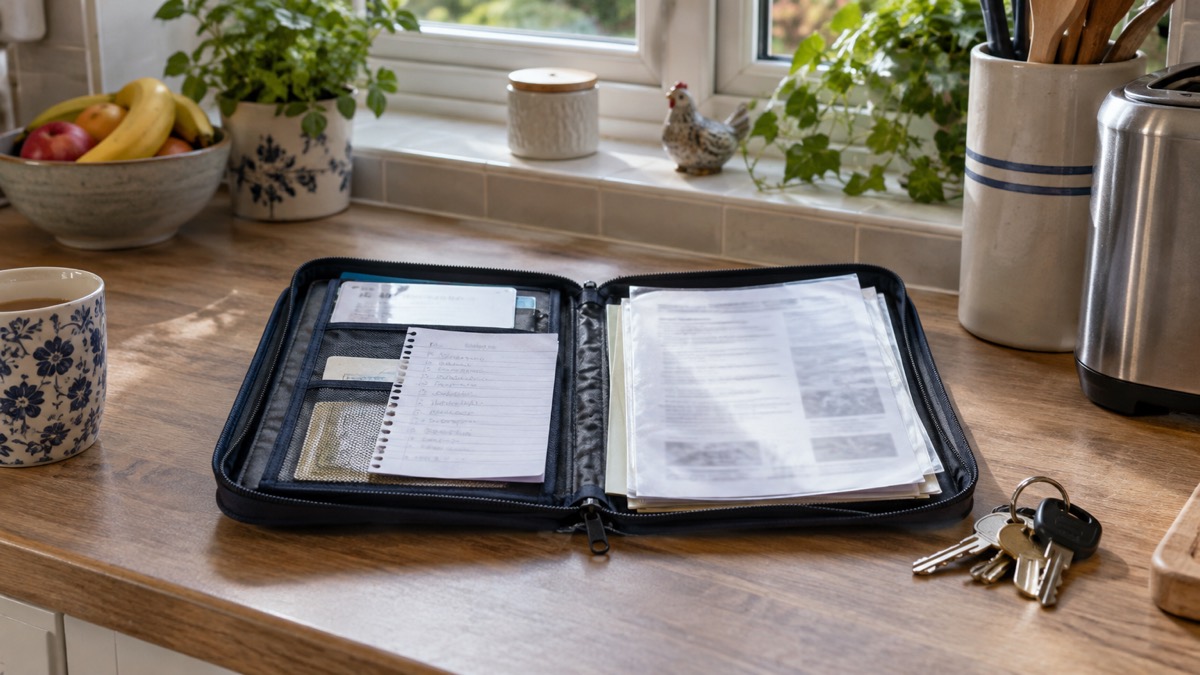
A paper medication list is the record most likely to matter within hours of a system failing. Official emergency guidance is direct: it may be difficult to obtain prescription medications during a disaster, so ask your GP or pharmacist about storing them, be mindful of expiry dates, and keep a list of medications as part of your kit or plan9. For each person in the house, write down the medicine name, the dose, how often it is taken, and the repeat prescription arrangements: which surgery or pharmacy issues it and how it is normally ordered.
The repeat system itself is worth understanding, because it changes what you write down. NHS guidance is to always order repeat prescriptions before you run out, through your GP, local pharmacy or NHS-approved apps including the NHS App, especially before a GP practice or pharmacy closes for holidays11. NHS winter advice gives the same message: keep up to date with the repeat prescriptions you, your family or friends need12. Your paper record should therefore note the usual ordering route, so someone else could pick it up if the app is unavailable.
If the systems are down and you run short, NHS 111 online can help: it does not issue a prescription but sends a request to a local pharmacy for a limited supply of medicine until you can organise your regular repeat prescription, and this works for someone of any age13. Having your medication list and NHS number on paper makes that request straightforward. Our page on getting prescriptions when GP or pharmacy systems are down covers this in more detail.
Storage and safety rules belong on the same sheet of paper as the list. Keep medicines in a cool place out of direct sunlight, checking the medicine leaflet for storage advice14, and keep medication in its original packaging with clear labels and instructions15. Always follow the directions on medicine packets and information leaflets and never take more than the stated dose16. Remember that medicines go out of date, so do not overstock your medicine cabinet16, and keep medicines out of the sight and reach of children, in a high lockable cupboard in a cool dry place, checking expiry dates regularly16.
Contact numbers on paper for keeping in touch
The question that official guidance asks is a good one: what if you cannot access your phone or online accounts, how would you find those important numbers of family or your insurance?10 The answer is a written list, kept somewhere safe, that covers everyone you would need to reach in the first hours of an emergency.
The "Are You Ready" booklet sets out a practical list of who to include: contact details for work, your doctor, schools, the water supplier, the electricity network operator, the gas supplier, the telephone and internet provider, the home insurance company, home breakdown services and an emergency friend10. An emergency friend is someone who lives close enough to help and far enough away not to be affected by the same incident; agree the arrangement with them in advance and write their number at the top of the list.
| Who | Why you need them on paper |
|---|---|
| Emergency friend | Your agreed contact if you cannot get home or need help10 |
| Family and next of kin | Reaching relatives when your phone is dead or unavailable10 |
| GP surgery and NHS 111 | Health advice and out-of-hours care10 |
| Work and schools | Letting employers and schools know you are safe or delayed10 |
| Electricity network operator | Reporting a power cut in your area10 |
| Water, gas, telephone and internet providers | Reporting faults and getting updates10 |
| Home insurance company | Starting a claim as soon as damage happens10 |
| Home breakdown services | Boiler, plumbing or lock emergencies10 |
Two small extras from the same guidance are worth adopting. Keep extra batteries so you can charge your phone17, and keep people's email addresses in your phone, as they may be handy17. The written list is the backbone; the charged phone is the convenience.
Bank, utility and insurance account details
When online banking and app-based services are unreachable, you still need to tell an insurer about damage, ring the water company about a burst pipe, or identify yourself to your bank over the phone. The Environment Agency's personal flood plan template lists the account and contact details worth recording, and it is a sensible model for any emergency: insurance (home, contents, vehicle), utilities (electricity, gas, water, telephone, broadband, mobile phone and media providers), finance (bank accounts), pets (kennels, carers, vets), the council (district or unitary, town or parish) and medical contacts (doctors, hospitals)3.
What to write for each is deliberately limited. You do not need passwords, and for banking you should generally avoid writing down anything that could be used on its own. What helps is the boring identifying information: the company name, the account or policy number, and the phone number to ring. That is enough to start a claim or report a fault when the app is down.
- Insurance: policy numbers for home, contents and vehicle, and the claims line3
- Utilities: account numbers and fault lines for electricity, gas, water, phone, broadband and mobile3
- Finance: bank name and the phone number for its helpline, not your password3
- Pets: vet, kennel or carer contact details3
- Council: your district or unitary council, and town or parish council3
- Medical: your doctors and any hospital departments involved in your care3
The National Cyber Security Centre warns that some online banking services forbid users from writing down their passwords, so check the terms and conditions of your own bank before you note anything of that kind18. Our pages on paying for essentials when card machines and banking apps fail and when banks, shops and public services go offline cover what to do when you cannot get at your money at all.
Storing copies of important documents
Paper is one copy. For documents that would be hard to replace, official cyber security advice is to keep a second copy somewhere else. The NCSC's Cyber Aware guidance is to safeguard your most important data, such as photos and key documents, by backing them up to an external hard drive or a cloud-based storage system19. A backup is a copy of your important data stored in a separate safe location, usually on the internet as cloud storage, or on removable media such as a USB stick, SD card or external hard drive20.
For irreplaceable data such as photos and videos of family members, the NCSC suggests keeping a copy in the cloud and also on removable media4. The removable options it lists are an external hard drive, a USB stick or thumb drive, an SD card, or DVD and CD-R discs20. Backups have a second use that matters when a device is lost or broken: you can use them to transfer your existing files, apps and settings to a new device or computer20.
| Copy | Where it lives | What it is good for |
|---|---|---|
| Paper originals and prints | A grab folder at home | Working from them when systems are down1 |
| Cloud copy | Internet storage, away from home | Surviving fire, flood and device loss19 |
| Removable media copy | USB stick, hard drive, SD card or discs | Restoring files without internet access20 |
One rule from the NCSC's ransomware guidance applies to every removable copy: if it is on a USB stick, a hard drive or any type of removable media, do not leave it connected, or anywhere on your network, or it may also be attacked by ransomware5. Plug it in, copy your files, unplug it and put it somewhere safe. Our page on backing up files and photos at home walks through this in full, and cloud backup or external hard drive compares the two approaches.
Where to keep your records so they survive a flood or fire
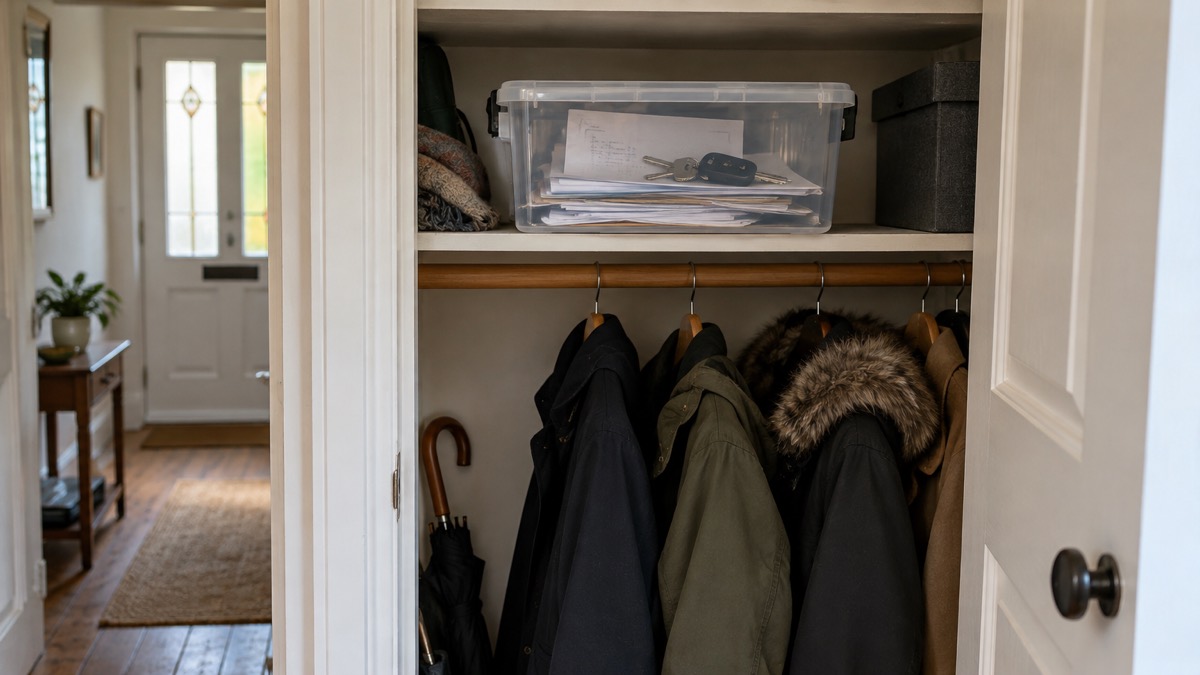
The Environment Agency's flood plan advice gives the location rules in three sentences: move important documents and possessions to a high-up place so that they are safe from flood water, protect them in a waterproof container, and keep them in a place that is easy to get to in an emergency3. Those three requirements, high, dry and reachable, are in tension, and that is the point: a box in the loft survives water but takes minutes to reach, a folder by the door is quick to grab but sits in the flood zone. A waterproof container on a high shelf or cupboard near an exit usually satisfies all three.
Emergency supplies guidance from Denbighshire goes further for the document set itself: keep personal identification, cash and a credit card, copies of important documents such as birth certificates, marriage certificates, wills, deeds, insurance papers and immunisation records, an emergency contacts list and an extra set of house and car keys, all stored in watertight containers9. Watertight rather than merely closed matters, because flood water ruins paper quickly, and the same container should hold the spare keys so that one grab takes everything.
For the offline digital copies, the same logic applies with one change: keep the removable drive somewhere other than beside the computer it backs up. A backup stored next to the machine burns with the machine. The NCSC's definition of a backup, a copy in a separate safe location20, is the standard to meet.
Keeping records private and secure
Offline records have a security advantage the NCSC points out when it discusses writing passwords down: an attacker would need physical access to where they are stored18. That does not make paper risk-free, but it changes the threat from everyone on the internet to the people who can reach your home. Your precautions should follow from that.
If you do write down passwords, the NCSC advises making sure they are not predictable or guessable, checking that you are not breaking the service's terms and conditions, since some online banking services forbid writing down passwords, and considering who has access to where they are kept18. Written passwords can suit people who need regular support to manage their online affairs18. Our page on whether it is safe to write your passwords down covers this properly.
For records about a vulnerable person, the rules are set out in the Herbert Protocol guidance used by police forces: the form should be stored securely, in accordance with data protection laws, but where you can find it quickly, and other relatives, carers or staff should know where it is21. A recent photograph of the person should be kept with the form21. Greater Manchester Police also describe Safe and Found Online, a digital platform where you can register a secure profile and store key information without a paper document, attaching photos and documents and updating them as often as you like; the details are only ever accessed by the police if that person is reported missing21.
The practical rules for any household: keep the folder somewhere a visitor cannot browse it, do not include passwords in any copy you hand to others, and if you keep records about people outside your household, tell them what you hold and where.
Updating your records: when and how
A record that is out of date is nearly as bad as no record, because it sends you to a wrong number or an old dose. The NCSC's advice on backups applies to paper too: once you have made your backup, check that it contains all your important data, such as recently taken photos or recently created files or folders20. For a paper folder, the equivalent check is a regular read-through: does the medication list match what is actually in the cupboard, and do the numbers still ring?
Tie the check to something that already happens. The seasonal moments when NHS bodies tell you to order repeat prescriptions in advance, before weekends, bank holidays and the winter period11, are natural times to re-read the medication list. When an insurance policy renews or a utility bill arrives, that is the moment to update the account details sheet. When a child changes school or a relative moves, update the contacts list the same week.
- After any backup: check it contains your recent files20
- For pets: keep microchip contact details up to date22
For pets specifically, Birmingham City Council's advice is to make sure your pet is microchipped and that your contact details are up to date, and to keep your pet's identification and contact details current in case they are lost22. The council also suggests taking a clear photo of you with your pet to help prove ownership if you are separated22, which is a record to refresh as the animal ages or changes appearance.
What to do if your records are lost or damaged
Paper records do fail: floods soak them, fires destroy them, and sometimes a folder simply goes missing. If documents are flood-damaged, Lancaster City Council's recovery advice for people affected by flooding is to store valuable papers that have been damaged in the freezer until you are able to work on them; lawyers will advise whether to save the papers themselves or just the information on them23. Freezing wet paper halts the mould and sticking that would otherwise destroy it within days, buying time to get professional advice.
If records are lost rather than damaged, the recovery route runs through the organisations that issued them. This is where your second and third copies earn their place: a cloud copy or a removable media copy of a document can be reprinted, and a photo of a passport or insurance schedule on a phone can identify you while replacements are arranged. The NCSC's ransomware guidance makes the general point: regularly create a backup copy of your important files, such as photos, documents and other files that cannot be replaced5.
For health records, NHS 111 online can be accessed using the website 111.nhs.uk or via the NHS App on a smartphone or tablet24, and depending on what you need, you might be advised to call 999 or go to A&E in an emergency, see an urgent treatment centre, an out-of-hours GP, a pharmacist, or look after yourself safely at home24. Our page on NHS appointments, A&E and tests during an IT outage covers health services in more depth.
Records for people who need extra help
Some households carry records for more than themselves. If you care for someone aged 18 or over, Norfolk's First Response guidance notes that you can create an emergency plan online as a carer25, and Staffordshire's advice for unpaid carers is to write down your plan and keep it somewhere easy to find26. A carer's plan should say what the person needs, who should step in, and where the medication list is, so that a stranger could keep things safe for a night.
For a person with dementia, the Herbert Protocol gives the police a ready-made record: a form with key information about the person, kept with a recent photograph, stored securely but findable, with relatives, carers or staff told where it is21. The digital alternative, Safe and Found Online, lets you attach photos and documents and update them as often as you like, with access only by police if the person is reported missing21.
For children, the records are simpler but the same in kind: medication names and doses, GP details, school contact numbers and any equipment instructions, all on the household's paper list. NHS guidance also suggests keeping medicines for children at home, with your pharmacist able to tell you which ones to keep in the house27.
Sources (27)
- Get prepared for emergencies, UK Government
- National Risk Register 2023, Cabinet Office, 2023
- Personal flood plan, Environment Agency, 2023
- Always back up your most important data, National Cyber Security Centre
- WannaCry guidance for home users and small businesses, National Cyber Security Centre
- ICE template, Surrey Prepared, Surrey County Council
- What to do in a power cut, Met Office
- Flood evacuation checklist, Croydon Council
- Emergency supplies kit, Denbighshire County Council
- Are You Ready booklet, Culham Parish Council, 2025
- Health advice for public holidays, NHS inform Scotland
- Keep winter well, Birmingham Community Healthcare NHS Foundation Trust
- When to use NHS 111, NHS
- Storing medicines at home, United Lincolnshire Hospitals NHS Trust
- Managing medication and health needs, Carers UK
- Keep a well-stocked medicine cabinet at home, NHS Black Country Integrated Care Board
- Yourself - Sub Section - Wiltshire & Swindon Prepared, Wiltshire & Swindon Prepared
- Top tips for staying secure online | Managing your passwords | National Cyber Security Centre, National Cyber Security Centre
- Cyber Aware, National Cyber Security Centre
- Backing up your data, National Cyber Security Centre
- Herbert Protocol, Greater Manchester Police
- Are you ready, Birmingham Prepared, Birmingham City Council
- Be prepared, flood recovery advice, Lancaster City Council
- NHS 111 online, NHS England
- Norfolk First Response, Norfolk County Council
- Plan emergencies and changes, support for unpaid carers, Staffordshire County Council
- Which NHS service, NHS Somerset
 Accounts to Protect With 2-Step
 After Fixing an Infected Device
 Home Online Security Checklist
 Antivirus Software
 Backing Up Files and Photos
 Council Online Services Down
 Your Details in a Data Breach
 FluBot Fake Parcel Texts
 Hacked Online Accounts
 How Services Respond
 Malware Signs and Removal
 National Cyber Security Centre
 NHS Services During an IT Outage
 Shopping Online Safely
 Paying for Essentials