If you have run out of prescribed medicine and need some urgently, there are a few ways to get an emergency supply, including out of hours1. The two main routes are to contact NHS 111, by phone or online, or to go straight to a community pharmacy and ask the pharmacist2. A pharmacist can supply certain medicines even without a prescription in front of you, and for most prescription medicines they can give up to 30 days' treatment as an emergency supply2. For controlled medicines the rules are tighter: only a few can be supplied in an emergency, and then only up to 5 days' worth2.
This matters most when your GP practice is closed: in the evening, at a weekend, on a bank holiday or over Christmas and New Year. If you run out of your regular medicine and your GP practice is closed, there are still ways to get an emergency supply3. NHS 111 is available 24 hours a day, 365 days a year4, and some pharmacies are open until late in the evening, at weekends and on bank holidays5.
One thing to understand before anything else: do not simply stop taking your regular medicine to "save" it. Stopping some medicines suddenly can cause significant harm or death, so check with your community pharmacist or prescriber whether any of your medicines cannot be stopped suddenly2.
Don't stop some medicines suddenly
Before you do anything else, be clear about which of your medicines matter most. Stopping some medicines suddenly can cause significant harm or death, so it is important that you understand whether any of yours fall into that group2. Ask your community pharmacist or your prescriber, and do this before you ever get close to running out, not on the day the box runs dry.
This is also why the standard advice is to order repeat prescriptions before you run out, through your GP, your local pharmacy or NHS-approved apps including the NHS App, especially before the GP practice or pharmacy closes for holidays9. If you get your medicine with a repeat prescription, you should usually allow 5 working days to request your prescription1.
The flip side is that you should not over-order either. Medicines go out of date, so don't overstock your medicine cabinet, and always follow the advice on the pack10. NHS guidance for Scotland and Wales makes the same point for winter: check that you have enough prescribed medicine to last through Christmas and New Year, but do not get too much, as it can go out of date11. If you end up with quantities of out-of-date or no longer used prescribed medicines, return them to your GP practice or local pharmacy for safe disposal10.
- Order repeat prescriptions before you run out, allowing 5 working days1
- Ask your pharmacist which of your medicines must not be stopped suddenly2
- Check your stock before holidays, but do not overstock, as medicines expire11
- Return out-of-date or unused medicines to a pharmacy or GP practice10
If a national shortage is behind your difficulty, avoid stockpiling and ordering more than you need until your next prescription12. Shortages are usually caused by shortages of ingredients, sudden spikes in demand, problems with manufacturing capacity or unexpected global events, and they usually resolve quickly, often as soon as the pharmacy receives its next daily delivery12. Our page on medicine shortages covers that situation in full.
Two routes to an emergency supply: NHS 111 or straight to a pharmacy
There are two main ways to request an emergency supply of medicines: contact NHS 111 by telephone or through the online service, or contact a community pharmacy directly2.
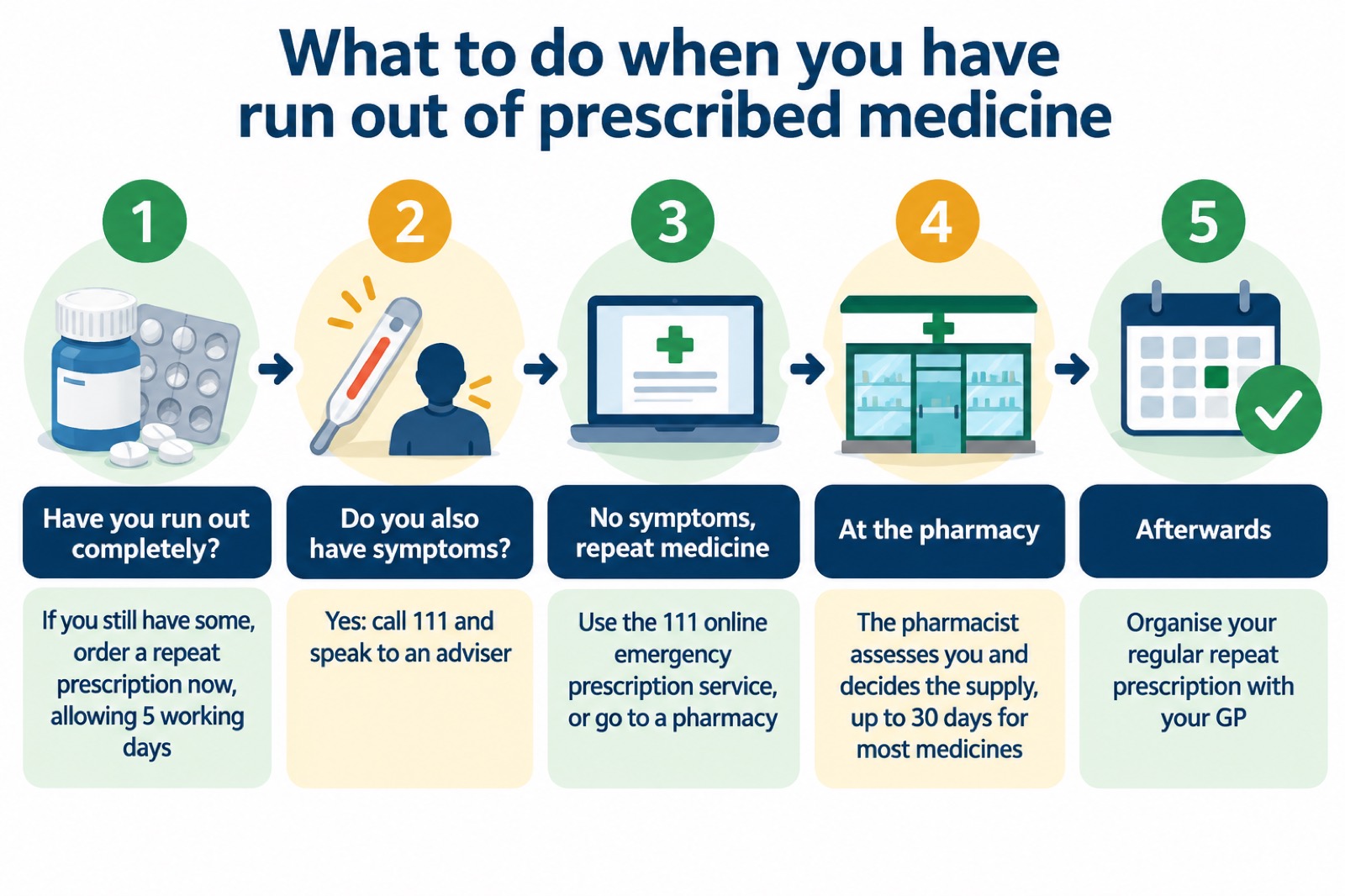
Route one: NHS 111. The NHS 111 emergency prescriptions service exists to request a limited emergency supply of a medicine you've completely run out of13. It is designed for people who get their medicine with a repeat prescription, who have completely run out and cannot wait the usual 5 working days1. Importantly, 111 online does not issue a prescription itself: it sends a request to a local pharmacy for a limited supply of medicine until you can organise your regular repeat prescription7. They may refer you to a pharmacy to get your medicine1.
One caution from the service itself: if you need medicine and also have any symptoms, call 111 and speak to an adviser instead of using the online emergency prescription request13. The adviser can assess both needs together.
Route two: the pharmacy directly. Walk in and ask. Pharmacists can help with minor illnesses and can also give you an emergency supply of some medicines if you've run out14. If you run out of prescription medicine and do not have a prescription with you, take an old prescription or repeat slip, or the medicine packaging, if you have it, as this helps the pharmacist confirm what you normally take. The pharmacist will decide how much to supply, up to a maximum of 30 days for most prescription medicines, and they keep a record of your details, the medicine provided and the nature of the emergency2.
If you already have a prescription in hand and simply need the medicine urgently, you can get it from any pharmacy as long as they have it in stock9. If your local pharmacy is closed, some pharmacies are open until late in the evening, as well as at weekends and bank holidays14.
How much you can get: up to 30 days
For most prescription medicines, the pharmacist will decide how much to supply, up to a maximum of 30 days2. How much you actually receive depends on their professional judgement and on what pack sizes the pharmacy has available.
Two things can reduce what you actually receive. First, sometimes the smallest pack available has to be given, such as one inhaler2. Second, the supply is at the pharmacist's discretion: the pharmacist will decide how much to supply, and they may not supply the medicine at all if they are not satisfied it is appropriate for you2. This is a professional judgement, not a refusal to help, and it protects you from being given something wrong.
Treat whatever you receive as a bridge, not a replacement for your normal prescription. The purpose of an emergency supply is to cover you until you can organise your regular repeat prescription7. As soon as the surgery opens, order it.
| Situation | How much you can usually get | Who decides |
|---|---|---|
| Most prescription medicines, via 111 or pharmacy | Up to 30 days2 | The pharmacist2 |
| Smallest pack size, e.g. an inhaler | Sometimes only one inhaler2 | Pack availability2 |
| Controlled medicines that qualify, e.g. phenobarbital for epilepsy | Up to 5 days2 | The pharmacist, within the legal limit2 |
| Controlled medicines such as morphine or diamorphine | None without a prescription2 | Not permitted2 |
Controlled medicines: what can and cannot be supplied
Controlled medicines, the ones subject to legal restrictions, are where emergency supply runs into hard limits. Only a few controlled medicines can be prescribed in an emergency, such as those for epilepsy, and only up to 5 days' supply can be given2. Many controlled medicines, such as morphine or diamorphine, cannot be supplied without a prescription by a pharmacist in an emergency2. Where a prescriber organises the supply, the medicine involved must not be a controlled medicine, except phenobarbital for the treatment of epilepsy2.
The Emergency Medicines Supply Service in Wales states the position plainly: it applies to most prescription drugs but not controlled drugs, and it is at the pharmacist's discretion15.
"It applies to most prescription drugs but not controlled drugs, and it is at the pharmacist's discretion"
If your regular medicine is a controlled drug that cannot be supplied in an emergency, you need a prescriber, and that means NHS 111 or the out-of-hours GP service rather than a pharmacy counter. Call 111 and explain the situation; they can direct you to out-of-hours care16. If you are unsure whether your medicine is controlled, ask your pharmacist: they can tell you in seconds and will know what they can and cannot legally hand over.
When your GP or prescriber asks the pharmacy: a prescription within 72 hours
There is a second route to an emergency supply that runs through your prescriber rather than through 111. Your GP or another prescriber can ask a community pharmacy to supply your medicine before the paperwork exists. When this happens, the community pharmacist makes a record of the supply, and the prescriber must supply a prescription within 72 hours2.
There is one exclusion to know about: the medicine involved must not be a controlled medicine, except phenobarbital for the treatment of epilepsy2. So this route covers ordinary repeat medicines but not most controlled drugs.
In practice, this is often what happens when you phone your surgery, or the out-of-hours service, and they say they will "sort something out with your pharmacy". The pharmacy dispenses against the prescriber's verbal or electronic request, and the prescription follows within the 72-hour window2. You do not need to do anything differently, but knowing the deadline exists helps you chase if the supply does not materialise.
If a shortage is the problem rather than timing, the pharmacy and GP can sometimes organise a solution over the phone. During a national shortage in England you might be asked to go to another pharmacy to collect your medicine, be given a different formulation such as a tablet instead of a capsule, receive a smaller quantity so you collect more frequently, or be asked back to your GP for a new prescription for an available medicine if this cannot be organised by the pharmacy and GP over the phone12.
Paying for an emergency supply
What you pay depends on the route you took. If the medicine is supplied via NHS 111, you will be charged the relevant prescription charge unless you are eligible for free prescriptions2. Pharmacies can provide certain emergency medicines to patients even if they don't have a prescription, but you may need to pay1.
Going directly to a community pharmacy is different in one important respect: contacting a community pharmacy directly is not an NHS service, so charges will vary2. That is not a reason to avoid the pharmacy route, but it is a reason to expect the cost to differ from what you usually pay, and to ask at the counter before the supply is made up.
Wales has its own arrangement. Some pharmacies in Wales provide an Emergency Medicines Supply Service free of charge when the GP surgery is closed17. Pharmacies not commissioned to provide that service free of charge can still provide an emergency supply under specific circumstances, but patients may be charged15.
| Route | What you pay |
|---|---|
| Supplied via NHS 111 | The relevant prescription charge, unless you get free prescriptions2 |
| Direct from a pharmacy (England) | Charges vary, as this is not an NHS service2 |
| Emergency Medicines Supply Service, Wales | Free of charge at participating pharmacies17 |
| Other pharmacies in Wales | An emergency supply may be possible, but you may be charged15 |
Getting help when the GP surgery or pharmacy is closed
If your GP surgery is shut, call 111 to be directed to out-of-hours care services16. NHS 111 is available 24 hours a day, 7 days a week6, and it is free from a landline or mobile phone6. You can get help from NHS 111 by using 111 online, in the NHS App, or by calling 1117.
Some pharmacies are open until late in the evening, as well as at weekends and bank holidays5, and some are open until midnight or later, even on public holidays9. But pharmacies may close at short notice, so check they are open and have what you require before travelling15. NHS 111 online can tell you where to get emergency supplies of your prescribed medicines and how to get a repeat prescription18.
The arrangements differ slightly across the four nations:
- England: contact NHS 111 by phone or online, or go straight to a community pharmacy2. NHS 111 online is for people in England aged 5 and over who need urgent health care advice when it is not a life-threatening situation8.
- Wales: some pharmacies offer the Emergency Medicines Supply Service free of charge when the GP surgery is closed, meaning Monday to Friday 6.30pm to 8.00am, Saturday, Sunday and bank holidays17. The service is for patients who have lost, forgotten or run out of prescribed medication, who have an immediate need and cannot wait until the GP practice reopens; availability depends on which Health Board area you live in17. You will need to show the pharmacist evidence that you have previously been prescribed the medicine, such as an empty packet or container with your name label17.
- Scotland: if you run out of your regular medicine and your GP practice is closed, there are ways to get an emergency supply3. Your local pharmacist may be able to help and in some circumstances can issue a small supply until your GP practice reopens19. Pharmacists in Scotland can help with coughs and colds, sore throat, indigestion, diarrhoea or constipation, aches and pains, and can help if you run out of a repeat prescription20.
If a national shortage is the cause, speak to your pharmacist or doctor, or contact NHS 11112. Order your medicine or repeat prescription in advance, ideally while you still have some left, so your pharmacist can source it in good time12. And if one pharmacy cannot help, try another: during shortages there may be a limit, or quota, on the quantity of medicines pharmacies can order each month, but another pharmacy may still have it in stock12.
Our page on what to do when your GP is closed covers the wider out-of-hours picture, and keeping enough prescription medicine at home covers the routine that stops this happening in the first place.
Reaching 111: age limits, interpreters and accessible formats
111 online has an age limit. The NHS 111 online triage service is for people aged 5 and over8. If you need help for a child under 5, call 111 and speak to an adviser instead7. The emergency prescription service is the exception: people can get an emergency supply of regularly prescribed medicine for someone of any age on NHS 111 online8.
Who answers the phone. NHS 111 calls are answered by health advisors, supported by experienced clinicians, who will assess your needs21. Sometimes, if appropriate, your call may be referred to a clinician, a trained nurse or paramedic, for further assessment of your condition or for medical advice21. The service is staffed 24 hours a day, 7 days a week by a team of fully trained advisers22. Calls to 111 are recorded, and records are maintained securely and only shared with others directly involved with your care22.
What they ask. Whether you're using the online assessment at 111.nhs.uk or the telephone, you answer the same few questions about your main symptoms to get the right information and advice5. For an emergency prescription request specifically, they ask questions including where you are and when you are due to take your medicine, so they can suggest the best way to get it1.
If you have difficulty hearing or speaking. If you have difficulty hearing, you can access NHS 111 using the British Sign Language interpreter service6. Use the NHS 111 British Sign Language (BSL) interpreter service at signvideo.co.uk/nhs111 if you're deaf and want to use the phone service, or call 18001 111 on a text phone23. You can also call 18001111 using text relay24.
If you need an interpreter. Call 111 and ask for an interpreter7.
Accessible formats. A large print guide to NHS 111 is available, and an easy read guide to NHS 111 is available23.
What 111 can arrange. Depending on what you need, you might be advised to call 999 or go to A&E in an emergency, go to an urgent treatment centre, see an evening and weekend GP, book a callback from a nurse, get urgent specialist support for dental or mental health problems, contact your own GP surgery, see a pharmacist for help with a minor illness, or look after yourself safely at home8. NHS 111 will help you right away and make sure you speak to a healthcare professional, or book you an appointment at an urgent treatment centre, emergency dental service or GP, and can even book you an appointment at A&E if necessary18. For mental health support, call 111 and choose the mental health option when prompted14.
Our main page on NHS 111 goes into the service in more detail.
When to call 999 instead
An emergency supply of medicine is not the right response to every situation. Call 999 in a medical emergency, when someone is seriously ill or injured and their life is at risk20. NHS 111 helps you when you need medical help or advice, but it is not an emergency5; for immediate, life-threatening emergencies, continue to call 9994.
If someone has taken more than the recommended maximum dose of a pain relief medicine, phone 11125. But if they are seriously ill as a result, that becomes a 999 call.
If an ambulance is on its way to someone who has collapsed or become seriously unwell, pick up any medication the poorly person may have to give to the crew26. The original boxes and labels tell the paramedics far more than a description does, and this is another reason to keep medicines in their dispensed packaging rather than decanting them.
If you are unsure which service you need, call NHS 111: it exists for exactly that moment when you urgently need medical advice or are not sure which NHS service you need5. Our page on when to call 111 and when to call 999 sets out the difference in full.
Sources (26)
- Emergency prescriptions, NHS.uk, 2024-01-15
- Emergency supply of medication from a community pharmacy, NHS Nottingham and Nottinghamshire ICB
- Health advice for public holidays, NHS inform, 2026-09-15
- NHS 111, South Western Ambulance NHS Foundation Trust
- Alternatives to 999, South Central Ambulance Service NHS Foundation Trust
- NHS 111 first point of contact for urgent care, NHS England
- When to use NHS 111, NHS.uk, 2022-11-14
- NHS 111 online, NHS England
- When you need urgent healthcare, NHS North Cheshire and Mersey ICB, 2026-08-11
- Your Health Guide Winter 2025, NHS Western Isles Integration Joint Board, 2025-12
- Prepare for winter, King Street Surgery, 2026-01-20
- Advice for patients during a medicines shortage, NHS Specialist Pharmacy Service, 2025-11
- Emergency prescriptions service, NHS 111 online
- Where is best for your care, NHS Cornwall and Isles of Scilly ICB, 2026-03-24
- Emergency Medicines Supply Service FAQ, NHS 111 Wales, 2021
- In an emergency, Medway NHS Foundation Trust, 2026-10-29
- What service do I need?, NHS 111 Wales, 2021
- Urgent care in north east London, NHS North East London ICB, 2026-04-14
- 111 service information, NHS 24, 2023-12-22
- When should you call 999?, Scottish Ambulance Service
- NHS 111 service, Yorkshire Ambulance Service NHS Trust
- Your local services: NHS 111, NHS Lancashire and South Cumbria ICB
- Alternative access to NHS 111, North West Ambulance Service NHS Trust, 2024-08-01
- NHS 111 support, NHS Essex ICB, 2026-08-19
- Dental emergencies - NHS Scotland, NHS inform (NHS Scotland)
- What to do when the ambulance is coming, South Western Ambulance NHS Foundation Trust
 NHS 111 How to Use It