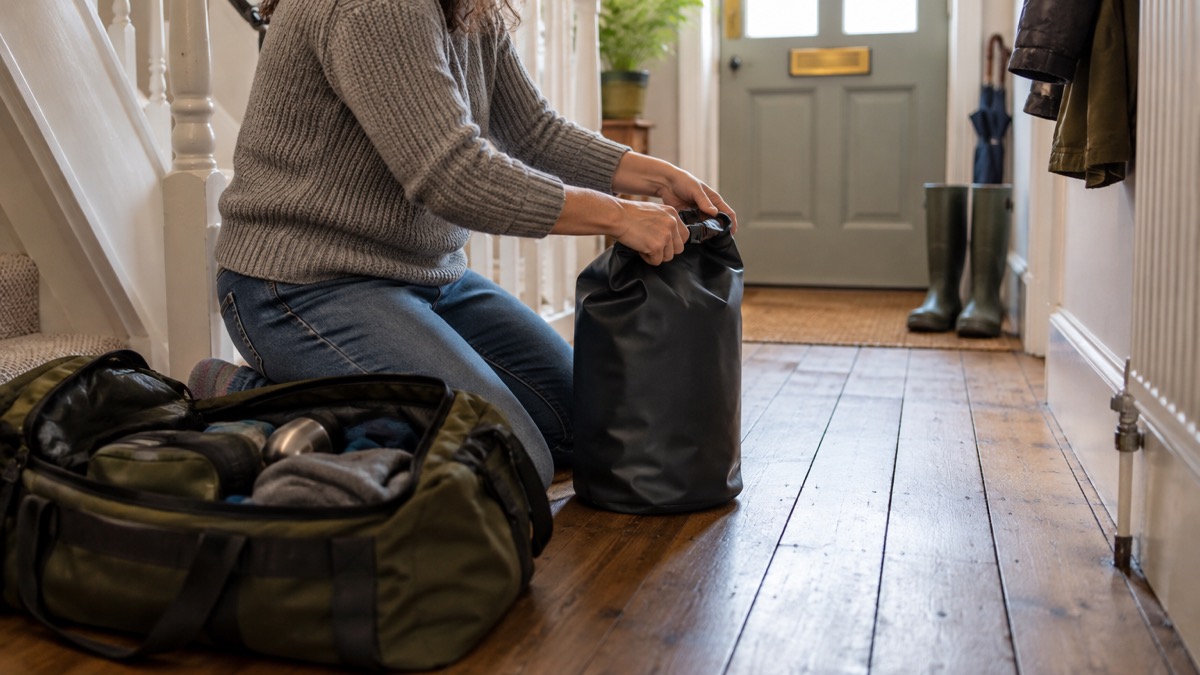
Water is the most common way emergency supplies are lost in the UK. A flood, a burst pipe, a storm-driven leak or simply a soaked grab bag can destroy the few items that are hardest to replace: passports and birth certificates, insurance policies, repeat prescriptions and the phone you need to call for help. The good news is that protecting them is cheap and quick, and official guidance is clear about what to do.
The core advice, repeated across official flood guidance in England, Scotland, Wales and Northern Ireland, is to store important documents in a waterproof container or sealed bag, keep them somewhere raised above floor level, and keep them where you can reach them in a hurry1. A grab bag should itself be kept in a box or waterproof bag that can be accessed quickly2. This page explains what to keep dry first, what dry bags, pouches and hard cases each do, what the waterproof ratings on the label mean, how to pack and check them, and where to get help if water gets in anyway.
What to keep dry first: documents, medicines and phones
Work down a short list, in this order, because these are the items that official guidance names again and again.
Documents. Hampshire Fire and Rescue Service's grab bag guidance lists important documents such as passports, insurance policies and other essential paperwork, and tells you to keep photographs or digital copies on your mobile phone as a back-up3. Harborough District Council's flood grab bag list is more specific still: documents including your passport, driving licence and insurance documents should go in a waterproof wallet7. A flood evacuation checklist from Croydon Council adds the sentimental items that cannot be replaced, such as photos, along with passports, birth certificates, marriage certificates, driving licences and contracts, all kept in a sealed bag away from flood water8. Our page on important documents covers which papers to gather and how to store copies.
Medicines. Prescribed medication and repeat prescriptions appear on the flood grab bag list7, and NHS guidance on storing medicines at home says to keep them away from water drips and possible food contamination, ideally in a clean, dry plastic container6. If your household depends on regular prescriptions, a sealed waterproof pouch inside your grab bag is the practical answer, with the caveats on heat covered later on this page.
Phones, chargers and power banks. The phone and charger or power banks are on the flood grab bag list7, and Belfast City Council's flooding advice is blunt about why: put your mobile phone in a plastic bag to keep it dry and keep in touch with your friends, relatives and neighbours9. A working phone is your link to the emergency services, to family, and to flood warnings, so it earns a waterproof place in your kit as a matter of priority.
A few other things worth sealing. Spare glasses and hearing aid batteries, spare house keys and emergency cash and bank cards all appear on the flood grab bag list7. If you have pets, official guidance on animals in a flood says to move their food, water, blankets, medicines and toys upstairs or somewhere dry, and to place important pet documents in a waterproof bag10.
Dry bag, pouch or hard case: what each one protects against
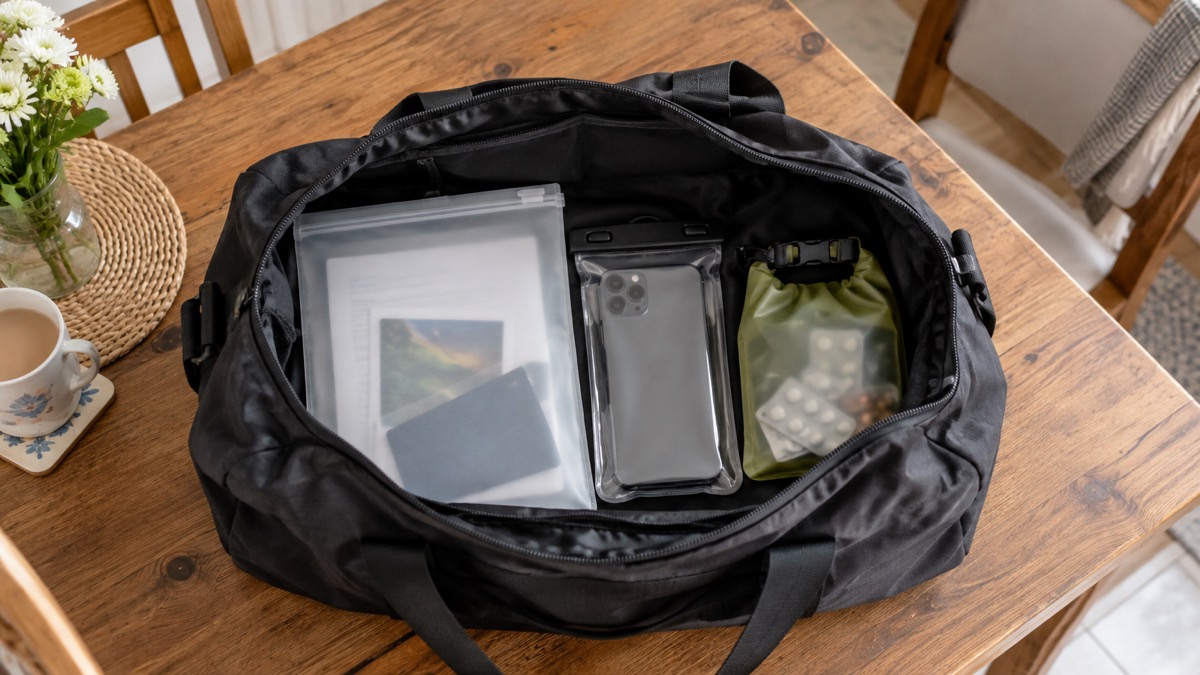
These three types of protection are not interchangeable, and choosing between them is mostly about what you are protecting and how much water it might meet.
A dry bag is a soft bag with a roll-top closure, sized in litres, built to carry a quantity of kit. The OverBoard 40 Litre Waterproof Dry Tube Bag is described by its maker as a waterproof dry bag with a Fold Seal System and welded seams, protecting contents from dust, sand, dirt and water4. Aquapac's Heavyweight Waterproof Drybag is a waterproof drybag with a detachable shoulder strap, made of heavy-duty 500D vinyl, offered for paddling, hiking, sailing, SUP, fishing, travel or everyday outdoor use11. A dry bag is the right choice for the bulk of a grab bag: clothing, a first aid kit, a torch, spare batteries and a document wallet all together.
A document pouch or wallet is a flat, sealed sleeve for papers. OverBoard's Waterproof Map Case, Large, is a waterproof document and map pouch that fits up to A3 and Ledger size paper, and the maker says it protects documents from water, sand, dirt, UV sun and frost damage, in materials that are easy to wipe clean after use5. This is what you want for birth certificates, insurance schedules and passports: flat, see-through if you need to show a document without opening it, and small enough to live inside a larger dry bag.
A hard case is a rigid box. Official guidance points this way for some uses rather than others: Westminster City Council's household emergency kit list includes a waterproof torch and spare batteries among supplies to keep together12, and NHS guidance for a baby's first aid kit says to choose a waterproof, durable box that is easy to carry, with a childproof lock, kept out of the reach of children but handy for adults13. Hard cases suit items that must not be crushed, such as glasses, hearing aid batteries or a small first aid kit.
| Type | What it protects against | Typical contents | Closure |
|---|---|---|---|
| Dry bag (7L to 40L) | Water getting at the bulk of a grab bag; heavy-duty versions use abrasion-resistant material with a reinforced base for demanding conditions4 | Clothing, first aid kit, torch, medicines, document wallet | Roll-top, rolled 3 to 4 times and clipped4 |
| Document pouch or wallet | Water, sand, dirt, UV sun and frost damage to papers you must keep flat and readable5 | Passport, birth certificate, insurance documents, pet documents | Slide seal along a strip5 |
| Hard waterproof case | Water, dust, corrosion, sand and mud, with rigid walls for items that must not be crushed13 | Glasses, hearing aid batteries, baby first aid kit, small torch | Lid or lockable box13 |
Sizes matter more than they first appear. Aquapac's Heavyweight Waterproof Drybag comes in three sizes, 7L, 15L and 25L11, while OverBoard's dry tube bag is 40 litres4. A 7L bag takes documents, medicines, a phone and a charger; a 25L or 40L bag takes a change of clothing and bulkier kit. For most households the sensible arrangement is a small pouch for papers inside a mid-sized dry bag, so the documents have two layers and the bag can still be carried by its shoulder strap.
Waterproof ratings and what they mean for your kit
Waterproof products carry a class and an IP rating, and the difference between them decides what the product will actually survive.
The OverBoard Waterproof Map Case, Large, is rated Class 2: IP655. The OverBoard 40 Litre Waterproof Dry Tube Bag is rated Class 3: IP66, which the maker describes as 100% waterproof4. In the IP system, the first digit describes protection against solids such as dust, and the second digit describes protection against water. The step from IP65 to IP66 is a step up in water protection, and the makers' own descriptions show what each is for: the map case protects documents from water, sand, dirt, UV sun and frost damage5, while the dry tube bag is suitable for quick submersion and floats safely if dropped in water4.
The practical reading for a household is this: a Class 2 document pouch is built to keep rain, spray and flood water off papers that are carried through it, not to be held underwater. A Class 3 dry bag is built for rougher water, and its maker states it is suitable for quick submersion4. Neither rating is a promise about long submersion, and a bag that is not rolled and clipped correctly will not meet its rating at all.
One more limit worth knowing, because it affects how people use bags around flood water: SEPA, the Scottish Environment Protection Agency, warns that sandbags may not hold back water unless a waterproof sheet is placed under them14. A dry bag is not a flood barrier. It protects what is inside it; it does not stop water entering your home.
Packing a dry bag so it stays sealed
The roll-top closure is the part most often done wrong, and a badly rolled bag is a wet bag. The makers' own instructions are consistent with each other.
- Fill the bag, leaving enough loose neck to make the rolls. Do not overfill: the neck needs material to fold.
- Squeeze or purge some air out of the bag if required, as OverBoard instructs, so the rolls are tight and the bag is not ballooned4.
- Roll the neck tightly over the plastic fastener 3 to 4 times, as OverBoard's instructions for its dry tube bag state4. Aquapac's instruction for its drybags is to roll 3 times and clip shut11.
- Connect the clips at the top to fasten and create the waterproof seal4.
- Check the rolls are flat and even along the whole neck before you rely on the bag.
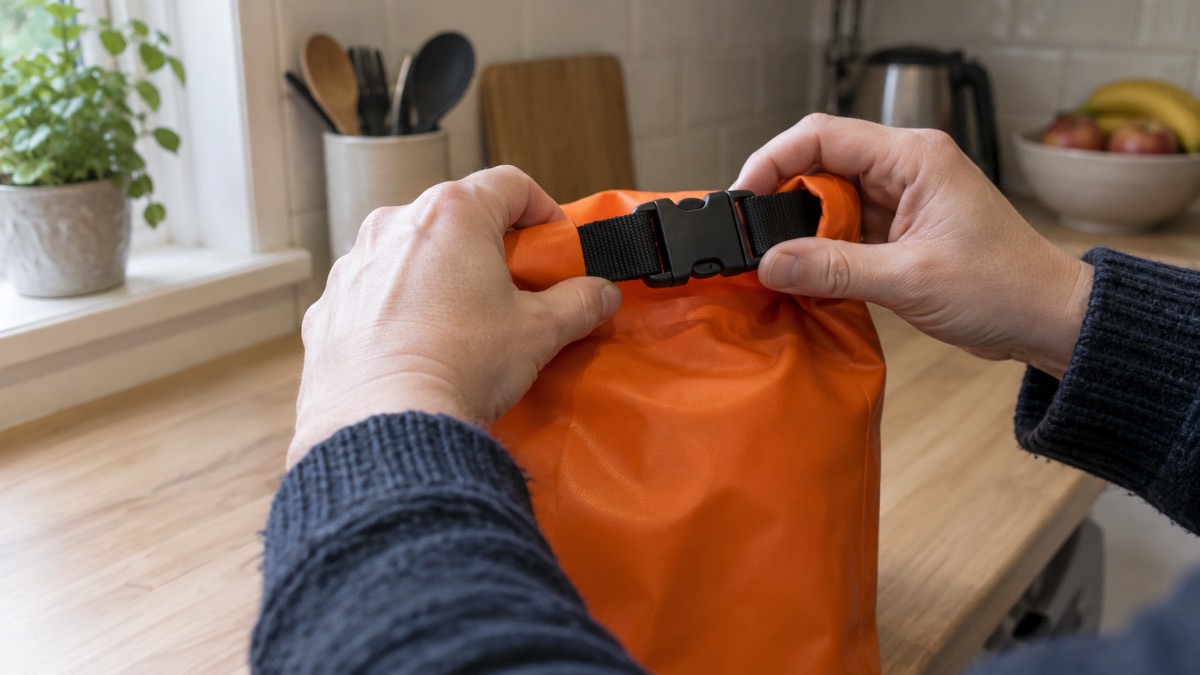
For a slide-seal document pouch, OverBoard's instruction is different: tightly grip the top edge between thumb and forefinger and slide all the way down the red strip to seal, and to open, start from the middle and pull apart the two different sides of the seal5. Slide seals fail when dust, sand or grit sits in the channel, so wipe the strip clean before closing it.
Pack thoughtfully as well as tightly. Put papers in their own pouch rather than loose in the dry bag, so a single failure does not wet everything. Keep medicines in a clean, dry plastic container inside the bag, as NHS guidance advises, away from water drips and possible food contamination6. If you are carrying food, note that Food Standards Scotland says food in water-resistant packaging such as metal cans, sealed pouches and tetra packs can be kept after flood contact if it is not damaged, but the outside of the packaging must be cleaned and sanitised first to avoid cross-contamination15: sealed packaging helps, but it does not make flood-wet food safe on its own.
Protecting important documents from flood water
Every official flood source in this area says the same thing in slightly different words, and together they give you a complete method: waterproof the documents, raise them, and keep them reachable.
The government's flooding guidance under the Be Prepared campaign says to move sentimental or valuable items upstairs or keep them in a high place such as the top shelf or drawer of a cabinet, and to store important documents such as birth certificates in resealable water-tight plastic bags to help protect them from water damage1. Surrey County Council says to keep all important documents in a waterproof sealed container16. The Environment Agency's personal flood plan says to move important documents and possessions somewhere they will not be damaged by flood water, protect them in a waterproof container, and keep them in a place that is easy to get to in an emergency17.
The height instruction appears just as consistently. The Greater London Authority's flash flooding advice says to put your valuables and important documents on a high shelf to protect them from water damage18, and Westminster City Council says the same19. SEPA's flooding guide for older communities says to store items with sentimental value and important documents somewhere raised well above floor level in watertight containers20. West Midlands Ambulance Service NHS Foundation Trust, advising households at risk of flooding, says to store valuables, furniture, electrical devices and important documents up high21.
So the method is:
- Seal the documents in a waterproof wallet, pouch or resealable water-tight plastic bag7
- Put that pouch inside a waterproof sealed container or dry bag if you can16
- Store the container high: upstairs, a high shelf, or the top drawer of a cabinet1
- Keep it somewhere easy to get to in an emergency, not buried17
- Keep copies: photographs or digital copies on your mobile phone as a back-up3
During a flood itself, the instruction narrows to what matters most. Nottinghamshire County Council's easy-read flooding guidance says to make sure important documents are safe and will stay dry, including details of your home insurance22, and its during-a-flood advice says to ensure important documents are safe, including your home insurance details23. Insurance documents are singled out because they are what you will need within hours of the water receding, to start a claim and arrange temporary accommodation.
Keeping phones, chargers and batteries dry
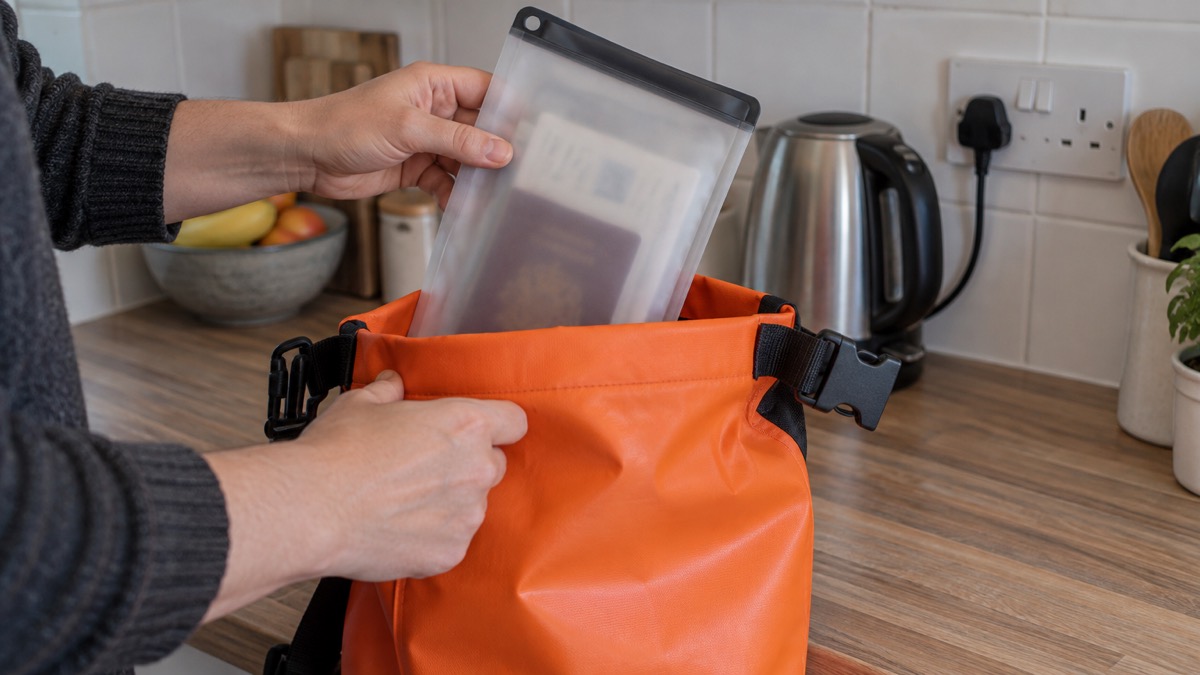
Your phone is the single most useful item in an emergency, and one of the most vulnerable to water.
Belfast City Council's flooding advice is direct: put your mobile phone in a plastic bag to keep it dry and keep in touch with your friends, relatives and neighbours9. A purpose-made waterproof phone pouch does the same job with a more reliable seal and the ability to use the phone through the material, but the council's advice shows that even a simple plastic bag is worth doing if it is what you have.
Build the protection in layers. Keep the phone in its own sealed pouch, keep the charger and power bank in the same dry bag, and keep the dry bag itself somewhere it will not sit in water. Coventry City Council's advice on essential items is to keep a torch, batteries, a mobile phone charger, important contact numbers, medications and basic supplies in an easily accessible place24, and the Met Office's winter and WeatherReady advice both say to put together a grab bag with bottled water, medicines, a torch, radio and batteries, copies of important documents and a change of clothes25. Batteries and power banks degrade if they get wet, so they belong inside the sealed bag, not loose in a pocket of it.
Two cautions from official guidance. First, do not rely on a phone alone: the same grab bag lists include a wind-up or battery torch and spare batteries7, because a phone battery has to last for calls and warnings. Second, if you are evacuating, the flood evacuation checklist says to take photos of damage before cleaning once you return7, which is a reason to keep a camera or recording device, and the phone that takes those photos, working and dry throughout.
Where to store waterproof bags at home and in a grab bag
Storage is the step that turns a collection of waterproof items into a system you can use at three in the morning.
Central Bedfordshire Council's guidance on emergency kits and grab bags says a grab bag should be kept in either a box or waterproof bag that can be accessed quickly2. Harborough District Council's flood grab bag advice says to keep it upstairs or near your door7. Those two instructions work together: the bag itself should be waterproof or boxed, and it should live either high, out of the way of flood water, or right by the door so you can pick it up as you leave.
Inside the bag, organise by priority. Documents in their own wallet, medicines in a clean dry container, phone and charger in a pouch, and the rest packed around them. Hillingdon's household emergency plan goes as far as telling you to store the plan document itself in a waterproof resealable bag in your grab-and-go bag27, which is a good habit for any paper you would want in an emergency: the plan, the insurance schedule, the repeat prescription list.
For the home store, the same rules as documents apply: high and dry. SEPA's guide for older communities applies the raised-storage rule to watertight containers generally20, and the personal flood plan's instruction to keep protected items easy to get to17 applies to your whole kit, not just papers. Our page on where and how to store your supplies covers the wider storage questions, and the grab bag page covers what goes in one.
When a seal fails: checking bags and cases for leaks
Waterproof gear fails in predictable ways, and a minute of checking prevents most of them.
Check the closure every time. Seals and closure mechanisms degrade over time and may need replacing, so inspect the seal before you rely on the bag. Run a finger along it and look for anything trapped in it.
Check the materials for age. The failure mode is well documented in official guidance on sandbags, whose hessian or fabric material behaves like any soft barrier material: Belfast City Council notes that the bag material normally breaks down over time and will perish if left in place for a long time9, and SEPA warns that sandbags are prone to leakage and rot very quickly after use14. Dry bags and pouches are made of tougher stuff, but the lesson transfers: material perishes, especially if stored damp, folded hard or in sunlight. Unfold and inspect your bags once or twice a year.
Check for condensation. Sealed bags trap air, and damp air inside settles as condensation on the contents. Pack items dry, and open and wipe the inside if you have carried the bag through rain.
Test before you trust. The maker of the OverBoard dry tube bag states it floats safely if dropped in water and is suitable for quick submersion4, but only a correctly sealed bag will do either. If a bag matters to your plan, seal it with dry paper inside and test it in a basin before you rely on it in a flood.
Handle flood-wet gear with care. SEPA warns that sandbags can contain viral and bacterial infections often present in flood water14, and the government's flooding and health guidance says to wear gloves when handling sandbags and wash your hands thoroughly afterwards28. Treat any bag that has been in flood water as contaminated: dry it out, clean it, and check the seal before reusing it. Somerset Council's advice on sandbags and gel bags after a flood is to dry them out for reuse, raised off the ground while they dry to help prevent mould forming29.
Where to get help after a flood
If water has reached your supplies despite everything, the priorities are safety, evidence, and replacements, in that order.
Harborough District Council's after-a-flood advice is to return home only when it is safe, wear gloves and waterproof clothing, take photos of damage before cleaning, contact insurers and keep records, and restock your grab bag7. The photos matter for your claim, which is one more reason to have kept a working, dry phone. Croydon Council's flood evacuation checklist says to pack clothing, toothbrushes and personal items, and to keep personal items in a sealed bag away from flood water, including sentimental items such as photos that cannot be replaced, passports, birth certificates, marriage certificates, driving licences and contracts8.
For documents that have been lost or damaged, Devon and Somerset Fire and Rescue Service's after fire or flood guidance notes that documents can be easily lost, damaged or destroyed in fire, flood or storm, and that getting replacements as soon as possible speeds up disaster recovery; for replacement travel documents, contact your travel agent or carrier30. The government's flooding and health guidance adds practical detail on sanitation while your home is unusable: if toilets cannot be used, use the facilities of unaffected family, friends, neighbours, public toilets, rest centres, local shops, supermarkets and hotels; chemical toilets may be provided, and portable bag-in-a-bag products designed for solid and urine waste may be provided28.
Sandbags and barriers are part of the recovery too. The government's guidance notes that sandbags are a cheap flood protection measure, that they help keep water out for short periods and work better with plastic sheeting, and that local councils should have access to sandbags28. Northern Ireland's nidirect thunderstorm advice similarly says to have some sandbags, floodboards or plastic covers prepared to block doorways and airbricks31. Somerset Council's preparing-for-flooding pages cover the same ground for before and during32. For the wider picture of warnings, evacuation and insurance, see our flooding guide, and for the kit side of recovery, checking and restocking supplies.
Sources (32)
- Flooding, Prepare for Emergencies (Be Prepared campaign)
- Emergency kits and grab bags, Central Bedfordshire Council
- Reduce the risk of wildfire damage to your property, Hampshire Fire and Rescue Service
- 40 Litre Waterproof Dry Tube Bag, OverBoard
- Waterproof A3 Map Pouch, OverBoard
- Storing medicines at home, United Lincolnshire Hospitals NHS Trust
- Resident grab bags, Harborough District Council
- Flood evacuation checklist, Croydon Council
- Flooding advice, Belfast City Council
- Animals in a flood, Deanshanger Parish Council
- Heavyweight Waterproof Drybag, Aquapac
- Prepare your household for emergencies, Westminster City Council
- Newborn essentials and first aid, NHS 111 Wales
- Flooding FAQs, SEPA
- Flooding, Food Standards Scotland
- Preparing for flooding, Surrey County Council
- Personal flood plan, GOV.UK
- How to prepare for flash flooding, Greater London Authority
- Plan and prepare for floods, Westminster City Council
- Flooding guide for older communities, SEPA
- Staying safe in flooding, West Midlands Ambulance Service NHS Foundation Trust
- Flooding during a flood, easy read, Nottinghamshire County Council
- During a flood, Nottinghamshire County Council
- Protect and prepare, Coventry City Council
- 10 things you should do now to prepare for winter, Met Office
- Top tips to be WeatherReady, Met Office
- Household emergency plan, London Borough of Hillingdon
- How to recover from flooding, GOV.UK
- After flooding, Somerset Council
- After fire or flood, Devon and Somerset Fire and Rescue Service
- Thunderstorms weather warning advice, nidirect
- Preparing for flooding, Somerset Council
 30-Day Household Checklist
 Emergency Plan Template
 Supply Interruption Checklist
 Home Emergency Pack
 Grab Bags
 What to Keep in Your Car
 Important Documents
 Cash to Keep at Home
 How Many Days Supplies Last
 Storing Your Supplies Safely
 Checking and Restocking Supplies
 Rucksacks and Holdalls
 Foil Blankets
 Portable Jump Starters
 Supplies for Babies and Children