
OverBoard is a maker of waterproof dry bags, sold in the UK through its own online store. For a household preparing for emergencies, its kit does one job and does it well: it keeps your emergency supplies dry, together and carryable, whether that kit is sitting in a cupboard under the stairs, in the boot of the car, or on your shoulder as you walk out of a flooding house. The maker's flagship product for this purpose is the 40 Litre Waterproof Dry Tube Bag, built around a Fold Seal System™ with a sealing stiffener bar and high frequency welded seams, which the maker states makes it 100% waterproof1.
The reason a prepping household wants waterproof storage is simple: much of the UK's emergency risk involves water. Official guidance states that currently 1 in 6 homes in the UK is at risk of flooding2. Storms and snow, the most common disruptions most of us actually live through, bring wet ground, standing water and soaked belongings. An emergency kit that has been sitting in a damp garage or a flooded hallway for three days is of limited use if its contents are ruined. A dry bag solves that, and it also solves the second problem: a kit scattered across five drawers is not a kit. One bag, packed and sealed, is something you can grab in the dark.
This page sets out what OverBoard's dry bags are and how they are built, how to use one as the container for your household emergency kit or evacuation grab bag, what to pack in it by official council and fire service guidance, and what the maker's warranty, returns and support arrangements are. If you are new to preparing a household kit, start with Getting Started: Preparing Your Household for an Emergency and the full Emergency Kit: What a UK Household Should Keep Ready guide.
What OverBoard makes: waterproof dry bags
OverBoard's product for household preparedness is the waterproof dry bag. The maker's product page for the 40 Litre Waterproof Dry Tube Bag describes it as featuring "our easy-to-use Fold Seal System™ and welded seams, making it 100% wa[terproof]"1. The construction details that matter for an emergency kit are these: the seams are high frequency welded rather than stitched, so there are no needle holes for water to find; the closure is a fold-down seal with a stiffener bar that helps the fold hold its shape and stay closed; and the base is durable and abrasion resistant, which matters when you set the bag down on wet gravel, a flooded pavement or the floor of a car boot1.
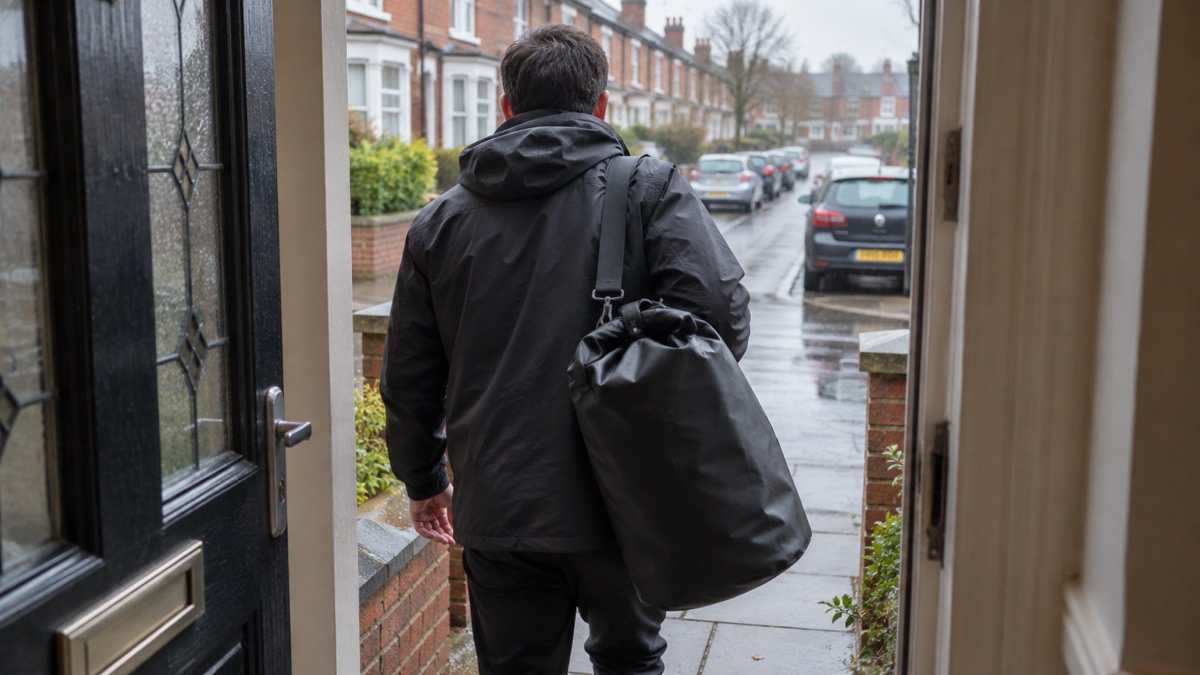
Carrying is built in. The bag has a top carry handle and a removable adjustable shoulder strap, and the maker states that "The adjustable shoulder strap and grab handle make it easy to carry, even when fully packed"1. For a household that may need to leave home quickly, that is the difference between a container and a grab bag: a fully packed 40 litre bag is heavy, and a shoulder strap leaves your hands free for a child, a pet lead or a torch.
What a dry bag is not also matters. It is not a cooler, a power source or a first aid kit in itself: it is the container that keeps those things dry and together. Your plan still needs the contents, and the guides on Water in an Emergency, Emergency Food and First Aid at Home cover what goes inside. Think of the dry bag as the outer layer of your kit, the one that lets everything else survive the event that triggered it.
Why waterproof storage belongs in a prepping plan
The clearest case is flooding. Official guidance from Wiltshire and Swindon Prepared states that "Currently 1 in 6 homes in the UK is at risk of flooding"2. That figure covers more than the households beside rivers: surface water flooding after heavy rain affects homes nowhere near a watercourse, and it is the most common form of flood risk in the UK. When flood water enters a home, it does not just wet the floor: it soaks everything stored at floor level, which is exactly where many households keep boxes of spare supplies. A sealed dry bag stored with your emergency kit keeps those supplies usable through the event and afterwards, during the cleanup, when you may be without power and unable to dry things out.
The second case is evacuation. Council emergency guidance is explicit that households should prepare not just a main kit but a portable one: "Prepare a household emergency kit and a smaller personal kit e.g. in a backpack for use should you need to be evacuated"3. A dry bag is well suited to that role because it is one sealed unit: rain, spray and standing water cannot reach the contents while you walk to a rendezvous point, a rest centre or a waiting car. The full picture of what a flood does and how to prepare for one is in Flooding: A Household Guide.
The third case is the car. A boot in a British winter is a wet place, with wet roads, spray and condensation, and a dry bag keeps the car kit from becoming a sodden box of ruined supplies. It also makes the kit one item to move between cars if the household changes vehicle. Storms, Snow and Ice: A Household Guide covers the rest of the winter plan.
The 40 Litre Waterproof Dry Tube Bag: what the maker specifies
The maker's own product page is the source for these specifications, and they are the ones that decide whether the bag fits your household's plan1.
| Specification | Detail |
|---|---|
| Product type | Waterproof dry bag1 |
| Capacity | 40 litres1 |
| Sealing system | Fold Seal System™ with sealing stiffener bar1 |
| Seams | High frequency welded seams1 |
| Waterproofing | 100% waterproof, as stated by the maker1 |
| Base | Durable and abrasion resistant base1 |
| Carrying | Top carry handle and removable adjustable shoulder strap1 |
| Warranty | 5 Year Extended Warranty1 |
A 40 litre capacity is in the range that suits a household grab bag rather than a single person's pouch: it will hold a change of clothes for more than one person, a first aid kit, torches, batteries, some water and food, and pet supplies, while still being one bag one adult can carry. If your plan is a smaller personal kit per person, as council guidance suggests3, a household may choose more than one bag, one per adult, so that no single person carries everything.
The Fold Seal System™ works by folding the top of the bag down on itself several times and closing it, with the stiffener bar helping the fold stay put1. Practice this before you need it: a bag sealed properly is waterproof, and the maker's instructions on its product page are the ones to follow for its own product1. Check the seal is closed fully each time you repack the kit, and check the bag itself once or twice a year for wear, especially at the base and along the fold.
Packing your household emergency kit in a dry bag
What goes inside is set by official guidance, not by the bag. Councils and preparedness partnerships across the UK publish broadly consistent emergency kit lists, and the dry bag is simply the container that keeps them dry. Drawing those lists together, a household kit packed in a dry bag should include:
- A change of clothes per person, or an emergency blanket4
- A whistle to signal for help5
- A torch, with spare batteries kept at home6
- A spare mobile phone with charger and credit7
- A first aid kit8
- Water and food, covered in the Water and Emergency Food guides
- Any medicines the household depends on, covered in Health Emergencies
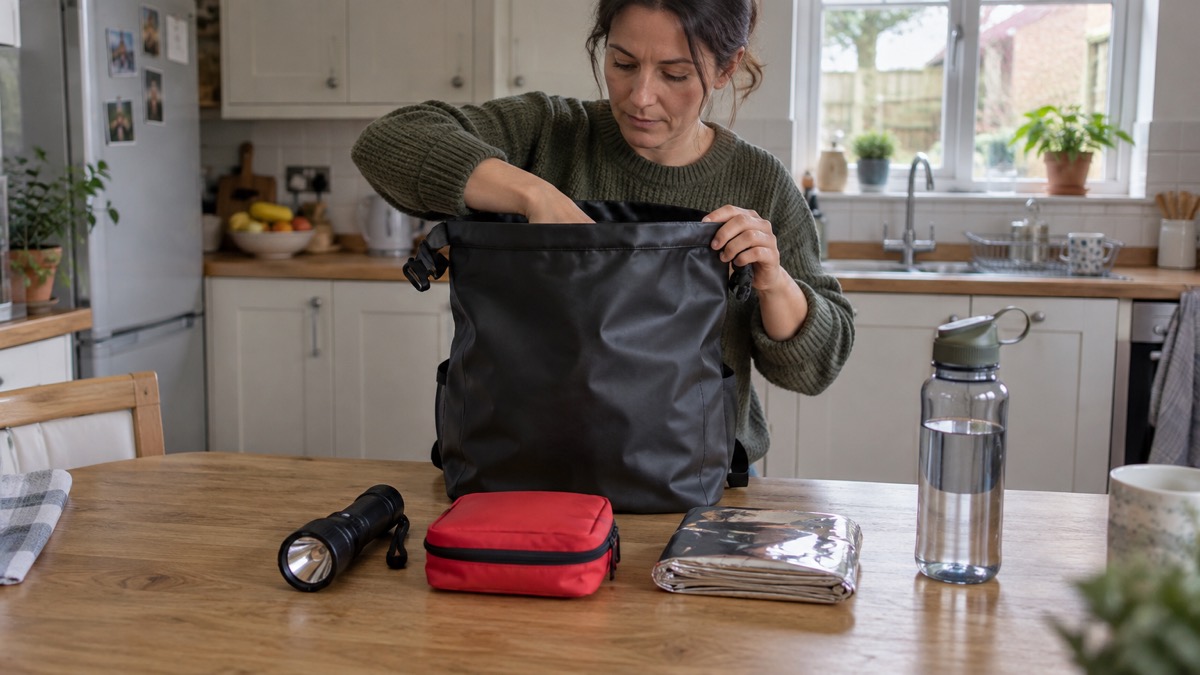
Lincolnshire's emergency advice includes "Whistle to signal for help" in its kit list5, and Neath Port Talbot's emergency kit checklist advises keeping "spare batteries" at home6. Wiltshire Council's kit list goes further on communications, including "a spare mobile phone with charger and credit"7. Nottinghamshire's guidance adds "a change of clothes per person or an emergency blanket"4. These are the contents; the dry bag is what protects them.
Two habits make the kit real rather than theoretical. First, pack it once, properly, and then leave it packed: a kit that is raided for batteries and never restocked is not a kit. Second, make sure everyone in the household knows where it is kept, which North Hertfordshire's guidance states directly when it advises preparing a personal kit "and make sure everyone knows where the kits are kept"3. A dry bag in a known place, sealed and ready, is the goal.
A grab bag for evacuation
The same council guidance that asks for a household kit asks for a portable one: "Prepare a household emergency kit and a smaller personal kit e.g. in a backpack for use should you need to be evacuated"3. Evacuation is the scenario where a dry bag earns its place most clearly, because an evacuated household is usually walking out into whatever weather caused the evacuation: rain, flood water, or snow.
Pack the personal kit around the person, not the house. For each adult's bag, that means their own change of clothes or emergency blanket4, their own whistle5, and the shared items distributed between bags so that losing one bag does not lose everything. Documents matter too: sealed inside a dry bag, passports, insurance documents and prescription lists survive water that would destroy them in a folder. The maker's welded seams and fold seal are what make that a reasonable plan1.
Keep the grab bag where it can be reached in the dark and in a hurry, and tell everyone where that is3. If you have pets, the next section covers their kit, because over half of the homes in the UK have a pet9 and an evacuation plan that cannot move the pets is not a complete plan.
Pets and the car: two more places a dry bag helps
Pet kit is a distinct list, and a pet grab bag packed in a dry bag can hold a spare collar or harness, a lead, food, a bowl and any pet medicines, all protected from water. For most households with animals, the evacuation plan has to move them too, and a ready-packed, waterproof bag makes that faster and less stressful. The full guidance is in Pets and Animals in an Emergency: A Household Guide.
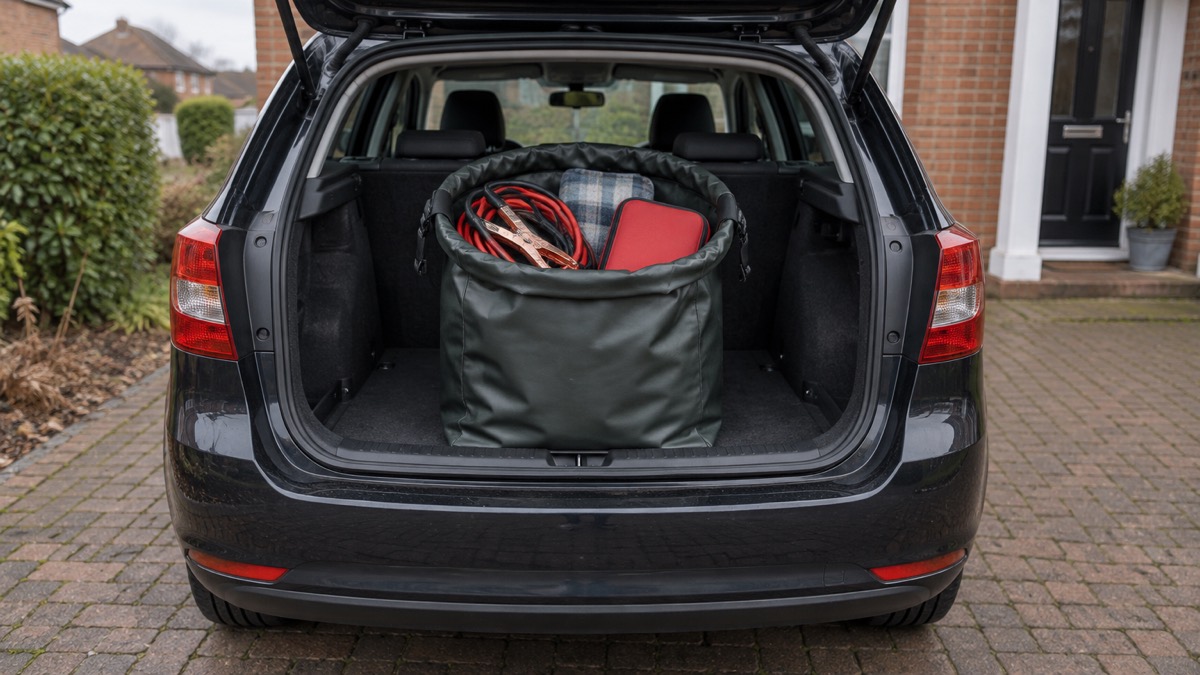
The car kit is the second. Neath Port Talbot's checklist adds "jump leads" to the car kit6. A dry bag in the boot keeps all of it dry through a British winter of wet roads, spray and condensation, and makes it one item to move between cars if the household changes vehicle.
Keeping the kit ready: checks and storage
A dry bag needs almost no maintenance, but the kit inside it does. Set a routine, twice a year at the clock changes is a common pattern, and check:
- The bag's fold seal closes fully and the stiffener bar is intact
- The base and seams show no wear or damage
- Batteries still hold charge and spares are in date
- The spare phone charges and holds credit7
- Medicines and food items are in date, per the Emergency Food and Health Emergencies guides
- Pet supplies, including the spare collar or harness, are still there and still fit
- Everyone in the household still knows where the kit is kept3
Store the bag off the floor where flooding is a risk, since a sealed bag in standing water is protected but a bag under a collapsed shelf is not. The maker's product page is the authority on the bag's own care, and its stated construction, welded seams, abrasion resistant base, is what you are checking against1.
Support, warranty and returns
The maker's product page for the 40 Litre Waterproof Dry Tube Bag lists a 5 Year Extended Warranty1. Keep your proof of purchase where you can find it: a warranty claim years into ownership depends on it, and the same document habit that protects your passports in the dry bag should protect the receipt for the dry bag.
Returns are straightforward on UK orders. The maker's page states: "You'll have 30 days to return or exchange your item, as long as it's unused and in its original packaging"1. Returns are free within the UK via InPost, and to start one you email support@overboard.com1. The practical implication for a prepping household: decide on size before you pack the bag for real, because a bag that has been packed and carried is no longer unused. If you are unsure whether 40 litres suits your household, contact the maker at that address before the returns window closes.
For any product question, warranty or otherwise, support@overboard.com is the contact the maker gives1. That is also the address to use if you find a fault in the bag's sealing or construction, since a dry bag that does not seal is not doing the one job you bought it for.
Safety notices and recalls
There are no OverBoard recalls or safety notices in the pack for this page, and a dry bag is a passive container rather than an electrical appliance, so the main recall risks in an emergency kit lie in the electrical items you pack inside it. Fire and rescue services are consistent on what to do about those. Manchester Fire and Rescue Service advises: "Register electrical items with the manufacturer to be informed of any safety recalls"10, and its maintain-and-recalls guidance adds: "Check your appliances are not subject to a product recall by checking the Office for Product Safety and Standards (exter[nal site])"11. London Fire Brigade likewise notes that "The Office for Product Safety and Standards issue recalls & alert notices on their website"12.
So the habit to build is registration. When you add a torch, a power bank or a radio to the dry bag, register it with its maker, and check the Office for Product Safety and Standards recalls page periodically. South Wales Fire and Rescue Service makes the same point for e-bikes and e-scooters: "Register your product with the manufacturer to validate any warranties, batteries are usually included in warranties"13. Cheshire Fire and Rescue Service adds, for white goods: "Check for recalls or safety notices on the Electrical Safety First website"14.
The wider electrical safety picture, including charging and battery care for anything you pack, is covered in Home Emergencies: Fire, Carbon Monoxide, Gas Leaks and Burst Pipes and Backup Power at Home.
Where OverBoard fits a household plan
To sum up the practical place of this maker in a UK household's preparedness: OverBoard supplies the waterproof container layer of the plan. The contents come from the official kit lists, the plan comes from the guides on this site, and the dry bag is what lets both survive water, which is the element behind the most likely scenarios, flooding, storms and snow. Buy the size that matches your household, pack it once by the lists, seal it by the maker's instructions, store it where everyone can find it, and check it twice a year. The 5 year warranty and the 30 day returns window are the maker's own terms, and support@overboard.com is the contact for both15.
Sources (14)
- OverBoard 40 Litre Waterproof Dry Tube Bag product page, OverBoard, 2026
- Flooding risk in Wiltshire and Swindon, Wiltshire and Swindon Prepared
- Preparing for emergencies, North Hertfordshire District Council
- Preparing for an emergency, Nottinghamshire County Council
- Get help and advice in an emergency, Lincolnshire County Council
- NPT Prepared emergency kit checklist, Neath Port Talbot Council
- Planning for an emergency kit, Wiltshire Council
- Winter preparedness, NHS Lanarkshire
- Pet safety campaign, North Yorkshire Fire and Rescue Service
- Electrical safety in the home, Manchester Fire and Rescue Service
- Maintain appliances and recalls, Manchester Fire and Rescue Service
- Electrical items safety, London Fire Brigade
- E-bikes and e-scooters safety advice, South Wales Fire and Rescue Service
- White goods electrical fire safety, Cheshire Fire and Rescue Service