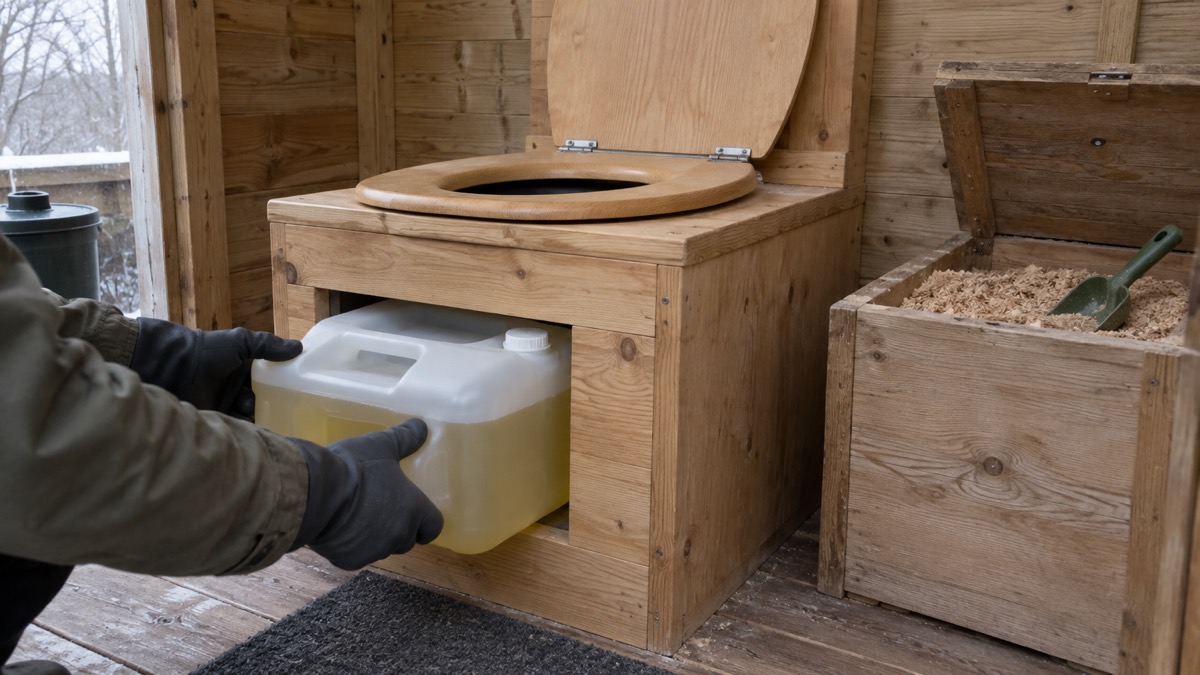
A composting toilet does the same job as a flush toilet without any mains water or drainage. Waste drops into a chamber where it breaks down naturally, a vent pipe carries away moisture and odour, and you empty the finished compost once or twice a year rather than flushing every use. For a household off the mains, on an allotment or in a property where the sewer cannot be relied on, it removes the single largest daily use of water in the home: older toilet cisterns use as much as 13 litres per flush, whilst current modern models use 6 litres per flush or less1, and a composting toilet uses none.
The approach that suits the UK climate best, according to the Centre for Alternative Technology (CAT), whose guidance on composting toilets is the basis for much of this page, is to alternate annually between two separate chambers: one in use while the other rests and finishes composting2. Keeping urine separate from solids is usually the key to success, because a wet, urine-soaked mass turns anaerobic and smelly2. This page explains how the systems work, how to choose between the two main designs, how to site and empty one safely, and how a permanent composting toilet differs from the emergency toilet bags in a flood kit.
How a composting toilet works with very little water
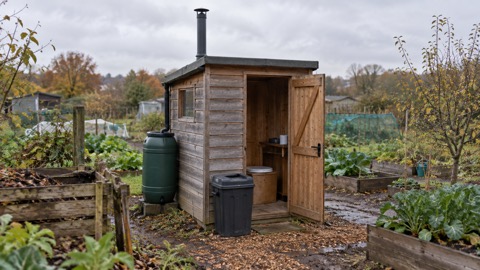
A composting toilet is a container, a pedestal and a vent. Solids and soak material (something dry and carbon-rich, discussed below) build up in a chamber beneath the seat, where decomposer organisms break them down over months. Moisture and odour leave through the vent pipe rather than through a drain. Nothing is flushed anywhere, so there is no cistern and no sewer connection, and composting toilets use minimal water to break down waste into compost, which is what makes them useful in remote areas and off-grid properties1.
Ventilation is what makes the system work without smells. CAT's guidance is that a simple unpowered, passive vent is a straight pipe of at least 110mm diameter, reaching well above the roof line and fitted with a rotating cowl2. The cowl spins in the wind, drawing air down through the pedestal and up the pipe, which pulls moisture out of the chamber and keeps odour moving away from the building. Because it is passive, it needs no electricity, which matters if the property is off-grid or you want the toilet to keep working through a power cut.
If the toilet is in a standalone building that needs lighting, keep the power demand tiny. CAT advises that using low voltage, 12 or 24 volt DC, reduces equipment costs when off-grid, and a motion detector minimises power demand2. A photovoltaic panel with a battery can supply enough energy for lighting during the summer months but would be inadequate in winter; year-round power can come from combining a photovoltaic panel on a south facing roof with a wind turbine on a nearby mast2. If you are planning that kind of set-up, our pages on off-grid solar systems and small wind turbines cover the components in detail.
Keep urine separate to stop smells
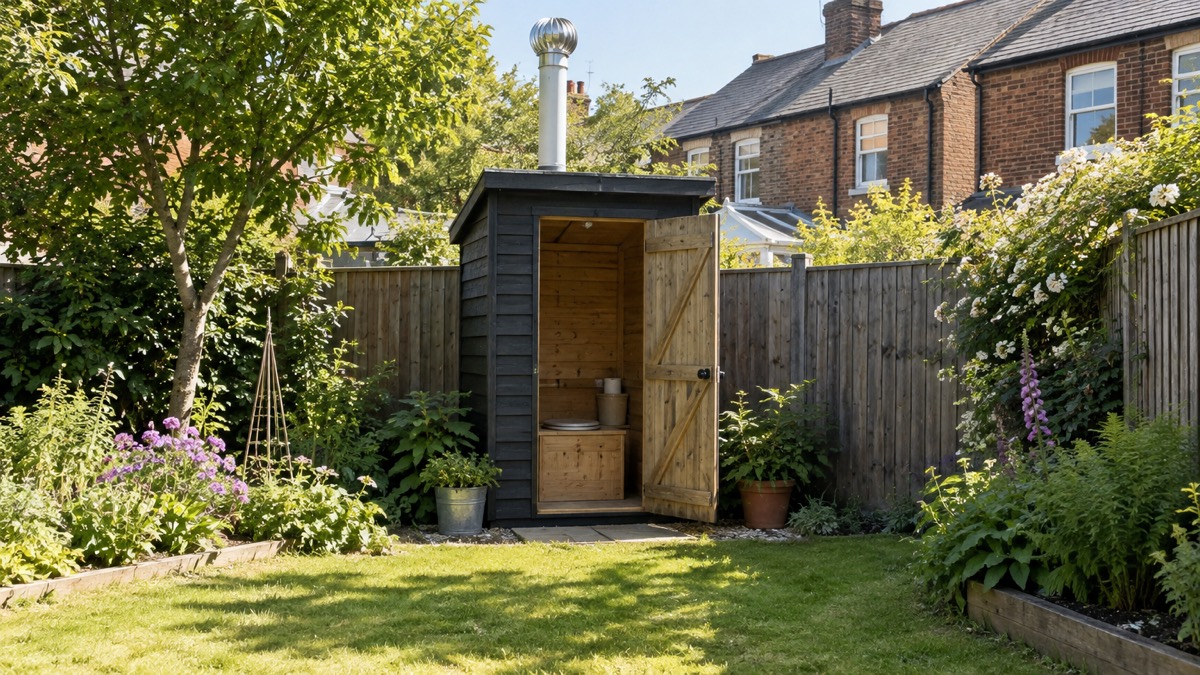
Urine is the enemy of a sweet-smelling composting toilet. CAT's guidance is blunt on this: keeping urine separate is usually the key to successful composting, otherwise it can become anaerobic and smelly2. Urine is mostly water, and a chamber that stays saturated excludes the air that aerobic decomposers need. What you get then is a wet, oxygen-starved mass that rots rather than composts, and the smell of that is the smell people remember from badly run composting toilets.
Most designs achieve separation with a urine diverting pedestal: a shaped bowl that channels liquid forwards into its own container while solids drop behind it into the chamber. There is a practical limit to how well this works. CAT notes that urine separation only works when users are sitting down2. In a family household that is a habit to teach; with visitors it is a sign to put up. If the pedestal is used standing, urine misses the divertor and ends up in the solids chamber, and the anaerobic slide begins.
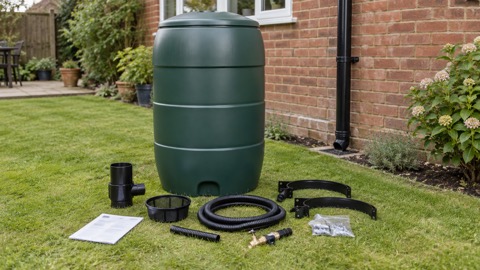
The collected urine is not waste. Diluted, it is a useful garden fertiliser, and CAT advises that urine collected without other contamination should ideally be used within a day or so, before ammonia levels build up and it starts to smell2. Our page on using urine as garden fertiliser safely covers this. If you already harvest rainwater, note that a water butt connected to your downpipes can be linked to greywater uses such as toilet flushing and garden watering3, but with a composting toilet there is no flushing demand to supply at all.
Two chambers alternated each year suit the UK climate
The design CAT recommends as reliable and robust for the UK climate is two separate chambers used in alternation, one year each2. You fill the first chamber over the course of a year, then seal it and switch to the second. While the second fills, the first rests: the waste continues composting with no additions, and by the time the second chamber is full a year later, the first holds finished compost you can empty before the cycle starts again. The year-long rest matters in Britain because our cool winters slow decomposition; a single chamber emptied on demand would need heat or constant intervention to keep up.
Sizing follows from the alternation. CAT's guidance on one system, the Aquatron, is that a composting chamber may need to be about one-third to one half of a cubic metre per person, equal to a box about 70 to 80 cm on each side2. Two people therefore need two chambers of roughly that size each; a larger household needs proportionally more, or more frequent emptying. Our page on composting toilet chamber size per person works through the arithmetic.
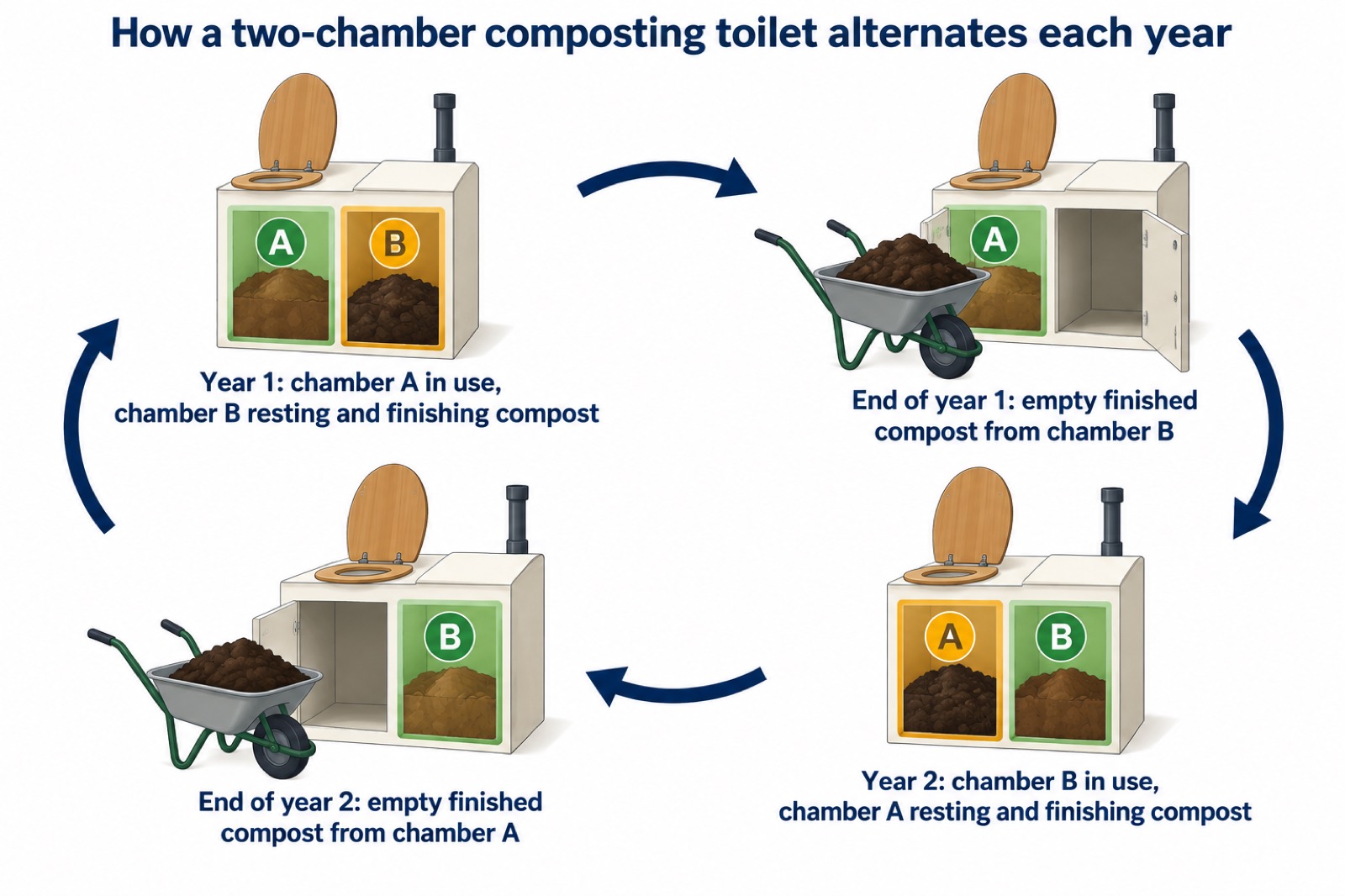
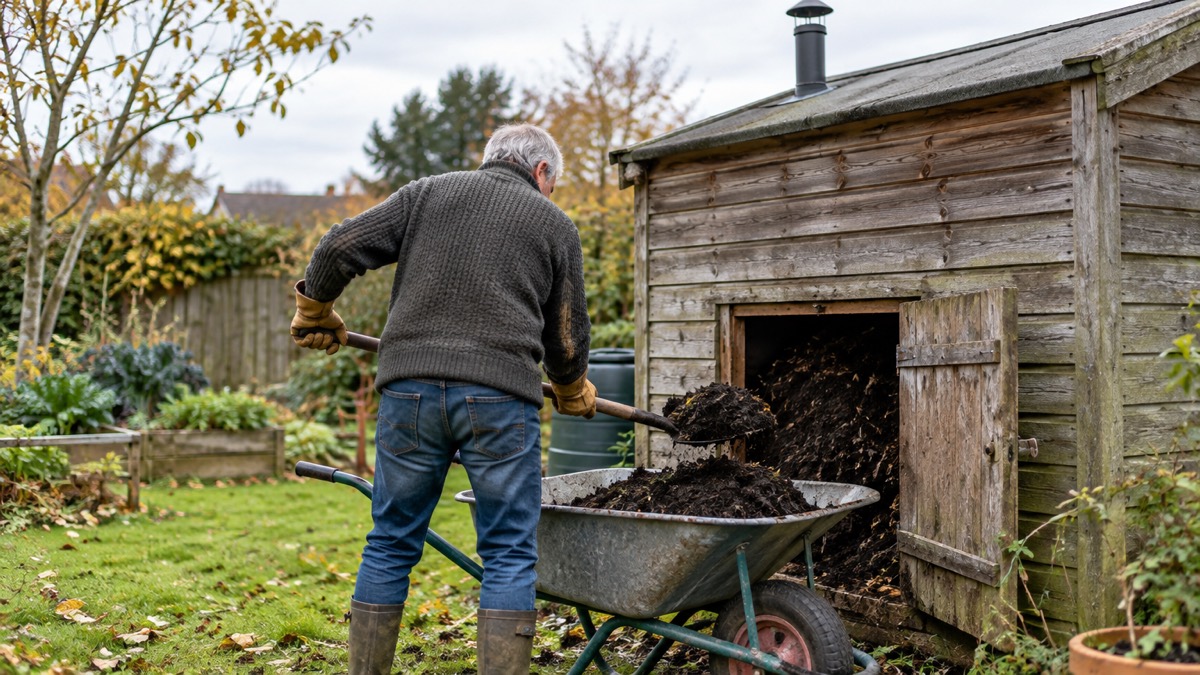
The alternation also shapes emptying. You handle finished, rested compost once a year per chamber, not fresh waste, which is a far more pleasant job and a safer one. The planning rules reflect this too: CAT notes that composting toilets are acceptable where suitable arrangements can be made for disposal of waste on or off site, and where waste can be removed without carrying it through living space or food preparation areas2. Two chambers with an outside or outhouse access door make that straightforward.
Continuous systems settle within a few months
The alternative to the two-chamber design is a continuous system: a single larger chamber where fresh material is added at the top and finished compost is removed from the bottom, usually through a raking or sliding mechanism. The advantage is that there is no annual switch-over and the unit can be more compact. The trade-off is that the composting has to keep pace with the additions, which depends on the chamber being large enough, warm enough and ventilated enough.
The reassuring news from CAT's experience is that a continuous system should settle down within a few months, after which no intervention in terms of adding worms or other decomposers should be necessary2. The decomposer community, bacteria, fungi and the small creatures that follow them, establishes itself from the waste and soak material without help. In the first few months the system may smell a little or compost slowly while this community builds; that is normal and not a reason to start adding things.
That answers the worm question directly: no, you do not need to add worms, and once a system has settled, adding them is unnecessary2. If composting is slow or smelly months in, the cause is almost always one of the basics, excess urine, too little soak, or a weak vent, and fixing that will do more than any additive. Flies are the other early problem, and CAT suggests two controls: a simple fly trap made from a jam jar with a 2 to 3mm diameter hole drilled in the middle of the lid and a cone of clear plastic to funnel flies up, and a vent pipe running vertically upwards with a metal gauze over the top so flies are drawn up and trapped2. Our page on how to stop flies in a composting toilet goes through the options.
Adding soak material: when and how often
Soak is the dry, carbon-rich material you add to the solids chamber after use: sawdust, coir, dry shredded garden waste or similar. Its job is to absorb moisture, balance the nitrogen-rich waste with carbon and keep the mass aerated, all of which keep the composting aerobic. Without enough soak the chamber trends wet and anaerobic; with it, the mass stays crumbly and sweet-smelling.
How it is added depends on who uses the toilet. In a private household, each user adds a handful after solids, which is simple and self-regulating. In a public toilet, CAT's experience is that a daily or even weekly addition of soak by the operator may be better than leaving users to add it indiscriminately2. Visitors add too much or too little, or none at all, so an operator topping up on a rota keeps the balance right. If you are installing one for a community building, allotment site or holiday let, plan for that rota from the start.
What counts as soak overlaps with ordinary garden composting: dry, woody or leafy garden material can serve as soak once it is dry. Keep cooked food and anything oily out of the toilet chamber; it belongs in the garden heap or the council food waste collection, not a system designed for human waste.
Siting: separation distances, sandy soil and flood water
Where the toilet and its chambers sit is partly a plumbing question and partly a legal one. If the composting chamber is a separate unit connected to a pedestal by a pipe, as with the Aquatron system, CAT advises it must be less than 25 metres, ideally less than 15 metres, from the toilet, so that solids and liquids have not separated unhelpfully in transit2. Closer is better; the drop should be direct.
Distance from water supplies matters most. CAT's guidance is that if the soil is sandy the separation distance from a well or water source could be reduced to 7.5m2, implying a larger default distance in other soils, which our page on how far a composting toilet should be from wells and water supplies covers in full. Sandy soil drains and filters differently, which is why the figure changes with it.
The rules around installation are set out in building law. CAT notes that composting toilets are mentioned in Part G of the Building Regulations, and that they are acceptable where suitable arrangements can be made for disposal of waste on or off site, where waste can be removed without carrying it through living space or food preparation areas, and where no part of the installation would be rendered ineffective by entry of flood water2. That last condition deserves attention in a flood-prone area: a chamber that flood water can reach is both a failed toilet and a contamination hazard. Our page on planning permission and building regulations for tanks, turbines, toilets and panels explains the consent side.
Flood-prone households should also think about where the chamber sits relative to the house. Fire service guidance on protecting homes advises positioning garden structures such as sheds and compost heaps away from the house6, and the same logic of separation applies to a composting chamber: keep it accessible for emptying, but not where water or leachate could reach the dwelling or a water supply.
Why to avoid electrically heated dry toilets
Some dry toilets use electrical elements to heat the compost, evaporating liquid and speeding the process. CAT does not recommend them: do not use dry toilets that use electrical elements to heat the compost2. The reasons are practical. Heating an outdoor chamber through a British winter draws power continuously for a sanitation task that a properly sized two-chamber system does for free, and it makes the toilet dependent on a supply that fails exactly when you may need it most, in a storm or a power cut.
The Building Regulations guidance CAT cites points the same way: composting toilets should not be connected to an energy source other than for purposes of ventilation or sustaining the composting process2. A small fan on the vent is within that allowance and is a common, low-draw addition; a heating element is not. If you are off-grid, that continuous load would dominate your system sizing, and our page on sizing an off-grid solar system from your daily watt-hours shows how quickly a constant heater dwarfs lighting and ventilation loads.
There is a general household safety point too. Any heater left running unattended in an outbuilding carries fire risk, and official fire safety advice on electric heaters is to keep them away from curtains and furniture, never use them for drying clothes, and always unplug them when you go out or go to bed7. A heating element buried in a compost mass is harder to supervise than a room heater, which is a further reason to choose a design that needs no heat at all.
Composting toilet or emergency toilet bags: two different jobs
A composting toilet and an emergency toilet kit are not alternatives; they answer different questions. A composting toilet is permanent infrastructure: it composts waste over months and needs siting, chambers and a vent. Emergency toilet bags are what a household keeps for the days when the ordinary toilet cannot be used at all, because the water supply is off, the drain is blocked or flood water is coming up through it.
Council emergency supplies guidance is specific about what to keep: heavy duty plastic rubbish bags and ties for personal sanitation, toilet paper, a medium sized plastic bucket with a tight lid, disinfectant and household chlorine bleach, moistened towelettes, soap and hand sanitiser, and it suggests considering a small shovel for digging a latrine8. Keep the kit together in plastic boxes or backpacks in a designated place that all household members know8. Our emergency kit page covers the rest of the household kit this sits inside.
In a flood, the flush toilet becomes a route for sewage into the home, and official flood guidance includes placing a sandbag in the toilet bowl and blocking the washing machine drain with a suitable plug, such as a cloth or towel, to prevent backflow9. After flood water recedes, the Scottish Flood Forum advises removing any toilet waste from affected areas by shovelling it into black bags and sealing them10. Neither job is anything a composting chamber should be asked to do, which is why the Building Regulations condition on flood water matters when you site one2.
If the water supply is interrupted rather than the drains, the advice shifts. Official guidance is to use alternative water supplies such as bottled water solely for drinking, washing your hands and food preparation whilst there is no mains supply11, and Public Health Wales advises that if your toilet is unusable you should use toilets belonging to unaffected family, friends or neighbours, public toilets, rest centres, local shops, supermarkets and hotels if possible12. A household with a composting toilet has one more option that needs no water and no drain, but the emergency kit is still worth having for everything else.
| Composting toilet | Emergency toilet bags | |
|---|---|---|
| What it is | Permanent installation with chambers and a vent2 | Bucket, bags, ties, disinfectant and hygiene supplies in a stored kit8 |
| Timescale | Months of composting, emptied about yearly2 | Days, until services return8 |
| Water needed | None2 | None, but bottled water is needed for drinking and hand washing11 |
| Suits | Off-grid homes, allotments, properties without drainage2 | Every household's emergency kit8 |
Handling the finished compost safely
The end product of a well-run system is a dark, crumbly, earthy-smelling compost, and handling it safely is mostly ordinary garden hygiene. Wear gloves, because NHS guidance warns that Legionella bacteria can be found in compost, and consider a mask for dusty work, washing your hands afterwards4. Avoid turning or emptying the chamber in a confined space on a still day if the material is dry and dusty.
After emptying, clean the contact points. Official guidance on preventing the spread of illness is to disinfect door and toilet handles, taps and the toilet seat after use, and to disinfect the toilet bowl frequently5; with a composting toilet the pedestal, seat and any tools used for emptying deserve the same treatment. Wash hands thoroughly even after gloves.
Where the finished compost goes is a judgement for your site. The Building Regulations conditions CAT cites require suitable arrangements for disposal on or off site and removal without carrying waste through living space or food preparation areas2, and the safest reading of those conditions is to keep the finished material away from food growing areas and to move it out via an outside door. Time and the elements help: the Scottish Flood Forum notes that after grass has grown and been cut once there should be no further risk, as sunlight and soil will usually destroy harmful bacteria within a few weeks10, and Perth and Kinross Council's flooding checklist similarly notes that grass is usually safe after about a week because sunlight and soil help destroy harmful bacteria13. Sunlight and soil are on your side, but give the compost the benefit of them before it goes near anything you eat.
Where to go next
If you are weighing a composting toilet against other water and waste arrangements, start with the pages that share its decisions: how far a composting toilet should be from wells and water supplies, composting toilet chamber size per person, how to stop flies in a composting toilet and using urine as garden fertiliser safely. For the wider picture of living with less mains dependence, see self-reliance at home: rainwater, off-grid power and living without mains, and for the short-term side of sanitation, water in an emergency and the emergency kit page.
Sources (13)
- Droughts: be informed about hazards, UK Government Prepare Campaign, 2026
- Composting toilets, Centre for Alternative Technology, 2025
- Drought advice and support, Westminster City Council, 2026
- Summer health campaign, NHS inform Scotland, 2026
- Food poisoning advice, Northumberland County Council, 2026
- Protecting your home from wildfires, North Yorkshire Fire and Rescue Service, 2026
- Keeping your home warm in winter, Met Office, 2026
- Emergency supplies kit, Denbighshire County Council, 2020
- Damage limitation guide, Dover District Council, 2001
- Immediately after the flood, Scottish Flood Forum, 2026
- Water supply interruptions or outages, UK Government Prepare Campaign, 2026
- Weather and health, Public Health Wales, 2026
- Flooding checklist for residents, Perth and Kinross Council, 2024
 Composting Toilet Kit Checklist
 Garden Harvesting Kit Checklist
 Rainwater Winter Checklist
 Above-Ground Rainwater Tanks
 Direct vs Gravity Feed Systems
 Planning Permission for Systems
 Private Water Supply Running Low
 Private Water Supply Regulations
 Private Water Supplies Scotland
 Treating a Private Water Supply
 Rainwater Filter Types
 How Rainwater Harvesting Works
 Rainwater System Maintenance
 Pumps for Rainwater Tanks
 Rainwater Systems and the Law