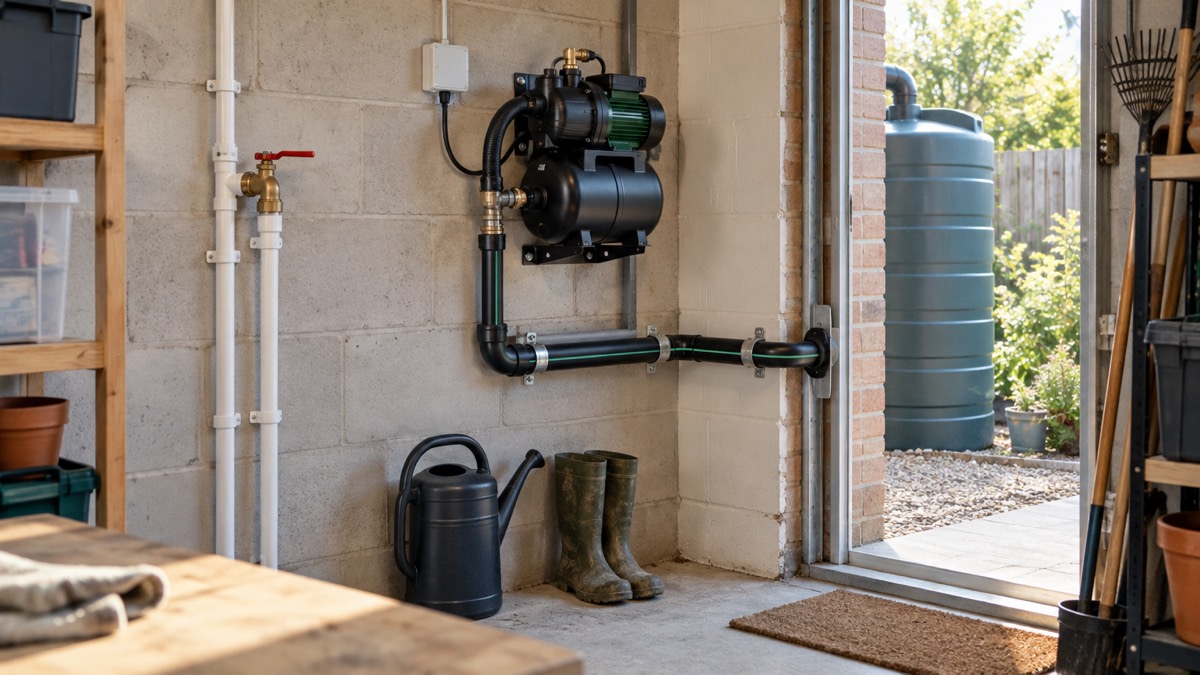
Collecting rainwater from your roof is legal in the UK, and councils and water companies actively encourage it1. What the law cares about is what happens next: as soon as rainwater is plumbed into pipework, or stored in a tank that also serves your drinking water, you are in the territory of the Water Supply (Water Fittings) Regulations 1999, which apply to new plumbing systems and to alterations and additions to older ones2.
The core rule is simple. Within a normal system, rainwater is classed as non-potable, non-drinking water under UK water regulations, which means it cannot be used for anything involving human contact: drinking, bathing or cooking3. Every bit of plumbing that connects a rainwater system to your household exists under that constraint, and the regulations exist to make sure the two waters never mix.
This page sets out which rules apply to which arrangement, how the nations differ, what the British Standards cover, and where to go for advice before you install anything.
What the Water Fittings Regulations are and who they cover
The Water Supply (Water Fittings) Regulations 1999 are the rules that govern plumbing connected to the public water supply. New plumbing systems, and alterations and additions to older systems, must comply with them2. They are not about rainwater as such: they are about protecting the quality of the water that reaches your tap, and they apply to anyone whose plumbing is connected to a water company's mains.
The Drinking Water Inspectorate's guidance on storage tanks and cisterns explains the practical effect for households. Any tank or cistern that holds water for household use should be made of an approved material, and the advice is to look for the relevant Water Regs UK Approved Product logo, which ensures the tank material is of an approved type2. That applies to cold water storage tanks on the drinking water side of your plumbing, and it is the same logic that runs through the rainwater rules: materials in contact with water matter because they can change what is in it.
The regulations sit alongside building rules rather than replacing them. Independent guidance on water saving notes that grey water installations, which reuse water from baths and basins in much the same spirit as rainwater systems, must comply with the Water Supply (Water Fittings) Regulations 1999 and with the Building Regulations, parts G and H7. A rainwater system that touches the household plumbing is in a similar position: two sets of rules apply at once, and both have to be satisfied.
If you are planning a system, the rainwater harvesting guide explains how the collection, filtration, storage and reuse chain works, and the planning permission and building regulations page covers the consents side in more detail.
When rainwater plumbing falls under the rules
A rainwater system in the garden, filling a butt from a downpipe, involves no plumbing connection to the mains and so falls outside the fittings rules. The moment rainwater enters pipework that is part of the household's water system, the position changes. The maker's description of a typical system is that rainwater is collected from the roof, filtered, stored in a tank and then reused within the home and garden3. That "within the home" step is what brings the regulations into play, because the home's plumbing is also the route by which mains drinking water arrives.
The classification of rainwater drives everything. Within a normal system, rainwater is classed as non-potable or non-drinking water by UK water regulations, and it cannot be used for applications where there is human contact, such as drinking, bathing and cooking3. So a plumbed-in rainwater system serves toilets, washing machines and outdoor taps, and the plumbing has to be arranged so that this non-drinking water cannot find its way back into the drinking water side. The potable and non-potable tanks comparison explains the tank side of that distinction.
Where the plumbing work happens matters for cost as much as compliance. Independent guidance notes that rainwater harvesting systems are typically more suited to new-build properties, where the cost of plumbing them in is negligible, while retrofitting into an existing property can be expensive7. The regulations apply either way, but a new build gives you the chance to design the two sets of pipework properly from the start, with separate runs and clear labelling, rather than adapting old pipes.
Electrical components in a plumbed-in system carry their own compliance marks. The maker of the Rain Director control unit certifies that it is compliant with the safety requirements of the Machine Directive 89/392/EC and amendments, the Low Voltage Directive 73/23/EC and the Electromagnetic Compatibility Directive 89/336/EC and amendments8. That is the maker speaking about its own product, but it reflects the reality that a pumped rainwater system is an electrical appliance as well as a plumbing one.
A separate rainwater or private supply: where the rules stop
Not every household gets its water from a water company. A private water supply is any water supply which is not provided by a water company, and in Wales the official guidance notes that most are in remote, rural parts of the country, with sources that may be a well, borehole, spring, stream, river, lake or pond, serving one property or several9. In Scotland the definition runs the same way: a private water supply is any water supply not provided by Scottish Water10.
Once you are off the mains, a different body of law applies, and it is not the Water Fittings Regulations. The requirements for private water supplies are different for each country in the UK, though they share similarities11. In England they are enforced through the Private Water Supplies Regulations 2016; in Wales through the Private Water Supplies (Wales) Regulations 2017 and the Private Water Supplies (Wales) (Amendment) Regulations 20184. Scotland has its own framework, and the legislation differs between the two types of supply it recognises12.
Scotland's split is worth understanding if you have a supply there. There are two types of private water supply, and the legislation relating to each is different12. Larger supplies, or those with a commercial activity, are defined as Regulated supplies, and these are regulated by the Water Intended for Human Consumption (Private Supplies) (Scotland) 2017; supplies serving 50 or more persons in total, or supplies to commercial or public activities irrespective of size, fall in this group13. Smaller supplies that only serve domestic properties are Exempt supplies, regulated by the Private Water Supplies (Scotland) Regulations 200613.
| Nation | Regulations | Who enforces |
|---|---|---|
| England | Private Water Supplies Regulations 20164 | Local authorities4 |
| Wales | Private Water Supplies (Wales) Regulations 2017 and Amendment Regulations 20184 | Local authorities4 |
| Scotland | Water Intended for Human Consumption (Private Supplies) (Scotland) 2017 for Regulated supplies; Private Water Supplies (Scotland) Regulations 2006 for Exempt supplies13 | Local authorities, overseen by the Drinking Water Quality Regulator for Scotland12 |
The enforcement duty sits with local authorities. The regulations place a duty on local authorities to carry out a risk assessment of each private water supply in their area, except supplies to single untenanted dwellings4. Cornwall Council's guidance adds that local authorities must carry out sampling at all supplies except those which serve only one domestic property which is owner occupied14. The private water supply regulations page goes through risk assessments and testing in detail.
For a single dwelling, the reach of the rules is narrower. If a supply provides water for domestic purposes to only one dwelling, the regulations do not require a risk assessment or testing unless the owner or occupier requests it, the dwelling is in Wales and rented to tenants, the dwelling is in England, rented to tenants and meets the criteria in the guidance on regulation 9, or the local authority believes there to be a risk to health15. Wales is the stricter of the two on tenancies: for lead, the risk assessment requirement applies to all shared, public and commercial supplies, and in Wales it also includes all supplies provided as part of a tenancy agreement16.
What happens if a supply breaks the rules
The rules on water supplies are not advisory. Where a supply is deemed a potential, or actual, danger to human health by the local authority, a relevant person is liable to be served a notice under regulation 18 in England, or regulation 20 in Wales, of the respective private water supplies regulations15. That is the enforcement mechanism for a private supply that has gone wrong, and it can require works to be carried out.
The health stakes are real. Official Scottish guidance states plainly that private water supplies can present a risk to health if not properly managed, and that outbreaks of disease attributed to private water supplies have occurred in Scotland12. A documented case study from the Drinking Water Inspectorate describes a Regulation 9 supply where faecal contamination was found, in a system where water is pumped to a covered holding reservoir before being gravity fed to the properties17. The contaminated supply FAQ below covers what to do if you suspect a problem.
On the plumbing side, the sanctions run through the building regulations. The person installing your tank could be prosecuted and fined if they do not comply with building regulations18. That is worth remembering when choosing an installer for anything from a heating oil tank to a rainwater storage tank: the legal duty sits with the person doing the work, but it is your water and your home.
Water use restrictions carry their own penalties. If you are found to break the rules of a hosepipe ban, you could be fined up to £1,00019. Temporary use bans, the formal name for hosepipe bans, are implemented by water companies under their own powers, under section 76 of the Water Industry Act 1991 as amended by the Flood and Water Management Act 201020. A rainwater store is one way households keep gardens watered within those rules: the Maidstone rainwater harvesting campaign was built partly on improving garden resilience during hosepipe bans21.
Mains top-up: keeping rainwater out of the drinking supply
Most rainwater systems in UK homes are not off-grid. They have a mains top-up: when the rainwater tank runs low, drinking water from the mains is used to keep the system flowing, so the toilets still flush in a dry spell. This is the point in the whole arrangement where the regulations bite hardest, because it is the one place where the non-potable rainwater system and the potable mains supply come near each other.
The principle that governs the design comes from the classification of the water. Rainwater is classed as non-potable or non-drinking water by UK water regulations, and it cannot be used for applications where there is human contact, such as drinking, bathing and cooking3. The corollary, and the reason the fittings rules exist, is that rainwater must not be able to flow back into the drinking water supply. A top-up arrangement has to be designed so that mains water can enter the rainwater tank, but tank water can never enter the mains pipework.
That is why the top-up is arranged through the tank rather than through a simple valve on a shared pipe. The mains water is delivered into the rainwater tank itself, at a level and in a way that leaves a break between the two waters, and the pump then draws from the tank as it always does. Keeping the tank at the centre of the arrangement in this way means the two supplies never share a single run of pipework, and the break between them is built into the layout rather than depending on a valve.
For domestic water use within the home, the maker's guidance is that the tank has to be underground3. In a typical harvesting set-up, rainwater is collected from the roof, filtered, stored in a tank and then re-used within the home and garden15. The underground tanks page covers the tank types, and the direct feed and gravity feed systems page explains the two ways water moves from tank to tap.
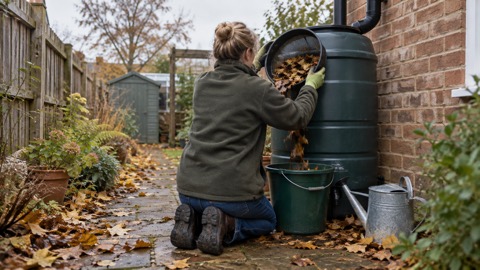
If you are weighing a simple butt against a plumbed system, the water butt or underground tank comparison sets out the trade-offs. A plumbed system is what makes the regulatory care worthwhile, because it feeds uses a butt cannot reach. Fitting a filter to catch the leaves and moss coming off the roof saves a build-up of sediment in the tanks22.
Approved materials: WRAS and regulation 5
Whatever water a tank or pipe holds, the materials it is made from can change that water. The official advice on private supplies is to ensure that materials and products in contact with the water conform to regulation 5 of the Private Water Supplies Regulations5. For rainwater harvesting systems specifically, the guidance is that approved materials, WRAS approved or permitted under regulation 5, should be used to prevent the contamination of rainwater during runoff and collection5.
On the drinking water side, the practical test is a mark on the product. The Drinking Water Inspectorate's advice on storage tanks and cisterns is to look for the relevant Water Regs UK Approved Product logo, which ensures the tank material is of an approved type2. WRAS, the Water Regulations Approval Scheme, is the route by which fittings and materials demonstrate compliance with the water fittings regulations, and an approval certificate tells you the product has been tested against them.
This matters for rainwater systems in two places. First, any component that carries mains drinking water, including the top-up line into your rainwater tank, should be made of approved materials. Second, the tank and pipework that hold the rainwater itself benefit from approved materials because contaminated storage is contaminated water: whatever you collect from the roof, you do not want the tank adding to the problem. The pipe labelling page covers the related duty to keep rainwater pipes identifiable so no one connects to the wrong one by mistake.
The British Standards: what BS 8551 and its neighbours cover
Alongside the regulations sit the British Standards, which describe good practice rather than laying down law. The British Standard for rainwater harvesting, BS 8515, provides criteria for rainwater harvesting equipment manufactured in the UK7. When a tank, filter or control unit is described as BS 8515 compliant, that is the standard being referred to, and it is the one to look for in the specification of a manufactured rainwater harvesting system.
BS 8551 has a different home territory: temporary water supplies. Official guidance on alternative supplies states that arrangements must ensure the temporary water supply is wholesome by specifying best practice, and it cites BS 8551 as the example of that best practice6. The context is supplies arranged when a normal source fails, where the relevant persons can put arrangements in place directly with commercial suppliers, and the standard is the benchmark those arrangements are measured against6.
For a household, the two standards answer different questions. BS 8515 is about the equipment you install permanently: does the harvesting kit meet the criteria for UK-manufactured rainwater harvesting equipment7. BS 8551 is about water supplied temporarily, for example where a private supply fails and an alternative has to be brought in, and it is the standard that makes such a supply wholesome6. If your private supply runs low or dry, the private water supply insufficiency page covers what happens next.
Standards and regulations work together rather than in competition. A system built from BS 8515 compliant equipment still has to be installed in accordance with the Water Fittings Regulations if it connects to mains plumbing2, and a temporary supply arranged to BS 8551 still has to be wholesome in the legal sense6. The standard is the how, the regulation is the must.
Protecting the collected water: what official advice asks of you
The rules on paper are one half of the job. The other half is keeping the water you collect fit for the uses you put it to, and official advice across the nations is consistent about what that takes. The starting point is the source: ensure that the water being collected is not contaminated by discharges from a septic tank, or slurry spreading, or any nearby sources of pollution, such as pesticide or oil storage23. Other potential sources of pollution impacting private water supplies may include farming activities, spills from domestic heating oil tanks and discharges from septic tanks or soak away systems4.
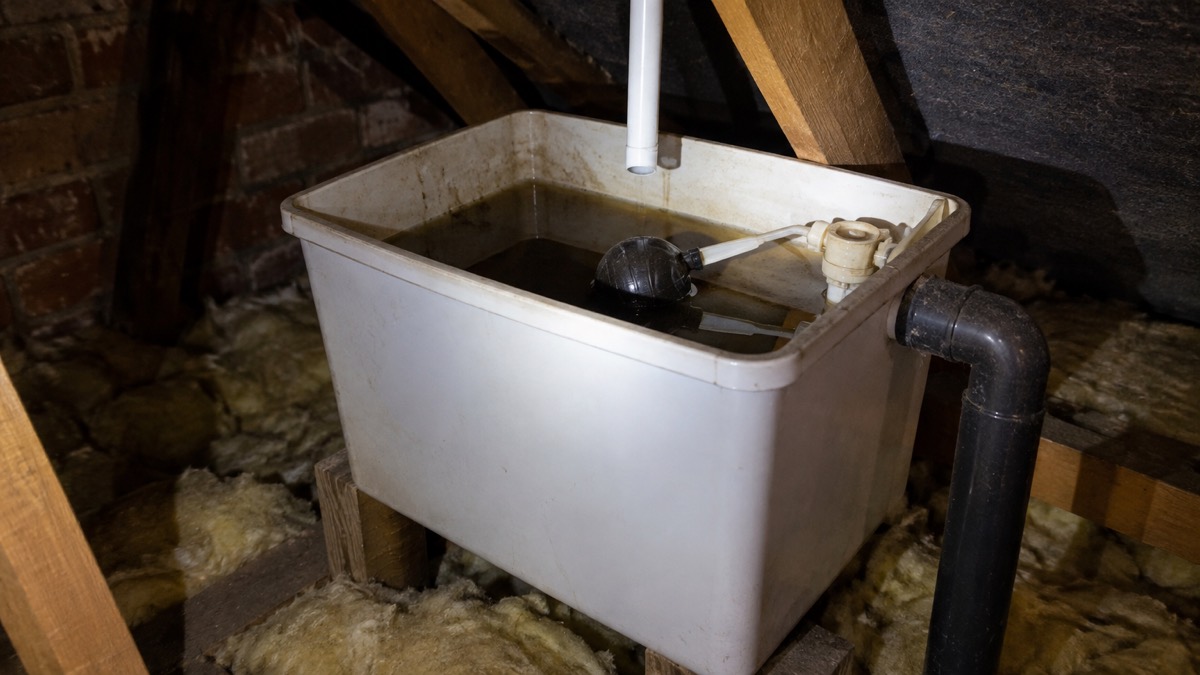
Distance is the main tool. Where a sewage or other discharge is within 50 metres of a private water supply, an environmental permit may be required to ensure protection of the supply4. But the 50 metre figure is a guide, not a guarantee: official case-study guidance on water safety plans notes that exclusion zones need to be tailored to the situation, and the generic 50m rule is only a general guide24. Slope, soil and the type of discharge all matter, so treat the distance as a prompt to look harder, not as an all-clear.
Rainwater itself needs managing at the source too. Divert rain water run off so it does not flow into your supply, for example with a small ditch leading away from it23. Runoff from ground surfaces picks up whatever is on them, and it is a different quality of water from what falls on your roof and passes through a filter.
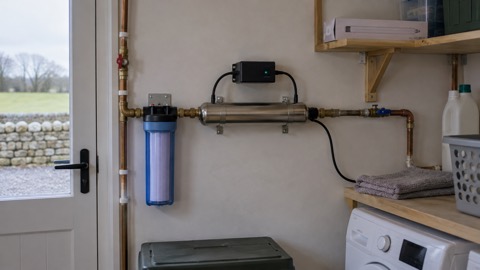
Once the water is in the system, maintenance carries the load. Households on private supplies in Cornwall are advised to protect water quality by ensuring source protection measures remain effective, livestock cannot contaminate water sources, treatment systems are operating correctly, and filters and UV treatment systems are serviced and maintained14. The same discipline applies to a rainwater system: the rainwater maintenance page sets out the yearly routine, and the rainwater filters page explains what the filter is doing for you.
The risks being managed are concrete. Private supplies can be affected by animal waste, fertiliser or pesticide runoff, high mineral levels such as iron or manganese, low or high pH, and changes in water colour10. None of these are exotic: they are the ordinary consequences of rural life happening around a water source, which is why the official advice is a set of ordinary habits rather than a one-off fix.
Where to get advice: your water supplier, WaterRegsUK and the local authority
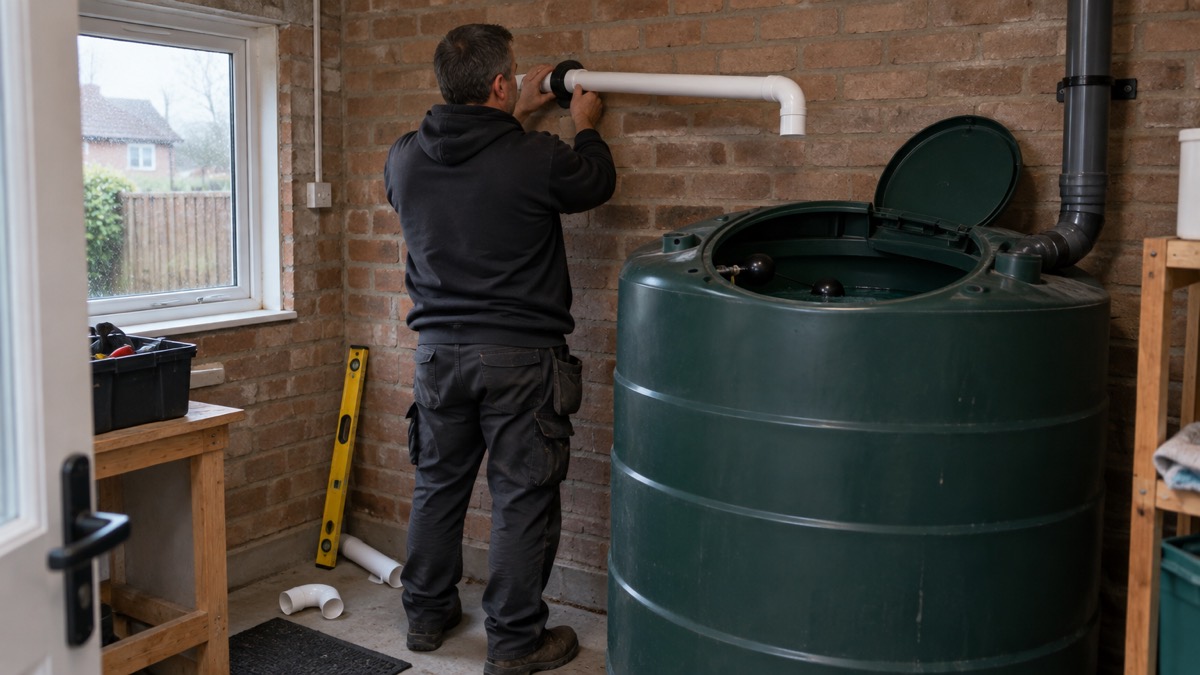
The right first call depends on which question you are asking. For anything about connecting to a nearby mains supply, contact your water company or local council for information9. For concerns about the quality of a private supply, contact your local authority, which carries the risk assessment and sampling duties described above9. For plumbing compliance questions, Water Regs UK is the body whose Approved Product logo identifies compliant materials2, and your water supplier enforces the fittings regulations in its area.
In Wales there is a further backstop. The local authority may be able to require water companies to assist where water supplies fail in domestic properties under certain conditions9. That is a Welsh provision, and it is one of the places the nations genuinely differ, alongside the stricter treatment of tenancy supplies in Wales noted earlier16.
Health questions go to the health bodies. Where lead is found in a private supply, the local authority should seek health advice from the UK Health Security Agency or Public Health Wales, as applicable, as part of its investigation16. Households do not contact those bodies directly in the first instance, but it is worth knowing who is in the chain when a supply fails.
*A water safety plan approach written out as a household checklist: source, storage, treatment and maintenance.
If your area faces drought measures, the same channels carry the news. Water companies implement temporary use bans under section 76 of the Water Industry Act 1991 as amended20, and breaking the rules of a ban can mean a fine of up to £1,00019. During any loss of water or sewerage services, follow advice from the water company, keep bottled water available, check your water supplier's website for information and updates, follow the instructions of the emergency services and your local authority, and make yourself known to your local authority if you are vulnerable or have additional needs for water25.
Local schemes can also help with the practical side. Maidstone Borough Council's rainwater harvesting campaign procured 555 free 210-litre water butts for eligible residents in priority neighbourhoods, working with a local retailer holding stock in-store21. The campaign's lessons for other councils included partnerships with local retailers to reduce costs and simplify distribution, and clear installation guidance for residents21. Ask your own council whether anything similar runs locally.
FAQ
Do I need permission for a water butt? No. Collecting rainwater from roofs is legal in the UK and is encouraged by councils and water companies1. A water butt used only in the garden involves no connection to your plumbing, so the Water Fittings Regulations, which govern new plumbing systems and alterations to them, are not engaged2. The rules bite when rainwater is plumbed into pipework that also carries mains drinking water.
Does my rainwater tank have to be underground? For garden use, above-ground tanks and water butts on downpipes are a normal way to collect and store rainwater15. If the rainwater is being used for domestic purposes within the home, the maker's guidance is that the tank has to be underground3. A gravity feed arrangement, where water is pumped to a covered holding tank and then gravity fed to the property, is one documented approach17.
Can harvested rainwater be made drinkable? Within a normal system, rainwater is classed as non-potable or non-drinking water by UK water regulations, and it cannot be used for applications where there is human contact, such as drinking, bathing and cooking3. That classification is the starting point, not a challenge to be engineered around. The is harvested rainwater safe to drink page covers the question in full.
What is the air gap on a mains top-up for? The top-up exists so that mains drinking water can keep a rainwater system running when the tank is low. The arrangement has to ensure tank water cannot flow back into the mains pipework, because a private supply connected to the mains must comply with the regulations. Delivering the top-up water into the tank, rather than joining the two pipe systems directly, is how that separation is achieved.
I am buying a house with a private supply. What should I check? Start with the type of supply and the local authority's knowledge of it. If a supply serves only a single dwelling, no risk assessment or testing is required unless the owner or occupier requests it, the dwelling is rented to tenants, or the local authority believes there is a risk to health15. The buying a house with a private water supply page takes the process step by step.
Who pays if a private supply fails? That depends on where you are and why it failed. In Wales, the local authority may be able to require water companies to assist where water supplies fail in domestic properties under certain conditions9. In Scotland, grants exist for improving private supplies, covered on the private water supply grant page. Ask your local authority what applies to your supply.
What is a water safety plan? A water safety plan is an approach to improving the safety of a water supply by assessing the whole system from source to tap. Official case-study guidance describes using the approach to improve the safety of a private supply, and notes that exclusion zones within it need to be tailored to the situation rather than relying on the generic 50m rule24. Local authorities apply the same thinking when risk assessing supplies in their area4.
Sources (25)
- Water butts and rainwater collection, Royal Horticultural Society
- Water storage tanks and cisterns, Drinking Water Inspectorate
- Rainwater harvesting FAQ, Rainwater Harvesting Ltd
- Protection of drinking water sources, Drinking Water Inspectorate
- Protecting your private water supply, Drinking Water Inspectorate
- Alternative supplies for private water supplies, Drinking Water Inspectorate, 2017-11
- Saving water FAQs, Cambridge Water
- Rain Director manual RD-150126, Rainwater Harvesting Ltd, 2026-01
- Drought planning and management, Natural Resources Wales
- Private water supplies, The Highland Council
- Private water supplies: a rapid scope of the literature, Public Health Wales, 2023-10-01
- Private water supplies, Drinking Water Quality Regulator for Scotland
- Private water supplies, Argyll and Bute Council
- Private water supplies, Cornwall Council
- Buying a dwelling with a private water supply, Drinking Water Inspectorate
- Lead in private water supplies, Drinking Water Inspectorate
- Faecal contamination of a supply, case study 2017/05, Drinking Water Inspectorate
- Oil storage regulations and safety, Department for Environment, Food and Rural Affairs
- Hosepipe bans: what they are and what they mean, Ofwat, 2022-08-12
- Drought: how it is managed in England, Department for Environment, Food and Rural Affairs
- Rainwater harvesting campaign, Maidstone, Local Government Association, 2026-03-19
- Rainwater Harvesting Filters for rainwater harvesting tanks- Enduramaxx, Enduramaxx
- Private water supplies, Scottish Borders Council
- Water safety plan approach to improving the safety of a private supply, case study 2013/19, Drinking Water Inspectorate
- Loss of essential services, Lancashire Resilience Forum
 Composting Toilet Kit Checklist
 Garden Harvesting Kit Checklist
 Rainwater Winter Checklist
 Above-Ground Rainwater Tanks
 Composting Toilets
 Direct vs Gravity Feed Systems
 Planning Permission for Systems
 Private Water Supply Running Low
 Private Water Supply Regulations
 Private Water Supplies Scotland
 Treating a Private Water Supply
 Rainwater Filter Types
 How Rainwater Harvesting Works
 Rainwater System Maintenance
 Pumps for Rainwater Tanks