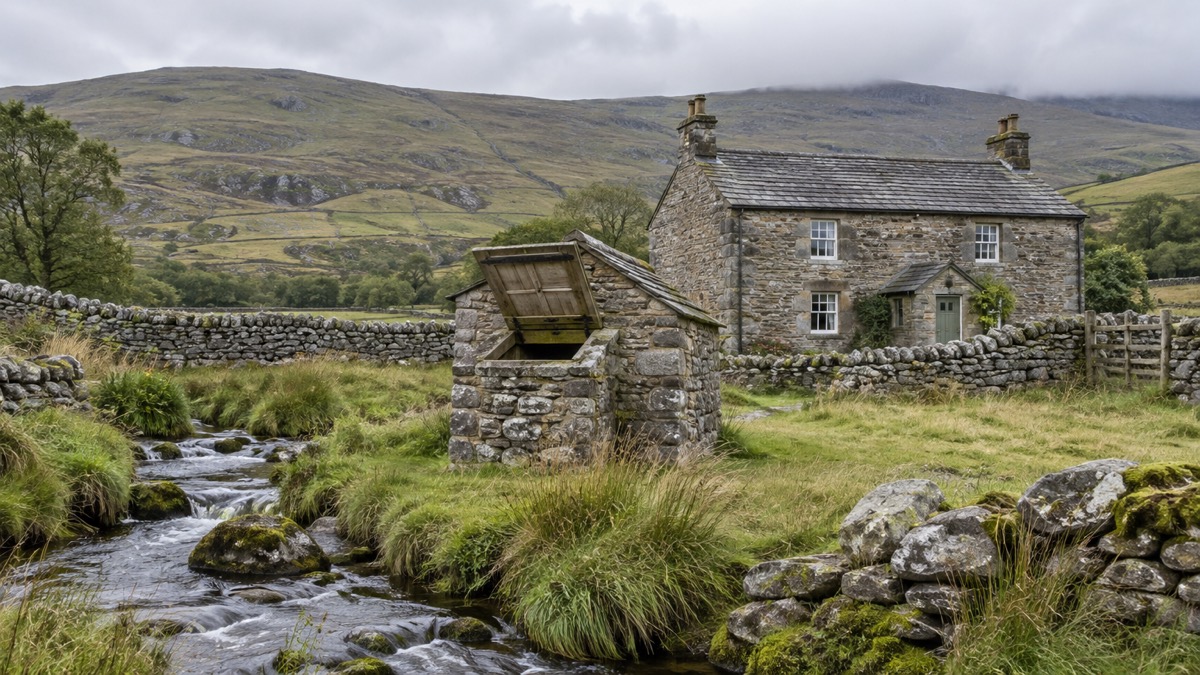
A private water supply is any water supply that is not provided by a water utility company1. It may come from a well, borehole, spring, stream, river, lake or pond, and it may serve one property or several1. Most are in remote, rural parts of the country1. If you are buying a house that relies on one, the water is your responsibility in a way that mains water never is, and the checks you make before exchange are the ones that decide whether the supply is safe and reliable.
The single most important thing to understand is that an owner-occupied home with its own supply sits outside the council's routine sampling. Local authorities must carry out sampling at all supplies except those which serve only one domestic property which is owner occupied2. The regulations do not require a risk assessment or testing for a single dwelling unless you request it, the dwelling is in Wales and rented to tenants, the dwelling is in England, rented to tenants and meets the criteria in the guidance on regulation 9, or the local authority believes there is a risk to health3. In other words, nobody will knock on the door to tell you the water is contaminated.
So the practical answer is this: ask the seller for any risk assessment, sampling results and treatment records; commission your own test through the council if none exist; walk the catchment to see what drains towards the source; and check whether the plumbing is direct or indirect. This page sets out what each of those means, what can go wrong, and who to contact in each nation.
What a private water supply is and where the water comes from
A private water supply is any water supply which is supplied to a property and does not originate from a mains supply or licensed water supplier6. The source can be a borehole, a natural spring or a watercourse6. In Wales the definition is drawn the same way: any water supply which is not provided by a water company, most of them in more remote, rural parts of the country, serving one property or several1.
That breadth matters when you are viewing a house. A borehole drilled into rock, a spring feeding a tank in a field, a stream diverted into a holding tank and a shared well serving a hamlet are all private supplies, and each behaves differently. Groundwater from a borehole is usually the most consistent. A spring or stream responds directly to rainfall and to what happens on the land above it.
Ask the seller four questions before anything else: where the source is, whether the supply serves only this property, what treatment is fitted, and whether there is a written record of any risk assessment or sample result. If the answer to the last is nothing, treat the supply as untested until you have had it tested yourself.
Where the property also has a mains connection, the picture changes. If both plumbing systems are directly or indirectly connected, then you and your plumbing system must comply with the Water Supply (Water Fittings) Regulations 19997. If the property has only a private supply and receives no clean water supply from Dŵr Cymru, those regulations do not apply7. For most buyers of a remote rural property, the second case is the one that applies, which is precisely why the burden lands on you.
Owner-occupied homes are not regulated, so the checks fall to you
The dividing line in private supply law is not between good and bad water. It is between a single owner-occupied dwelling and everything else. Other supplies, such as those for owner-occupied homes, are not regulated8. Consumers on private supplies that serve a single dwelling in isolation are not subject to mandatory risk assessments or testing for lead9.
That does not mean the council is uninterested. It means the trigger is different. The regulations do not require a risk assessment or testing unless requested by the owner or occupier, the dwelling is in Wales and rented to tenants, the dwelling is in England, rented to tenants and meets the criteria in the guidance on regulation 9, or the local authority believes there to be a risk to health3. You can therefore ask for one, and in practice that is what a careful buyer does.
| Situation | Risk assessment and testing required? | Who acts |
|---|---|---|
| Single dwelling, owner occupied, England | No, unless you request it or the council believes there is a risk to health3 | You, the owner |
| Single dwelling, owner occupied, Wales | No, unless you request it or the council believes there is a risk to health3 | You, the owner |
| Single dwelling rented to tenants, Wales | Yes3 | Local authority |
| Single dwelling rented to tenants, England, meeting regulation 9 criteria | Yes3 | Local authority |
| Two or more dwellings and/or other properties | Yes, every 5 years, plus regular testing3 | Local authority |
If you are buying, the practical step is to ask the council's environmental health department what records they hold for the address, and to commission a sample if there are none. Your local authority will provide advice on any testing and arrange for this to be carried out on your behalf10. In Northern Ireland, your local council will normally lift a sample, when asked, from a private water supply which serves a single private home11.
Risk assessment and testing: what the council does and when
Where the council does act, its duties are specific. Regulations place a duty on local authorities to carry out a risk assessment of each private water supply in their area, except supplies to single untenanted dwellings5. Any private water supply used for domestic purposes that supplies two or more dwellings and/or other properties must be assessed every 5 years, and regularly tested in accordance with the regulatory requirements by the local authority3.
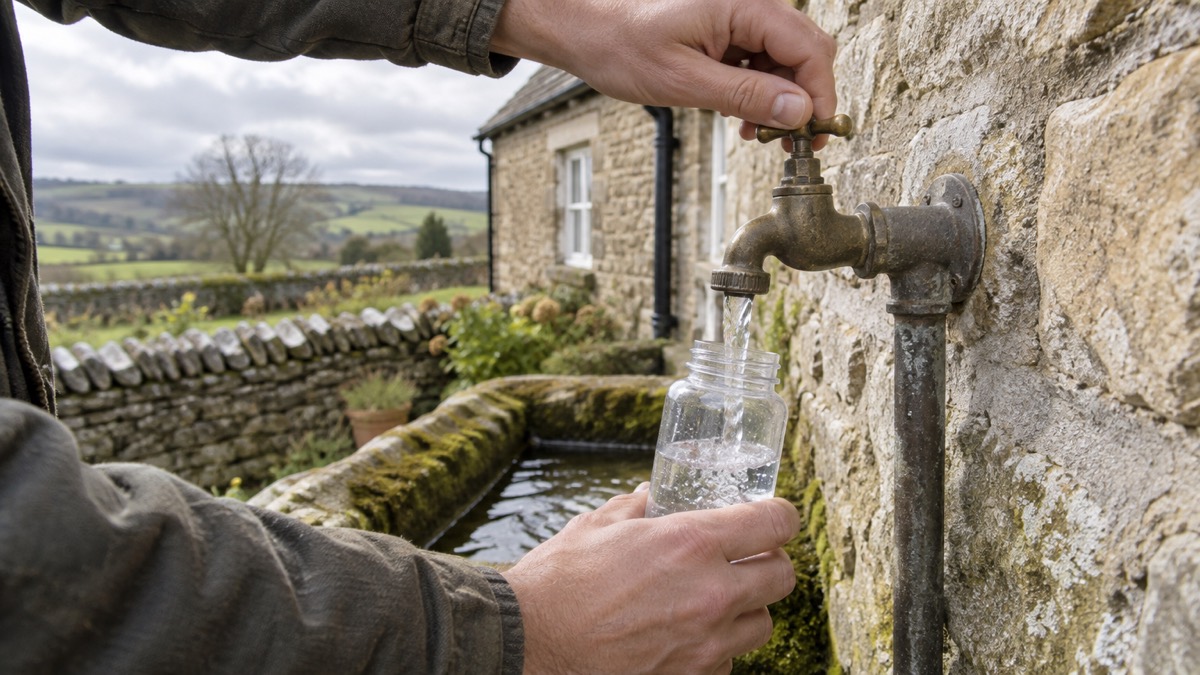
Some councils go further and offer the service commercially. In Argyll and Bute, the council can carry out a risk assessment of the supply and produce a report of Approved Improvement Works12. That report is useful to a buyer because it sets out what would need doing, and roughly in what order, before the water could be considered safe.
Testing is not a single test. Different parameters tell you different things, and the ones that matter depend on the source and the land around it. A laboratory analysis arranged through the council will normally cover the bacteriological and chemical risks relevant to your supply. If you want to understand what a result means and what to do about it, the council's environmental health team is the first call.
For a buyer, the sequence is straightforward:
- Ask the seller for any existing risk assessment, sample results and treatment servicing records.
- Ask the council whether it holds records for the address and what it would charge to assess or sample.
- If nothing exists, arrange a sample before exchange, not after.
- Read the result alongside the catchment walk described below, because a clean sample taken in a wet month is not the same as a clean sample in a dry one.
What can contaminate the supply
Private water supplies can pose a threat to health unless the water is properly protected and treated13. Contamination can be bacteriological in nature, from faecal matter such as human sewerage or animal droppings, or may arise from chemical sources, such as fertiliser or pesticide run-off from fields, deterioration of distribution pipework (for example lead, copper, nickel or zinc) or natural sources such as soils and rocks (for example iron, manganese, arsenic)13.
The recognised pollution sources around a supply are wider than most buyers expect. Other potential sources of pollution impacting private water supplies may include farming activities, spills from domestic heating oil tanks and discharges from septic tanks or soakaway systems5. Private supplies can also be affected by animal waste, fertiliser or pesticide runoff, high mineral levels such as iron or manganese, low or high pH, and changes in water colour8.
Two distances are worth remembering when you walk the land:
- Prevent storage or spreading of manure within 50 metres of the water source4.
- Where a sewage or other discharge is within 50 metres of a private water supply, an environmental permit may be required to ensure protection of the supply5.
Neither is a guarantee of safety, but both are a useful test of how the land is managed. If a slurry store, a fuel tank or a septic tank soakaway sits within that radius and uphill of the source, ask what has been done to protect the supply.
The record shows what happens when this is neglected. A risk assessment found a supply source contaminated with animal faeces and frogs, confirmed by failed microbiological samples, after the water turned brown following heavy rainfall14. In another case, a local authority risk assessment in March 2011 identified a risk of contamination from slurry spreading around the springs, and a 50 metre exclusion zone was created15. By August 2013 the supply owner had completed a water safety plan covering weekly checks, annual servicing, alternative supply arrangements and use of the diversion valves15. Contamination can be bacteriological, from faecal matter such as human sewerage or animal droppings, or chemical, from fertiliser or pesticide run-off, deterioration of distribution pipe work or natural sources such as soils and rocks16.
Direct or indirect system: checking the plumbing
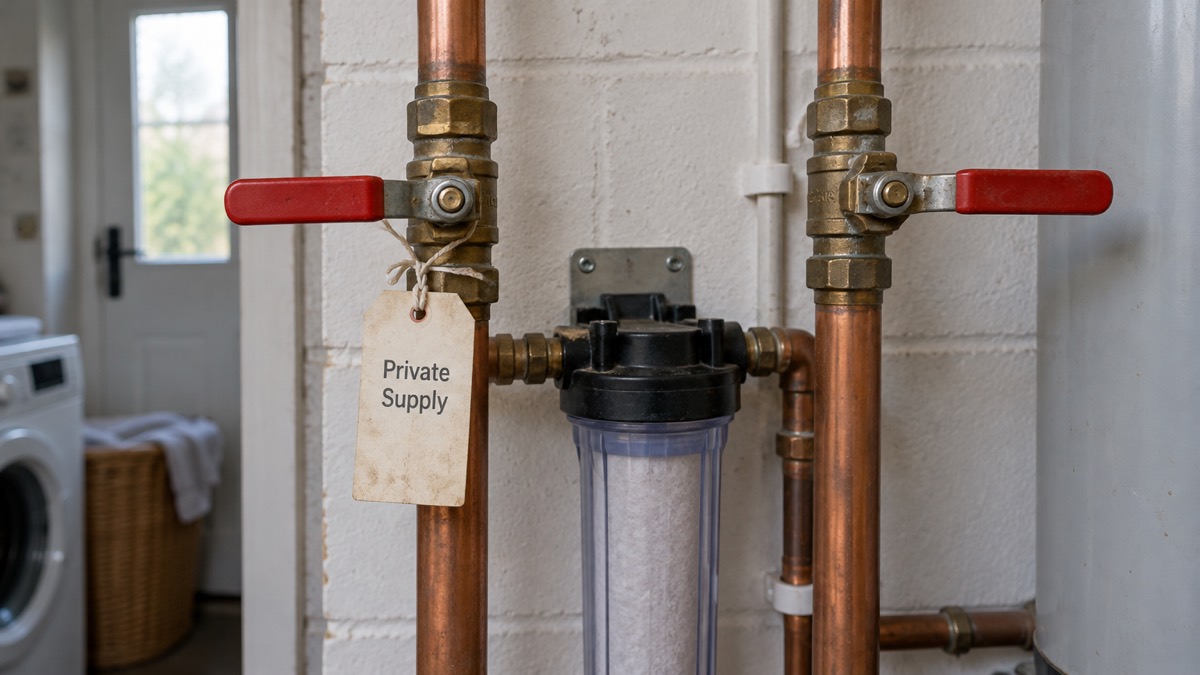
How the supply connects to the taps decides how much of your home is exposed if the water goes bad. A direct system is one where the drinking water system or plumbing is connected directly to the private supply, such as a kitchen tap fed straight from a well18. An indirect system is one where the private water is stored or pumped into a tank which then supplies part or all of the plumbing, and the tank may also be refilled with mains water18.
The distinction matters for three reasons. First, an indirect system with a storage tank gives you a buffer, so a pump failure or a short interruption does not immediately stop the taps. Second, a tank that can be refilled from the mains gives you a fallback, but only if the air gap is right. Third, a direct system puts untreated water at every outlet, so the treatment has to be right at the point of entry.
When you view the property, work through this checklist7:
- Whether the system is direct or indirect.
- Whether there is a direct connection between the two systems.
- Whether correct backflow protection is fitted.
- Whether both systems are labelled and easily identifiable.
- Whether tank refill complies with the correct air gap.
- Whether mains refill complies with the correct air gap.
- Whether drinking and non-drinking water points are clearly labelled.
If both plumbing systems are directly or indirectly connected, then you and your plumbing system must comply with the Water Supply (Water Fittings) Regulations 19997. That is a legal duty, not a recommendation, and it is the point at which a private supply stops being purely a private matter.
Treatment, where it exists, should be sized to the whole house. Any treatment should be point of entry, designed to treat all of the water entering the property19. A filter under the kitchen sink protects one tap; it does not protect the shower, the washing machine or a child brushing their teeth in the bathroom.
Drought and heavy rain: when a private supply becomes less reliable
A private supply that tests clean in April can fail in August. Houses with a private water supply may be more vulnerable to drought because private water supplies often rely on small water sources that can dry up quickly20. During prolonged dry weather, supplies can become unreliable and may also experience changes in water quality2. The water quality of private water supplies can decline during drought conditions and they can become contaminated when water levels are low, which could make someone who drinks that water unwell20.
The mechanism is not mysterious. When there is a lack of rainfall over a long period, groundwater levels can become exceptionally low and there may be impacts on private water supplies, with spring sources drying up or pumps running dry1. Insufficiency is becoming an ever increasing problem with private supplies, due to the impact of climate change16. It can arise from challenging weather conditions, for example drought or severe cold weather, or when the source dries up or freezes, from undetected leaks, pipe bursts, pump failure, inadequate supply arrangements and disconnection of pipework21.
Heavy rain brings the opposite problem. Flooding can overwhelm a spring head or a wellhead, and the official advice is blunt: check that the supply has not been affected by flooding before any usage22. If you are buying in a flood risk area, ask the seller whether the supply has ever been affected and what was done afterwards.
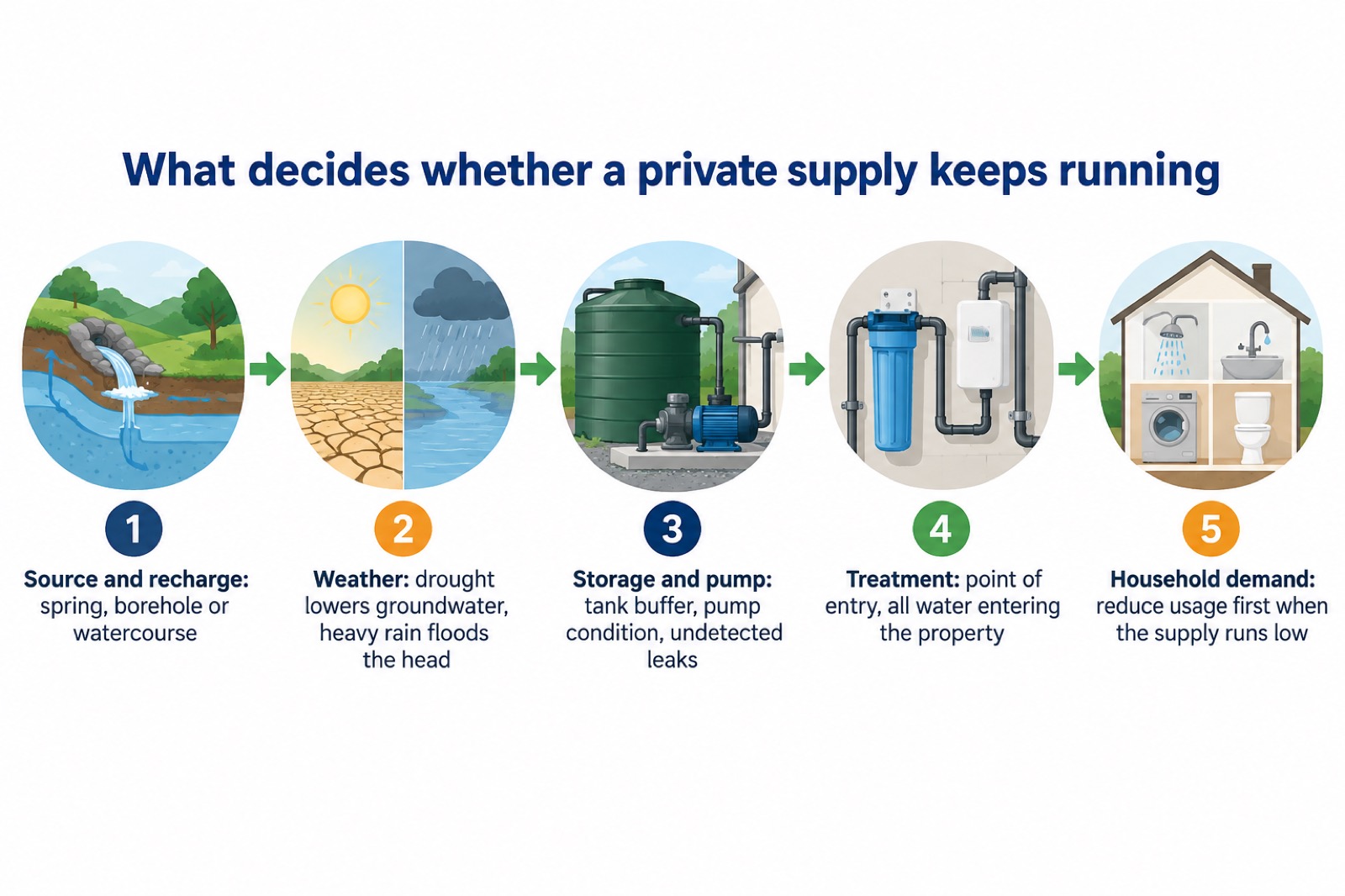
If the supply does run low, the first steps are likely to include reducing current usage to conserve the supply and considering where you could access drinking water should the supply stop19. Alternatives may include a neighbour on a different supply, connecting to an alternative source if available, or purchasing bottled water23. For a buyer, that list is a useful prompt: does the property have a neighbour on a different supply, and is there a realistic alternative source?
Grants, tenants and shared supplies
Three practical questions come up again and again once a buyer has decided the water itself is sound.
Grants. You may be entitled to a grant to help make improvements to your private water supply20. In Scotland, non means tested grant funding of up to £800 per property may be available to improve a private water supply, and applications can be made by owners, occupiers or landlords19. Further advice on the safe treatment of private water supplies and the Private Water Supply Grant Scheme may be obtained from the Environmental Health Department of your local authority24. Ask before you exchange, because the grant may affect what work you can afford in the first year.
Renting it out. Examples of commercial use include food businesses, holiday accommodation, visitor attractions, campsites, workplaces and rented homes8. Letting the house changes the regulatory position, because the council's duties attach to supplies used commercially. If you plan to let, budget for the testing and any improvement works the council requires.
Shared supplies. If you live in an older property, you may share a supply pipe with your neighbours25. A shared supply serving two or more dwellings must be risk assessed every 5 years and regularly tested3. Establish in writing who owns the source, who maintains the pump and treatment, and how costs are split. Scotland has run a private water supply connections pilot project, delivered with Scottish Water, Consumer Scotland and local councils, aimed at connecting properties to the mains where that is feasible12.
Where to get help
If you have a private supply, usually a well, borehole or spring, report any problems to your council's environmental health department26. Pollution incidents affecting a private water supply should be reported to the Environment Agency's national incident hotline on 0800 8070605. Sewer problems should be reported to your water company27.
In Northern Ireland, you should contact the Drinking Water Inspectorate (NI) or the environmental health department of your local council11. Your local council will normally lift a sample, when asked, from a private water supply which serves a single private home11. Anyone with any concerns in relation to their public drinking water supply should contact Waterline on 03457 44 00 88 or waterline@niwater.com28. NI Water provides information on supply issues and customer advice in Northern Ireland29.
The environmental health department of your local authority handles sampling and risk assessment where the supply serves more than one dwelling.
For the wider picture of how a household copes when water stops, see Water in an Emergency: A Household Guide and Private Water Supply Regulations: Risk Assessments, Testing and Who Is Responsible. If the supply is already failing, When a Private Water Supply Runs Low or Dry sets out the options, and Treating a Private Water Supply: UV, Filters and Spring Protection covers treatment. Buyers in Scotland should read Private Water Supplies in Scotland: Rules, Councils and Connecting to the Mains and The Private Water Supply Grant in Scotland: Who Can Apply and What It Covers.
Sources (29)
- Drought planning and management, Natural Resources Wales, 2026-10-29
- Private water supplies, Cornwall Council, 2026-10-29
- Buying a dwelling with a private water supply: what do I need to know?, Drinking Water Inspectorate, 2026-10-28
- Protecting your private water supply, Drinking Water Inspectorate, 2026-10-28
- Protection of drinking water sources, Drinking Water Inspectorate, 2026-11-04
- Private water supplies, Drinking Water Inspectorate, 2025-12-15
- Private water supplies and the Water Regulations, Dŵr Cymru, 2026-10-29
- Private water supplies, Highland Council, 2025-10-10
- Lead in private water supplies, Drinking Water Inspectorate, 2026-10-28
- Water testing, Drinking Water Inspectorate, 2025-12-09
- Dealing with drinking water problems, nidirect, 2026-10-06
- Private water supplies water sampling, Argyll and Bute Council, 2026
- Private water supplies, Argyll and Bute Council, 2026
- Private supplies require active management to ensure they are safe, Drinking Water Inspectorate, 2013/18
- Water safety plan approach to improving the safety of a private supply, Drinking Water Inspectorate, 2013-08
- Private water supplies, Somerset Council, 2026-08-12
- Flooding advice for properties using a private water supply, Shropshire Council, 2026-10-29
- Cyflenwadau Dŵr Preifat a’r Rheoliadau Dŵr | Dŵr Cymru Welsh Water
- Private water supplies, Scottish Borders Council, 2026-10-29
- How to stay safe during a drought, NHS Inform Scotland, 2026-05-12
- Managing insufficiency of private water supplies, Drinking Water Inspectorate, 2025-12-15
- Flooding, Drinking Water Inspectorate, 2026-10-28
- Loss of supply for private water supply users, Argyll and Bute Council, 2026
- pH Correction, dwqr.scot
- Pipe responsibility, South Staffs Water, 2026-10-28
- Check drinking water quality, GOV.UK, 2026-10-29
- During a flood, Nottinghamshire County Council, 2026-10-29
- Drinking water and blue green algae, DAERA Northern Ireland, 2025-08-27
- Water supply interruptions or outages, Prepare campaign, 2026-10-12
 Composting Toilet Kit Checklist
 Garden Harvesting Kit Checklist
 Rainwater Winter Checklist
 Composting Toilet Near Wells
 Flies in a Composting Toilet
 Composting Toilet Chamber Size
 Is Harvested Rainwater Safe
 Garden and Lawn Water Needs
 Grey Water Disposal Off Mains
 Rain and Grey Water in Garden
 Rainwater Pipe Types and Labels
 Private Water Supply Visitors
 Rainwater Systems in a Power Cut
 Does Stored Rainwater Stagnate
 Underground Tank Dig Depth