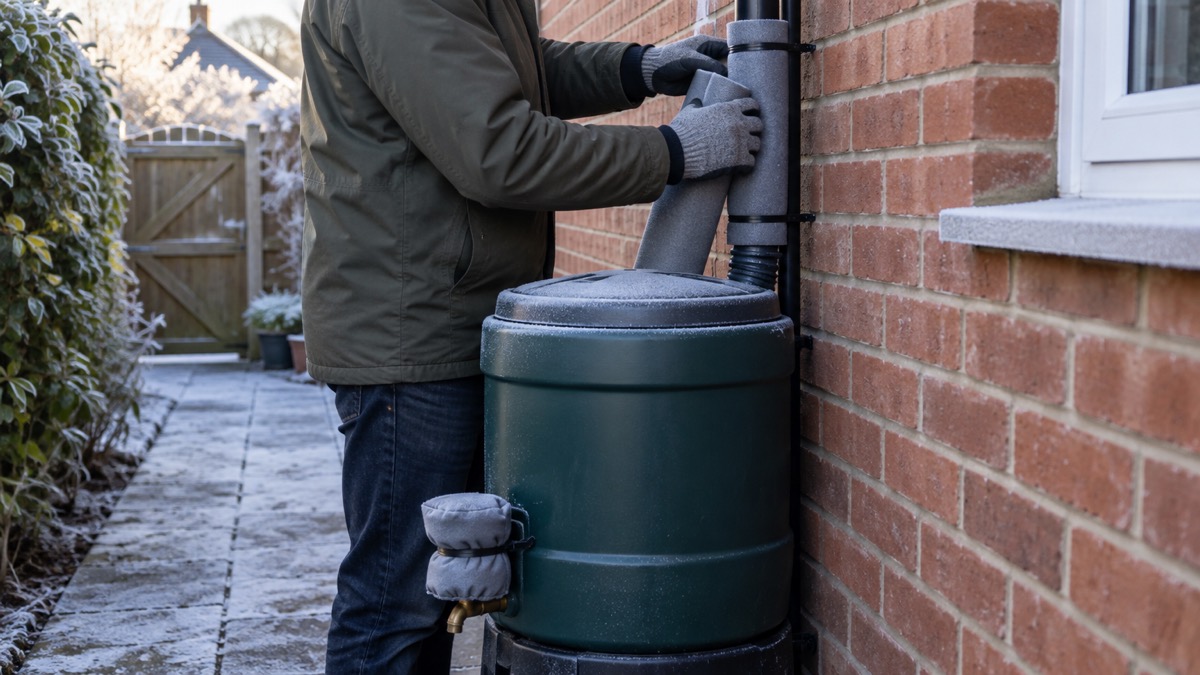
A water butt is a simple piece of household resilience, and winter is when it is most likely to be damaged. Frost can split a tank, ice can crack an outlet, and a full butt left standing through a cold snap can be ruined by the time you need it. The work to prevent that takes an afternoon.
The core of it is simple. Drain what you will not use, or keep the tank working and insulated, and protect the pipework and taps that feed it. One maker of a wall-mounted tank states plainly that it is recommended to empty the water in the tanks during the winter period1. Water companies and councils take the other side of the same coin: check for pipes, taps, cisterns, tanks and water meters in unheated areas and insulate them with lagging secured with cable ties2.
Then there is the water itself. Stored rainwater is for flushing toilets and watering plants, and official guidance is clear that you should not drink it because it could contain bacteria or disease3. Keep it covered, keep it moving, and it will still be there when the mains supply is not.
The winter checklist
Work through this before the first hard frost, then again after any storm that brings down branches or blocks a gutter.
Keep stored water clean: filters, dark storage and settled sediment
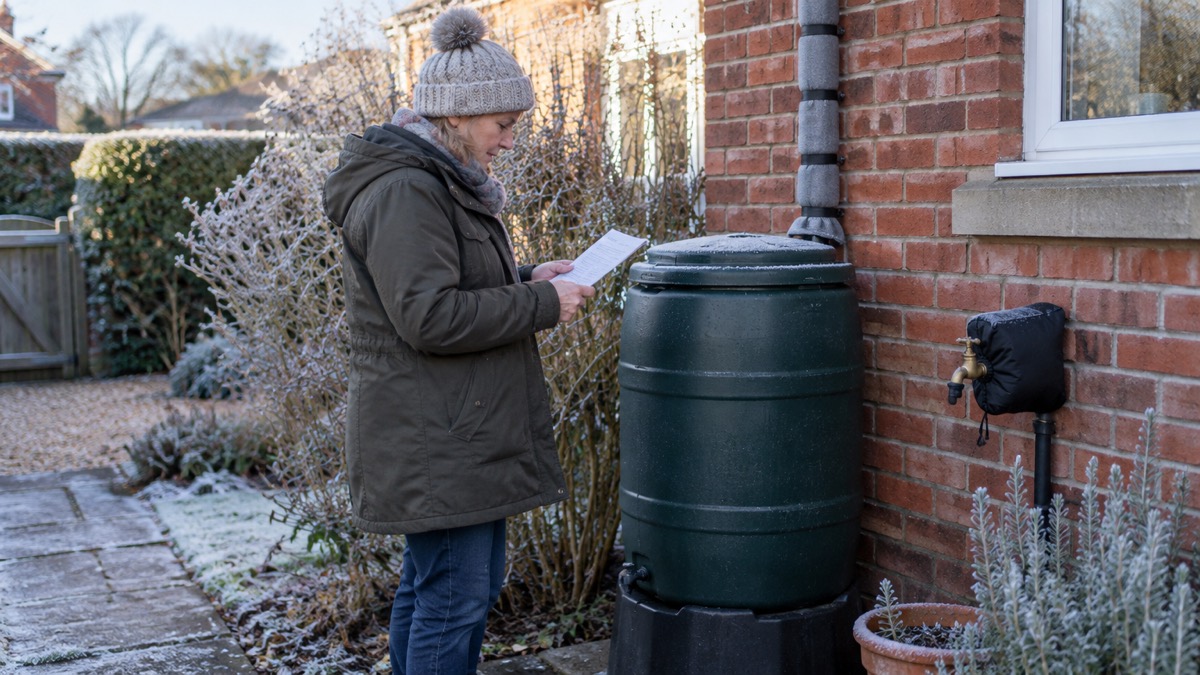
Water sitting in a tank does not stay fresh on its own. The Drinking Water Inspectorate lists the conditions under which water in a tank will deteriorate: there is no lid on the storage tank, the water becomes warm, too much water is stored and turnover is low, the tank is made from or lined with an unsuitable material, or work on the tank is carried out by an unqualified person7. Every one of those is something a household can control.
A secure lid is the first defence. Storage tanks should be closed with a secure lid to stop dust and debris falling in12, and treated water tanks should be designed, installed and maintained to prevent contaminants getting in through rain or snow9. If your butt has lost its lid, replace it before winter rather than after.
The second is the roof. Official guidance for rainwater harvesting systems is specific: remove or avoid the use of roof-mounted aerials or overhanging trees in the water collection area, discourage birds from perching on roof collection areas, and consider diverting the first flush of rainwater to waste9. A first-flush diverter throws away the dirtiest water from each rainfall, which is where much of the bird mess and leaf litter ends up. Our guide to rainwater filters sets out the downpipe, inline and in-tank types.
The third is inspection. Periodic visual checks should make sure there has not been a build-up of scale or deposits on the tank floor and that the lid and screens are securely in place7. If water from a tank tastes bitter or metallic, check what the tank is made from and what condition it is in13. And if you filter water for any purpose, do not leave filtered water standing in sunlight for too long11.
Stored rainwater keeps for weeks to months, so use it and refresh it
There is no single shelf life for water in a butt, because it depends on the tank, the lid, the temperature and how often you draw on it. What the guidance does give is a pattern: water deteriorates when turnover is low7, and keeping water usage to a minimum will prolong alternative sources of water such as water tanks14. In practice that means a butt that is drawn down and refilled by rain stays in better condition than one that sits full for months.
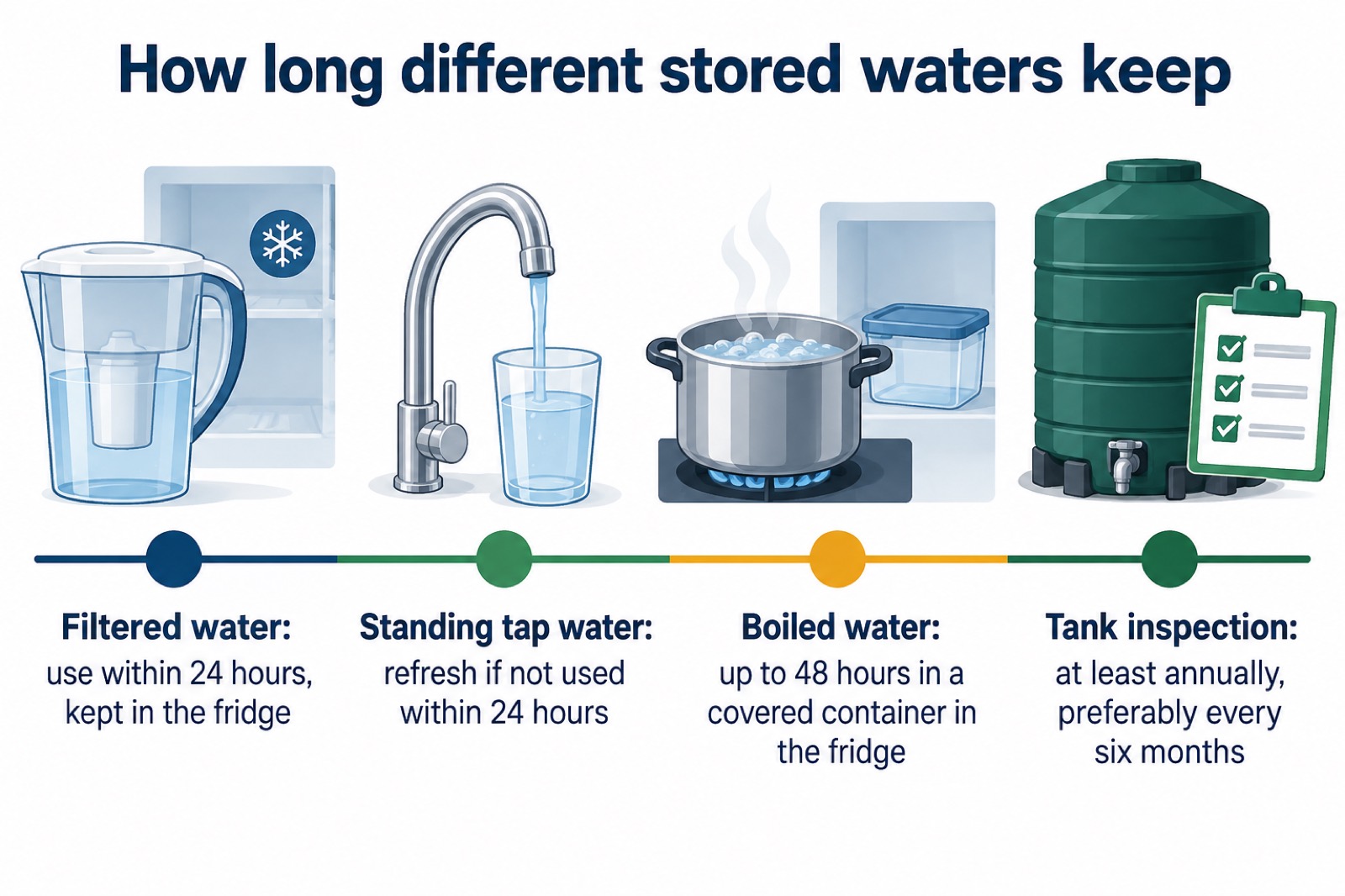
For water you intend to store deliberately, the figures are tighter. Filtered water should be stored in the fridge and used within 24 hours of filtering11. Water that has been boiled needs only to be brought to the boil, and can then be stored in a covered container in the fridge for up to 48 hours15. If tap water has been left standing, cover it with a lid or clean cloth, let it stand in the fridge for about an hour or until chilled, and refresh it if it has not been used within 24 hours12.
For tanks themselves, inspection should be regular: at least annually and preferably every six months8. If the tank stores drinking water, check annually for the condition of the tank and the quality of the water7.
Using a water butt during a supply interruption
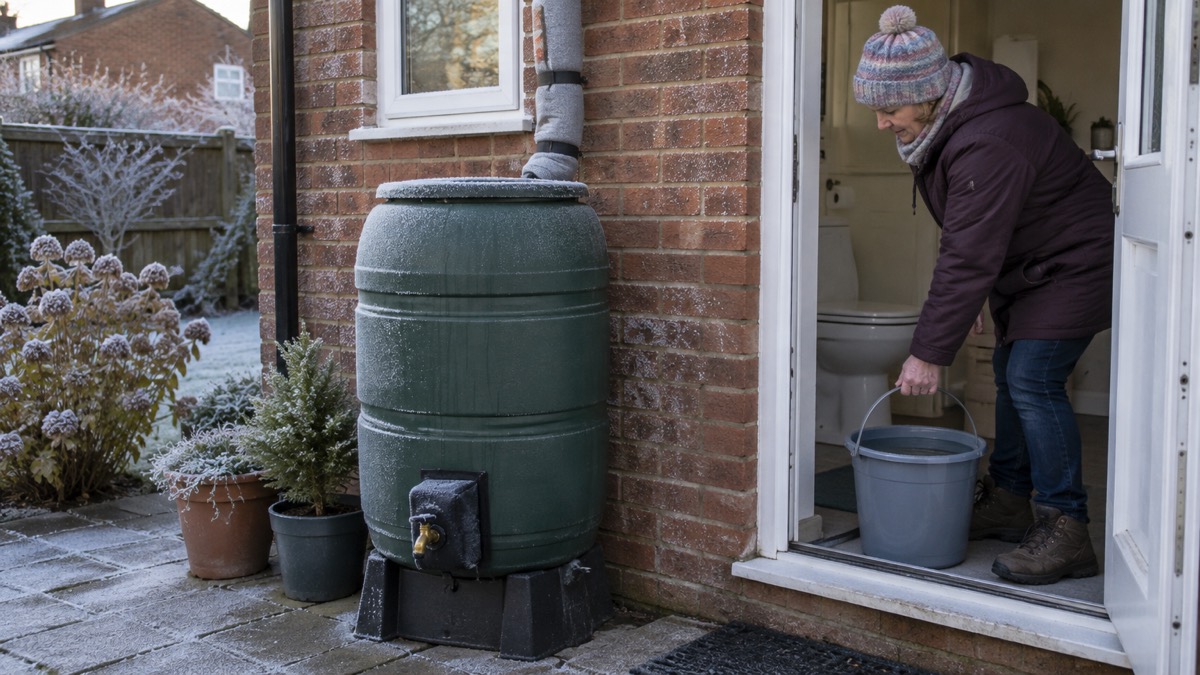
This is what the butt is for. When the mains stops, a full tank gives you a way to keep flushing the toilet and watering plants without touching your drinking water supply. Official guidance says rainwater can be used for flushing toilets or watering plants14, and a water company advises that during an incident you use your water butt or some of your stored water to flush the loo by filling a bucket and pouring it into the bowl16.
The same guidance is clear about priorities. Keep water usage to a minimum, because that prolongs alternative sources such as water tanks14. Some houses have a cold-water tank in the loft that allows some water for a short period in an outage, and that should be used only for critical purposes17. Store water in advance for cooking, drinking and pets, filling bottles or containers from the tap, ideally on the morning of a planned interruption16.
If you have a private water supply rather than mains, the picture is different and the stakes are higher. Do not rely solely on treatment systems during flooding; treatment systems will be under a lot of pressure, should be checked and serviced where applicable, and advice should be sought from your water engineer18.
| Situation | What the butt can do | What to do |
|---|---|---|
| Mains interruption | Flush toilets, water plants14 | Fill a bucket and pour into the bowl16 |
| Planned shutdown | Back up stored mains water | Store water the morning of the interruption16 |
| Frozen pipe, not burst | Cover toilet needs while mains is off6 | Store water before switching off6 |
| Private supply in flood | Not a substitute for treatment | Do not rely solely on treatment systems18 |
Rainwater is not safe to drink without treatment
This is the rule that matters most, and it does not change in winter. Official guidance states that rainwater can be used for flushing toilets or watering plants, but do not drink this water as it could contain bacteria or disease3. The same warning appears in the national water supply interruption guidance14.
The independent advice goes further. In the UK, treating rainwater to a high standard for bathing or drinking is not recommended, because of the expense and environmental impact of the equipment19. If you are not on mains water, collecting and treating rainwater is an option, but in the UK groundwater or a stream will usually be more reliable and need less treatment19. Households on a private supply have their own rules and responsibilities, covered in our guide to private water supply rules.
If you want to know more about what harvested rainwater can safely be used for, our guide to what harvested rainwater can be used for covers the full range, and is harvested rainwater safe to drink deals with treatment in detail.
Where to get help and further reading
If your mains supply fails or is interrupted, your water company is the first call, and their websites carry incident updates and advice on storing water in advance16. For private water supplies, your local authority environmental health team is responsible for risk assessments and advice, and in Scotland the council also administers the private water supply grant scheme.
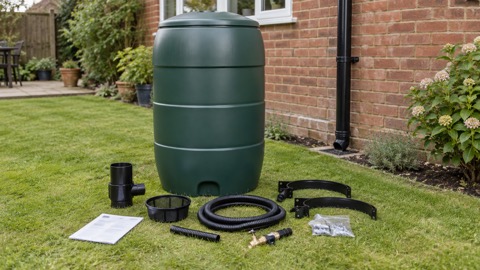
For the wider picture, our rainwater harvesting guide explains how a system works, water butts covers sizes, fittings and siting, and keeping a rainwater system clean takes the maintenance routine through the year. If you are preparing for a supply interruption more broadly, start with water in an emergency and the self-reliance section.
Sources (19)
- 2 x 250 Litre Multitank Rainwater Wall Tank, Rainwater Harvesting, 2026-10-01
- Get winter ready, Yorkshire Water, 2026-10-28
- Loss of essential services, Greater Manchester Combined Authority, 2026-10-29
- Are You Ready booklet, Culham Parish Council, 2025-09
- Winterproof your home, SES Water, 2026-10-28
- Snow and ice in Cornwall, Cornwall Council, 2025-10-01
- Water storage tanks and cisterns, Drinking Water Inspectorate, 2026-06-09
- Water storage, Drinking Water Inspectorate, 2025-11-05
- Protecting your private water supply, Drinking Water Inspectorate, 2026-10-28
- WeatherReady winter checklist, Met Office, 2026
- Water quality in the home, Dŵr Cymru, 2026-10-28
- My water looks, smells or tastes unusual, Southern Water, 2026-10-28
- Bitter or metallic taste, United Utilities, 2026-10-28
- Water supply interruptions or outages, Prepare campaign, 2026-10-12
- Private water supplies, Argyll and Bute Council, 2026
- Preparing for an incident, Bournemouth Water, 2026-10-28
- Failure of water infrastructure or loss of drinking water, Wiltshire and Swindon Prepared, 2026-10-25
- Flooding advice for properties using a private water supply, Shropshire Council, 2026-10-29
- Reducing water use, Centre for Alternative Technology, 2025-06-27
 Composting Toilet Kit Checklist
 Garden Harvesting Kit Checklist
 Hydroponic System Parts List