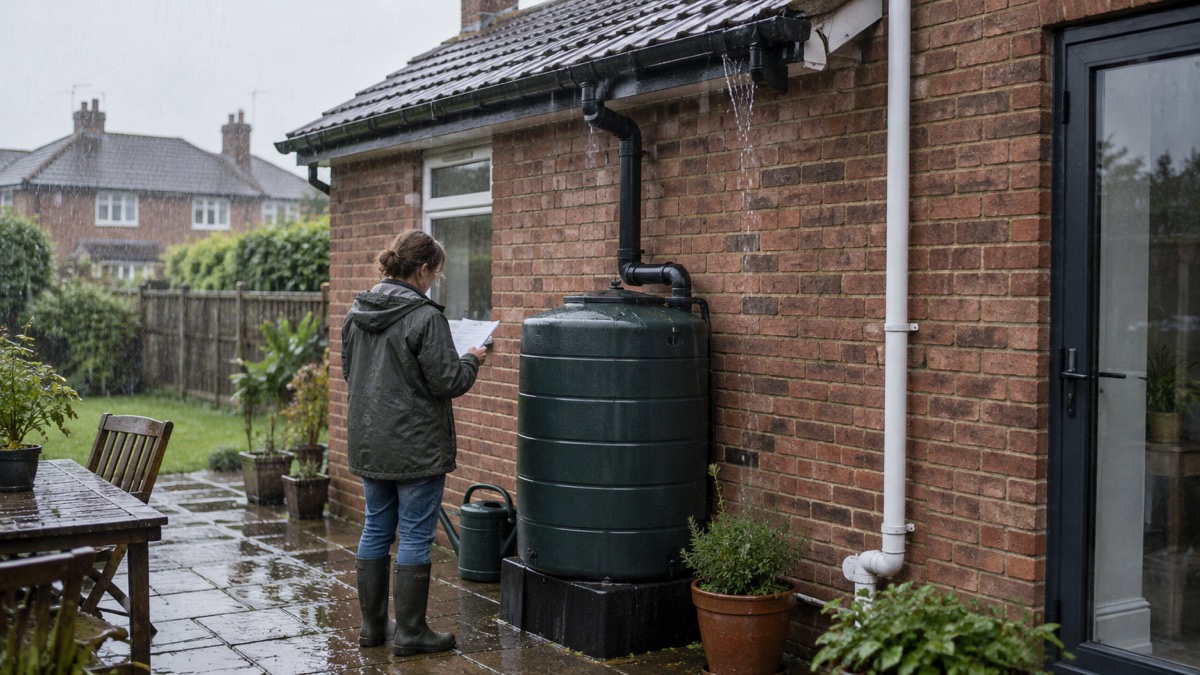
If you are putting in a rainwater system, the single rule that governs everything else is that rainwater must never be able to reach your drinking water. The Water Fittings Regulations exist to prevent the contamination and waste of water supplied by a water undertaker once it has entered your plumbing system1. Any premises with a mains supply, including a back-up supply, is covered by those regulations1. So the pipe you choose, the way you label it and the way a mains top-up is connected all matter, not just for the garden but for the safety of everyone in the house.
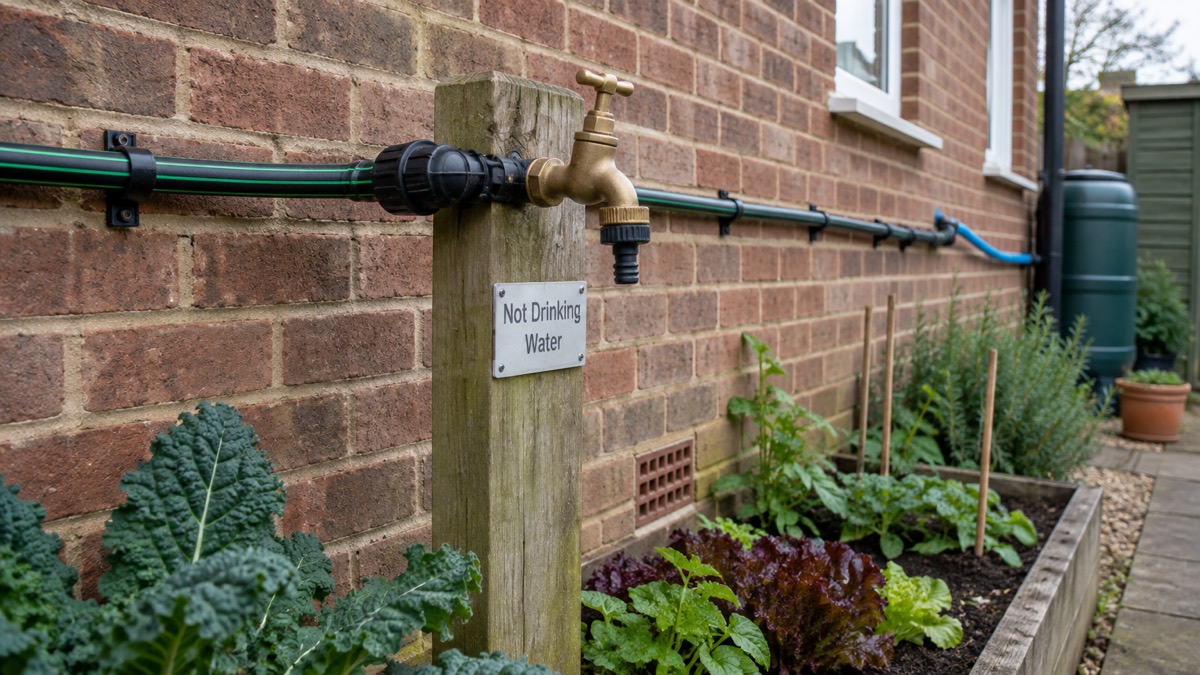
In practice that means three things. Use pipe that is recognisably for rainwater, which in most systems means black and green HDPE, the colour water companies recommend and in some cases require for piping rainwater from the tank to the point of use2. Label every outlet so nobody can mistake it for a drinking tap, because untreated rainwater is not for human consumption2. And if your system tops up from the mains, it must have an air gap so that rainwater cannot possibly flow back into the mains supply3.
Get those right and a rainwater system is a straightforward piece of household plumbing. Get them wrong and you have created a cross-connection between a tank of untreated water and the supply you drink from. This page sets out what the rules ask of an ordinary household, which materials suit a system, where rainwater can and cannot be used, and who to tell before and after the work.
Rainwater pipes must stay separate from the mains supply
The principle is simple: two supplies, two sets of pipe, no join between them. The Water Fittings Regulations exist to prevent the contamination and waste of water supplied by a water undertaker once it has entered a customer's plumbing system1. A rainwater system that shares pipework with the drinking supply defeats that purpose, because a drop in mains pressure can draw untreated water back into the pipe that feeds your kitchen tap.
Separation starts at the source. If you have a private water supply, official guidance is to divert rain water run off so it does not flow into your supply, for example with a small ditch leading away from it5. Treated water tanks should be designed, installed and maintained to prevent the ingress of contaminants through precipitation6. On a mains supply the same logic applies at the other end: keep rainwater out of the pipes you drink from.
Separation also means not letting the two systems share fittings by accident. Wessex Water advises householders to ensure that both hot and cold water pipes in the property are separated and insulated, and to drink water only directly from the mains supply7. That advice is about taste and smell, but the underlying point holds for rainwater: the drinking supply should be a clean, direct line from the mains, not something that has passed through or near a rainwater tank.
Where a property is served by a shared communication pipe, NI Water usually recommends that each property has a separate supply8. That is a different situation from rainwater, but it reinforces the same habit of thinking about which pipe serves what, and of not assuming that a pipe running into a building carries drinking water.
Which pipe materials suit a rainwater system
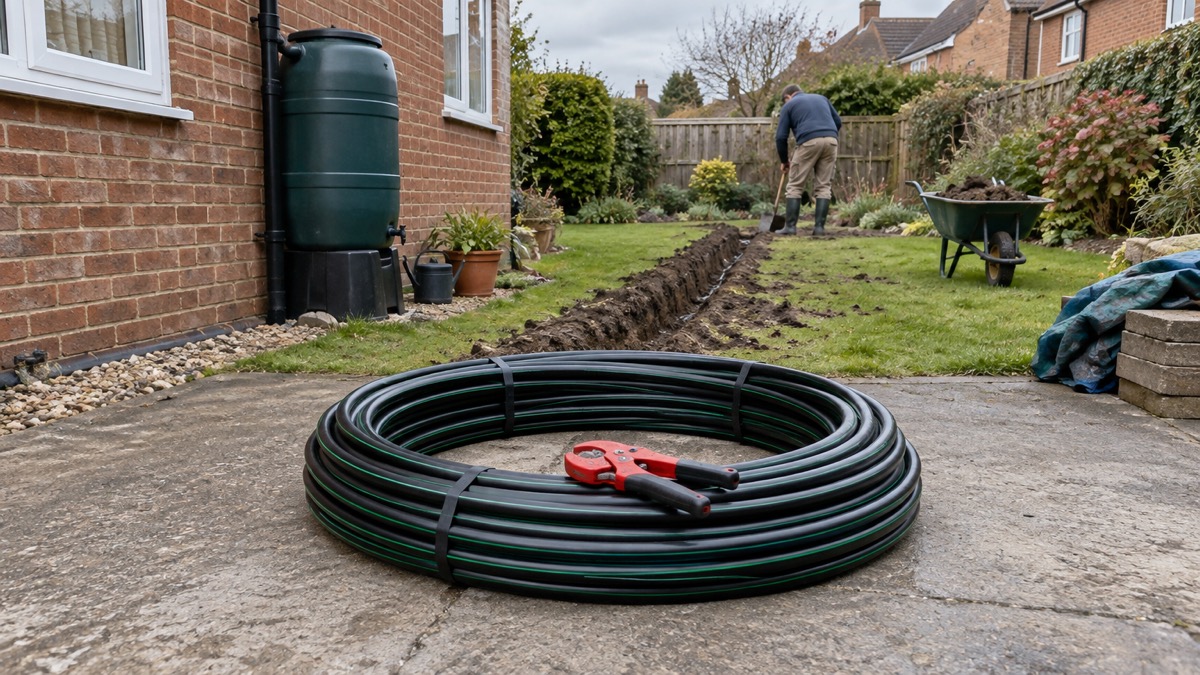
For the run from tank to point of use, the material most associated with rainwater in the UK is high density polyethylene, usually shortened to HDPE. The maker of one rainwater pipe describes HDPE as perfectly suited for the distribution of fluids, and states that the use of its black and green HDPE rainwater pipe is obligatory for use in rainwater systems under the Water Regulations9. That is the maker's own statement about its own product, so treat the word "obligatory" as the maker's characterisation; what is clear from several sources is that black and green HDPE is the expected choice, with water companies recommending and in some cases requiring it for piping rainwater from the tank to the point of use10.
The colour is the point. The pipe is colour coded so that there can be no possibility of rainwater being used where purified tap water is required9. Water companies are recommending, and in some cases requiring, that black and green HDPE pipe is used for piping rainwater from the tank to the point of use2. Using the same colour for the whole run, from tank outlet to garden tap, means anyone working on the plumbing later can see what they are dealing with.
HDPE has practical advantages for a garden run. The maker lists it as corrosion resistant with a zero leak rate, hydraulically smooth, fatigue and surge resistant, scratch tolerant, chemically resistant but non-toxic and non-tasting, lightweight, flexible and coilable, strong and ductile, and recyclable9. Those properties matter underground and outdoors, where pipe may be buried, moved or exposed to weather.
Not every part of a system has to be HDPE, though. The Rain Director manual states that either plastic or copper pipe may be used11. That is the maker's instruction for its own product, and it is useful where a short internal connection is needed. The safe approach is to follow the maker's manual for the tank and controls, and to use black and green HDPE for the rainwater distribution run so the pipe is identifiable wherever it goes.
| Pipe | Where it suits | What to know |
|---|---|---|
| Black and green HDPE | The run from tank to point of use, indoors or out | Recommended, and in some cases required, by water companies for rainwater2; colour coded so rainwater cannot be mistaken for tap water9 |
| Plastic or copper | Internal connections specified by the system maker | The Rain Director manual states either plastic or copper pipe may be used11 |
Labelling rainwater pipes and taps as not for drinking
A label is the last line of defence. Untreated rainwater is not for human consumption, and the point of use should be clearly labelled to show that rain water is the source2. The same warning appears across the maker's system pages: untreated rainwater is not for human consumption, black and green HDPE is recommended or required, and the point of use should be clearly labelled2. Three separate instructions, and the labelling is as consistent as the pipe colour.
Label at the point of use first. That is the tap, the hose connector or the outlet where someone fills a can, because that is where a person makes the decision about what the water is for. A sign reading "rainwater, not for drinking" at the tap does more than a label on a tank in the garden, though labelling both is better.
Then label along the run where it could be confused. If rainwater pipe passes through a shed, a garage or a utility room alongside other services, a label at each end and at any junction makes the separation visible to anyone who later works on the plumbing. This matters most in a house that changes hands: a new owner should be able to see at a glance which pipe is which.
Keep the labels durable. A paper sign will not survive a winter outdoors, so use a proper pipe marker or an engraved or printed sign fixed at the outlet. The point is not decoration but a permanent, legible warning that survives weather and time.
Where rainwater can and cannot be used in the home
Rainwater is a garden and utility resource, not a drinking supply. Official guidance is that water collected this way can be used for flushing toilets or watering plants, but should not be drunk as it could contain bacteria or disease12. That single sentence covers most household uses: toilets, plants, and by extension washing the car or cleaning outdoor surfaces, none of which involve drinking the water.
Hosepipe bans do not stop you using collected rainwater. Affinity Water confirms that you can water your garden using a watering can or water collected in a water butt, just not with a hosepipe or sprinkler13. Cambridge Water makes the same distinction for irrigation: a drip-fed system can continue to be used, but a system that is not drip-fed cannot be used when connected to mains water, though it may be used with grey water or rainwater recycling systems14. In other words, the restriction falls on mains water, not on the rain you have stored.
What a ban does stop is a long list of mains-fed uses. Affinity Water lists watering gardens, washing cars, cleaning windows and patios, filling swimming and paddling pools, and using jet washers, garden sprinklers and pressure washers as not allowed during a ban15. Thames Water adds that hoses and sprinklers cannot generally be used in parks, public gardens and other green spaces, with exemptions for health and safety and National Plant Collections16. Approved drip or trickle irrigation systems are allowed if fitted with a timer and pressure-reducing valve, not hand-held, delivering water directly to the soil and not spraying water into the air16.
There are narrow exemptions. South East Water notes that watering trees, whips, saplings and hedging planted before the ban, in the last planting year, where this cannot reasonably be done another way, is exempt17. Those are exceptions to a ban, not a licence to use a hosepipe generally.
Rainwater butts earn their place beyond drought, too. Westminster City Council advises householders to consider installing rainwater butts to reduce flood pressure on drainage systems and conserve water19. A butt that takes roof runoff before it reaches the drain does two jobs at once.
Air gaps and backflow protection on mains top-up
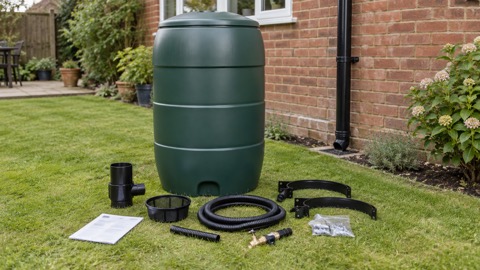
A rainwater tank that tops itself up from the mains is convenient, and it is also the point where a rainwater system comes closest to the drinking supply. The rule is absolute: UK Building Regulations require that rainwater cannot possibly flow back into the mains water supply, so all mains backup devices must have an air gap3. The air gap is the physical separation that makes backflow impossible, not merely unlikely.
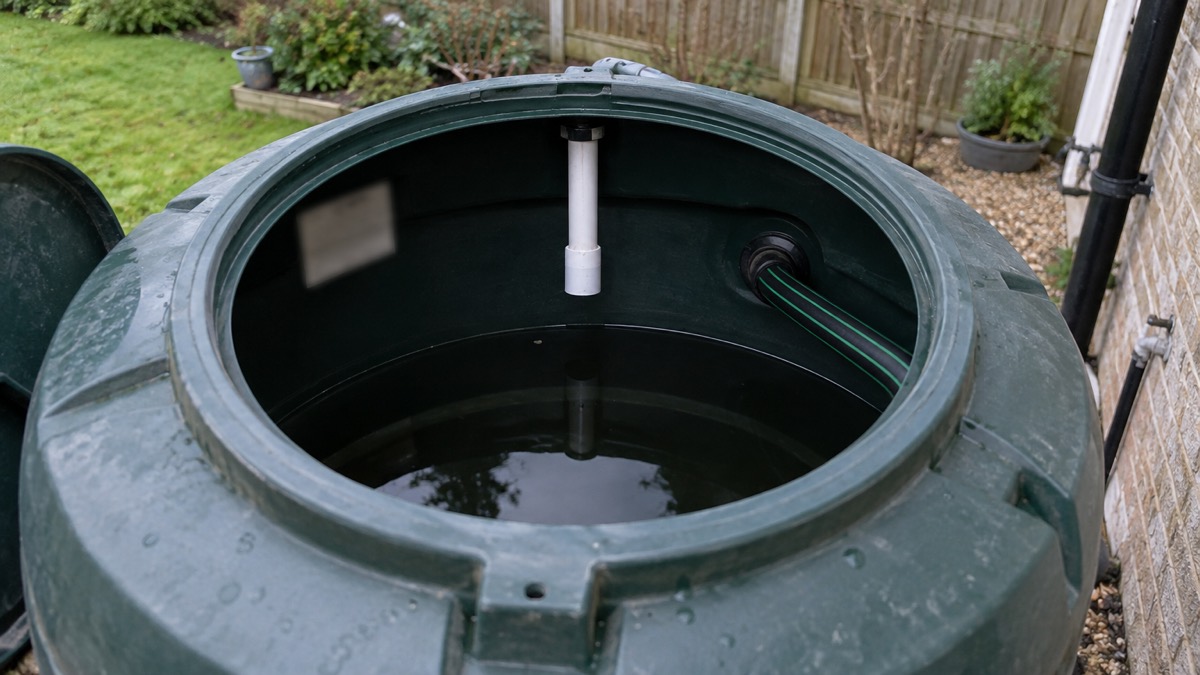
What an air gap looks like depends on the device. In one maker's Rain Backup in a Box, the air gap is an anti-splash tundish and overflow incorporated into one, a transparent clear moulded part3. Being able to see it matters, because it lets you check the gap is clear and working.
The design requirements for a Type AA or Type AB air gap are set out in independent guidance. There must be an unrestricted or weir spill over; the pipework supplying the mains water must be external to the tank; the mains water feed must discharge at a higher level than, and maintain a minimum clearance from, those supplying water from other sources; and the water in the tank should not come into contact with the mains water inlet, for example as a result of splashing1. The minimum clearance is twice the internal diameter of the supply pipework, or 20 mm, whichever is the greater1.
That 20 mm figure is the one to remember if you are checking an installation or asking a plumber about one. It is a minimum, and it is measured between the mains outlet and the highest water level the tank can reach, so a tank that overfills or splashes can defeat a gap that looked adequate when it was dry.
Getting a system checked and who to tell
Before work starts, find out whether it needs notifying. Certain changes to internal plumbing systems require prior notification to the local water company4. Under the water regulations, plumbers are required to notify the local water company about certain types of work carried out in homes and businesses20. If you are using a qualified plumber, ask them directly whether your job is notifiable; if you are doing the work yourself, check with your water company before you begin.
Use someone who can confirm the rules. WaterSafe advises that if you are planning to install a new bathroom or kitchen, you should make sure you know the plumbing law21. The same applies to a rainwater system with a mains top-up: the person installing it should be able to tell you what the regulations require and what has to be notified.
After the work, know who to call when something goes wrong. The Met Office advises having the name and telephone number of your nearest WaterSafe qualified plumber to hand, kept by the boiler or stop tap22. If a pipe bursts, contact a WaterSafe registered emergency plumber to fix the pipe and give you advice on preventing it from happening again23. Knowing where your outside stop tap is helps too: go to the boundary of your property and look for an 8-inch (20 cm) iron or plastic cover, which should be marked with a W, WM, or the word WATER24.
Some problems go to the water company rather than a plumber. Sewers should be reported to your water company25. If you are pumping flood water into public sewers, check with your water company first26. Water companies will also tell you if they are going to turn off your water23, which is worth knowing if your household depends on a stored supply.
If anyone in the household needs extra help, ask about the Priority Services Register. Water companies will tell you if they are going to turn off your water23. It is worth signing up before you need it, particularly in a household where someone relies on water for medical reasons.
Finally, keep the system maintainable. Approved materials, WRAS approved or permitted under regulation 5, should be used to prevent contamination of rainwater during runoff and collection6. Grey water installations must comply with the Water Supply (Water Fittings) Regulations 1999 and the Building Regulations, parts G and H27. Those are the standards a competent installer will already be working to, and asking about them is a fair way to check that the person quoting for your system knows the rules.
Sources (27)
- Alternative water supplies, Water Regs UK, 2026-11-04
- Carat 2700 Litre Rain Director System, Rainwater Harvesting Ltd, 2026-07-01
- Rain Backup in a Box SD, Rainwater Harvesting Ltd, 2026-07-01
- Water storage tanks and cisterns, Drinking Water Inspectorate, 2026-06-09
- Private water supplies, Scottish Borders Council, 2026-10-29
- Protecting your private water supply, Drinking Water Inspectorate, 2026-10-28
- Tastes and smells, Wessex Water, 2026-10-28
- Pipework Responsibilities - Northern Ireland Water, Northern Ireland Water
- Rainwater Pipe 25mm 50m, Rainwater Harvesting Ltd, 2026-10-15
- Carat 3750 Litre Rain Director System - Rainwater Harvesting, Rainwater Harvesting Ltd (rainwaterharvesting.co.uk)
- Rain Director manual, Rainwater Harvesting Ltd, 2026-01
- Loss of essential services, Greater Manchester Combined Authority, 2026-10-29
- Hosepipe ban FAQs, Affinity Water, 2026-10-29
- Temporary hosepipe ban FAQs, Cambridge Water, 2026-10-28
- Hosepipe ban, Affinity Water, 2026-10-28
- Hosepipe ban FAQs, Thames Water, 2026-10-28
- Temporary Use Ban, South East Water, 2026-10-29
- Hosepipes and hidden health risks, Met Office, 2026-10-29
- Plan and prepare for floods, Westminster City Council, 2026-09-03
- General plumbing advice, WaterSafe
- New home plumbing tips, WaterSafe, 2026-10-29
- Frozen or burst pipes, Met Office, 2026-10-26
- Priority Services Register, Surrey County Council, 2026-10-28
- Outside stop tap, Affinity Water, 2026-10-28
- During a flood, Nottinghamshire County Council, 2026-10-29
- Help during a flood, GOV.UK, 2026-10-25
- Saving water FAQs, Cambridge Water, 2026-10-28
 Composting Toilet Kit Checklist
 Garden Harvesting Kit Checklist
 Rainwater Winter Checklist
 Composting Toilet Near Wells
 Flies in a Composting Toilet
 Composting Toilet Chamber Size
 Is Harvested Rainwater Safe
 Garden and Lawn Water Needs
 Grey Water Disposal Off Mains
 Rain and Grey Water in Garden
 House With a Private Supply
 Private Water Supply Visitors
 Rainwater Systems in a Power Cut
 Does Stored Rainwater Stagnate
 Underground Tank Dig Depth