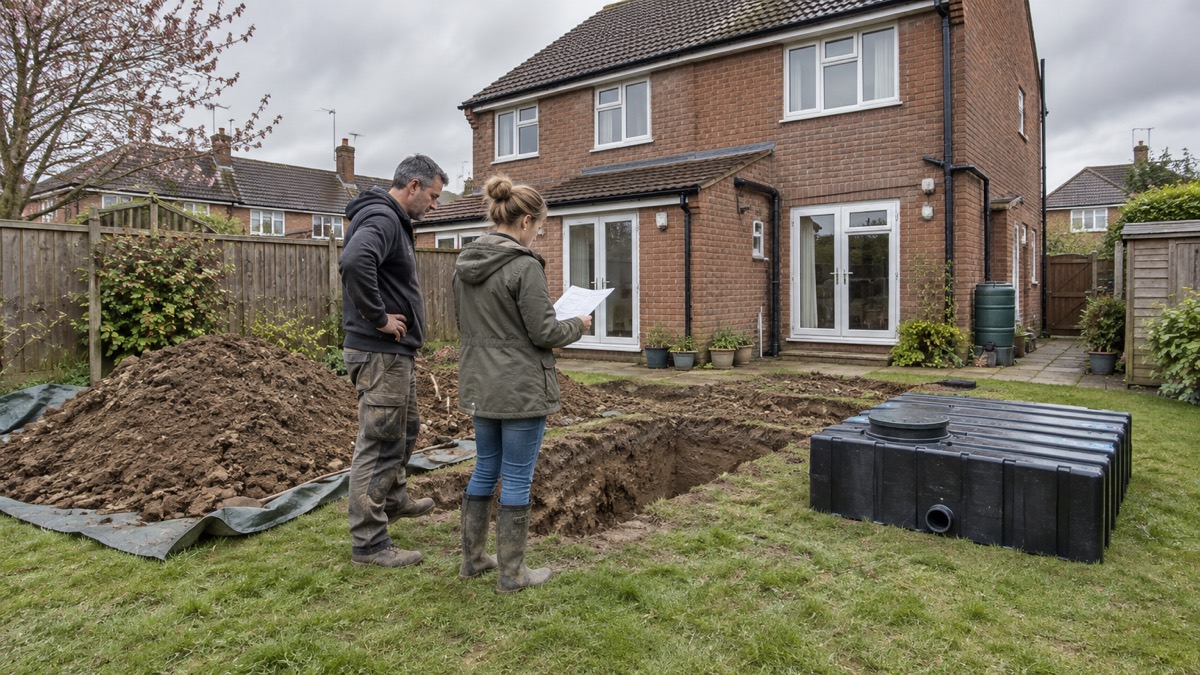
There is no single depth to dig for an underground rainwater tank. The hole is set by the tank you choose: its capacity, its shape and the maker's installation guide. Below ground tanks run from 180 litres to 10,000 litres in one maker's range1, and a garden system range runs from 1,500 litres to 15,000 litres2. A small tank needs a modest excavation; a large one needs a machine, a lifting plan and a properly prepared base.
The shape of the tank matters as much as the size. Flat "shallow dig" tanks are described by their maker as having an installation depth 60% less than other rainwater tanks, with excavation up to 70% less3. That is the single biggest lever on how deep you dig. Before you break ground, check the ground water: F-Line tanks can be installed in ground water up to the shoulder of the tank body, the maker states2.
This guide takes you through what decides the dig, how to match capacity to your household, what the maker's installation guide covers, and where to get help. It is for an ordinary UK household planning a garden or domestic rainwater system, not a contractor's manual.
Tank size decides the dig: below ground tanks run from 180 to 10,000 litres
The first thing that sets your hole is the tank's capacity. One maker lists underground rainwater tanks from 180 litres to 10,000 litres1. Another lists its underground garden tanks from 1,500 litres to 15,000 litres2. A 2,700 litre tank is sold as an underground storage tank for installation below ground to serve commercial or residential premises5. A 1,100 litre underground tank is also available6.
Capacity and footprint are not the same thing. A tall, narrow tank and a flat, wide tank can hold the same volume but need very different holes. That is why the maker's installation guide, not a rule of thumb, sets the depth.
The base under the tank is part of the dig, and it varies with size. One maker gives base depths of 102mm (4") for tanks up to 2,500 litres, 152mm (6") for tanks 4,000 to 10,000 litres, and 204mm (8") for tanks over 10,000 litres4. That base is a prepared layer, not loose soil, and it adds to the total depth you excavate.
| Tank size band | Base depth | What it suits |
|---|---|---|
| Up to 2,500 litres | 102mm (4")4 | A garden tap, a single downpipe, a modest plot |
| 4,000 to 10,000 litres | 152mm (6")4 | Larger garden systems, toilet flushing in some kits |
| Over 10,000 litres | 204mm (8")4 | Big garden or domestic systems, often multiple tanks |
Above ground tanks run from 150 litres to 30,000 litres1, so if your space or ground is difficult, an above ground tank is worth considering before you commit to a dig. The choice between the two is set out in Water Butt or Underground Tank?.
Matching tank capacity to your household's water needs
Before you decide how deep to dig, decide how much water you actually want to store. One maker's sizing advice is that how much rainwater storage you require depends on the roof area of the buildings, sheds or garage you are looking at, the amount of water you want to save, and the space and budget you have7. A tank size calculator asks for the approximate dimensions of your house in metres7.
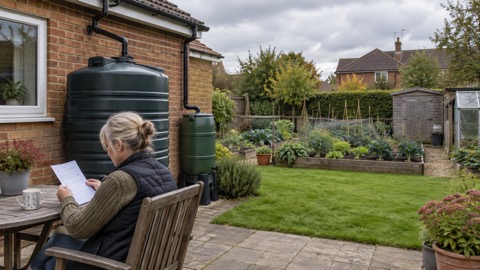
Underground tanks are not a standalone item. One maker states that underground rainwater harvesting tanks require a pump to work as part of a rainwater harvesting system1. So the tank, the pump and the pipework are a package, and the package decides the excavation.
Think about what the water is for:
- Garden only: a smaller tank and a garden pump. A 1,500 litre direct feed kit includes a 1500 litre underground tank, a pre fitted in tank filter, overflow and calmed inlet kit, a Hydroforce Series 4 submersible pump and the accessories to deliver clean rainwater to a garden tap and to flush toilets8.
- Garden and toilets: a direct feed system, which feeds appliances directly from a submersible pump9.
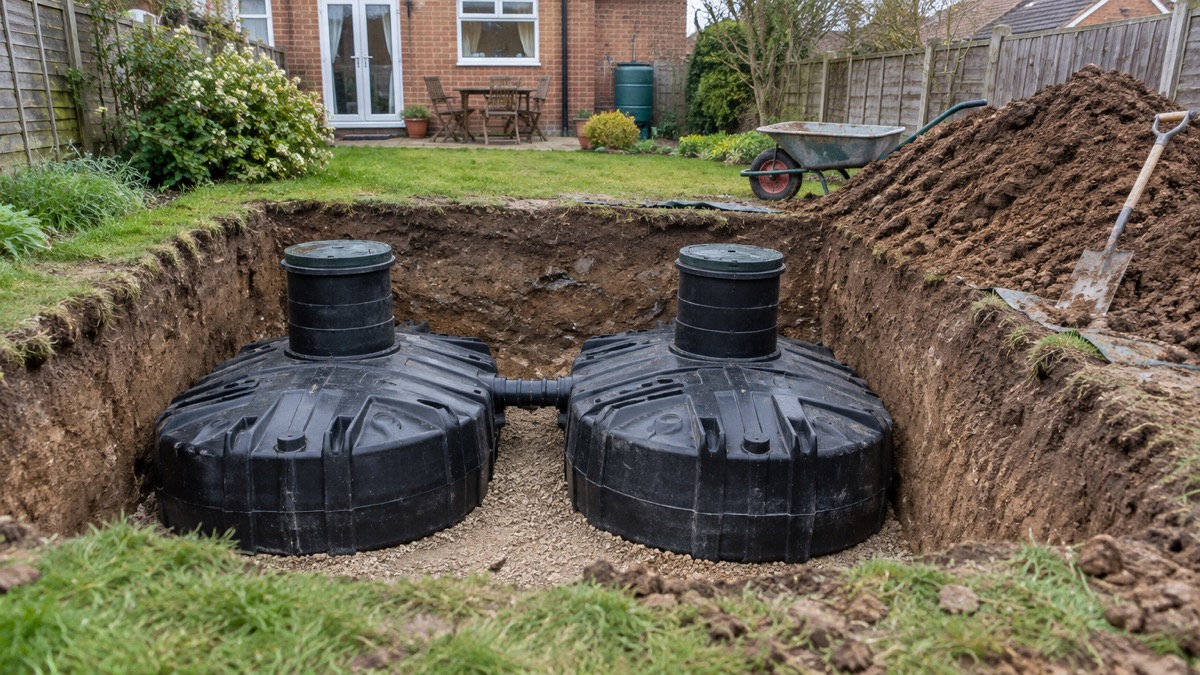
- Whole house garden system: larger tanks, often in multiples. A 15,000 litre garden kit includes 2 x 7500 litre shallow dig underground tanks, an inline filter and overflow kit3.
If you are unsure of the size, work through How to Size a Rainwater Tank: Roof Area, Rainfall and Demand before you dig. Getting the size wrong is expensive to fix once the hole is backfilled.
Larger garden systems: 1,500 to 15,000 litres
The garden system range is where most households land. A 3,000 litre garden kit includes a 3000 litre shallow dig underground tank, an inline filter and overflow kit, a Hydroforce Series 4 pump and accessories to deliver rainwater to a garden tap10. A 7,500 litre garden kit includes a 7500 litre shallow dig underground tank, an inline filter and overflow kit, a Hydroforce Series 4 pump and accessories to deliver clean rainwater to a garden tap11.
At the top of the range, a 15,000 litre garden kit uses two 7,500 litre shallow dig tanks rather than one huge one3. That is a practical point for digging: two smaller holes can be easier to manage than one very large excavation, and each tank is a size that can be handled.
| System | Capacity | What is in the kit |
|---|---|---|
| F-Line 1500 direct feed | 1,500 litres | Tank, in tank filter, overflow and calmed inlet, submersible pump, garden tap and toilet flush accessories8 |
| F-Line 3000 garden | 3,000 litres | Tank, inline filter and overflow, pump, garden tap accessories10 |
| F-Line 7500 garden | 7,500 litres | Tank, inline filter and overflow, pump, garden tap accessories11 |
| F-Line 15000 garden | 2 x 7,500 litres | Two shallow dig tanks, inline filter and overflow kit3 |
Larger systems also come in direct feed and gravity feed versions. A 5,000 litre direct feed kit includes a 5000 litre underground tank, a pre fitted in tank filter, overflow and calmed inlet kit, a Hydroforce Series 4 submersible pump and accessories12. A 5,000 litre gravity feed system uses a Rain Director to manage the supply13. The difference between the two is explained in Direct Feed and Gravity Feed Rainwater Systems Explained.
What the maker's installation guide tells you about depth
The maker's installation guide is the document that turns a tank size into a depth. The most useful thing it tells you is the shape of the tank. F-Line tanks are flat, and the maker states the installation depth is 60% less than other rainwater tanks14. For the 15,000 litre garden system, the maker adds that the excavation can be up to 70% less3.
That is a big difference in the hole you dig, and it is why the tank's shape matters as much as its capacity. A flat tank spreads the volume sideways rather than downwards.
The guide also covers ground water. F-Line tanks can be installed in ground water up to the shoulder of the tank body, the maker states15. That means a high water table is a design question, not an automatic stop, but it does need to be designed for.
Other installation details the guide covers include the filter. A 200m2 garden rainwater filter is for installation inside a rainwater tank16. A level sensor for a mains top-up device comes with a 110mm pipe clip that houses the sensor, fixed to a 110mm pipe in the tank17. These are small fittings, but they need to be planned into the tank position before backfill.
For the wider picture on tank types, see Underground Rainwater Tanks: Shallow Dig, Deep Dig and Flat Designs.
Digging by hand or with a machine
Whether you can dig by hand depends on the tank. A maker reports that its 1500 litre shallow dig tank has been located in the hole by two people with no lifting equipment2. That suggests a modest excavation for a small flat tank.
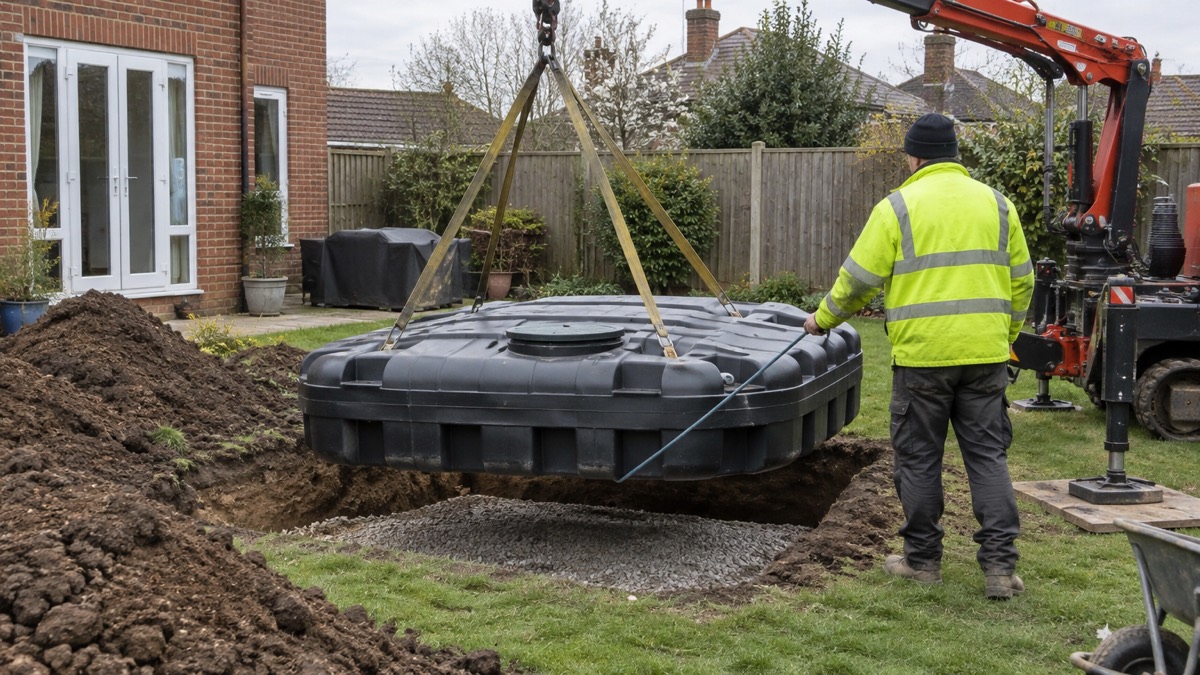
Larger tanks are a different job. A 7500 litre tank is delivered complete and requires hole cutting equipment for pipe connections, and lifting equipment is required on site at delivery18. Plan for a machine and a lifting plan for anything large.
A simple way to think about it:
- Small flat tank (around 1,500 litres): a two-person lift has been done, according to the maker2. Still plan the base and the pipe runs.
- Mid-size tank (3,000 to 7,500 litres): expect lifting equipment on site at delivery and hole cutting for pipe connections18.
- Large or multiple tanks: plan the excavation, the lifting and the pipe connections together, and ask the maker's technical desk before you start.
Checking ground conditions before digging
Ground conditions decide whether your planned depth is achievable. The key question is water. F-Line tanks can be installed in ground water up to the shoulder of the tank body, the maker states2, so a high water table needs to be designed for rather than ignored.
Check how the ground drains before you dig. Garden flood prevention advice includes checking that soakaways are working properly19. A soakaway that is not working tells you something about the ground you are about to excavate.
Flood risk is part of the picture. The national flood risk assessment for England bands flood depth as less than 30cm, between 30cm and 60cm, and greater than 60cm20. That is about flooding, not your tank, but it is a reminder that ground water and surface water are real forces in a UK garden.
After a flood, official guidance says that if you have wooden floors, check the space under the ground floor, as the dirty water in this space may need to be pumped out19. During a flood, official advice is to move vehicles to higher ground21. These are the kinds of ground and water conditions that should make you pause before digging.
If your ground is wet or the water table is high, ask the maker's technical help desk before you commit. The Rainwater System Winter Checklist is a useful companion for looking after the system once it is in.
Using stored rainwater in an emergency
An underground tank is a store of water that keeps working when the mains does not, for the uses it is plumbed for. A maker states that, due to the design of the filtration and calmed inlet, collected rainwater stored below ground will not stagnate or go off, because of the lack of light, the temperature and the movement of the water, even if you are not using it22.
That makes a below ground tank a more reliable store than a water butt left in the sun. But it is not drinking water. Keep mains water taps available alongside the rainwater outlet so you can switch to mains for garden use when the tank is empty, one maker advises23.
Some systems include a mains top-up. A Rain Backup in a Box puts about 250 litres of mains water into the underground tank when the water level runs dry15. Another description of the same device says it uses a level sensor in the tank to open a solenoid valve within the control unit to allow around 200L of mains water to enter the underground tank9. The two figures differ; the maker's pages give both, so treat the top-up volume as approximately 200 to 250 litres.
For what the water can safely be used for, see What Harvested Rainwater Can Be Used For in Your Home and Garden.
Where to get installation help and advice
The maker's technical help desk is the first place to ask about depth. One maker provides a full time, fully trained technical help desk to answer questions from the client, builders or plumbers before, during and after the install15. Use it before you dig, not after.
Ask specifically about:
- the installation depth and base for your model and ground;
- ground water and how the tank should be set if the water table is high;
- lifting and delivery arrangements for a large tank;
- the rainwater filters, calmed inlets and overflows the maker lists for rainwater applications24.
If you are fitting a system yourself, the maker's guide and the help desk are the documents that matter. For the wider rules on rainwater systems, including mains top-up, see Rainwater Systems and the Law: BS 8551, Water Fittings Rules and Mains Top-Up.
Know where your stop tap is before any work starts. Independent guidance says the internal stop tap is usually located in a kitchen cupboard, utility room or garage, under the stairs, or a downstairs bathroom or toilet25. If a pipe is disturbed during the dig, you will want to turn the water off quickly.
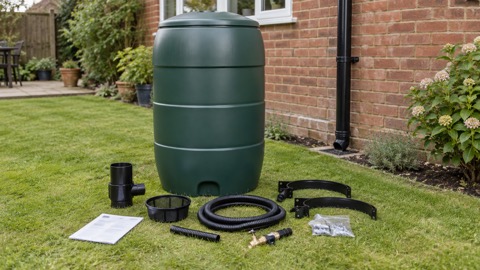
For the full picture on how a system works, start with Rainwater Harvesting at Home: How a System Works, and for the kit you will need alongside the tank, the Garden Rainwater Harvesting Kit Checklist sets it out.
Sources (25)
- Rainwater Harvesting Tanks, Enduramaxx, 2026-10-29
- Rain Activ Dual Garden System, Rainwater Harvesting Ltd, 2026-07-01
- F-Line 15000 Litre Garden System, Rainwater Harvesting Ltd, 2026-07-07
- Enduramaxx 30,000 Litre Rainwater Tank, Enduramaxx, 2026-09-28
- Graf Carat 2700 Litre Tank, Rainwater Harvesting Ltd, 2026-07-01
- Enduramaxx 1,100 Litre Underground Tank, Enduramaxx, 2026-09-28
- Tank Size Calculator, Rainwater Harvesting Ltd, 2026-08-12
- F-Line 1500 Litre Direct Feed System, Rainwater Harvesting Ltd, 2026-07-07
- Rainwater Harvesting Direct Feed Systems, Rainwater Harvesting Ltd, 2025-10-23
- F-Line 3000 Litre Garden System, Rainwater Harvesting Ltd, 2026-07-03
- F-Line 7500 Litre Garden System, Rainwater Harvesting Ltd, 2026-07-03
- F-Line 5000 Litre Direct Feed System, Rainwater Harvesting Ltd, 2026-07-07
- F-Line 5000 Litre Gravity Feed System, Rainwater Harvesting Ltd, 2026-07-07
- F-Line 1500 Litre Gravity Feed System, Rainwater Harvesting Ltd, 2026-07-07
- F-Line 15000 Litre Direct Feed System, Rainwater Harvesting Ltd, 2026-07-07
- Rainwater Harvesting Filters, Enduramaxx, 2026-10-29
- Rain Backup in a Box SD, Rainwater Harvesting Ltd, 2026-07-01
- Rainwater Tank 7500 litre, Rainwater Harvesting Ltd, 2026-03-24
- Flooding and Health: Safely Cleaning Your Home, Wiltshire and Swindon Prepared, 2026-10-25
- National Assessment of Flood and Coastal Erosion Risk in England 2024, GOV.UK, 2026-08-05
- During a Flood, Nottinghamshire County Council, 2026-10-29
- Rainwater Harvesting Garden Systems, Rainwater Harvesting Ltd, 2025-10-23
- 9250 Litre Rain Backup in a Box System, Rainwater Harvesting Ltd, 2026-03-24
- Enduramaxx 150 Litre Underground Tank, Enduramaxx, 2026-06-17
- Your stop tap | South East Water, South East Water
 Composting Toilet Kit Checklist
 Garden Harvesting Kit Checklist
 Rainwater Winter Checklist
 Composting Toilet Near Wells
 Flies in a Composting Toilet
 Composting Toilet Chamber Size
 Is Harvested Rainwater Safe
 Garden and Lawn Water Needs
 Grey Water Disposal Off Mains
 Rain and Grey Water in Garden
 House With a Private Supply
 Rainwater Pipe Types and Labels
 Private Water Supply Visitors
 Rainwater Systems in a Power Cut
 Does Stored Rainwater Stagnate