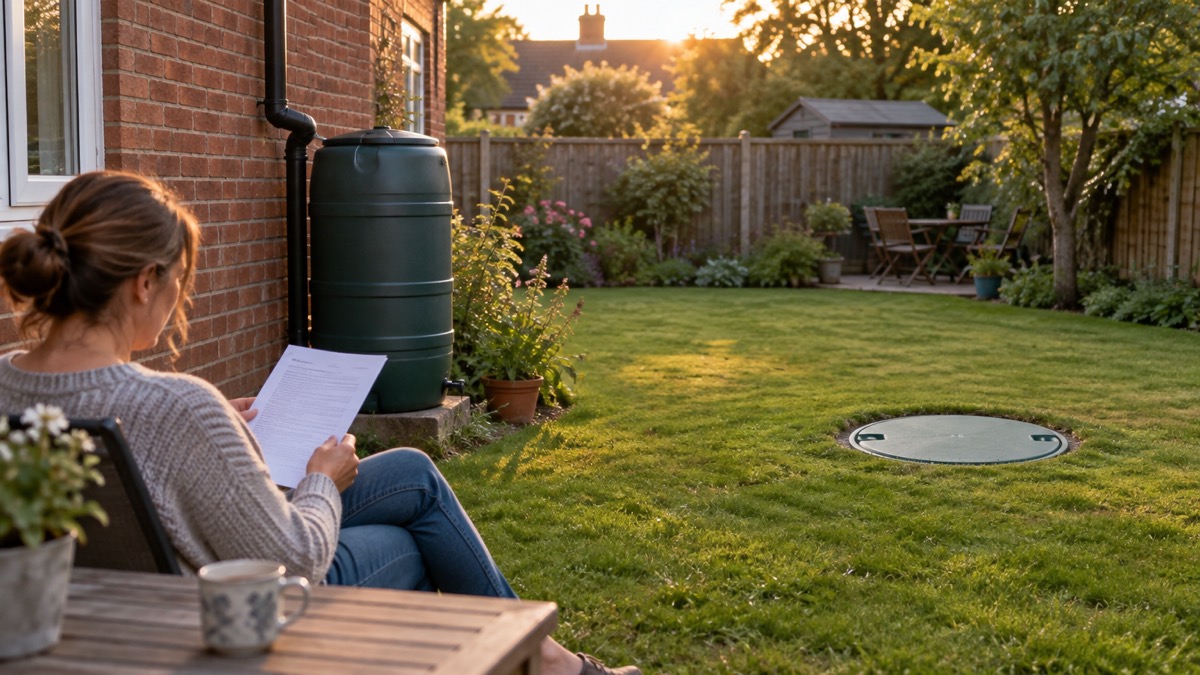
When the mains supply stops, the first thing most households miss is not drinking water but the ability to flush the toilet. A water butt solves that problem cheaply: water companies and public health bodies all point to stored rainwater as a way to keep the loo working during an interruption1. Wessex Water estimates that a water butt can save around 1,000 litres of water every year in ordinary use, so it earns its place in the garden as well as in an emergency1.
An underground tank does a different job. It stores far more water out of sight, which suits a household planning a bigger rainwater system, but it is a construction project rather than a weekend job. For most ordinary homes the question is not really which is better, but which one matches what you want the water to do.
This page sets out what each option gives you, how a butt fills from your roof, how to fit one to a downpipe, how long the water keeps, what gets into it, and where it must never be used. If you are starting from scratch, the water in an emergency guide covers the wider picture of storing and rationing water at home.
| Water butt | Underground tank | |
|---|---|---|
| Where it sits | Above ground, against a wall, fed by a downpipe11 | Below ground, out of sight; a storage tank can sit under a paved area and discharge slowly19 |
| What it suits | A garden, toilet flushing in an outage, reducing runoff1 | A household planning a larger rainwater system with more storage |
| Fitting | A diverter and a level base; a weekend job6 | A dig and construction project; check planning permission first |
| Maintenance | Lid, debris, occasional empty and clean13 | Inspection at least annually, preferably every six months7 |
| Emergency use | Flushing and watering5 | Same limits apply: not for drinking unless treated to drinking water standards |
A water butt keeps your toilet flushing when the mains stop
The single most useful thing a water butt does in an emergency is keep the toilet usable. Affinity Water tells customers that during an interruption "you won't be able to flush your toilet, but if you have a water butt, you could collect water from there to pour into your toilet"2. South West Water gives the same instruction in practical terms: fill a bucket from the butt and pour it into the bowl4. Public Health Wales lists garden water butts among the sources that can be used for flushing during a water shortage3.
This matters because a toilet that cannot be flushed quickly becomes the thing that makes a short outage feel like a crisis. A resident quoted in a council risk register put it simply: "Having a water butt with water that can be used for loo flushing is very helpful too"8.
There is a second, quieter benefit. Westminster City Council advises households to consider rainwater butts to reduce flood pressure on drainage systems and conserve water9, and Wessex Water lists installing a water butt among the ways to manage rainwater runoff and improve your home's drainage10. A butt that takes roof water out of the drain during heavy rain is doing two jobs at once.
What a water butt is and how it fills from your roof
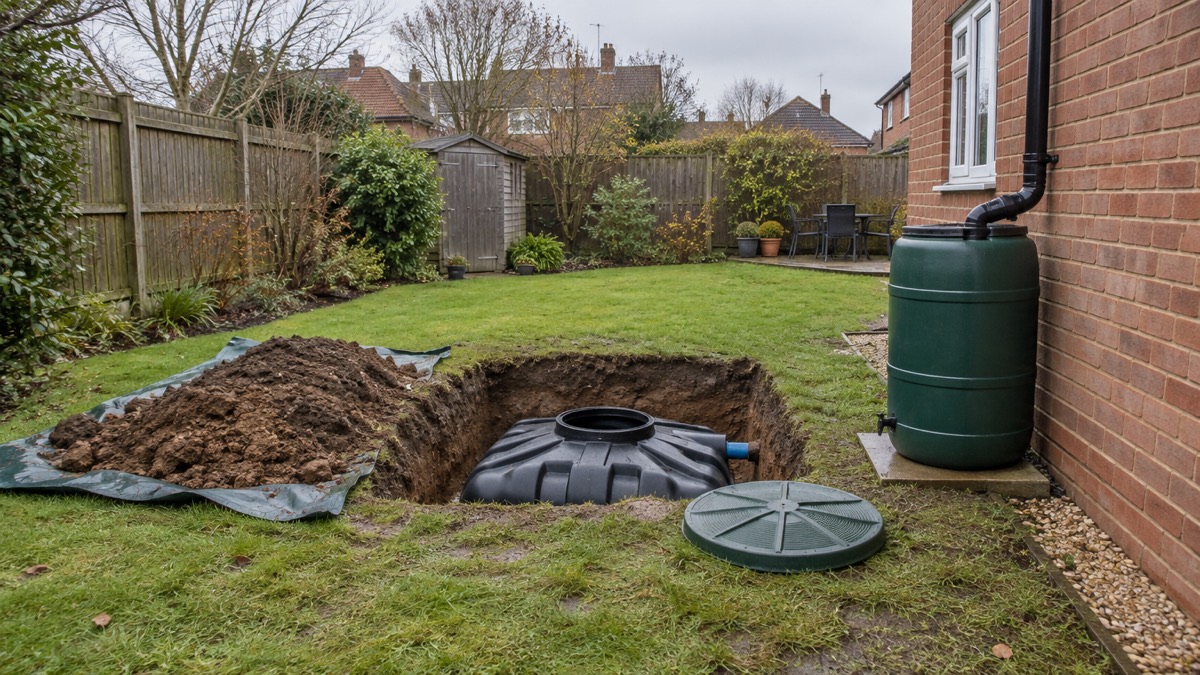
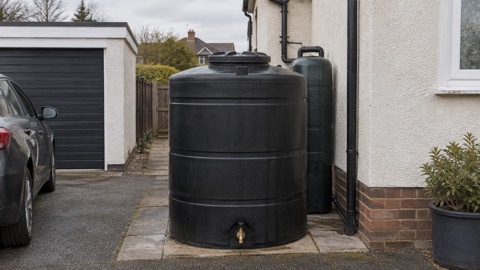
A water butt is a tank that collects rainfall from the roofs of your property and any outbuildings, positioned next to the wall and fed by a downpipe11. The water can be used in the garden, or filtered and stored for reuse within the home11. That is the whole principle: your roof is the catchment, the gutter is the channel, and the butt is the store.
The practical details decide whether it works. The butt needs a firm, level base, because a full tank is heavy. It needs to sit close to the downpipe it draws from. And it needs a way for surplus water to leave when it is full, which is where a diverter or overflow comes in.
If you want the fuller picture of how a roof, gutter, filter and tank work together, the rainwater harvesting guide takes it step by step, and water butts: sizes, fittings and where to put one covers siting in detail.
Sizes: from 110 to 340 litres
Domestic water butts come in a range of sizes, and the choice turns on how much roof water you can capture and how much you will actually use. A butt that is too small overflows constantly in wet weather; one that is too large for your roof and rainfall sits half empty.
| What you are storing for | Typical size band | What it gives you |
|---|---|---|
| A small garden and occasional flushing | 110 to 200 litres | Easy to site, light enough to move empty, quick to fill |
| A larger garden and regular emergency flushing | 200 to 340 litres | More reserve for a multi-day interruption, needs a solid base |
For comparison, a water company tanker used in a supply emergency carries anything from 5,000 litres in smaller trucks to 30,000 litres in larger tankers12. That is the scale of what an official response brings; a domestic butt is a household's own small reserve, not a substitute for the tanker. If you are working out how big a tank your roof can actually fill, how to size a rainwater tank does the arithmetic on roof area, rainfall and demand.
Fitting a water butt to a downpipe
The connection between downpipe and butt is where most installations succeed or fail. Westminster City Council's advice is to install a water butt for rainwater storage from your downpipes, connected to greywater uses such as toilet flushing and garden watering9. The fitting that makes this work is a diverter.
One maker's kit, the 3P Filter Collector and Tank Connector Kit, illustrates what a diverter does. It fits round downpipes of 68mm to 100mm and square downpipes of 65mm to 75mm, and the maker describes it as adaptable to nearly all downpipes6. Rainwater flows from the filter entrance into the cartridge, where debris is forced to the sides and on down the drainpipe, while filtered water flows out to the tank inlet6.
A short numbered sequence keeps the job manageable:
- Choose a spot next to the downpipe, on firm level ground, close to where you will use the water.
- Fit the diverter to the downpipe at the height the maker specifies, following its instructions.
- Connect the diverter outlet to the tank inlet, and check the overflow leads away from the house.
- Let the first rain run through and check for leaks at both joints.
The how to connect a water butt to a downpipe guide covers the fittings in more detail, and rainwater filters explains what different filter types remove.
Stored rainwater keeps for weeks to months, not indefinitely
Rainwater sitting in a tank does not stay fresh forever. Debris settles, the water warms in summer, and anything that lands in an open butt starts to break down. The Drinking Water Inspectorate's rule for stored supplies is a useful benchmark for any tank: it must be inspected regularly, at least annually and preferably every six months7.
For a garden butt, that translates into a simple routine. Check the lid is secure, skim off leaves, and empty and clean the butt when the water looks or smells stale. The Inspectorate's consumer guidance is to check the instructions supplied with the tank, which should contain details of how to maintain and clean it13. If you want to know whether stored water actually goes off, does stored rainwater go off or stagnate? answers it directly, and keeping a rainwater system clean sets out a year-round routine.
What gets into rainwater from a roof
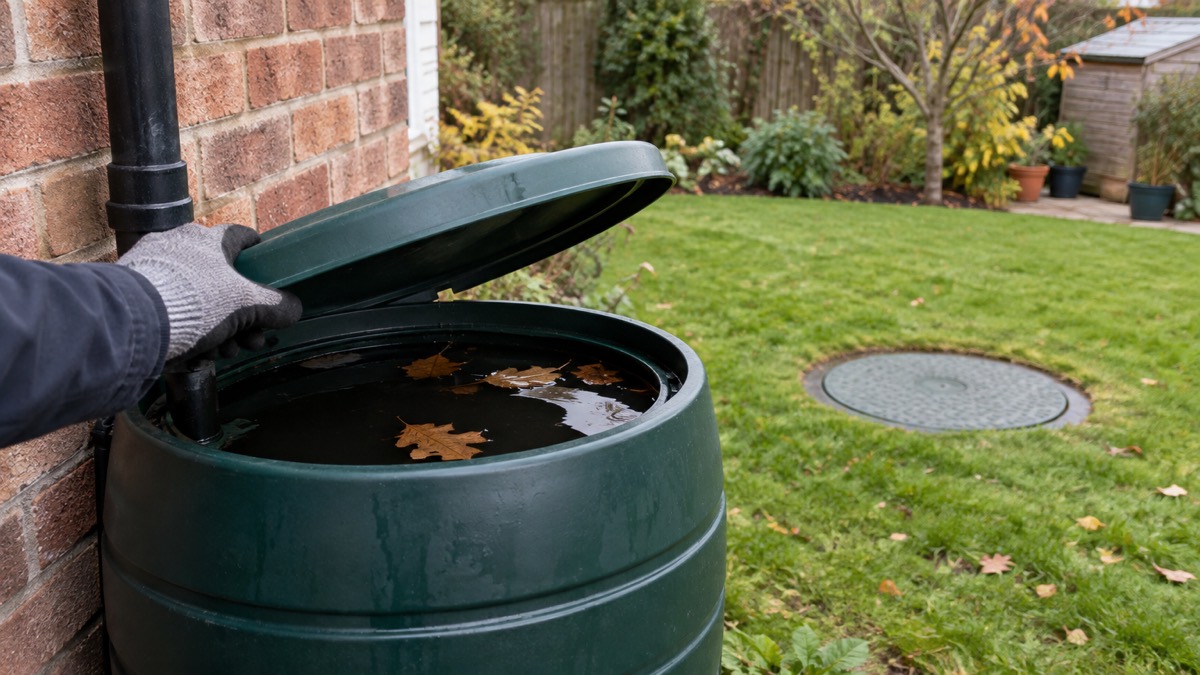
Roof runoff is not clean water. It carries whatever has settled on your roof: leaves, grit, moss and bird droppings. In towns it also picks up airborne dirt, which is one reason urban roof water is treated as non-potable. A downpipe filter works by sending rainwater from the filter entrance into the filter cartridge, where debris is forced to the sides and on down the drainpipe, while filtered water flows out of the cartridge to the tank inlet6.
The same principle applies to any stored supply. The Drinking Water Inspectorate advises that treated water tanks be designed, installed and maintained to prevent contaminants getting in through rain or snow14. For a garden butt, a close-fitting lid does that job. For a private supply feeding taps, the rules are stricter, and private water supply rules explains who is responsible for testing and risk assessment.
Where a water butt must never be used
The line is simple and it does not move: butt water is for flushing and for plants, never for drinking, cooking or washing up5. Public Health Wales allows garden water butts for flushing during a shortage3, and the government's water supply interruption guidance says the same, adding watering plants5. Nothing in official advice extends it further.
There are related dangers worth knowing. Floodwater is not the same as stored rainwater, and the rules for it are stricter: Natural Resources Wales says never let children play in floodwater15. If someone falls into water, fire and rescue services say never enter the water to attempt a rescue16. And if you are using any fuel-burning equipment while the power is off, Humberside Fire and Rescue Service warns that it should never be used inside a tent, camper or other enclosed shelter, because of carbon monoxide18.
"Do not drink this water as it could contain bacteria or disease."
Water butt or underground tank: what each one offers a household
Set side by side, the two options serve different households.
An underground tank earns its place when you want volume without taking up garden space. The Campbeltown flood protection scheme shows the principle at civic scale: new pipelines lead into a storage tank built underneath Burnside Square, safely storing water and allowing it to discharge slowly, hidden underground once finished19. A domestic version does the same job for one household. Underground rainwater tanks covers shallow dig, deep dig and flat designs, and above-ground tanks covers the larger above-ground alternatives.
For most households weighing up the two, the honest answer is that a water butt gives you most of the emergency benefit for a fraction of the work. An underground tank is worth it when you are building a system, not when you are buying insurance against a supply interruption.
Looking after the butt through the year
A water butt needs little attention, but the little it needs matters. In winter, lag or insulate exposed pipework and check the butt has not frozen solid; Northern Ireland Water's winter advice covers protecting pipework around the home20. In summer, keep the lid on to stop algae and mosquitoes, and use the water rather than letting it stand.
The Drinking Water Inspectorate's guidance on discoloured water is a useful reminder of what stored water can do if a tank is neglected: if the problem is only at taps other than the mains-fed kitchen tap, a storage tank in the house may be the cause21. A garden butt is not a household supply, but the lesson holds: stored water needs checking.
If you are heading into winter, the rainwater system winter checklist lists what to check and when. And if you are building a wider plan, the self-reliance at home section covers rainwater, off-grid power and living without mains.
Sources (21)
- Guidance for incidents, Wessex Water, 2026-10-28
- Incident support, Affinity Water, 2026-10-28
- Weather and health, Public Health Wales, 2026-07-16
- Preparing for an incident, South West Water, 2026-10-28
- Water supply interruptions or outages, UK Government, 2026-10-12
- 3P Filter Collector and Tank Connector Kit, Rainwater Harvesting Ltd, 2026-10-01
- Water storage, Drinking Water Inspectorate, 2025-11-05
- York and North Yorkshire Community Risk Register, North Yorkshire Local Resilience Forum (North Yorkshire Council)
- Advice and support: drought, Westminster City Council, 2026-08-06
- Causes of sewer flooding, Wessex Water, 2026-10-28
- Flood Smart Living, Suffolk County Council, 2024-11
- Water tankers, United Utilities, 2026-10-28
- Water storage tanks and cisterns, Drinking Water Inspectorate, 2026-06-09
- Protecting your private water supply, Drinking Water Inspectorate, 2026-10-28
- What to do after a flood, Natural Resources Wales, 2026-10-29
- Water safety, Lincolnshire County Council, 2026-10-29
- How to stay safe during a heatwave, Devon and Somerset Fire and Rescue Service, 2026-06-23
- Barbecue safety, Humberside Fire and Rescue Service, 2026-10-29
- Campbeltown flood protection scheme, Argyll and Bute Council, 2026
- Winter proof your home, Northern Ireland Water, 2026-10-28
- Discoloured or dirty water, Drinking Water Quality Regulator for Scotland, 2026-10-28
 Composting Toilet vs Septic Tank
 Potable vs Non-Potable Tanks