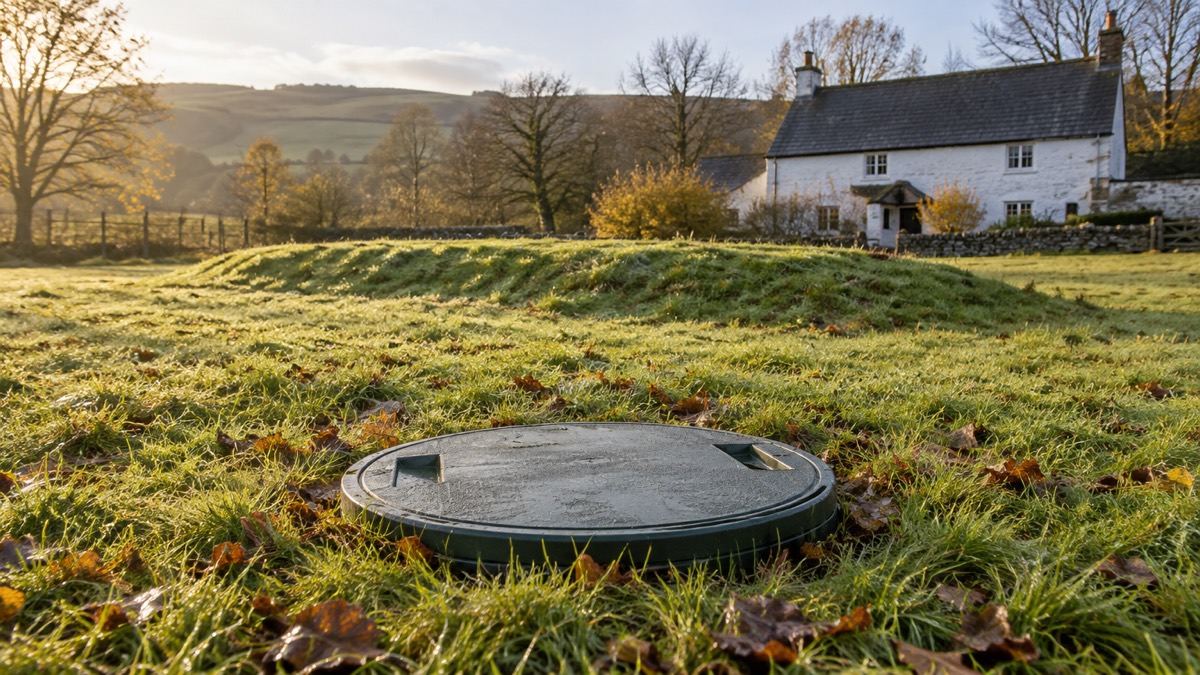
If your home is not connected to mains sewerage, you have two broad choices: a composting toilet, which deals with waste where it falls with very little water, or a septic tank, which holds and settles sewage before releasing liquid to the ground. A composting toilet needs no water flush and, in the UK climate, a reliable approach is to alternate annually between two separate chambers, allowing up to two years for complete decomposition1. A septic tank is sized by a simple rule: multiply the number of people by 180 litres, then add 2,000 litres1.
The choice turns on your site, your water supply and your flood risk. A composting toilet suits a household that can manage the compost, keep the vent clear and remove waste without carrying it through living space or food preparation areas2. A septic tank suits a household with the land for a drainage field and enough space for a tank that will not be overwhelmed. Both need planning thought: the relevant agencies are the Planning Department of the Local Authority, the Building Regulations Officer, the Environmental Health officer and the Environment Agency, or SEPA in Scotland2.
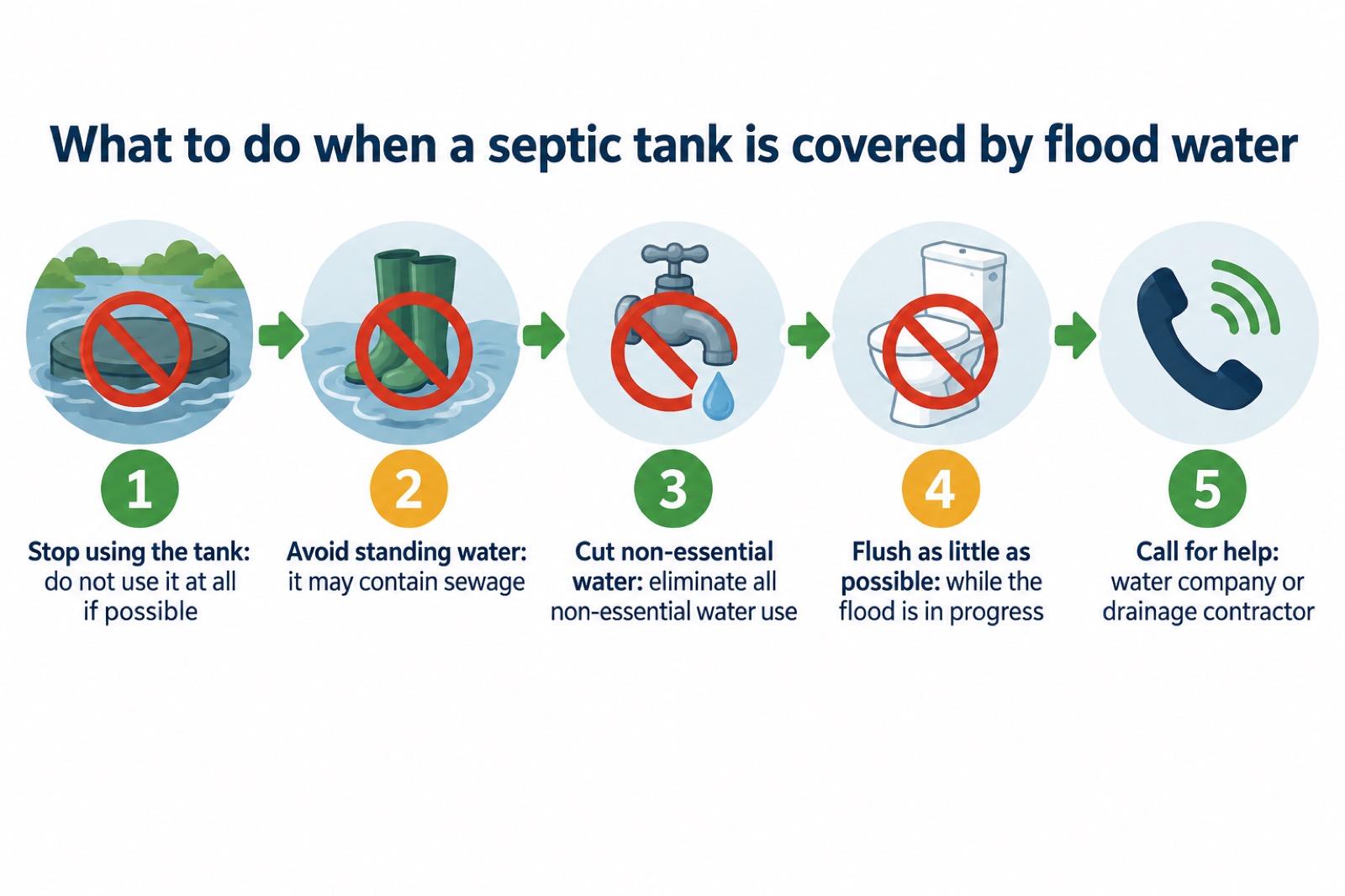
Whichever you choose, the failure mode to plan for is water. Septic tanks often fail during groundwater flooding, and official advice is not to use the tank at all if possible when it becomes covered with water, to avoid contact with standing water that may contain sewage, and to flush toilets as little as possible while a flood is in progress3. The sections below set out how each system works, how to size and site it, what goes wrong, and where to get help.
Composting toilet or septic tank: how each one deals with waste
The two systems treat waste in fundamentally different ways, and that difference decides what you need on site.
A septic tank is a holding and settling vessel. The tank fills until it reaches an equilibrium point, after which incoming sewage displaces effluent to the outlet; a crust forms on top and sludge builds up on the bottom1. The crust may be absent if only toilet waste flows in, which allows much less frequent emptying1. If the tank is too small there will not be enough time for proper settlement1. Where the land is very flat or rises away from the tank, it can have a third chamber from which effluent is pumped1. Package treatment plants are a related option: they carry out primary and some secondary treatment in compact units, and produce a cleaner effluent than a septic tank1.
A composting toilet keeps solids out of water altogether. The waste breaks down in a chamber, and the liquid fraction is managed separately. At the Centre for Alternative Technology, a settlement tank is used instead of a septic tank and the solids are dealt with on site: crust is taken off and composted or removed, effluent goes to the reed beds, and sludge goes to a separate bed for treatment1. An Aquatron separates solids and liquids using the sticking properties of liquid; in the hourglass-shaped device liquids stick to the sides while solids fall down the centre into a composting chamber, with liquids going to some secondary treatment stage1. CAT found the effluent quality from an Aquatron is much better than a septic tank because it does not create an anaerobic sludge and the majority of solids spend very little time in the water1.
| Feature | Composting toilet | Septic tank |
|---|---|---|
| Water use | Very little; no flush needed | Flush water plus household water |
| Where waste goes | Composted on site or removed | Settled in tank, liquid to drainage |
| Sizing basis | Chamber volume per person | 180 litres per person plus 2,000 litres1 |
| Emptying | Compost removed after up to two years1 | Sludge removed periodically |
| Flood behaviour | Can be sited to avoid flood water2 | Can fail when groundwater rises3 |
The planning rules for a composting toilet are specific: they are fine when suitable arrangements can be made for disposal of the waste on or off site, waste can be removed without carrying it through living space or food preparation areas, and no part of the installation would be rendered ineffective by entry of flood water2. Those three conditions are worth reading before you buy anything.
Composting toilets use very little water
Water is the strongest argument for a composting toilet in a household that is off the mains. A composting toilet needs no flush, so it removes the largest single use of water in most homes. For comparison, older toilet cisterns use as much as 13 litres per flush, while current modern models use 6 litres per flush or less5. A household of four flushing a modern cistern several times a day is using a substantial volume that a composting toilet simply does not require.
That matters most when your supply is your own. If you rely on a private water supply, protecting it from contamination is a constant concern, and reducing the volume of sewage you produce reduces the risk6. If you are not on mains sewerage, the Environment Agency may require that all grey and black water can be treated through your septic tank or similar system, so a smaller system might not be allowed1. That is a reason to talk to the agency early if you plan to reduce your water use dramatically.
There are practical limits. A composting toilet still needs ventilation, and a simple unpowered (passive) vent is a straight pipe of at least 110mm diameter, reaching well above the roof line and with a rotating cowl; painting the top of the pipe black assists thermal draw, and CAT toilets used a small 10 watt fan1. The vent is what keeps the chamber aerobic and the smell down, so it is not a detail to skimp on.
If you want to go further on water, a water butt for rainwater storage from your downpipes can be connected to greywater systems such as toilet flushing and garden watering7. During a temporary use ban, official advice includes installing a rain butt to collect rainwater, fixing a leaking toilet, using water from the kitchen such as washing up water to water your plants, and taking shorter showers8. Watering with a can rather than a hose uses much less and targets the roots better, and rainwater is preferable to tap water if you have a butt installed9.
Two chambers alternated each year suit the UK climate
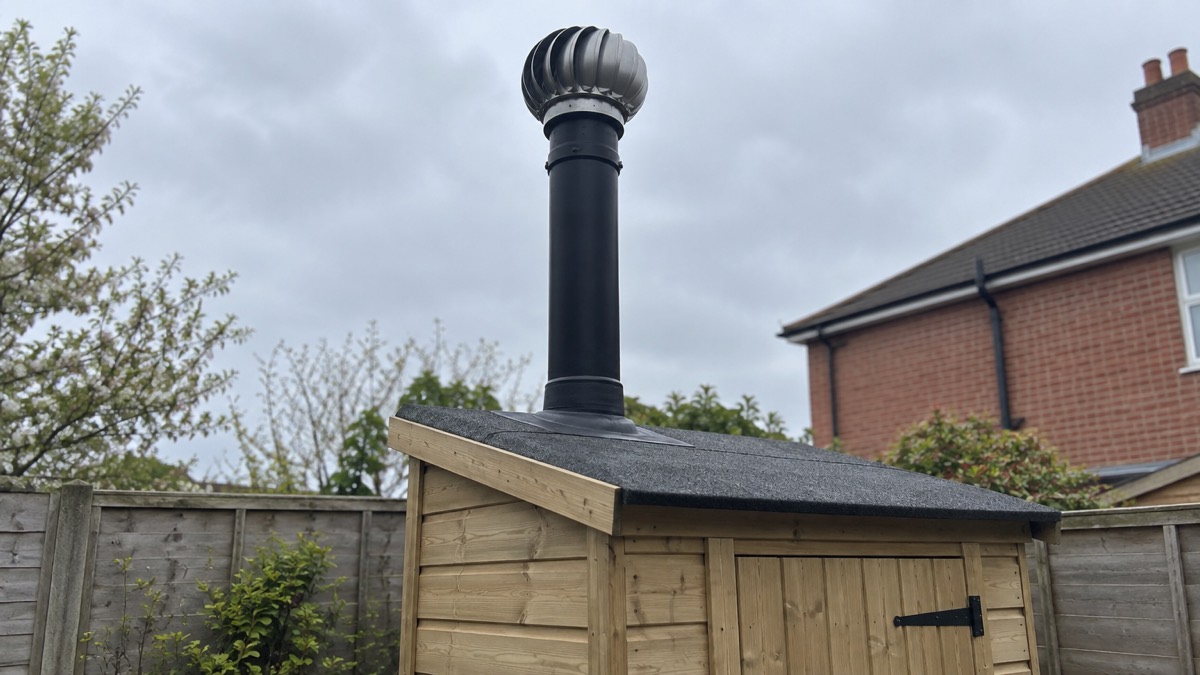
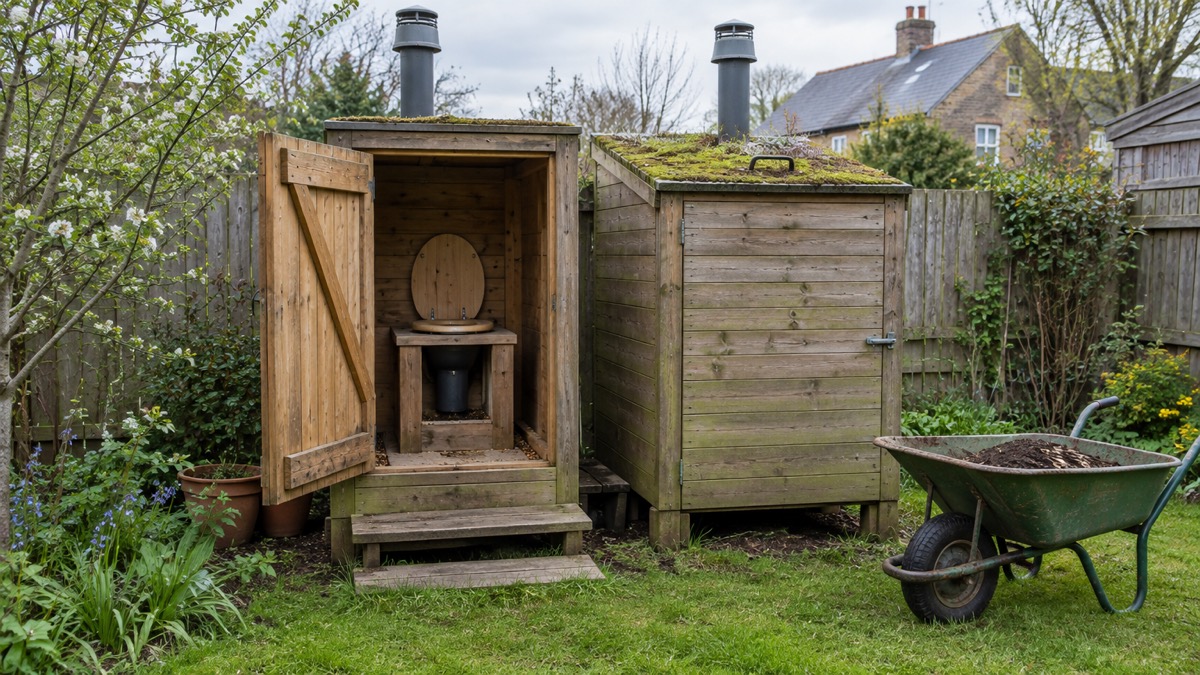
The UK climate is mild and damp, which is good for decomposition but slow. A reliable and robust approach for the UK climate is to alternate annually between two separate chambers2. The idea is simple: one chamber is in use while the other rests and finishes composting. After a year, you switch, and the resting chamber has had its full cycle before you empty it.
This matters because the alternative, a single continuous chamber, asks more of the operator. A continuous system should settle down within a few months, after which no intervention in terms of adding worms or other decomposers should be necessary2. But a continuous system never gives the finished material a clean rest period, so you are always working around material at different stages.
Chamber size decides how forgiving the system is. A composting chamber may need to be about one-third to one half of a cubic metre per person, equal to a box about 70 to 80 cm on each side; the larger the chamber the more forgiving the system, and drainage provision for the compost may be needed1. For a family of four, that is a serious structure, so plan the space before you plan the bathroom.
| Approach | How it works | Suits |
|---|---|---|
| Two chambers, alternated annually | One in use, one resting for a year2 | UK climate, households wanting a robust routine2 |
| Single continuous chamber | Waste added continuously, settles in a few months2 | Households with steady use and a larger chamber1 |
| Aquatron plus composting chamber | Solids and liquids separated first1 | Sites needing cleaner liquid effluent1 |
Whichever you choose, keep a good balance of green and brown materials in the compost10. That is the same principle as any compost heap, and it applies to the chamber as much as to a garden bin. If you already compost garden waste, the same habits carry over; see our guide to composting at home for the basics of green and brown balance.
Allow up to two years for waste to break down fully
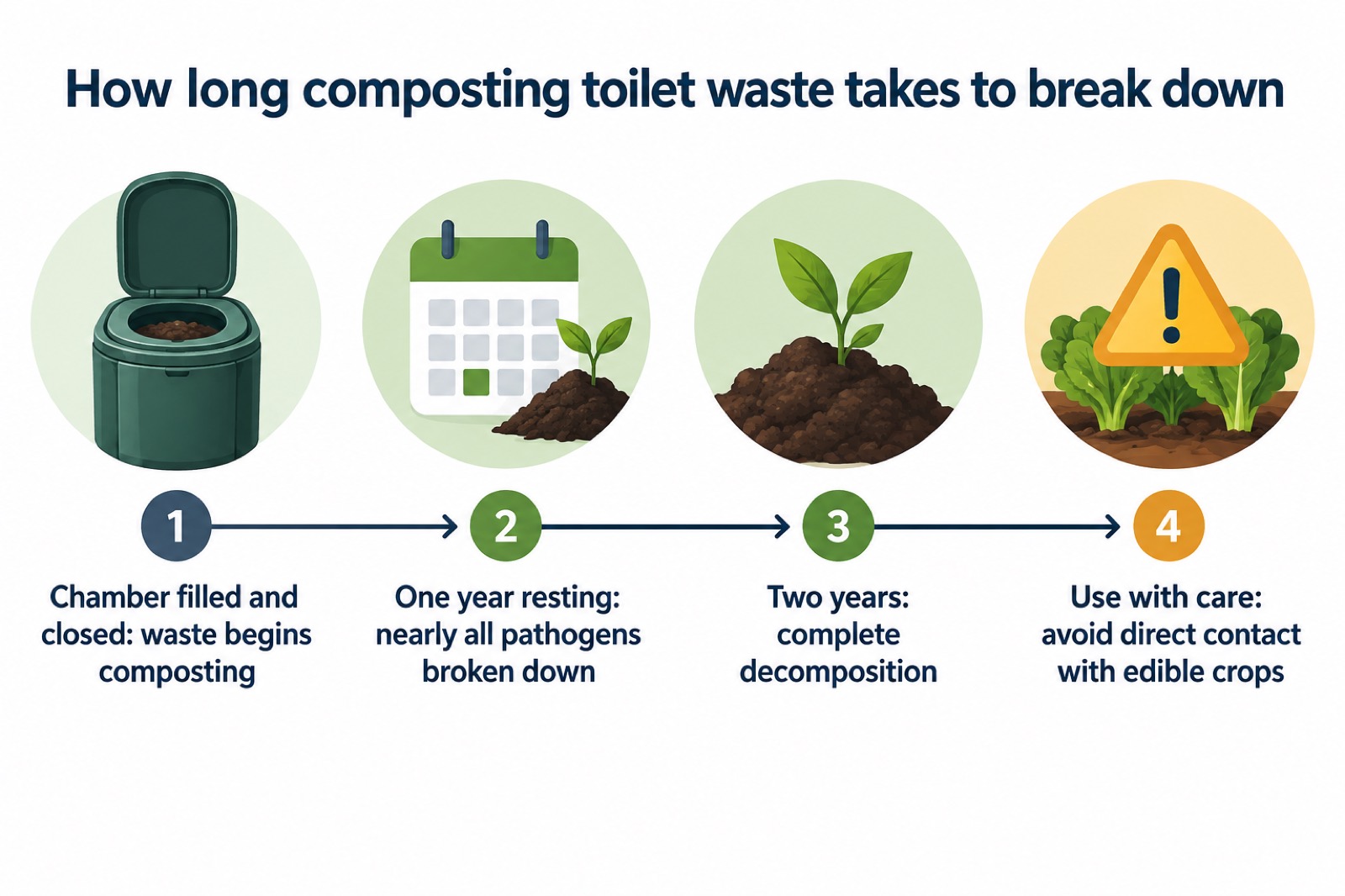
The single most important expectation to set is time. You need to allow up to two years for complete decomposition of the waste, and you need to allow enough space for composting to take place1. Nearly all pathogens are broken down by composting if it is left for at least a year, ideally two, to decompose; as an extra precaution it can be used where it does not come into direct contact with the edible part of crops1.
That has practical consequences. You need somewhere to put finished material, and you need to be patient about using it. The two year figure is not a target to beat; it is the period the guidance gives for the material to be safe. If you are composting human waste and intend to use it on a vegetable plot, the extra precaution about avoiding direct contact with the edible part of crops is worth following even after the full period.
The same patience applies to the liquid side. Reed beds and settlement tanks need time and space to work, and there should be a settlement tank between vertical and horizontal flow reed beds, to take out solids such as dead microbes; this tank will very rarely need emptying1. If grey water is not going through a septic tank, a trap is needed at the front end to catch solids, as hair is particularly likely to block things up, and a surge tank may be needed depending on flow rate variation1.
Which dry toilets to avoid
Not every dry toilet on the market suits an off-grid UK household. The clearest guidance is negative: do not use dry toilets that use electrical elements to heat the compost2. They tie your sanitation to a power supply, and they conflict with the principle that a composting toilet should not be connected to an energy source other than for purposes of ventilation or sustaining the composting process2.
The reasons are practical. A heated toilet draws power continuously, which is a poor fit for an off-grid solar system in winter, and it makes the toilet dependent on a component that can fail. Official planning guidance for composting toilets says they should not be connected to an energy source other than for purposes of ventilation or sustaining the composting process1. If you are sizing a power system, see our guide to off-grid solar systems for how much a small continuous load costs you.
There is a second category to think about: anything that cannot meet the three planning conditions. A composting toilet is acceptable when suitable arrangements can be made for disposal of the waste on or off site, waste can be removed without carrying it through living space or food preparation areas, and no part of the installation would be rendered ineffective by entry of flood water2. A toilet that requires you to carry a bucket through the kitchen fails the second condition. A toilet sited in a basement that floods fails the third.
| Avoid | Why |
|---|---|
| Dry toilets with electrical heating elements2 | Ties sanitation to a power supply; outside the ventilation allowance2 |
| Toilets needing waste carried through living or food areas2 | Fails the planning condition on removal routes2 |
| Installations that flood water could render ineffective2 | Fails the planning condition on flood entry2 |
If flies become a persistent problem, an insecticidal strip hung inside the chamber will control flying insects without affecting the other decomposers in the compost mass2. That is a remedy for a symptom, though; persistent flies usually mean the chamber is too wet or the vent is not drawing.
Septic tank size: 180 litres per person plus 2,000 litres
Sizing a septic tank is arithmetic, and getting it wrong is the most common cause of poor performance. To estimate a suitable size, multiply the number of people by 180 litres, and then add 2,000 litres1. If the tank is too small there will not be enough time for proper settlement1.
The 2,000 litre allowance is the settlement volume the tank needs regardless of occupancy. It is why a small tank for a small household is still a substantial structure. The rule assumes the tank takes household sewage; if only toilet waste flows in, the crust may be absent, which allows much less frequent emptying1.
The sums above apply the published rule; the rule itself is the figure to rely on1. Where the land is very flat or rises away from the tank, it can have a third chamber from which effluent is pumped1. That adds cost and a power dependency, so check the fall of your land before you dig.
Siting matters as much as size. Ensure that inlets and outlets to tanks are sited at opposite ends to reduce the possibility of stagnant areas of water and short circuiting6. If you are also storing water on site, check the instructions supplied with the tank, as this should contain details of how to maintain and clean the tank11. If you are unsure how to clean your storage tank or cistern, you can contact your local water company for advice or use a WaterSafe registered plumber who can carry out this task for you11.
Septic tanks often fail during groundwater flooding
The most common failure is not a design fault but water arriving from outside. When groundwater rises, a septic tank can be overwhelmed, and the results are unpleasant and sometimes structural. Official advice for a tank that becomes covered with water is not to use the tank at all if possible, to avoid contact with standing water that may contain sewage, to eliminate all non-essential water use and to flush toilets as little as possible while a flood is in progress3.
The signs of a failed system are worth knowing in advance: a pungent odour around the tank and land application area, blocked fixtures and wastewater overflowing from the relief point, high sludge levels within the primary tank, and sewage flowing up through the toilet and sinks3. If you see any of these during a flood, treat the area as contaminated.
Flood water can also arrive through the building itself. Flood water can come in through toilets, so be prepared to sandbag bathroom doors or block your toilet12. In one Lancashire home flooded on Boxing Day in 2015, most of the flood water came up through the floor, via the washing machine and the ground floor toilet, and was contaminated by the local sewage works being inundated13. In Cumbria, one household fitted a non-return valve on the septic tank as part of its flood resilience work13. Those measures are worth considering before the water arrives, not during.
Sewer networks themselves fail in the same conditions. In Campbeltown, the sewer network combines surface water with sewage water from households, and when the system is overwhelmed during periods of heavy rain, fouled water backs up out of the system and floods streets15. High water tables from heavy rainfall and overflowing rivers can make it difficult to flush toilets at all16. If your toilet or sink is backing up during floods, call your local water company14.
Where to get help with a flooded septic tank
Help depends on what is failing. If sewage is backing up into the house, the first call is your water company: for sewer flooding, or if your toilet or sink is backing up during floods, call your local water company14. In the Thames Water area, if your toilet, sink or bath is flooding, for example if wastewater or raw sewage is coming up through your toilet, sink or bath, call Thames Water on 0800 316 980017. Check your own company's number before you need it.
If the problem is pollution rather than backing up, the Environment Agency is the body to call. Report pollution incidents affecting a private water supply to the Environment Agency's national incident hotline on 0800 8070604. The Environment Agency will record the incident and may require further investigation or remedial works by the polluter, may inform the local authority and take enforcement action where appropriate4. If a domestic oil leak could affect a stream, pond or other water supply, call the Environment Agency18.
| Situation | Who to contact |
|---|---|
| Sewage backing up during a flood | Your local water company14 |
| Wastewater or raw sewage coming up through fixtures (Thames Water area) | Thames Water on 0800 316 980017 |
| Pollution affecting a private water supply | Environment Agency incident hotline 0800 8070604 |
| Oil leak threatening a watercourse | Environment Agency18 |
| Items polluted by chemicals or sewage | Environmental health at your local council19 |
While the tank is out of action, you still need sanitation. You can use the facilities of unaffected family, friends, neighbours, public toilets, rest centres, local shops, supermarkets and hotels; chemical toilets may be provided, and portable bag-in-a-bag products designed for solid and urine waste may be provided3. You can hire chemical toilets from hire companies and camping and caravan stores20. For small areas of flooding you could use a bucket to get rid of the floodwater; for larger areas consider hiring a water pump run by a generator21.
After the water goes down, there is more to do. Use your council's Household Bulky Waste Collection service for disposing of contaminated or flood-damaged property22. Contact the environmental health department at your local council to get rid of things polluted by chemicals or sewage19. If you need support, contact family and friends, your doctor or an organisation like the Red Cross or the Samaritans23. Check flooding advice for your area through the government's flood checking service24, and move vehicles to higher ground when flooding is expected25.
For the wider picture on preparing a household for flooding, see our guide to flooding, and for keeping a private supply safe, see private water supply rules. If you are still deciding on a composting toilet, our composting toilet kit checklist sets out what to gather, and how far a composting toilet should be from wells and water supplies covers siting in detail.
Sources (25)
- Sewage treatment, Centre for Alternative Technology, 2025-07-14
- Composting toilets, Centre for Alternative Technology, 2025-06-27
- How to recover from flooding, GOV.UK, 2023-12-19
- Protection of drinking water sources, Drinking Water Inspectorate, 2026-11-04
- Droughts, Prepare campaign, 2026-10-19
- Protecting your private water supply, Drinking Water Inspectorate, 2026-10-28
- Advice and support for drought | Westminster City Council, Westminster City Council
- Why do we have hosepipe bans during a drought?, Environment Agency, 2025-06-12
- Spotlight on Wessex Water - offers advice on saving every drop - Case Studies - Wiltshire & Swindon Prepared, Wiltshire & Swindon Prepared (Wiltshire & Swindon Local Resilience Forum)
- Wildfires - protecting your home and garden | London Fire Brigade, London Fire Brigade
- Water storage tanks and cisterns, Drinking Water Inspectorate, 2026-06-09
- Preparing for a flood, London Fire Brigade, 2026-10-25
- Property flood resilience case studies, Derbyshire County Council, 2024
- What to do in a flood, Natural Resources Wales, 2026-10-29
- Campbeltown flood protection scheme, Argyll and Bute Council, 2026
- Failure of water infrastructure or loss of drinking water, Wiltshire and Swindon Prepared, 2026-10-25
- How to prepare for flash flooding, London.gov.uk, 2026-10-25
- Domestic oil, Northumberland County Council, 2026-10-28
- After a flood, GOV.UK, 2026-10-25
- Further support after a flood, Nottinghamshire County Council, 2026-10-29
- After a flood, London Fire Brigade, 2026-10-25
- Clearing flood, Oxford City Council, 2026-10-29
- Emotional support after a flood, Herefordshire Council, 2026-10-29
- Check flooding, GOV.UK, 2026-10-29
- During a flood, Nottinghamshire County Council, 2026-10-29
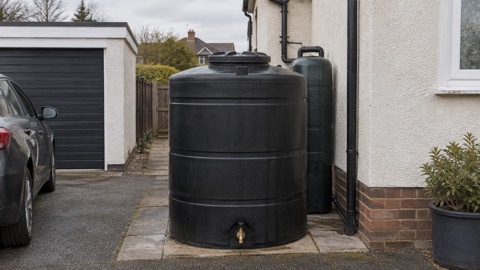 Potable vs Non-Potable Tanks
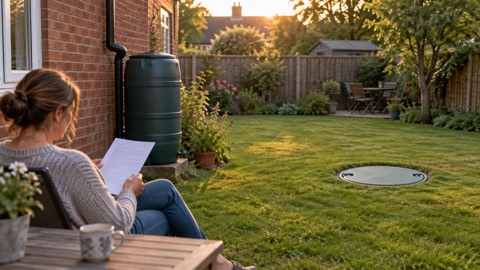 Water Butt or Underground Tank