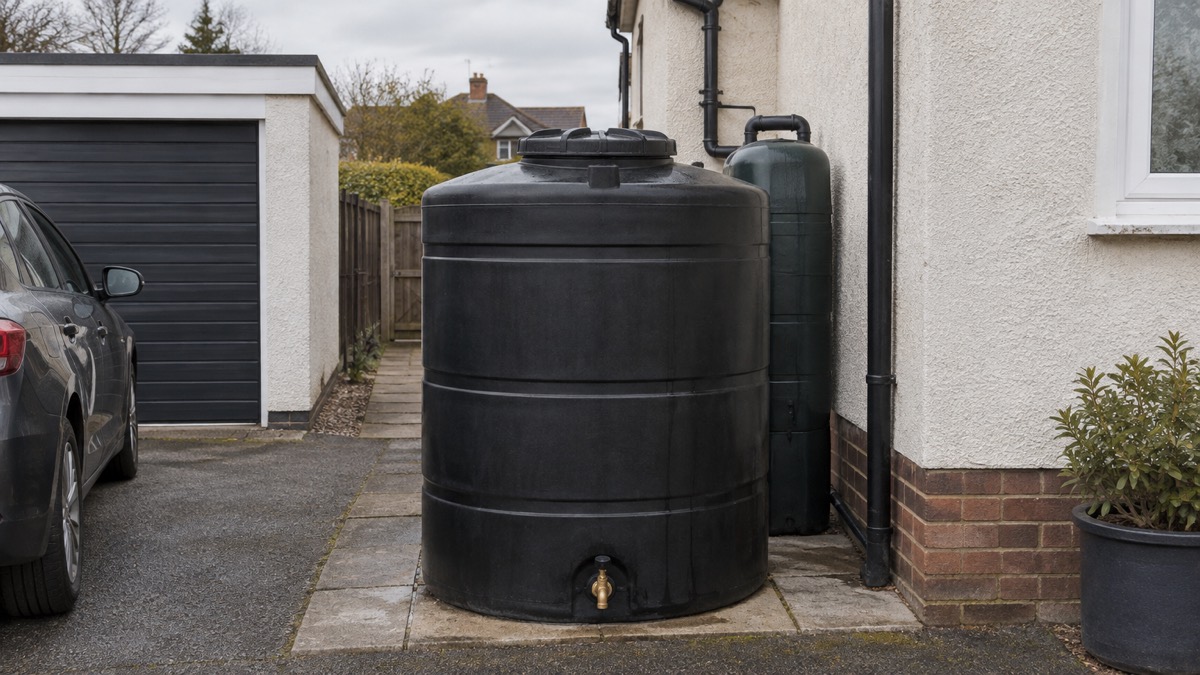
A potable water tank is one made to hold water fit for human consumption. A non-potable tank is not: it is designed for non-drinking water, for jobs such as toilet flushing, garden watering and irrigation. That single distinction decides which tank you can use for a drinking water store and which you cannot, and it is the first thing to settle before you look at sizes, colours or prices.
The difference is not a label stuck on at the end. Potable tanks are made to conform to the WRAS (Water Regulations Advisory Scheme) standard, and the plastic they are made from must not taint the water it holds1. Non-potable tanks carry no such promise and are sold for non-drinking uses3. Both types are commonly rotationally moulded from MDPE, a mid-density polyethene, and both are listed as 100 per cent rust proof, so the material alone does not tell you which you have3.
If you are storing water for an emergency, buy a tank sold as potable and keep it for drinking and cooking only. If you are capturing rain for the garden or flushing toilets, a non-potable tank is the right and usually cheaper choice. And if a potable tank is going to be connected to the mains supply, expect the installation to need fluid category 5 approval in many cases2.
Potable tanks are for drinking water, non-potable tanks are not
The dividing line is what the tank is promised to do. A potable drinking water tank is, in the makers' words, suitable for storing water fit for human consumption and conforms to the WRAS standard, including the requirement that the plastic does not taint the water it is holding2. That is the whole of the promise, and it is the one that matters if the water might be drunk.
A non-potable tank is designed for the storage of non-drinking water and for everyday uses across many different applications3. It may be made from the same family of plastic, moulded the same way and finished to the same standard of robustness, but it has not been sold as fit for drinking, and you should not treat it as though it were.
This matters most in an emergency. If your mains supply is interrupted, a stored reserve of drinking water is only useful if it was safe to drink when it went in and has stayed that way. A tank that was never intended for drinking water gives you no such assurance, however clean the water looks.
The Water in an Emergency guide covers how much to store and how to keep it fresh. This page deals with the tank itself: what each type is for, what the standards mean, and how to choose between them.
What makes a tank potable: WRAS-approved plastic that does not taint the water
Potable status rests on two things: the standard the tank is made to, and the behaviour of the plastic.
The standard is WRAS, the Water Regulations Advisory Scheme. Potable tanks are described as conforming to it, and makers list them as manufactured from WRAS approved polymer2. The second point is the one people overlook: the plastic must not taint the water it is holding6. A tank can be strong, food-grade in appearance and perfectly clean, and still fail this test if its material or its manufacture leaves anything in the water that should not be there.
Official guidance from the Drinking Water Inspectorate is reassuring on the material itself. Tanks are nowadays constructed of plastic (polyethylene) and are unlikely to cause problems provided that they are designed for drinking water purposes and have a close-fitting cover1. Note the two conditions. The tank has to be a drinking water tank, and it has to be covered properly. A potable tank left open to leaves, insects and light is no longer doing the job it was bought for.
"Nowadays tanks are constructed of plastic (polyethylene) and unlikely to cause problems provided that are designed for drinking water purposes and have a close-fitting cover"
In practice, then, buying a potable tank is necessary but not sufficient. Fit the lid, keep it on, and keep the tank and its surroundings clean. The rainwater maintenance guidance on keeping a system clean applies to any stored water, drinking or not.
What a non-potable tank is for: toilet flushing, garden and irrigation water
Non-potable tanks earn their place around a home and smallholding. The makers list their uses as toilet flushing, horticultural and market garden applications, agricultural irrigation, or where mains water is not available3. In a domestic setting that translates into a few familiar jobs:
- Flushing toilets during a supply interruption, using water you would not want to drink.
- Watering the garden, including beds, pots and a polytunnel, from stored rain.
- Irrigation of a vegetable plot, fruit cage or small orchard.
- General outdoor washing, such as boots, tools and paths.
For any of these, a non-potable tank is the sensible buy. It does the job without paying for a drinking water certification you do not need. If your interest is garden water, the rainwater harvesting section covers how a system is put together, and what harvested rainwater can be used for sets out the household and garden jobs it suits.
The one thing a non-potable tank must never become is a drinking water store by accident. Do not fill bottles from it, do not use it for cooking, and do not assume that because the water came off a clean roof it is safe. Label the tap or outlet so that nobody in the household, or a visitor, makes that mistake.
Never drink from a non-potable tank
This is the rule that matters more than any other on this page. Water from a non-potable tank is not drinking water, and no amount of filtering, boiling or settling at home turns an unapproved store into an approved one.
Water companies are blunt about the same principle when a supply is compromised. During a do not drink notice, the instruction is that you do not drink or consume your tap water at all, as it may be at risk of contamination8. A non-potable tank is in that category permanently: it is not a temporary precaution but the tank's designed purpose.
Two further habits are worth building in, drawn from water company advice for households under a notice. You should never drink water from the hot tap9, and when a supply is suspect the safe course is to use water you know the history of. A potable tank that you filled yourself, from a supply you trust, and kept covered gives you that history. A non-potable tank never will.
If a mains supply is interrupted in your area, your water company publishes what it will do and when. The utility's promise during an interruption is the place to check what help is available, and the extra help guide explains support for households that depend on a reliable supply.
Mains-connected potable tanks: fluid category 5 in many installations
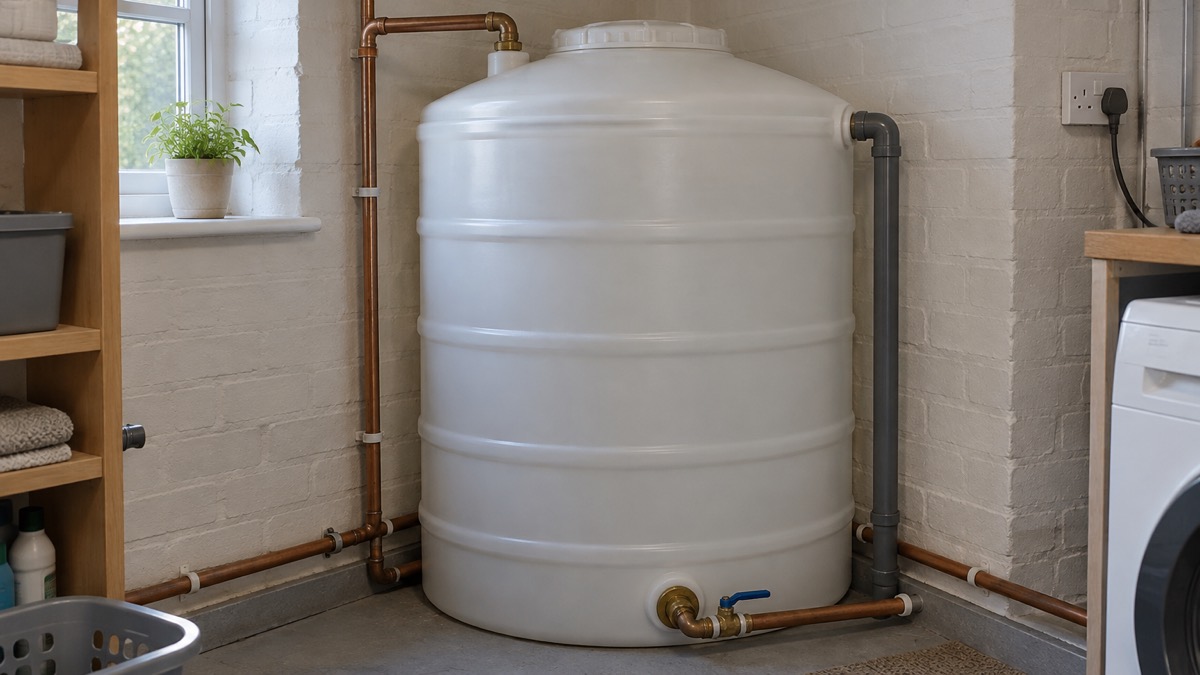
A potable tank that simply sits in a garden and is filled by hose is one thing. A potable tank plumbed into the mains is another, and this is where households most often get caught out.
The makers state the position consistently across their ranges: in many installations, potable drinking water tanks which are connected to the mains water supply will need to be fluid category 5 approved2. The wording is careful, and worth reading twice. It says many installations, not all, and it says will need, not may. Fluid category 5 is the highest risk classification in the water fittings system, and a tank connected to the mains is treated as a point where contamination could, in the wrong circumstances, work back into the supply.
What does that mean for you? If you plan to connect a drinking water tank permanently to your plumbing, with a float valve or a top-up arrangement, check the approval of the tank and the fittings before you install. Do not assume that a potable tank is automatically suitable for a mains connection. The rainwater regulations guide covers the water fittings rules and mains top-up in more detail, and pipe labelling explains the marking requirements that go with a secondary supply.
If your tank is a standalone store that you fill and draw from by hand or with a pump, the fluid category question is less likely to arise, but the drinking water standard still applies. When in doubt, ask the maker or a plumber who works with water fittings before you connect anything.
Sizes and materials
Tanks are sold by capacity in litres, and the range is wide. In the middle, potable tanks run at 2,500, 4,500, 7,500 and 12,000 litres2. At the top, potable drinking water tanks are listed at 30,000, 50,000 and 80,000 litres13.
The material is consistent across both types. Tanks are rotationally moulded from UV stabilised MDPE, a mid-density polyethene, and are listed as 100 per cent rust proof3. Potable models are described as manufactured from MDPE and UV stabilised for many years outside use12. That UV stabilisation matters for a tank standing in a British garden, where it will see sun and frost for years.
| What to check | Potable tank | Non-potable tank |
|---|---|---|
| Drinking water | Yes, made to WRAS standard2 | No, non-drinking water only3 |
| Typical uses | Drinking, cooking, emergency reserve | Toilet flushing, garden, irrigation3 |
| Colour options | Black, boat blue or natural15 | Black, boat blue, dark green or natural3 |
| Material | MDPE, UV stabilised12 | MDPE, UV stabilised3 |
| Rust | 100 per cent rust proof4 | 100 per cent rust proof3 |
| Standard outlet | 2 inch, other options available3 | 2 inch, other options available3 |
Sizing is a separate question from potability, and it depends on what you are storing for. The tank sizing guide works through roof area, rainfall and demand for a rainwater system. For a drinking water reserve, the water section sets out how much a household needs.
Choosing between the two
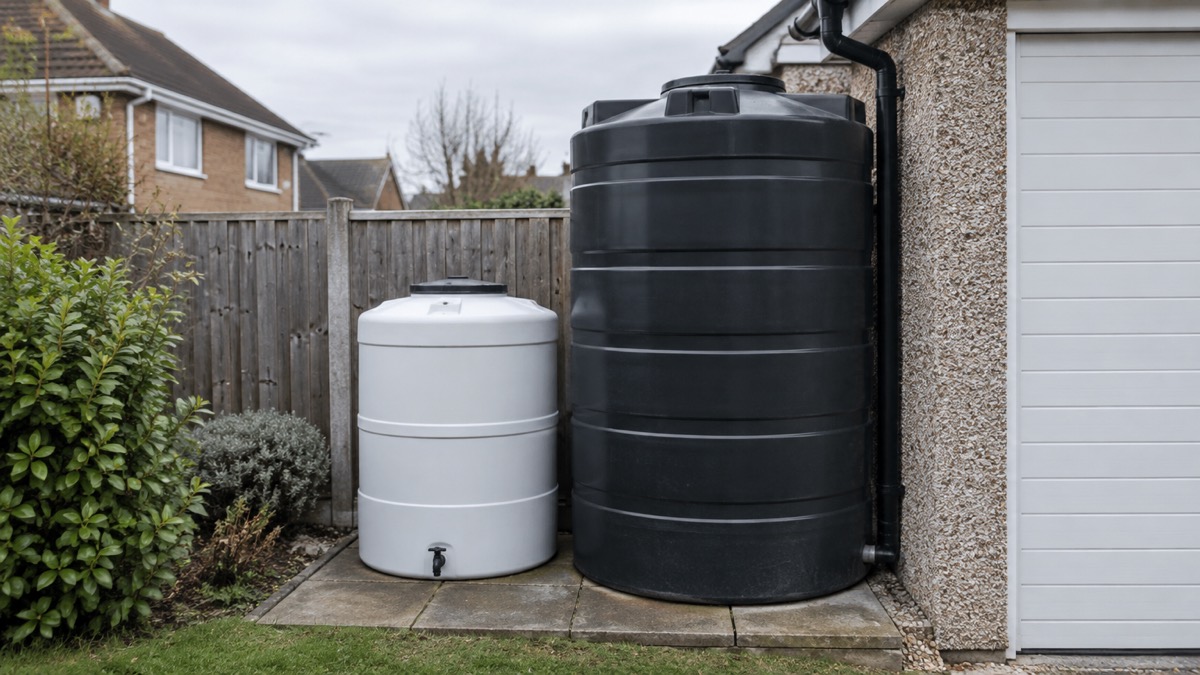
The choice comes down to one question: might anyone drink it? If yes, buy potable and keep it covered. If no, buy non-potable and label it clearly. Everything else, the colour, the outlet, the material, follows from that.
A few practical points to weigh:
- Where it will stand. Above-ground tanks are the common form, but a range of tanks is made specifically for underground installation, in both non-potable and potable versions16. The underground tanks guide covers the digging and installation side.
- How it will be filled. A tank fed from a downpipe is a rainwater tank. A tank filled from the mains, or topped up from it, brings the fluid category question into play2.
- What it will feed. A garden tap and a toilet cistern are non-potable jobs. A kitchen tap is not.
- How it will be kept clean. A close-fitting cover is part of what makes a plastic tank safe for drinking water1.
If you are building a wider water plan, the self-reliance section brings together rainwater harvesting, storage and pumping, and the above-ground tanks guide compares vertical, horizontal and slimline shapes.
Where to get help
For a drinking water tank, the maker's own product page is the place to confirm the standard, the colour options and the outlet size before you order. For a mains-connected installation, ask the maker or a qualified plumber about fluid category 5 approval, because the answer depends on the installation and not only on the tank2.
If your mains supply is interrupted, your water company is the first point of contact. It publishes what it will do for households during an interruption, and it issues boil water and do not drink notices with specific instructions when water is at risk8. Follow those instructions exactly, and do not substitute water from a non-potable tank.
Households that would struggle without a supply, including older people, disabled people and those with medical needs, can ask their water company about priority support. The extra help guide explains who is eligible and how to register.
Sources (17)
- Water storage tanks and cisterns, Drinking Water Inspectorate, 2026-06-09
- 2500 Litre Water Tank Non-Potable, Enduramaxx, 2026-08-11
- 10000 Litre Water Tank Non-Potable, Enduramaxx, 2026-09-24
- 12000 Litre Potable Drinking Water Tank, Enduramaxx, 2026-08-14
- 1450 Litre WRAS Approved Water Tank, Ecosure, 2026-11-04
- 4,500 Litre Water Tank, Non-Potable - Enduramaxx, Enduramaxx
- 5000 Litre Water Tank Non-Potable, Enduramaxx, 2026-11-02
- Our promise to you if your water supply is interrupted, South East Water, 2026-10-28
- Boil your water notice: questions and answers, Anglian Water, 2016-04
- 80000 Litre Potable Drinking Water Tank, Enduramaxx, 2026-03-09
- 7500 Litre Potable Drinking Water Tank, Enduramaxx, 2026-06-17
- 12000 Litre Water Tank Non-Potable, Enduramaxx, 2026-06-17
- 30000 Litre WRAS Approved Potable Water Tank, Enduramaxx, 2026-09-04
- 50000 Litre WRAS Approved Potable Water Tank, Enduramaxx, 2026-03-09
- 30,000 Litre Water Tank, Non-Potable - Enduramaxx, Enduramaxx
- 1000 Litre Layflat Potable Water Tank, Ecosure, 2026-11-04
- 13,000 Litre Water Tank Non-Potable, Ecosure, 2026-11-04
 Composting Toilet vs Septic Tank
 Water Butt or Underground Tank