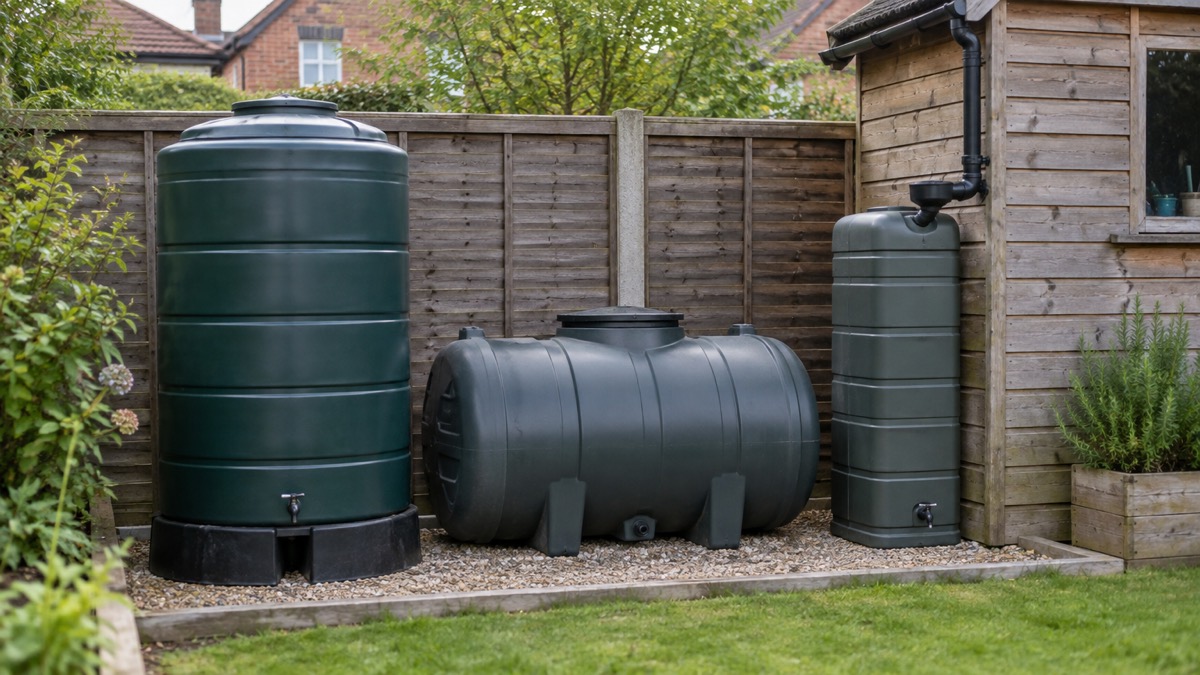
An above-ground rainwater tank is the step up from a water butt: the same idea, collecting rain from your downpipes, but with enough capacity to flush toilets, water a serious garden, or keep a household going through a supply interruption. Makers offer above-ground rainwater tanks in 40 sizes, from 150 litres for home and garden irrigation up to 30,000 litres for agricultural and industrial use1. They come as vertical cylinders, horizontal tanks and slimline designs for tight spaces, and several can be linked together to build far larger stores1.
This page explains how to choose between those shapes and sizes, how to prepare a base, what insulation does against frost, and the rules that matter most: rainwater is not drinking water, and any tank connected to the mains needs an air gap to protect your drinking supply. If you are new to the subject, start with how a rainwater harvesting system works and what harvested rainwater can be used for.
Sizes: from 150 litres to 30,000 litres
The smallest above-ground rainwater tanks, at 150 to 300 litres, do the job of a large water butt: keeping a patio or small border watered through a dry spell. From there the range climbs steadily through garden and smallholding sizes to 30,000 litres, which is agricultural and industrial territory1. To work out which size your roof and your demand actually justify, see how to size a rainwater tank.
A sense of scale helps. A 7,500 litre garden system, supplied as a complete kit for horticultural, agricultural or garden use, holds 7,370 litres of water in a tank 2,530mm high and 2,085mm in diameter5. That is already a tank taller than most people, and it needs a firm, flat patch of ground to sit on. At the top of the range, a 30,000 litre tank has a diameter of 3.45m and a total height of 3.6m6, which is a structure, not a container, and usually beyond anything a domestic garden can take.
| Tank | Capacity | Footprint and height | Typical use |
|---|---|---|---|
| Small vertical non-potable | 300 litres | Compact upright | Garden watering7 |
| Slimline baffled upright | 400 to 800 litres | Slimline, fits behind a shed or in a garage | Garden and rainwater harvesting8 |
| Garden system kit | 7,370 litres | 2,085mm diameter, 2,530mm high | Horticultural, agricultural or garden use5 |
| Large vertical | 15,000 litres | Vertical cylinder | Garden, commercial and agricultural storage10 |
| Largest single above-ground | 30,000 litres | 3.45m diameter, 3.6m high | Agricultural and industrial6 |
Two practical points about quoted sizes. First, makers state that tank sizes are subject to a plus or minus 3% variation, so a "15,000 litre" tank may hold slightly more or less than the name suggests6. Second, if you are comparing an above-ground tank with an underground one, the below-ground range is smaller: underground rainwater tanks are available from 180 litres to 10,000 litres1, so anything above that has to sit above ground or be built as a linked set.
For perspective on what these volumes mean in an emergency: water tankers used by water companies range from 5,000 litres in smaller trucks to 30,000 litres in larger tankers12. A single 7,370 litre garden tank holds roughly what one of the smaller emergency tankers delivers, which is why a full rainwater tank is a genuine backup for water in an emergency, even though the water itself is not drinkable.
Vertical, horizontal or slimline: choosing a shape
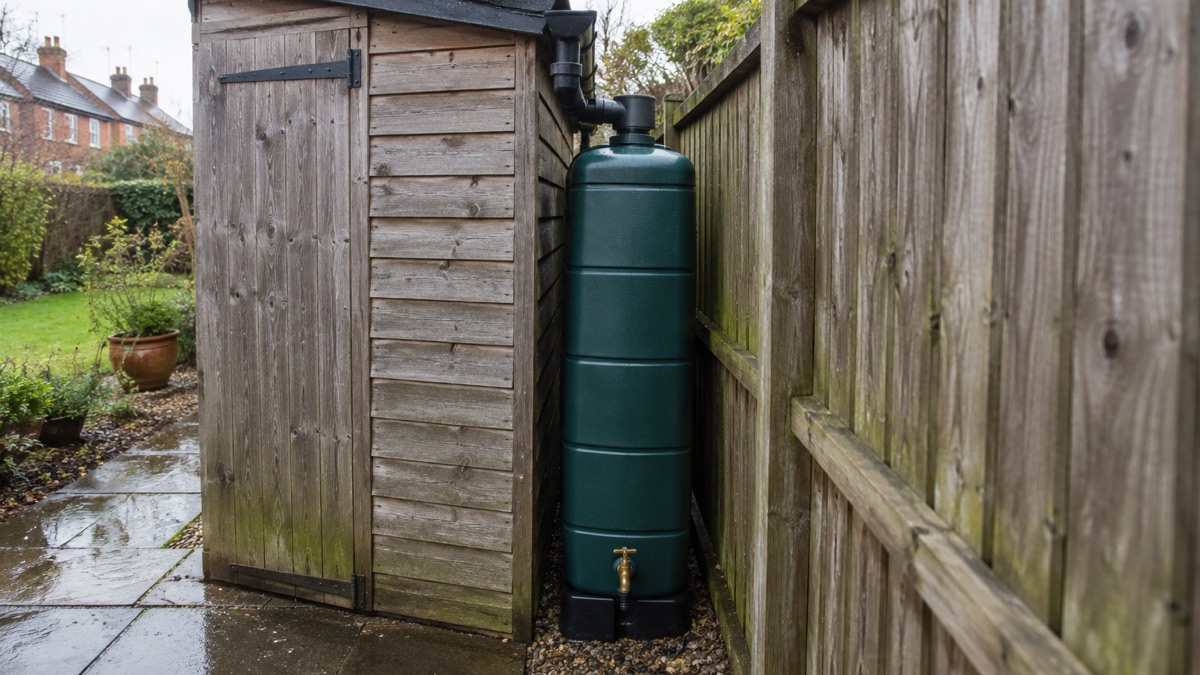
Above-ground rainwater tanks come in a range of configurations: vertical or horizontal, and standard or slimline, low profile, or designed for restricted spaces1. The right shape is decided by where the tank will go, not by any other factor.
Vertical cylinders hold their litres in the simplest moulded shape, a round upright tank. Their drawback is height and the footprint they need: the 7,370 litre tank above stands 2,530mm tall on a 2,085mm circle5. Vertical tanks suit a corner of a garden, a yard, or beside a shed where the height is not in anyone's way.
Horizontal tanks sit low and long, which makes them stable and easier to tuck against a wall or under a structure. They are the natural choice where height is the problem, such as under a low eave or inside a building with a low ceiling.
Slimline tanks trade some efficiency of shape for a narrow profile. A 400 litre baffled upright tank is described by its maker as a slimline water tank that can be sited behind sheds and in garages without taking up too much space, and the same applies to the 800 litre version8. Both are rotationally moulded for above-ground use and can serve as rainwater tanks, water butts for garden watering and rainwater harvesting8. At the extreme end, a 2 x 400 litre wall tank is sold as one of the slimmest tanks on the market, complete with downpipe filter and connector, ready to install13. Slimline tanks are the answer for the side return of a terraced house, the gap behind a garage, or a balcony-level space where nothing else fits.
Fittings matter as much as shape. On the 400 litre baffled tank, fusion-welded sockets are available in half, three-quarter, 1, 1 and a quarter, 1 and a half and 2 inch BSP female, and three-quarter, 1 and 1 and a half inch BSP male, with outlets available in different positions as well as the standard position8. That flexibility is what lets a slimline tank be plumbed in where a standard outlet would end up facing the wall. For what sits between the downpipe and the tank, see rainwater filters.
Siting a tank and preparing the base
An above-ground tank full of water is heavy, and the base it sits on decides whether it stays round and sound. The maker of the 30,000 litre tank recommends a smooth, level, firm surface, with a reinforced concrete base the best option, and the base a minimum of 600mm (24 inches) larger than the dimensions of the tank6. A base that is too small lets the tank edge overhang, which stresses the moulding as the tank fills and settles.
The required depth of the base scales with the tank:
| Tank size | Minimum base depth |
|---|---|
| Up to 2,500 litres | 102mm (4 inches)6 |
| 4,000 to 10,000 litres | 152mm (6 inches)6 |
| Over 10,000 litres | 204mm (8 inches)6 |
For the small and slimline tanks, a properly levelled paving slab or concrete pad is usually enough; for anything over 10,000 litres, treat the base as a small building project. Think about access for cleaning too: on insulated tanks, a bolt down lid and side access hatch are available for access for cleaning, installation and maintenance of water pumps4. Whatever the size, leave yourself a way to reach the tank for the routine jobs set out in keeping a rainwater system clean.
Where you site the tank also affects how well it works. Water pressure is lost the higher water has to be lifted, so the height of a tank relative to the supply pipe affects how quickly it refills14. A tank sited high, or on a stand, gives better gravity flow to a hose or tap below it; one at ground level may need a pump to deliver useful pressure. If you plan to run the water to toilets rather than a hose, read direct feed and gravity feed systems before deciding where the tank goes.
Linking tanks in series to store more
If one tank is not enough, or one large tank will not fit through the gate, link several. Makers state that multiple above-ground rainwater tanks can be connected in series to increase capacity, by linking tanks through simple connection kits1. Linked tanks behave, hydraulically, much like one big one: water finds its level across the set, and you draw from the last tank in the line.
This is exactly how the largest installations are built. A 45,000 litre rainwater harvesting tank is sold as a combination of 2 tanks11; a 90,000 litre set-up is a combination of 3 tanks1; and a 100,000 litre low-profile rainwater tank is a combination of 5 tanks, with a 4-tank variant also listed15. The 100,000 litre low-profile set measures 20,000mm long by 3,450mm wide by 2,750mm high overall15, which tells you the real point of linking: each individual tank stays a manageable size to manufacture, deliver and place, while the total store grows to whatever the site needs.
For a household, the same logic works on a smaller scale. Two 7,370 litre tanks linked in series give you nearly 15,000 litres of storage in a garden where a single 15,000 litre vertical tank would be too tall or too wide. Makers supply simple connection kits for exactly this purpose, so linking tanks in series is a standard way to increase capacity rather than a workaround6.
UV-stabilised plastic, colour and light
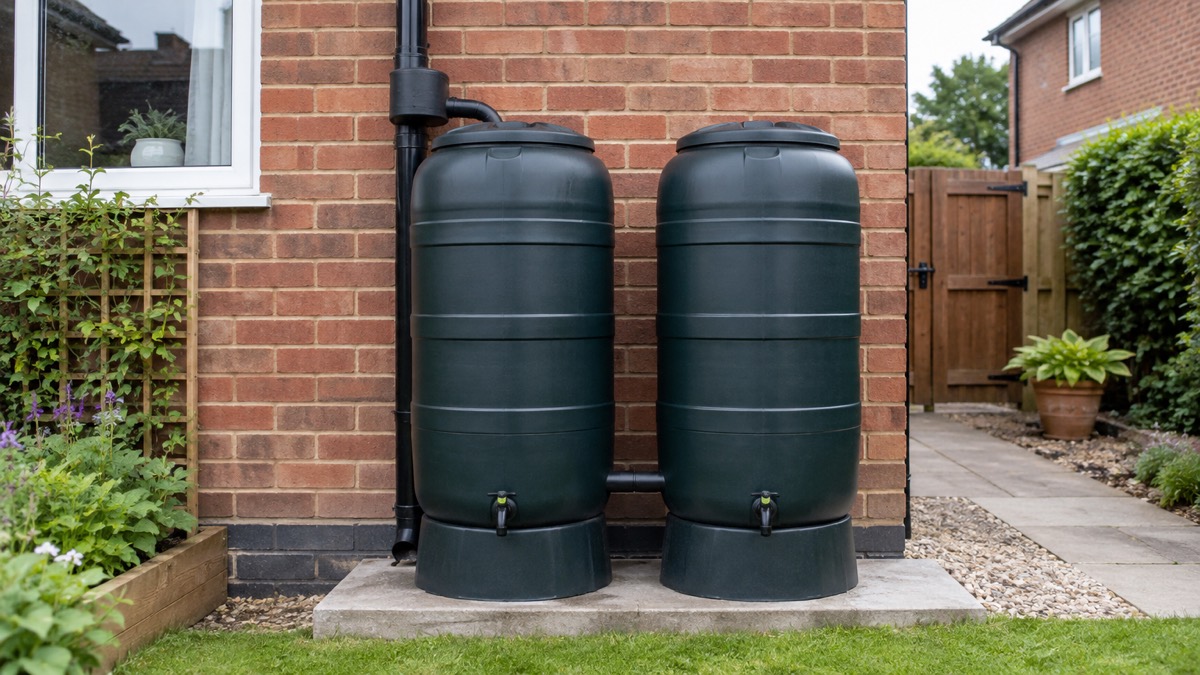
Above-ground plastic water tanks are UV stabilised for many years of outside use1, and makers repeat this across the range: the 300 litre, 720 litre and 15,000 litre non-potable tanks are all described as UV stabilised for outside use7, and the 15,000 litre rainwater tank is constructed from MDPE polyethylene which is UV stabilised10. UV stabilisation is what stops sunlight from making the plastic brittle and cracked over the years, and it is the specification that matters most for any tank that will live outdoors in a British garden.
Colour does two jobs. The first is appearance: black, dark green and boat blue tanks sit quietly against planting and fencing. The second is choice: what you can buy depends on the tank. Potable drinking water tanks come in black, boat blue or natural7, and the largest potable tanks are offered in black or blue12. Check the colour options for the specific tank before you order, as they vary by model and maker.
Natural, the translucent option, is the one to treat with care: it lets light through, so a natural tank in a sunny spot is the likeliest to grow algae. If you want or need a natural tank, site it in shade, in a garage or under decking. For the same reason, keep the lid on and the inlet filtered: the Rain Activ system filters rainwater from the roof as it enters the tank, removing any particles larger than 1mm18, and a downpipe filter does the same job on a simpler set-up.
Insulated tanks to stop water freezing
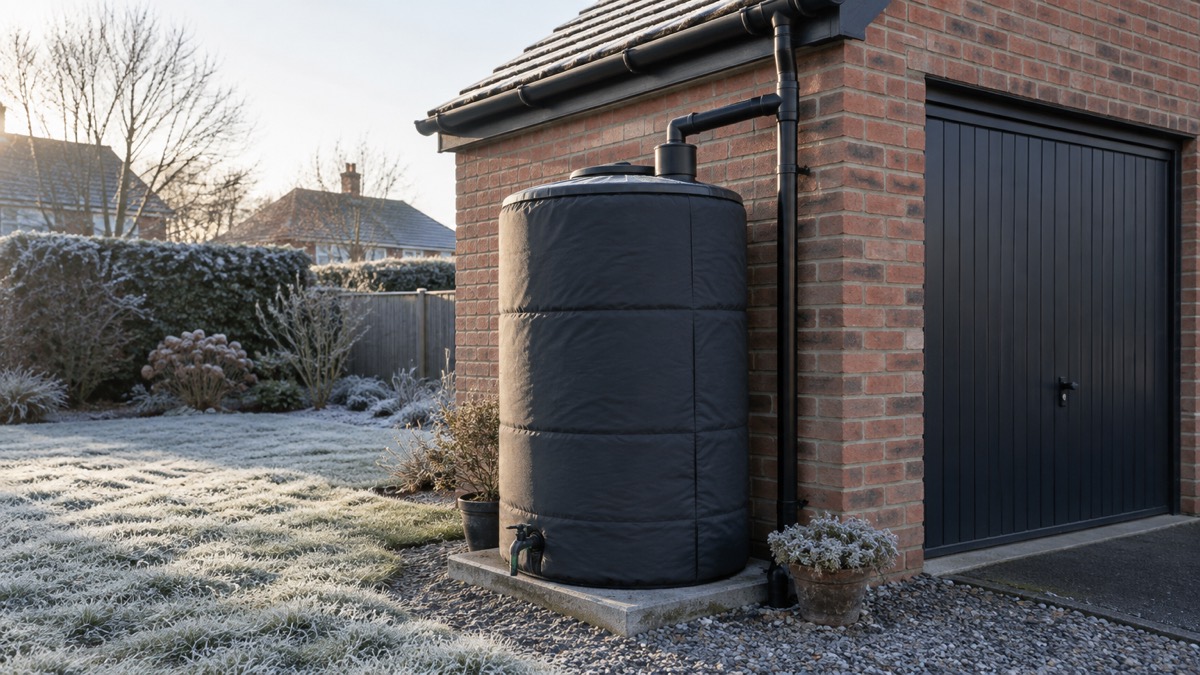
An above-ground tank in a British winter is exposed on every side, and a tank that freezes solid is out of action until the thaw, with a risk of split pipework and a damaged moulding. Insulated water tanks are designed for exactly this: use where temperature regulation is key, and for the prevention of overheating or freezing of liquids4. The insulation jacket is engineered to prevent condensation and effectively reduce thermal and energy loss19, and insulated tanks are often used in conjunction with in-tank heaters or coolers to reduce running costs4.
The range runs from domestic to commercial sizes. A 1,500 litre vertical insulated tank is a one-piece mould, seamless, rotationally moulded tank, with 25mm insulation and UV stabilisation19. At the other end, a 12,500 litre vertical insulated water tank carries the same 25mm insulation4. Both can be fitted with liquid level sensor assemblies, fill pipes, flanged connections and welded BSP outlets and sockets, plus the bolt down lid and side access hatch mentioned above4.
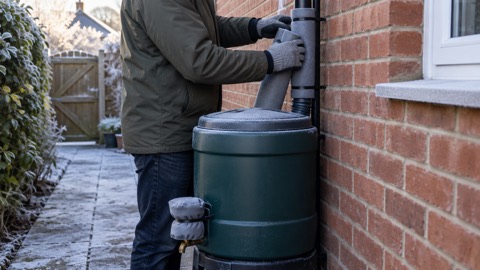
If your tank is in the loft rather than the garden, follow the plumbers' advice, which is consistent across the UK. WaterSafe advises fitting the water tank with an insulation jacket, or wrapping the top and sides with suitable insulation material20. Northern Ireland Water and Dwr Cymru Welsh Water give the same advice, and all three say the same thing about one common mistake21:
"Don't place loft insulation under the tank though as this stops heat from the rooms below helping to keep the water in the tank from freezing."
Do not push loft insulation under the tank: the advice is that this stops heat from the rooms below helping to keep the water in the tank from freezing, so it makes freezing more likely, not less22. Lagging the pipes to and from the tank, especially any that could be exposed to changes in temperature, helps prevent them freezing and bursting, and lagging material is sold at DIY stores22. A full season-by-season routine is in the rainwater system winter checklist.
Rainwater is not drinking water
This is the single most important rule on the page, and it applies however clean the water looks. The Centre for Alternative Technology goes further on the economics: in the UK, treating rainwater to a high standard for bathing or drinking is not recommended, because of the expense and environmental impact of the equipment23. The sensible division of labour is mains water for everything you swallow and rainwater for everything you pour away or onto soil.
That still leaves plenty of useful water. Official preparedness guidance states that water collected from downpipes can be used for flushing toilets or watering plants24, and a council advising households on drought recommends installing a water butt for rainwater storage from downpipes, connected to greywater systems such as toilet flushing and garden watering25. At commercial scale, a 100,000 litre low-profile tank is listed for landscape watering, horticultural and market garden applications, toilet flushing in industrial, commercial, hospital or school environments, equine and agricultural establishments, irrigation and wash-down facilities15. There is also a drought-specific benefit: a maker of garden systems points out that a household with its own stored rainwater can use that water during a hosepipe ban, water that cannot be claimed by the water authorities13.
Because the water is not for human consumption, the pipework must say so. On the Rain Activ Dual Garden System, the maker warns that untreated rainwater is not for human consumption, and water companies are recommending, and in some cases requiring, black and green HDPE pipe, with the point of use clearly labelled18. The details of pipe choice and labelling are covered in what pipe to use for rainwater and labelling rules.
How a rainwater tank differs from a drinking water tank
The difference is not mainly the shape or the plastic; it is the approval behind the tank and the fittings around it. Water tanks classified as potable drinking water tanks are suitable for storing water fit for human consumption and conform to the WRAS (Water Regulations Advisory Scheme)7. Part of that conformity is about the material itself: the plastic does not taint the water it is holding16. A non-potable tank, by contrast, is built for garden, agricultural and wash-down use and carries no drinking-water approval, which is why the small vertical tanks are sold explicitly as non-potable7.
If you are keeping a tank specifically as an emergency drinking water store, that is a potable tank, and it is a different purchase from a rainwater tank. See water in an emergency for what to store and how. What you must never do is use one tank for both jobs, or let rainwater pipework and mains pipework meet without protection.
Some tanks blur the line in ways worth knowing. The 7,500 litre garden system's tank is described by its maker as providing cost effective potable and non-potable water storage, used by schools, hotels, housing estates, farms, equestrian and commercial properties, in above ground locations only5. The Rain Activ Dual tank splits its volume in an unusual way: the bottom portion stores the rainwater for use in the garden, while the top portion serves as attenuation capacity, slowing the release of storm water18. Neither changes the rule above: rainwater in any of them stays non-potable in use.
Where a tank meets the mains: the fluid category 5 air gap
Any tank that is connected to the mains water supply, usually so it can top itself up when rain is short, needs protection so that stored water can never flow back into the drinking water main. The maker's guidance is that in many installations, water tanks connected to the mains water supply will need to have a type of AB air gap to be fluid category 5 approved4, and the same requirement is stated for potable drinking water tanks connected to the mains19. Fluid category 5 is the highest contamination risk classification, and rainwater in a tank counts as it: without the air gap, a drop in mains pressure could siphon tank water back into the street main.
An AB air gap is a physical gap between the inlet pipe and the water surface, sized so that water can only ever fall into the tank, never rise back up the supply. On underground tanks, makers offer a raised turret specifically for AB air gap installations26. The same principle applies above ground, and it is one of the things a BS 8551 and water fittings rules compliant installation gets right.
Official guidance for private water supplies adds a related duty on tank design: ensure that treated water tanks are designed, installed and maintained to prevent ingress of contaminants through precipitation, rain and snow27. In practice that means a sound lid, a sealed inlet and an overflow that keeps insects and debris out, on any tank whose water matters. Approved materials, WRAS or permitted under regulation 5, should be used to prevent contamination of rainwater during runoff and collection27, which is why makers specify WRAS approved polymer for tanks that store water for human consumption3.
Discoloured or smelly water: what it means and what to do
Stored rainwater that sits unused for a long time can develop earthy, musty or stale smells, because water left standing in pipework and tanks changes character, especially where there is little turnover28. The answer is turnover: use the tank, and keep the inlet filtered to 1mm or better18. The question of whether stored rainwater goes off is covered in full at does stored rainwater go off or stagnate?.
The advice on smells has a useful household test. Affinity Water suggests filling a glass with water and smelling it in a different room, away from the kitchen sink; if the water smells fine, the problem may be the sink or plug hole, which can be cleaned with a normal domestic cleaner29.
For mains tap water, the picture is different and more serious. If your water is discoloured, cloudy or smells, check with your water supply company before drinking it or using it for baby formula or brushing teeth, as it may be contaminated30. After a supply interruption, try running the cold tap nearest to your stopcock, usually under the kitchen sink, for a while to see if it clears the discolouration, and contact your water provider if problems continue31. After a flood, contact your water company if tap water is discoloured or tastes bad32.
One diagnostic detail is worth knowing: if the issue is only present at taps other than the mains-fed kitchen tap, a storage tank in the house may be the cause33. That points at a loft tank or cistern rather than the mains, and at the maintenance section of this page. WaterSafe also lists overflows from a water tank or cistern in the loft among the sources of household leaks to check34.
Frequently asked questions
Are there flexible or inflatable rainwater tanks? Most above-ground tanks are rigid, rotationally moulded plastic. For above-ground use where space is tight, rigid slimline baffled upright tanks of 400 and 800 litres are the practical small option8. If you are considering a flexible or underground design, check the maker's installation instructions for that specific tank before buying.
Can I use tank rainwater to flush toilets and water the garden? Yes. Official guidance says water collected from downpipes can be used for flushing toilets or watering plants24, and drought advice recommends connecting storage to greywater systems such as toilet flushing and garden watering25. Label the point of use, because the water is not for human consumption18.
Is an above-ground tank better than an underground one? They suit different sites. Above-ground tanks need no excavation, are easy to inspect and run from 150 to 30,000 litres1; underground tanks save space and run from 180 to 10,000 litres1. Some designs cross over: a 1,100 litre underground tank can be used above ground also3. The full comparison is at underground rainwater tanks.
What does WRAS approval mean? A potable drinking water tank conforms to WRAS and is suitable for storing water fit for human consumption7, with WRAS approved polymer used in its construction3. Official guidance says approved materials, WRAS or permitted under regulation 5, should be used to prevent contamination of rainwater during runoff and collection27.
Does tank colour matter? It affects what you can buy and how the tank looks. Potable drinking water tanks are available in black, boat blue or natural7, and the largest potable tanks come in black or blue12. Options vary by tank and maker, so check the colour choices for the specific model before you order.
How do I stop my tank freezing? Choose an insulated tank with a 25mm jacket4, or fit an insulation jacket to a loft tank, wrapping the top and sides, and never put loft insulation under the tank20. Lag any exposed pipes22.
Can I link tanks together? Yes, with simple connection kits1. Large stores are built this way: 45,000 litres as 2 tanks, 90,000 as 3, and 100,000 litres as 511.
Sources (34)
- Enduramaxx Rainwater Harvesting Tanks, Enduramaxx, 2026-10-29
- Enduramaxx Rainwater Harvesting Overview, Enduramaxx, 2026-10-29
- Enduramaxx Rainwater Tanks, Enduramaxx, 2026-10-29
- 12,500 Litre Vertical Insulated Water Tank with 25mm Insulation, Enduramaxx, 2026-09-16
- 7500 Litre Garden System, Rainwater Harvesting Ltd, 2026-03-24
- Enduramaxx 30,000 Litre Rainwater Tank, Enduramaxx, 2026-09-28
- Enduramaxx 300 Litre Vertical Tank, Non-Potable, Enduramaxx, 2026-06-17
- 400 Litre Water Tank, Slimline, Baffled, Upright, Enduramaxx, 2026-06-17
- 800 Litre Water Tank, Slimline, Baffled, Upright, Enduramaxx, 2026-06-17
- 15,000 Litre Rainwater Tank, Enduramaxx, 2026-10-05
- 45,000 Litre Vertical Rainwater Harvesting Tank, Enduramaxx, 2026-09-28
- United Utilities Water Tankers, United Utilities, 2026-10-28
- Rainwater Harvesting Ltd Homepage, Rainwater Harvesting Ltd, 2026-07-17
- Low Water Pressure, Affinity Water, 2026-10-29
- 100,000 Litre Rainwater Harvesting Tank, Low Profile, Enduramaxx, 2026-09-28
- Enduramaxx 720 Litre Water Tank, Non-Potable, Enduramaxx, 2026-06-17
- Enduramaxx 15,000 Litre Slimline Water Tank, Non-Potable, Enduramaxx, 2026-06-30
- Rain Activ Dual Garden System, Rainwater Harvesting Ltd, 2026-07-01
- 1,500 Litre Vertical Insulated Water Tank with 25mm Insulation, Enduramaxx, 2026-09-16
- How Do I Protect Against Frozen Pipes?, WaterSafe, 2026-10-29
- Winter Proof Your Home, Northern Ireland Water, 2026-10-28
- Protecting Your Pipes, Dwr Cymru Welsh Water, 2026
- Reducing Water Use, Centre for Alternative Technology, 2025-06-27
- Water Supply Interruptions or Outages, Prepare Campaign, 2026-10-12
- Drought Advice, Westminster City Council, 2026-08-06
- Enduramaxx Underground Water Tanks, Enduramaxx, 2026-10-29
- Protecting Your Private Water Supply, Drinking Water Inspectorate, 2026-10-28
- Taste and Smell, Bristol Water, 2026
- Tastes and Odours, Affinity Water, 2026-10-28
- Prepare Yourself, Greater Manchester Combined Authority, 2026-10-29
- Water Supply Interruptions or Outages, Be Ready Campaign, 2026-10-12
- Flooding Advice, Mid and West Wales Fire and Rescue Service, 2026-10-29
- Discoloured or Dirty Water FAQ, Drinking Water Quality Regulator for Scotland, 2026-10-28
- How Do I Know If I Have a Leak?, WaterSafe, 2026-10-29
 Composting Toilet Kit Checklist
 Garden Harvesting Kit Checklist
 Rainwater Winter Checklist
 Composting Toilets
 Direct vs Gravity Feed Systems
 Planning Permission for Systems
 Private Water Supply Running Low
 Private Water Supply Regulations
 Private Water Supplies Scotland
 Treating a Private Water Supply
 Rainwater Filter Types
 How Rainwater Harvesting Works
 Rainwater System Maintenance
 Pumps for Rainwater Tanks
 Rainwater Systems and the Law