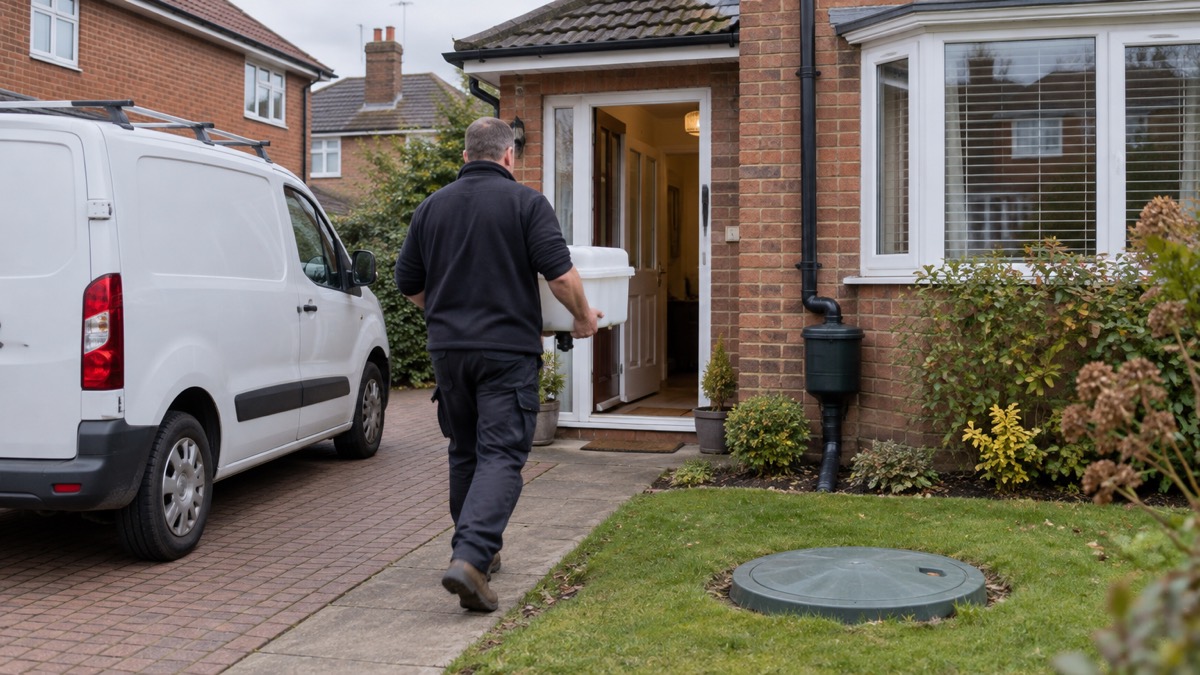
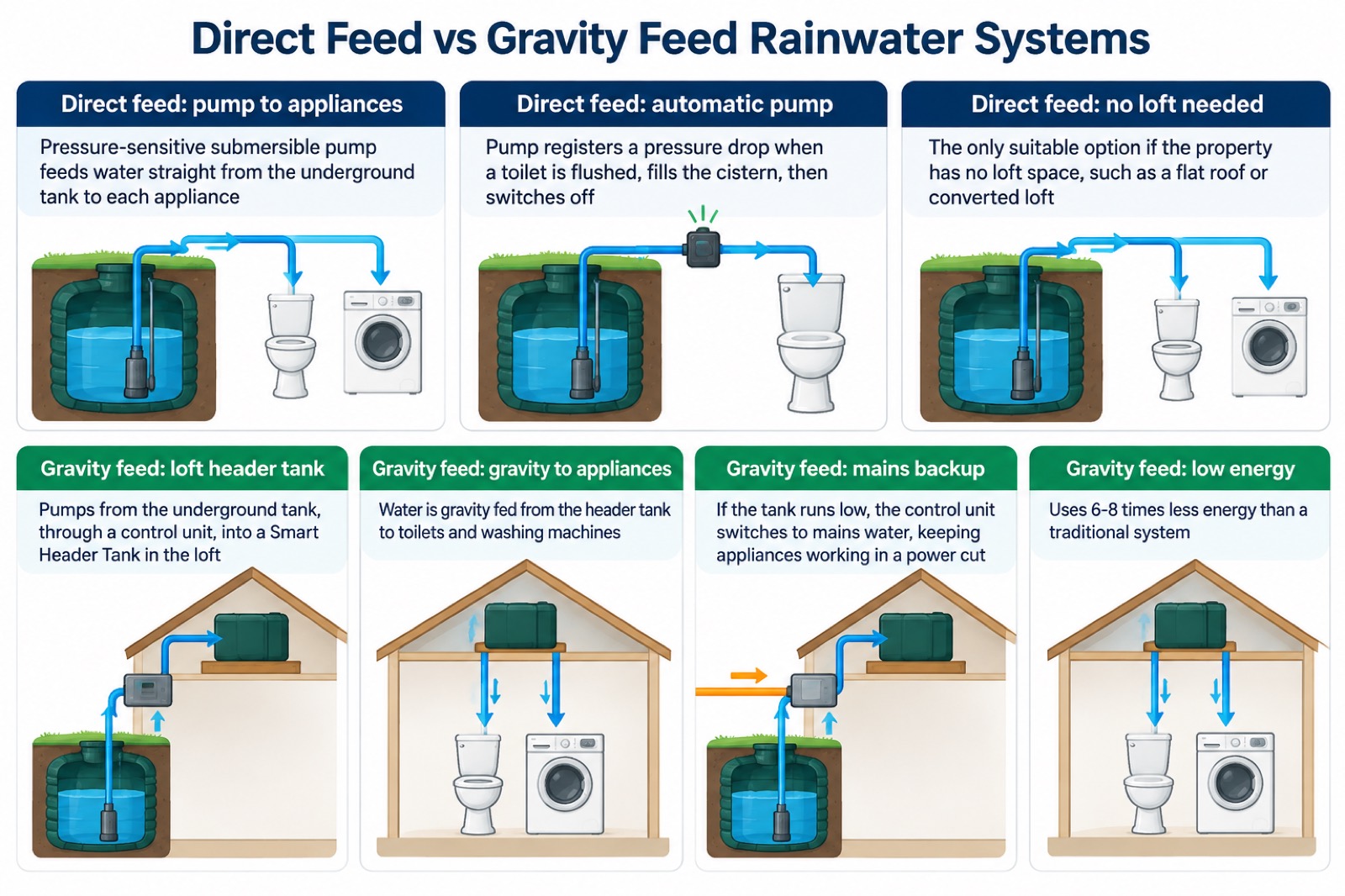
A whole-house rainwater system collects water from your roof, filters it and stores it in a tank, usually buried in the garden. The question this page answers is what happens next: how the water actually reaches your toilet cisterns and washing machine. There are two arrangements. In a direct feed system, a submersible pump in the underground tank pushes water straight to each connected appliance whenever it is needed1. In a gravity feed system, the pump moves water up to a small header tank in the loft, and gravity then feeds the toilets and washing machine from there2.
The choice matters for three practical reasons. A direct feed system is the only option if your home has no loft space, for example a flat roof or a converted loft1. A gravity feed system keeps working through pump failure or a power cut, because the header tank holds a reserve that drains down without any electricity1. And a gravity arrangement uses far less energy over a year, because the pump fills the header tank in batches rather than starting for every single flush3.
Both systems deliver the same thing at the tap end: non-potable water for toilets, washing machines and the garden, which the makers estimate can cut your incoming mains water use by around 50 per cent when those uses are added together2. Neither is for drinking. This page explains how each works, what each needs, and how to tell which one suits your house.
The two systems side by side
The difference between the two is entirely about where the water goes after the underground tank. In a direct feed arrangement the pump is the whole delivery system: every toilet flush and every wash cycle is a fresh demand on it. In a gravity arrangement the pump works ahead of demand, filling a loft tank, and the appliances draw from that tank by gravity, exactly the way a traditional cold water storage cistern feeds a gravity-fed shower.
| Direct feed | Gravity feed | |
|---|---|---|
| Where water goes after the tank | Straight from the submersible pump to each appliance2 | Up to a header tank in the loft, then down by gravity3 |
| What triggers the pump | A drop in pressure when an appliance opens2 | The control unit, when the header tank needs topping up3 |
| Needs loft space | No1 | Yes, for a small header tank1 |
| If the pump fails or power cuts | Appliances stop until mains backup or repair | Toilets and washing machine keep working from the header tank1 |
| Energy use | Pump runs for every demand | One maker states 6 to 8 times less energy than a traditional system3 |
| Suits | Homes without a loft; flats and converted lofts1 | Nearly all homes where a small header tank fits in the loft3 |
The plumbing trade uses the same distinction for private water supplies generally. Dwr Cymru Welsh Water describes a direct system as one where the plumbing is connected straight to the supply, and an indirect system as one where the water is stored or pumped into a tank which then feeds part or all of the plumbing, with the tank sometimes also refilled from the mains5. A rainwater system with a header tank is an indirect system in that sense, and the mains top-up that most of them include is exactly the kind of arrangement the water regulations govern, covered on our page on rainwater regulations.
How a direct feed system works
In a direct feed system, water is fed directly from the submersible pump in the underground tank to each appliance2. The pump is pressure sensitive, so it reacts automatically when water is needed1. The sequence runs like this:
- You flush a toilet, or the washing machine calls for water.
- The pressure in the rainwater pipework drops.
- The submersible pump registers the drop and starts.
- It pumps until the cistern or machine is full.
- It switches itself off automatically2.
That on-demand behaviour is the system's main appeal: there is no loft tank to find space for, no extra plumbing between the pump and the appliances, and the pressure at the appliance is the pump's pressure. It is the arrangement the maker recommends when a property has no loft space, for example a flat roof or a loft that has already been converted1.
The pump itself sits submerged in the tank. One maker describes its HydroForce pump as a submersible, pressure sensitive, electronically controlled rainwater tank pump, centrifugal and roto-dynamic with no reciprocating parts, manufactured in the UK and designed for rainwater harvesting systems6. The absence of reciprocating parts is the maker's own point about wear: fewer moving components in contact with the water. You can read more about pump types on our page on rainwater pumps.
The weakness of a direct feed arrangement is that the pump is a single point of failure. Every appliance depends on it, and it depends on electricity. To cover dry spells, direct feed systems are supplied with a mains backup device: the maker describes it as delivering a small amount of mains water to keep domestic appliances functioning when the underground tank has insufficient water due to lack of rainfall2. One version, sold as Backup in a Box, is commonly used with direct feed systems where a submersible pump supplies water directly from the tank to appliances such as toilets or washing machines7. When the tank level becomes too low, the control unit opens a solenoid valve and allows approximately 200 litres of mains water to enter the tank1. That is a measured top-up, not an open refill, and it is the point at which the water regulations on cross-connection and backflow prevention bite, which is why the whole subject has its own page on mains top-up rules.
Direct feed systems are sold as complete kits in a range of tank sizes, from a 3000 litre4 through 50008 to 7500 litres9, each an underground domestic kit with mains water backup. There are also above-ground direct feed packages, such as a 7500 litre and a 9250 litre complete direct feed system intended to sit above ground10, which suit sites where excavation is impractical.
How a gravity feed system works
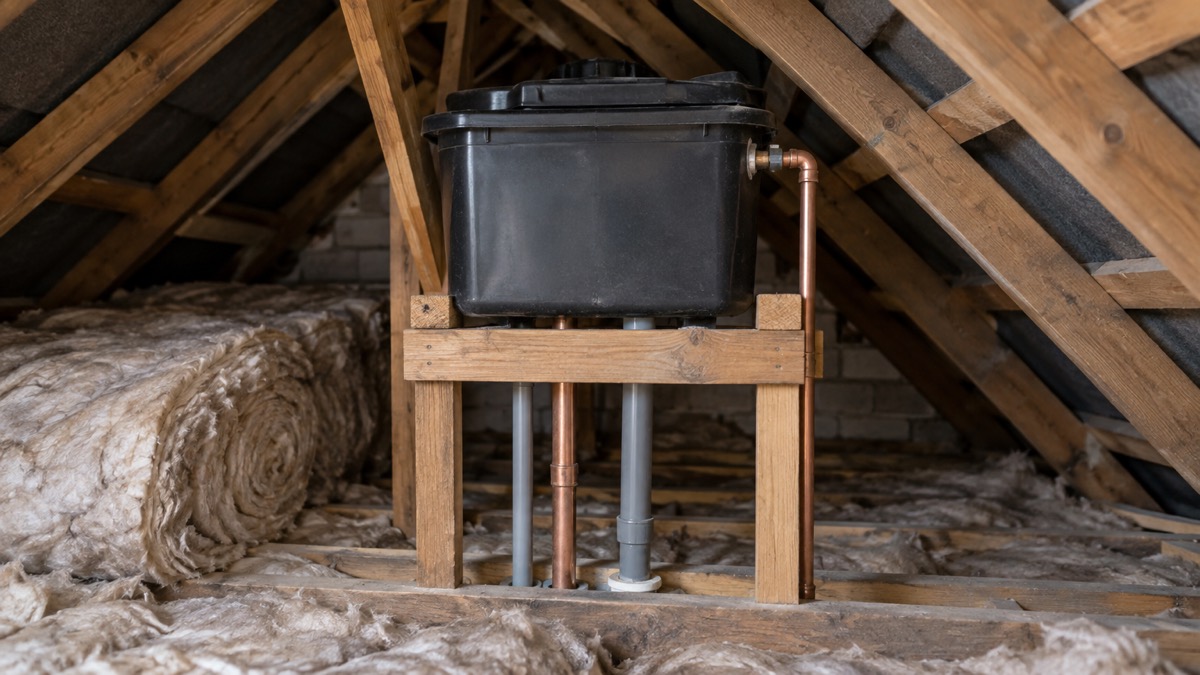
A gravity feed system adds one stage: the pump moves water from the underground tank, through a control unit, into a header tank in the loft, and the toilets and washing machine are then fed by gravity from that tank3. The maker's own product, the Rain Director, works exactly this way, pumping from the underground tank through a control unit into what it calls a Smart Header Tank within the loft space3.
The header tank changes how the pump behaves. Instead of starting for every flush, the pump runs to fill the header tank, then rests while the loft reserve covers demand. The maker states the Rain Director uses 6 to 8 times less energy than a traditional system by completely filling the Smart Header Tank and then letting gravity supply the appliances3. For a household watching its electricity use, that is the practical difference between the two arrangements.
The reserve in the loft is also what carries the house through trouble. The maker's guidance is blunt about the benefit: if the underground tank runs low, the control unit switches to mains water and feeds the header tank directly, keeping toilets and the washing machine working during low rainfall, pump failure, or a power cut1. So a gravity system fails soft in three separate ways:
- Dry weather: the control unit delivers mains water directly to the header tank3.
- Pump failure: the water already in the header tank still drains to the toilets by gravity1.
- Power cut: the same applies, no electricity is needed for the gravity leg1.
One installation detail from the maker is worth noting before the plumber arrives: always plumb the outside tap or taps directly from the pump so you get full pump pressure, and do not feed them from the header tank3. A loft tank delivers gravity pressure only, which is fine for filling a cistern but weak at the end of a hose. Gravity pressure depends on height: Yorkshire Water explains that the lower your home is in relation to the storage tank, the higher the pressure, and the closer it is, the lower12. A header tank a metre or two above a cistern gives a modest but steady flow, which is why power showers, which Cambridge Water notes use almost twice as much water as gravity-fed showers, are a different animal altogether13.
Gravity feed kits are sold in the same range of underground tank sizes as direct feed ones: 150014, 500015, 750016 and 15,000 litres17, each built around the Rain Director control unit and header tank.
Why many systems need a header tank
The header tank is not an afterthought; for many homes it is the heart of the design. Enduramaxx, a tank maker, puts it plainly: water recycling systems often require a header tank to provide a steady supply of water18. The Rain Director is described by its maker as a gravity fed rainwater management control unit and header tank, and it is specified to nearly all customers when a small header tank can be situated in a loft space3.
Three reasons recur across the makers' material:
- Steady supply: the loft tank buffers demand, so appliances see a constant gravity-fed flow rather than pump starts and stops18.
- Energy: filling a tank in batches and letting gravity do the delivery uses 6 to 8 times less energy than a traditional arrangement, the maker states3.
- Resilience: the tank's contents keep flushing toilets through a power cut or pump failure, and the control unit can fall back on mains water1.
The header tank itself is a modest piece of kit. Makers supply small horizontal tanks for exactly this duty, chosen for their low weight so a loft floor can carry them19. A loft reserve is a meaningful buffer for a household, and it is worth checking what your loft floor can safely carry before choosing a size, a point covered with tank sizing generally on our tank sizing page.
The principle is the same one used on private water supplies at village scale. In a Drinking Water Inspectorate case study of a contaminated private supply, the arrangement described is that water is pumped to a covered holding reservoir before being gravity fed to the properties20. Your header tank is that arrangement in miniature: pump once, store high, deliver by gravity.
What a rainwater system is not for
The permitted uses are the non-potable ones. A domestic rainwater harvesting system can be used for laundry, watering gardens, toilet flushing and cleaning18, and the direct feed system's maker sums up the classification: rainwater is classed as non-potable, allowing water to be used for toilets and washing machines, plus garden use2. Enduramaxx describes the same scope for large-scale storage: rainwater stored in its tanks can be used for non-potable applications such as toilet flushing, garden watering and washing clothes using a washing machine21. If you want the detail on what is and is not safe, our page on what harvested rainwater can be used for and our page on drinking rainwater cover it.
Two further limits shape whether a system makes sense at all. First, pipework: water companies recommend, and sometimes require, black and green HDPE pipe for rainwater, so that the non-potable supply can never be confused with the mains17. Our page on pipe labelling sets out what that means in practice. Second, cost and disruption: rainwater harvesting systems are typically more suited to new-build properties, where the cost of plumbing them in is negligible, and retrofitting into an existing property can be expensive18. If you are laying pipes anyway, a system is cheap to add; if it means lifting floors, it is a bigger decision.
A note on the mains side of the house, because it is often asked alongside: if you ever face a boil water notice or similar instruction on your mains supply, follow the water company's advice, and remember that normal mains use flushes the system through, as South West Water explains for households without a storage tank, where water is fed directly from the mains22. Your rainwater system does not change what you should do about your drinking water.
Underground tanks: collecting, filtering and storing
Whichever feed arrangement you choose, the front half of the system is the same: collect, filter, store. The direct feed system's maker describes it as designed for homeowners who want to collect, filter and store rainwater from their roof for domestic use and garden irrigation1. Water arrives through the downpipes, passes through a filter, and settles in a tank that is usually buried, because buried tanks stay dark and cool and free up the garden.
Filtering happens before storage, not after. Inline filters are made for exactly this duty: one maker's compact rainwater harvesting filter is for inline filtration of rainwater in tanks both above and below ground23. Keeping leaves and grit out of the tank protects the pump and keeps the water reaching your appliances cleaner. The filter types and how to maintain them are covered on our rainwater filters page and our maintenance page.
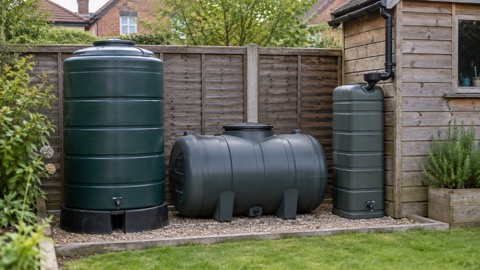
The tank itself comes in two broad families. Enduramaxx makes rainwater harvesting tanks, also called vertical storage tanks or water storage tanks, which provide the water storage element of a rainwater harvesting system, available as above-ground or underground tanks24. Above ground, they can be vertical or horizontal, standard or slimline, low profile, or designed for restricted spaces25. Below ground, the maker is clear about one requirement: underground rainwater harvesting tanks require a pump to work as part of a rainwater harvesting system25, which is why every system on this page is built around one.
| Tank style | Where it sits | What to know |
|---|---|---|
| Flat underground tank (F-Line range) | Buried, shallow dig | Installation depth 60% less than other rainwater tanks; excavation up to 70% less on some sizes15 |
| Traditional underground tank | Buried, deeper dig | Greater excavation depth and handling15 |
| Above-ground vertical or horizontal | Beside a wall or in a outbuilding | Vertical, horizontal, slimline or low profile options for restricted spaces25 |
| Loft header tank | In the loft | Small horizontal tanks chosen for low weight in a loft19 |
The F-Line flat tanks are the makers' answer to the biggest objection to underground systems, the dig. The tanks are flat and the installation depth is 60% less than other rainwater tanks, and on the larger sizes the maker states the excavation can be up to 70% less, meaning little earth excavation, easy handling and less cost15. How deep to dig in practice is covered on our underground tank depth page, and the tank designs themselves on our underground tanks and above-ground tanks pages.
Scale runs from small domestic set-ups to far larger stores, but the principle is the same: collect rainwater, filter it, and hold it underground until the household needs it. For an ordinary home, a domestic rainwater harvesting system covers laundry, watering the garden, toilet flushing and cleaning21. That is the yardstick to size against: enough stored water to keep those jobs running through a dry spell, without paying for capacity the roof catchment cannot refill.
One practical point on delivery, because it surprises people: on garden systems, the delivery is kerbside and offloading is the responsibility of the customer, though the maker notes shallow dig tanks can be lifted off the vehicle by hand with enough people26. Plan for bodies and trolleys on delivery day.
Which arrangement suits your house
The decision comes down to three questions, in this order:
- Do you have a loft you can put a small tank in? If not, a flat roof or a converted loft, the maker's guidance is that a direct feed system is the only suitable option1.
- How much do you value keeping toilets working through a power cut or pump failure? If that matters to you, and for a prepping-minded household it usually does, the gravity system's header tank reserve is the deciding feature1.
- How much does the pump's energy use matter? The gravity arrangement's batch filling uses 6 to 8 times less energy than a traditional system, the maker states3.
For most houses with an ordinary loft, the makers' own guidance points to gravity feed: the Rain Director is specified to nearly all customers when a small header tank can be situated in a loft space3. Direct feed earns its place where there is no loft, or where the household prefers the simpler pipework and accepts that a pump failure stops the rainwater supply until it is fixed.
If your interest is emergency water rather than everyday savings, read the two together: a gravity system's header tank is a small household reserve by design, and our pages on rainwater in a power cut and on water in an emergency pick up that thread. For the garden-only end of the scale, a water butt or a garden system may be all you need, and our water butt or underground tank comparison sets out the trade-off.
Sources (26)
- Direct Feed or Gravity Feed, Rainwater Harvesting Ltd, 2026-04-10
- Rainwater Harvesting Direct Feed Systems, Rainwater Harvesting Ltd, 2025-10-23
- Rainwater Harvesting Gravity Feed Systems, Rainwater Harvesting Ltd, 2025-10-23
- F-Line 3000 Litre Direct Feed System, Rainwater Harvesting Ltd, 2026-07-07
- Private Water Supplies and the Water Regulations, Dwr Cymru Welsh Water, 2026-10-29
- 7500 Litre Garden System, Rainwater Harvesting Ltd, 2026-03-24
- Backup in a Box, Rainwater Harvesting Ltd, 2026-03-13
- Rainwater Harvesting Ltd homepage, Rainwater Harvesting Ltd, 2026-07-17
- F-Line 7500 Litre Direct Feed System, Rainwater Harvesting Ltd, 2026-07-07
- 7500 Litre Rain Backup in a Box System, Rainwater Harvesting Ltd, 2026-03-24
- 9250 Litre Rain Backup in a Box System, Rainwater Harvesting Ltd, 2026-03-24
- Water Pressure, Yorkshire Water, 2026-10-28
- Saving Water FAQs, Cambridge Water, 2026-10-28
- F-Line 1500 Litre Gravity Feed System, Rainwater Harvesting Ltd, 2026-07-07
- F-Line 5000 Litre Gravity Feed System, Rainwater Harvesting Ltd, 2026-07-07
- F-Line 7500 Litre Gravity Feed System, Rainwater Harvesting Ltd, 2026-07-07
- F-Line 15,000 Litre Gravity Feed System, Rainwater Harvesting Ltd, 2026-07-07
- Enduramaxx Rainwater Tanks, Enduramaxx, 2026-10-29
- 500 Litre Horizontal Water Tank, Enduramaxx, 2026-09-28
- Faecal Contamination of a Supply (Case Study 2017/05), Drinking Water Inspectorate, 2022-07-11
- 100,000 Litre Rainwater Harvesting Tank, Low Profile, Enduramaxx, 2026-09-28
- Lifting a Boil Water Notice, South West Water, 2026-10-28
- Clean Rain Ultra Filter, Rainwater Harvesting Ltd, 2025-11-19
- Enduramaxx Rainwater Harvesting, Enduramaxx, 2026-10-29
- Enduramaxx Rainwater Harvesting Tanks, Enduramaxx, 2026-10-29
- Rain Activ Dual Garden System, Rainwater Harvesting Ltd, 2026-07-01
 Composting Toilet Kit Checklist
 Garden Harvesting Kit Checklist
 Rainwater Winter Checklist
 Above-Ground Rainwater Tanks
 Composting Toilets
 Planning Permission for Systems
 Private Water Supply Running Low
 Private Water Supply Regulations
 Private Water Supplies Scotland
 Treating a Private Water Supply
 Rainwater Filter Types
 How Rainwater Harvesting Works
 Rainwater System Maintenance
 Pumps for Rainwater Tanks
 Rainwater Systems and the Law