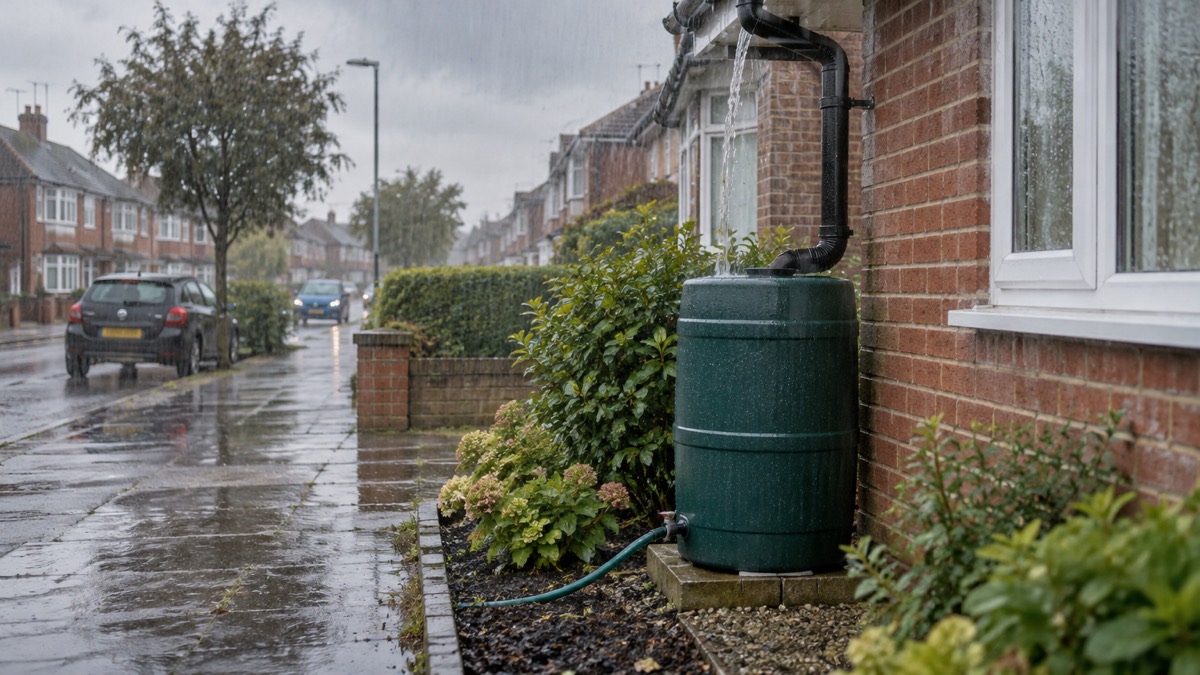
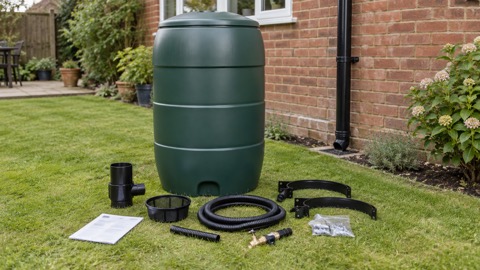
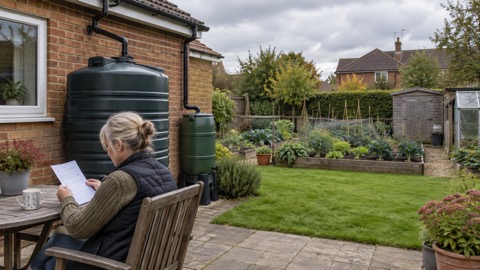
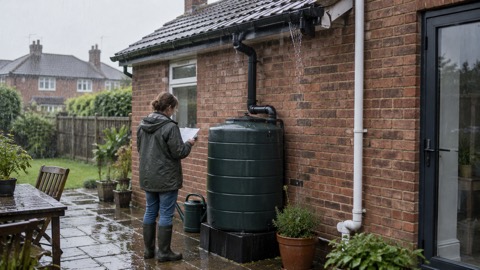
A water butt is a simple storage container that collects rainwater from your roof through a downpipe1. To make that connection properly you need a diverter or filter fitted into the downpipe, a level and firm base for the butt, and a lid that closes. The Royal Horticultural Society sets out the essentials: you need a gutter with a downpipe, a filter to keep leaves and debris out, a firm level stand or bricks so a watering can fits under the tap, and a close-fitting lid to keep out plant disease spores and discourage algae2.
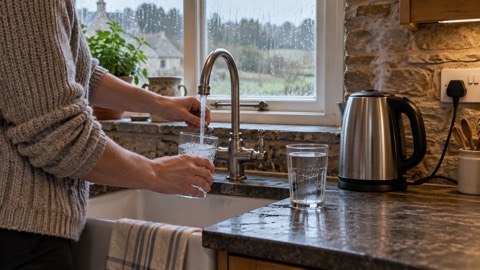
The payoff is real. Southern Water says fitting a water butt to collect and reuse rainwater could save more than 800 litres of water a year3, and the RHS estimates that in dry south-east England, 2,500 to 3,500 litres of rainwater a year can be collected from the roof of a small shed, enough to fill around 10 to 15 standard 240-litre water butts2. That water is for the garden, the car and the toilet, never the kettle.
This page takes you through the fit, the siting, the sizes, linking a second butt, keeping the water clean, and what the butt is worth when the mains supply fails.
Fitting a rainwater diverter to your downpipe, step by step
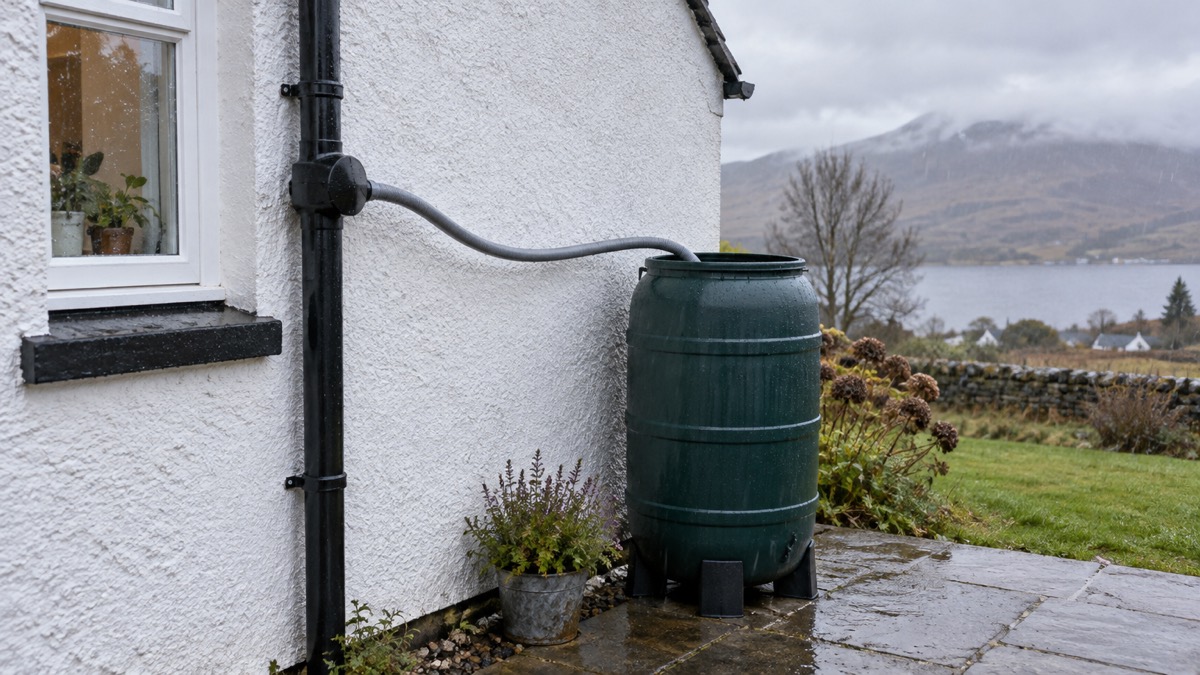
The diverter is the part that does the work. Ecosure, a maker of water butts, states plainly that to collect rainwater you will need a water butt connected to a downpipe via a rainwater diverter7. The reason is debris: a filter diverter takes rainwater in at the entrance, forces leaves and solids to the sides and on down the drainpipe, and passes the filtered water out through a cartridge to the tank inlet8. Without that separation, every leaf on the roof ends up in your butt.
Work in this order:
- Choose the butt and the diverter together. Check the diverter's pipe range against your downpipe before you cut anything. Common kits fit round downpipe of 68mm to 100mm and square downpipe of 65mm to 75mm, typical of UK plastic or iron downpipes4.
- Mark the height. The diverter sits on the downpipe at a height that lets water run downhill into the butt's inlet. The butt must stand on a firm, level base, so set the base first and mark from there.
- Cut the downpipe. Remove the section where the diverter body fits, following the maker's instructions for that unit. Makers describe these kits as do-it-yourself installation, adaptable to nearly all downpipes9.
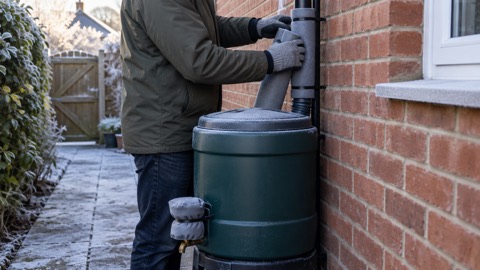
- Fit the diverter and seal it. Assemble the body onto the pipe with the seals supplied, then run the flexible connector from the diverter outlet to the hole cut in the butt. One maker's connector pipe is 1m long with an internal diameter of 32mm (1¼ inches)10.
- Test with a hose or the next rain. Watch for leaks at the pipe joints and check that water enters the butt and that overflow escapes where it should.
If you would rather understand the fittings before you buy, the guide to rainwater filters covers downpipe, inline and in-tank types, and the 3P Filter Collector and Tank Connector Kit page describes one kit in detail.
Choosing a level, stable spot near the downpipe
Place the butt close to a downpipe so rainwater can flow easily into it11. Distance matters because the feed relies on a gentle fall; a long, flat run of pipe holds water and silts up. Keep the run as short and as steep as the fittings allow.
Level and firm matter just as much. The RHS advises placing the butt on firm, level stands or bricks, high enough that a watering can fits beneath the tap2. A full butt is heavy, and a butt that settles on one side will lean, strain its outlet and eventually leak. A paved corner, a concrete pad or a purpose-made stand all work; soft ground does not.
Think about where the overflow goes. In heavy rain a full butt sends the excess back out, and you want that water to reach a drain or a planted area rather than the foot of your wall. Place the tank close to a downpipe so rainwater can flow easily into it7, and fix dripping taps while you are about it8.
A few siting checks before you commit:
- The ground is level and will stay level when wet.
- The tap is reachable with a watering can or bucket underneath.
- The overflow points away from the house.
- The butt is not where it will be knocked by bins, bikes or a car.
- You can reach the lid to clean it.
If space is tight, slimline and wall-mounted tanks exist for narrow gaps; the guide to water butts sets out sizes, fittings and placement, and above-ground rainwater tanks covers vertical, horizontal and slimline types.
Sizes: what fits your pipe and what fits your space
Two sizes decide the job: the diameter of your downpipe and the capacity of the butt. Get the first wrong and the kit will not seal; get the second wrong and you will either run dry in a dry spell or crowd your garden.
| Fitting | Round downpipe | Square downpipe | Notes |
|---|---|---|---|
| 3P Filter Collector and Tank Connector Kit | 68mm to 100mm | 65mm to 75mm | Typical UK plastic or iron downpipes4 |
| Downpipe Filter and Connector Kit | 68mm to 100mm | Not stated | Connector pipe 1m long, 32mm internal diameter10 |
Measure the outside of your downpipe with a tape before ordering, and measure a square pipe across the flat face. If your pipe is outside these ranges, ask the supplier for the right fitting rather than forcing a seal.
Capacity is the other half. The RHS figure of 2,500 to 3,500 litres a year from a small shed roof shows how quickly a single butt fills in wet weather and how quickly it empties in a dry one2. A larger tank buys you a longer gap between refills. Choose by what you will use it for and how much roof feeds it; the guide to sizing a rainwater tank works through roof area, rainfall and demand.
Linking two water butts from a single downpipe
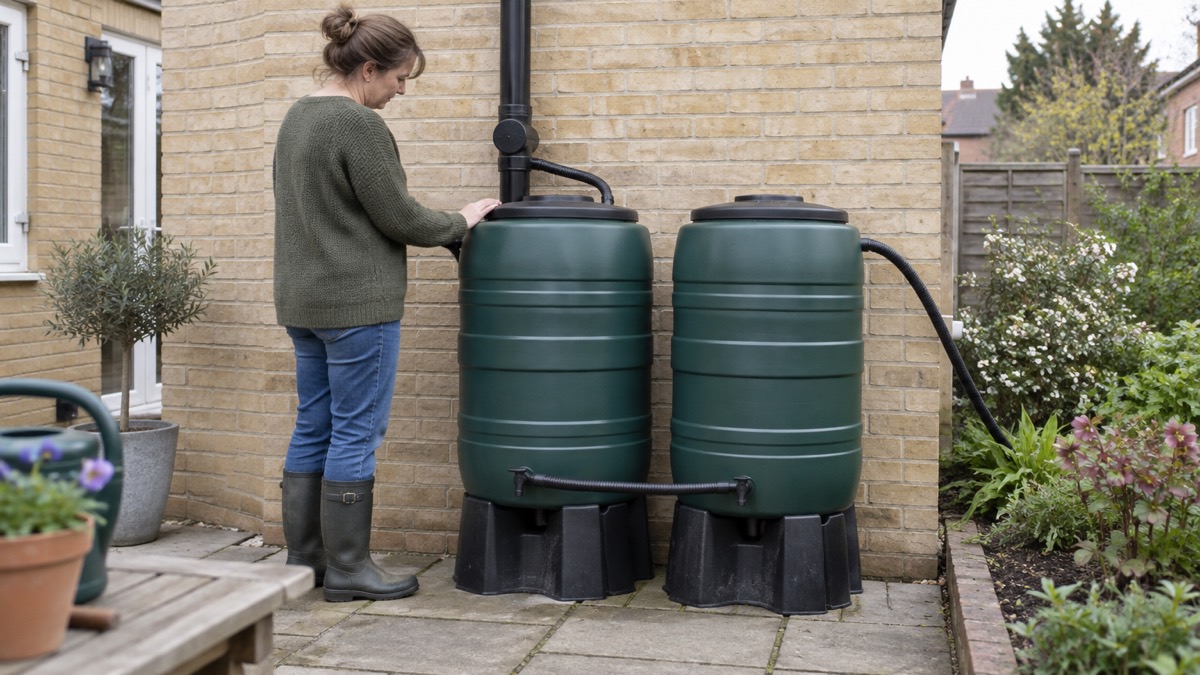
One downpipe can fill more than one butt. Some water butts can be linked together to give a larger capacity2, and makers sell connector kits for the job. The Cambridge Water Butt Planter, for example, states that butts can be connected together using bottom outlets12. A bottom outlet link lets the second butt fill to the same level as the first, so the pair behaves as one store.
Set the two butts on the same level base, as close together as the link allows, and fit the link at the lowest outlet on each so the water equalises. The diverter feeds the first butt; the link carries water across. Both need lids, and the second butt needs its own overflow or a shared one that reaches a drain.
If you want to move water rather than let gravity do it, a submersible or external pump gives hose pressure2, and the guide to pumps for rainwater tanks explains the types. A wall tank to pump connector kit exists for connecting a wall tank to a pump13. For a fuller picture of how a system is put together, see rainwater harvesting at home.
Keeping stored water clean enough to use
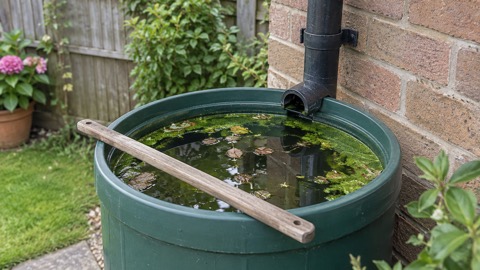
Stored rainwater is not sterile, and the point of the filter and lid is to keep it usable rather than pure. Official guidance is blunt about drinking it: do not drink this water as it could contain bacteria or disease, though it can be used for flushing toilets or watering plants5. Treat that as the boundary for everything that follows.
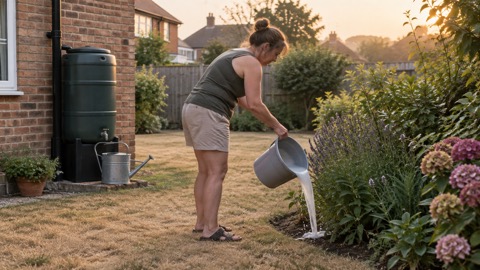
For the garden, the RHS advises using stored water on established plants but avoiding it on seedlings, because it may contain damping-off diseases; it is well suited to houseplants, particularly orchids and carnivorous plants2. Rainwater also has a lower pH, which the Consumer Council for Water notes makes it better for your plants14.
Keep the butt itself in order:
- Clear the gutters. The RHS says keeping gutters clear reduces waterborne plant diseases such as Phytophthora and Pythium2.
- Use it often. Frequent use keeps the water fresh2.
- Do not dose it. If the water smells, empty and clean the butt rather than adding chemicals2.
- Clean annually. Use warm water and a little washing up liquid to prevent disease build-up and smells2.
- Keep the lid on. A close-fitting lid keeps out plant disease spores and discourages algal growth2.
The guide to cleaning a water butt goes further on debris and maintenance, and keeping a rainwater system clean covers the year-round routine.
Using water butt water in a supply interruption
When the mains stop, the butt becomes part of your household's reserve. Official guidance says that while there is no mains water supply, alternative supplies such as bottled water should be used solely for drinking, washing your hands and food preparation5. That leaves the butt for everything else. The same guidance confirms butt water can be used for flushing toilets or watering plants5, and Public Health Wales notes that other sources such as garden water butts can be used for flushing16.
South West Water gives the practical method: use your water butt or stored water to flush the toilet by filling a bucket and pouring it into the bowl17. Affinity Water makes the same point, that you will not be able to flush your toilet in an interruption but a water butt lets you collect water to pour into it6. Pour steadily from low down to avoid splashing.
A few things make the butt more useful in an outage. Keep a bucket and a lidded container beside it. Know where your stop tap is: it is often under the kitchen sink, though some houses have it in a downstairs bathroom18. If a pipe bursts, turn off the water supply at the main stop valve19. WaterSafe advises locating your internal stopcock, usually under the kitchen sink or in a cupboard, garage or cellar, and turning it clockwise to stop the water15.
Water companies set up water stations in the area during a supply interruption6, so check your supplier's incident page for where to collect drinking water. For the wider picture, see water in an emergency and what harvested rainwater can be used for.
Sources (18)
- Save a little water, Southern Water, 2026
- Water butts and rainwater harvesting, Royal Horticultural Society, 2026
- Water supply interruptions or outages, Cabinet Office, 2026
- 3P Filter Collector and Tank Connector Kit, Rainwater Harvesting Ltd, 2026
- Water supply interruptions or outages, Cabinet Office, 2026
- Incident support, Affinity Water, 2026
- Ecosure FAQs, Ecosure, 2026
- 280 Litre Novara Rainwater Wall Tank, Rainwater Harvesting Ltd, 2026
- 430 Litre Botaqua Rainwater Wall Tank, Rainwater Harvesting Ltd, 2026
- 2 x 650 Litre Aqua Tower Rainwater Wall Tank, Rainwater Harvesting Ltd, 2026
- Above-ground tanks, Rainwater Harvesting Ltd, 2026
- Wall Tank to Pump Connector, Rainwater Harvesting Ltd, 2026
- Drought - CCW, CCW
- Frozen or burst pipes, Met Office, 2026
- Hydraulic flooding, Thames Water, 2026
- Preparing for an incident, South West Water, 2026
- At Home - Sub Section - Wiltshire & Swindon Prepared, Wiltshire & Swindon Prepared
- At home, Wiltshire and Swindon Prepared, 2026
 Composting Toilet Kit Checklist
 Garden Harvesting Kit Checklist
 Rainwater Winter Checklist
 Composting Toilet Near Wells
 Flies in a Composting Toilet
 Composting Toilet Chamber Size
 Is Harvested Rainwater Safe
 Garden and Lawn Water Needs
 Grey Water Disposal Off Mains
 Rain and Grey Water in Garden
 House With a Private Supply
 Rainwater Pipe Types and Labels
 Private Water Supply Visitors
 Rainwater Systems in a Power Cut
 Does Stored Rainwater Stagnate