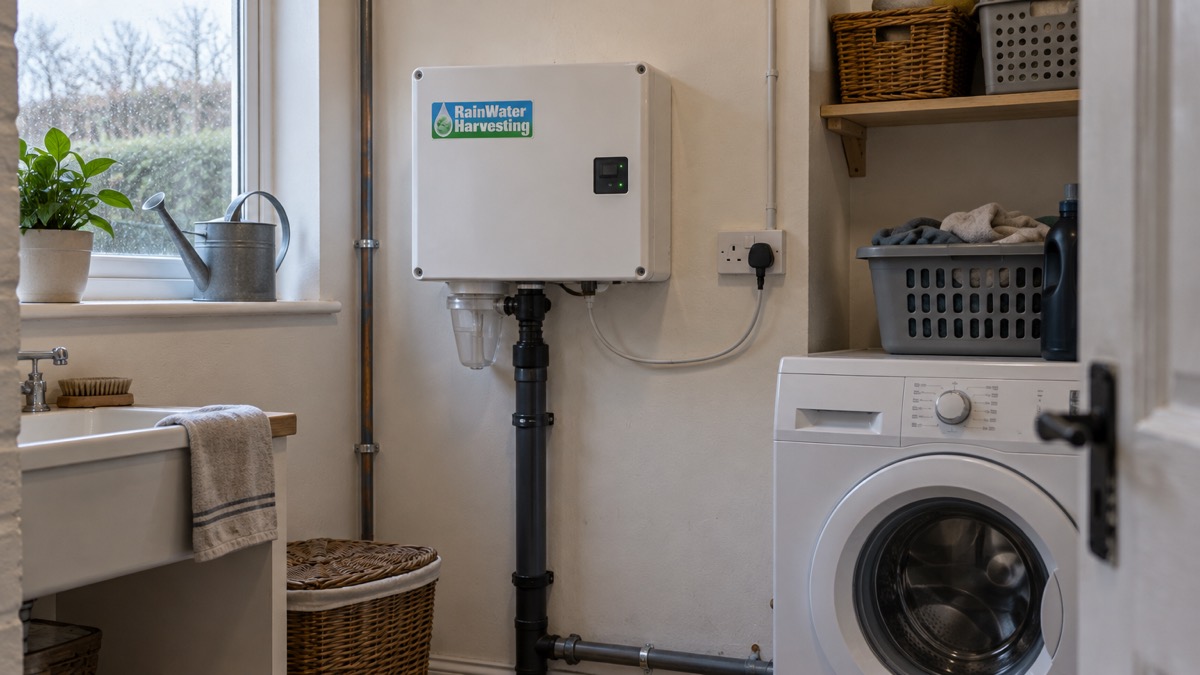
Rain Backup in a Box is a mains water top-up unit for a rainwater harvesting system. When a long dry spell empties the underground tank, it lets mains water in so the pump keeps supplying the toilets and the washing machine instead of the house losing its water supply. The maker states it is fitted inside the building where the occupiers can see and hear it1.
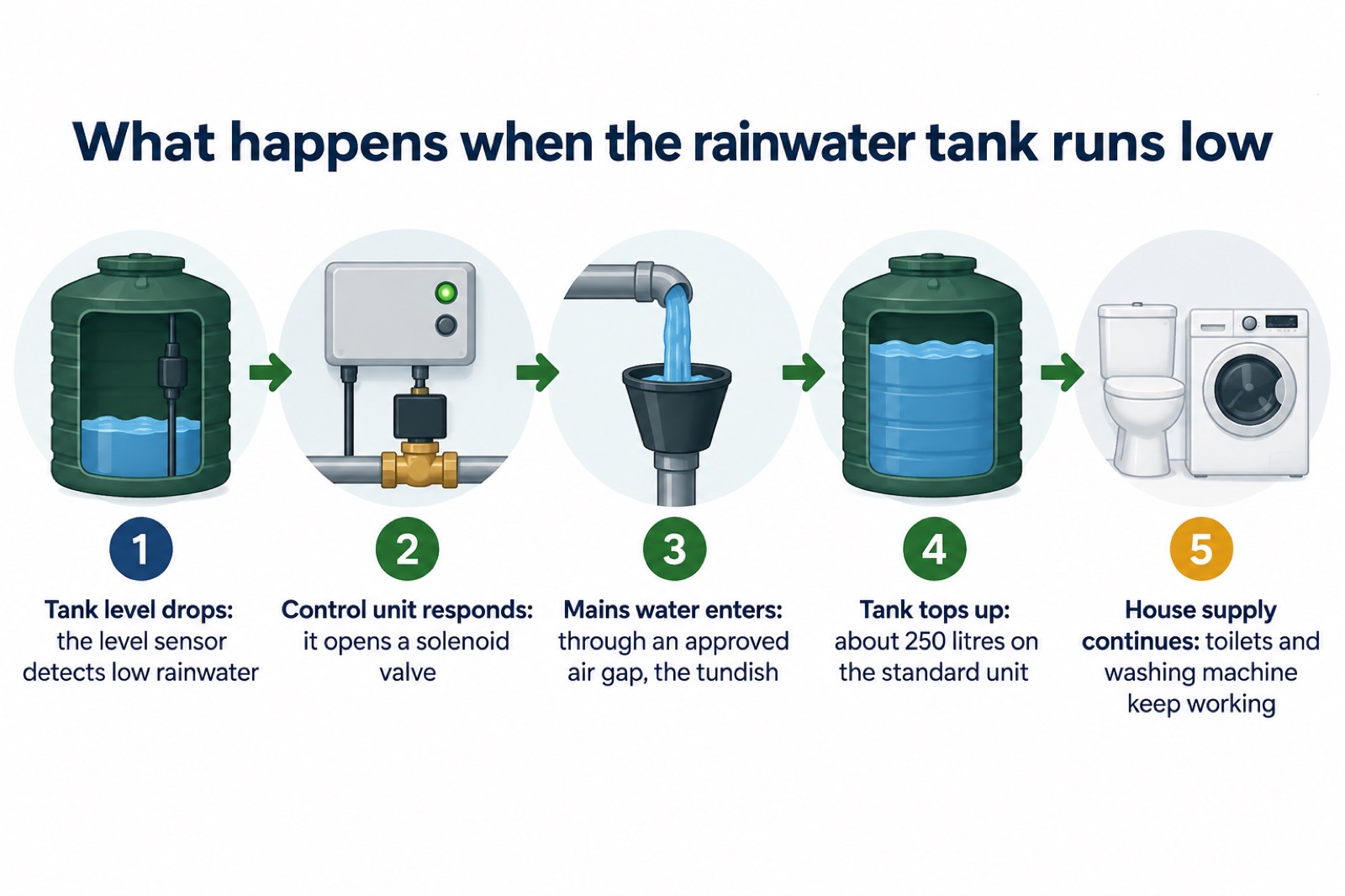
The volume it adds is modest. The maker's product pages say it puts about 250 litres of mains water into the tank when the level runs dry, and one page describes the unit as typically adding around 200 to 250 litres2. The [SD] version of the unit is more specific: the control board allows 45 minutes of mains water, restricted to 4 litres per minute, which is 180 litres per activation1.
That is enough to keep normal household use going for a while, not to refill a garden supply. The maker states the unit will continue to keep up with demand in the house for toilets and washing machine, and that it is intended for domestic and light garden use2. If you are weighing up whether a rainwater system is worth having at all, our guide to how a rainwater system works sets out the whole picture.
What Rain Backup in a Box does for a rainwater harvesting system
A rainwater harvesting system collects rain from the roof, filters it and stores it in a tank, then pumps it to the places that use non-drinking water: toilets, the washing machine, an outdoor tap. In a wet winter the tank refills on its own. In a dry summer it does not, and a direct feed system has no water to send to the house at all.
Rain Backup in a Box is the maker's answer to that gap. It is a single wall-mounted unit that replaces what the maker calls a "higgle piggle of components" with one electric plug to a wall socket, a mains water input and a pipe to the underground storage tank6. It is commonly used with direct feed systems, where a submersible pump supplies water directly from the tank to appliances such as toilets or washing machines4.
The maker's wider description of the job is straightforward: it feeds small amounts of mains water into the tank if the rainwater level becomes low, keeping all appliances functional in times of low rainfall7. For a household, that means the difference between a dry spell being an inconvenience in the garden and a dry spell meaning the toilet cannot be flushed without a bucket.
It is not a whole-house water supply and it is not a substitute for mains water in an emergency. It is a top-up device that keeps a rainwater system's domestic side running. If you want to understand the difference between the two main system designs before deciding whether this unit fits yours, read direct feed and gravity feed rainwater systems explained.
How it works: level sensor, solenoid valve and tundish
The sequence is simple and mechanical. A level sensor detects when the rainwater level drops. The control unit opens a solenoid valve. Mains water flows safely into the tank through an approved air gap, and a small amount of water enters the tank to maintain supply8.
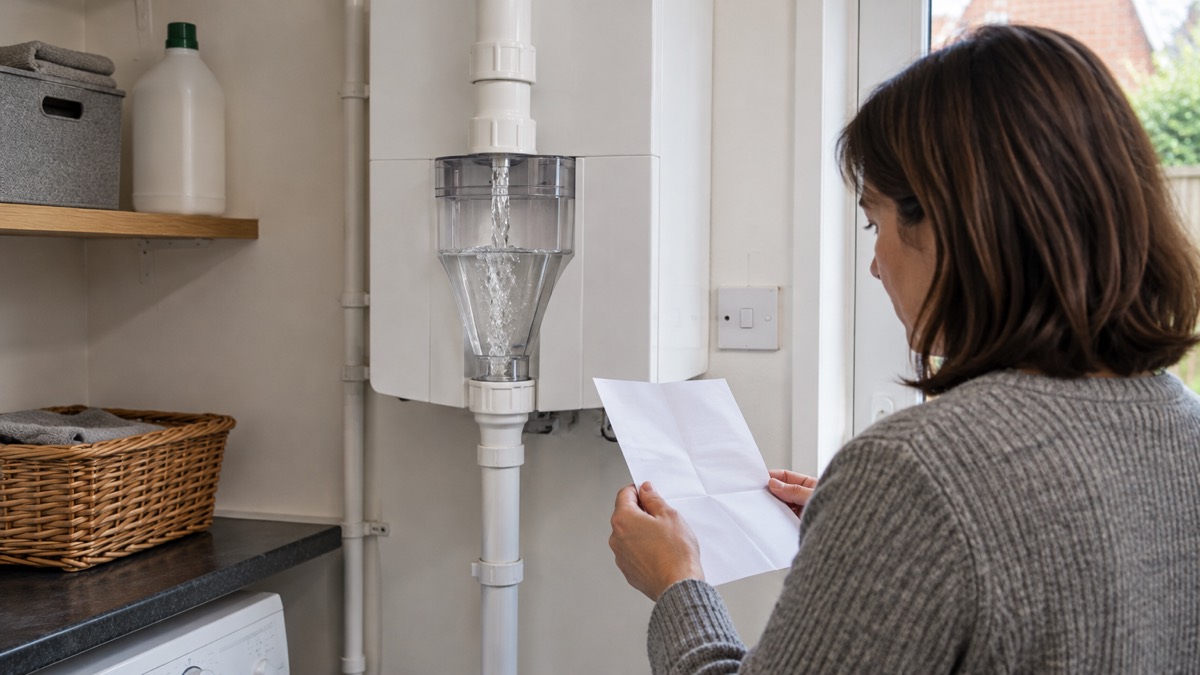
The air gap is the part that matters for water regulations. It is an anti-splash tundish and overflow incorporated into one, a transparent clear moulded part1. A tundish is a funnel shaped device through which mains water flows through open air into the rainwater tank6. That open air break is what stops tank water ever being able to flow back into the mains supply.
The level sensor is mounted in one of two ways depending on the tank. The standard fitting is a 110mm pipe clip that houses the level sensor, fixed to a 110mm pipe in the tank. Where the tank has a Rain Vantage Filter, a special D bracket houses the sensor and clips onto the D profile of the filter1.
The unit should be fitted inside the building where the occupiers can see and hear it2. That is not a cosmetic preference. It is how you notice the top-up happening and how you hear the alarm if something is wrong.
Top-up volume: about 250 litres of mains water at a time
The headline figure is about 250 litres. The maker's product pages for the systems that include the unit describe it as a simple mains top up device that puts about 250 litres of mains water into the underground tank where the water level runs dry2. One page describes the unit as typically adding around 200 to 250 litres of mains water to the tank4.
The [SD] version is specified more tightly. Its control board allows 45 minutes of mains water restricted to 4 litres per minute, which is 180 litres, to enter the tank once the level triggers it1. That is a deliberate restriction: a slow, controlled fill is gentler on the tank and gives the system time to respond.
| Version | Top-up per activation | Flow rate | Duration |
|---|---|---|---|
| Rain Backup in a Box (standard) | about 250 litres3 | not stated | not stated |
| Rain Backup in a Box [SD] | 180 litres1 | 4 litres per minute1 | 45 minutes1 |
To put 250 litres in context, the Royal Horticultural Society notes that in dry south-east England, 2,500 to 3,500 litres of rainwater each year can be collected from the roof of a small shed, enough to fill around 10 to 15 standard 240-litre water butts9. A single top-up is therefore roughly one standard water butt's worth of mains water, delivered into a tank that may hold several thousand litres.
That is why the unit is a bridge, not a solution. It buys the household time through a dry spell. It does not replace the rainfall the system depends on, and repeated activations over a long drought will show on your metered water bill if you have one.
Toilets and washing machine keep working when the rainwater runs out
The practical benefit is narrow and valuable: the house keeps its non-drinking water supply. The maker states repeatedly across its product pages that the unit will continue to keep up with demand in the house for toilets and washing machine2.
That covers the two biggest indoor uses of harvested rainwater in a typical home. It does not cover drinking water, cooking, bathing or the garden tap at full flow. The maker is explicit that the unit is intended for domestic and light garden use2.
For a household thinking about resilience, this is the point worth holding on to. A rainwater system with a backup unit keeps flushing toilets and running the washing machine through a dry summer without anyone carrying buckets. A system without one does not. If your concern is water in a wider emergency, from a burst main to a loss of supply, our guide to water in an emergency covers storing and treating drinking water, which this unit does not do.
Where it falls short: two garden taps and a high power pump
The limitation the maker is most candid about concerns garden use with a powerful pump. If you run two garden taps with a high power pump, such as the HydroForce, Steel Pumps or Divertron 1100 watt pumps, then the outflow of water is higher than the inflow from the backup device. When the underground storage tank is empty the pump will have no water and its dry-run protection will turn it off, and some pumps need resetting at the mains2.
In plain terms: the backup device fills the tank slowly, and two hoses on a big pump empty it faster than it fills. The pump protects itself by stopping. You then have to reset it, which is an annoyance in the middle of watering.
The maker's suggested workaround is simple. Most users get round this issue by having mains water taps available alongside the rainwater outlet so that they can switch to mains for garden use when the underground tank is empty. The backup device will continue to keep up with demand in the house for toilets and washing machine12.
The other limit is the alarm. The maker states the unit has an audible alarm if water continues running8. That is a signal to investigate, not a fault to live with. Water continuing to run when it should have stopped points to a stuck valve, a sensor that is not reading the level, or a tank that is not accepting water.
Water supplier acceptance and NSF Reg4 approval
Mains top-up of a rainwater tank is regulated, because the two supplies meet. The maker states the unit is NSF Reg4 Approved, with approval number 25106232. NSF Reg4 Approval demonstrates compliance as it is granted directly by representatives of the water suppliers14.
The maker goes further, stating that the unit is accepted by every water supplier in the UK12. The approval is granted directly by representatives of the water suppliers, which is why the maker treats it as the meaningful mark rather than a self-declaration14.
| Claim | What the maker states | Source |
|---|---|---|
| Certification | NSF Reg4 Approved, approval number 2510623 | 2 |
| What that means | Compliance granted directly by representatives of the water suppliers | 14 |
| Supplier acceptance | Accepted by every water supplier in the UK | 12 |
| Inspector recognition | Recognised by water inspectors across the UK as safe and compliant | 8 |
For a household, the practical point is that the air gap and the approval are what make a mains top-up lawful and safe to fit. If you are installing a system from scratch, our guide to rainwater systems and the law covers the water fittings rules and what a mains top-up must include. If your property is in Scotland, Wales or Northern Ireland, the water supplier and its fittings rules differ, so confirm acceptance with your own supplier before fitting.
Fitting it, keeping it ready and getting support
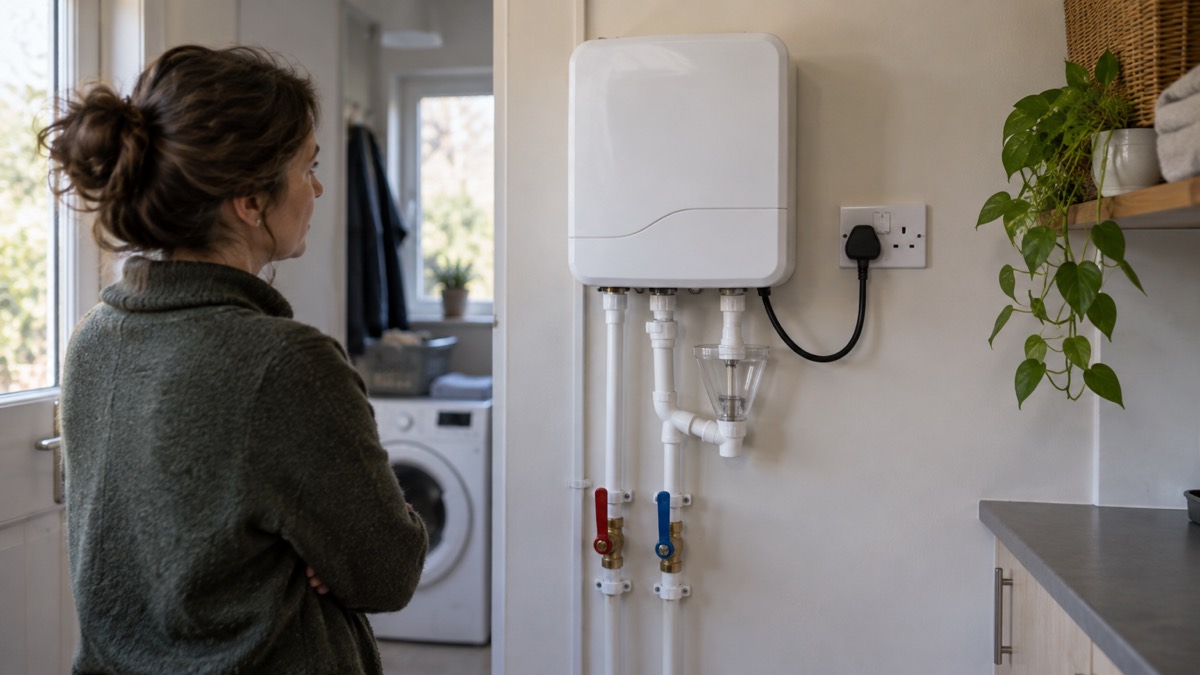
The unit is fitted inside the building, wall mounted with screws through holes in the back of the control unit, with one electric plug to a wall socket, a mains water input and a pipe to the underground storage tank1. The maker publishes an installation video for the control unit if you want to see the sequence before a plumber or installer arrives15.
For keeping it ready, the checks that matter follow from how it works:
- Watch the tundish during a dry spell. When rainwater has run out, mains water running from the solenoid valve into the tundish can be seen through the transparent cover and heard through the aperture at the side6.
- Listen for the alarm. The maker states there is an audible alarm if water continues running8.
- Check the tank level after a top-up. If the level has not risen, the problem is upstream of the house.
- Keep the sensor mounting clear. The sensor sits on a 110mm pipe clip or a D bracket on the filter1.
On support and warranty, the maker's pages describe the unit as UK manufactured5. The maker is Rainwater Harvesting Ltd, and its site carries the product pages and the technical detail for the unit16. Ask the supplier for the warranty terms in writing at the point of order, since they are not stated on the product pages.
Sources (16)
- Rain Backup in a Box [SD] product page, Rainwater Harvesting Ltd, 2026-07-01
- F-Line 5000 Litre Direct Feed System, Rainwater Harvesting Ltd, 2026-07-07
- 3800 Litre Rain Backup in a Box System, Rainwater Harvesting Ltd, 2026-03-24
- Direct Feed or Gravity Feed, Rainwater Harvesting Ltd, 2026-04-10
- F-Line 7500 Litre Direct Feed System, Rainwater Harvesting Ltd, 2026-07-07
- Rain Backup in a Box, Ecosure, 2026-11-04
- How to Collect Rainwater, Rainwater Harvesting Ltd, 2024-10-31
- Backup in a Box - Rainwater Harvesting, Rainwater Harvesting Ltd (rainwaterharvesting.co.uk)
- Water butts and rainwater harvesting, Royal Horticultural Society, 2026
- Carat 6500 Litre Rain Backup in a Box System, Rainwater Harvesting Ltd, 2026-07-01
- 2700 Litre Rain Backup in a Box System, Rainwater Harvesting Ltd, 2026-03-24
- F-Line 1500 Litre Direct Feed System, Rainwater Harvesting Ltd, 2026-07-07
- Rain Activ Dual Direct Feed System, Rainwater Harvesting Ltd, 2026-07-01
- Rainwater Harvesting Direct Feed Systems, Rainwater Harvesting Ltd, 2025-10-23
- How to install the Backup in a Box Control Unit, Rainwater Harvesting Ltd, 2023-06-12
- F-Line 15000 Litre Direct Feed System, Rainwater Harvesting Ltd, 2026-07-07