The Rain Acculevel is a wireless level sensor for a rainwater tank. It measures the water level in the tank and lets you see the reading on a PC or smart device, so you know how much water you have without opening the lid and looking. The maker, Rainwater Harvesting Ltd, describes it as a smart meter for rainwater tanks that works on tanks below or above ground and over long distances1.
The reading is refreshed every 15 minutes, which lets you build up a history of your water use1. The sensor sits in the tank and sends signals to a small receiver called a Gateway. The Gateway passes the data through your home hub to an online account at tanklevels.co.uk, where you log in to see the level1.
It is an optional add-on rather than part of the standard kit, so if you are ordering a system and want level readings, add it at the point of order2. Before you fit one, check three things: that you have a USB power source for the Gateway, broadband through a router, and a browser or smart device to view the data1.
What the Rain Acculevel does
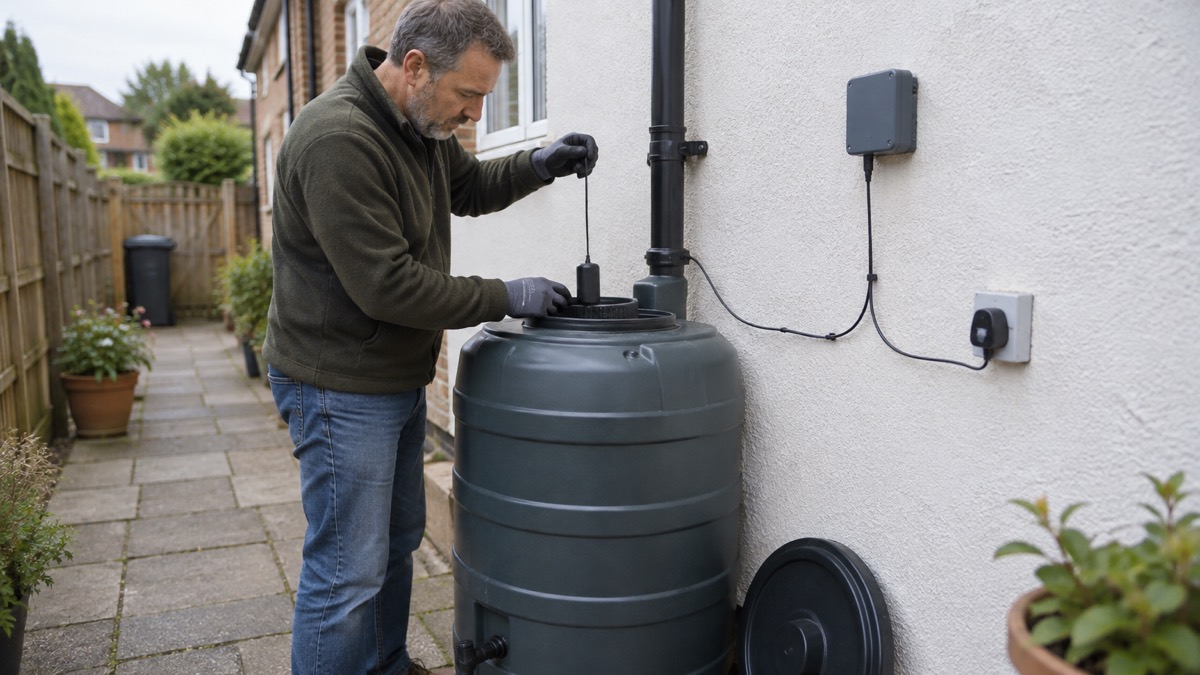
The Rain Acculevel is a level gauge for a rainwater tank, not a pump, a filter or a water treatment device. Its job is to tell you how much water is in the tank. The maker says it will accurately measure the water level in your rainwater tank, giving readings you can view on a PC or smart device1. It uses wireless technology and works on tanks below or above ground and over long distances1.
That combination matters for ordinary households because the tank is often the one part of a rainwater system you cannot easily inspect. An underground tank is out of sight by design. A large above-ground tank may be tall enough that you cannot see the level from the ground. The Acculevel gives you a number instead of a guess.
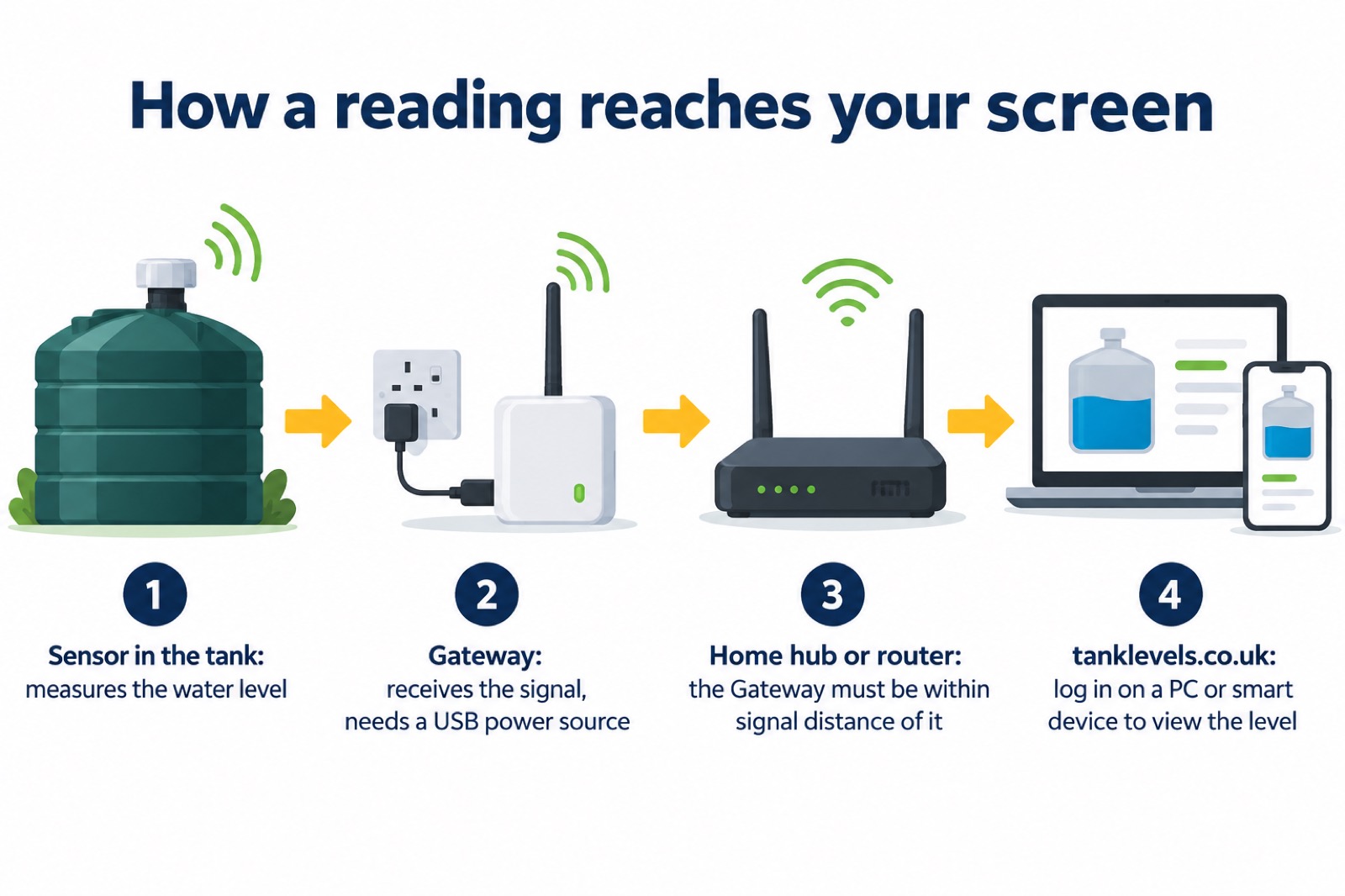
The chain is simple. Once placed in the water tank, the sensor sends signals to a small receiver called a Gateway. The Gateway sends data through the home hub to an online account at tanklevels.co.uk1. You log in to that account to see the level, and the maker says the data is available to view or download at any time1.
It is worth being clear about what the device does not do. It does not treat the water, it does not tell you whether the water is safe for a particular use, and it does not control the pump. It is a monitoring tool. What you do with the reading, from topping up a reserve before a dry spell to deciding whether to water the garden, is your judgement.
Level readings every 15 minutes on a PC or smart device
The level is measured every 15 minutes, which the maker says lets you build up a history of your water use1. That interval is the heart of the product. A single reading tells you how full the tank is now. A series of readings tells you how fast it is emptying, which is far more useful when you are trying to work out whether you have enough water to last.
The maker's own support article on setting up the Gateway confirms the Gateway is the piece that connects the sensor to your account3. The data is viewed by logging in to tanklevels.co.uk, and the maker says it is available to view or download at any time1.
| What you get | Detail | Source |
|---|---|---|
| Measurement interval | Every 15 minutes | 1 |
| Where you view it | PC or smart device, by logging in to tanklevels.co.uk | 1 |
| History | Built up from the 15-minute readings, to show your water use | 1 |
| Data access | Available to view or download at any time | 1 |
For a household, the practical value is in the pattern rather than the single figure. If the level drops sharply after a washing machine cycle or a long garden watering, you can see it. If it holds steady through a wet week, you know the tank is refilling. Over a season, the history shows whether your storage is matched to how you actually use water.
What you need before fitting
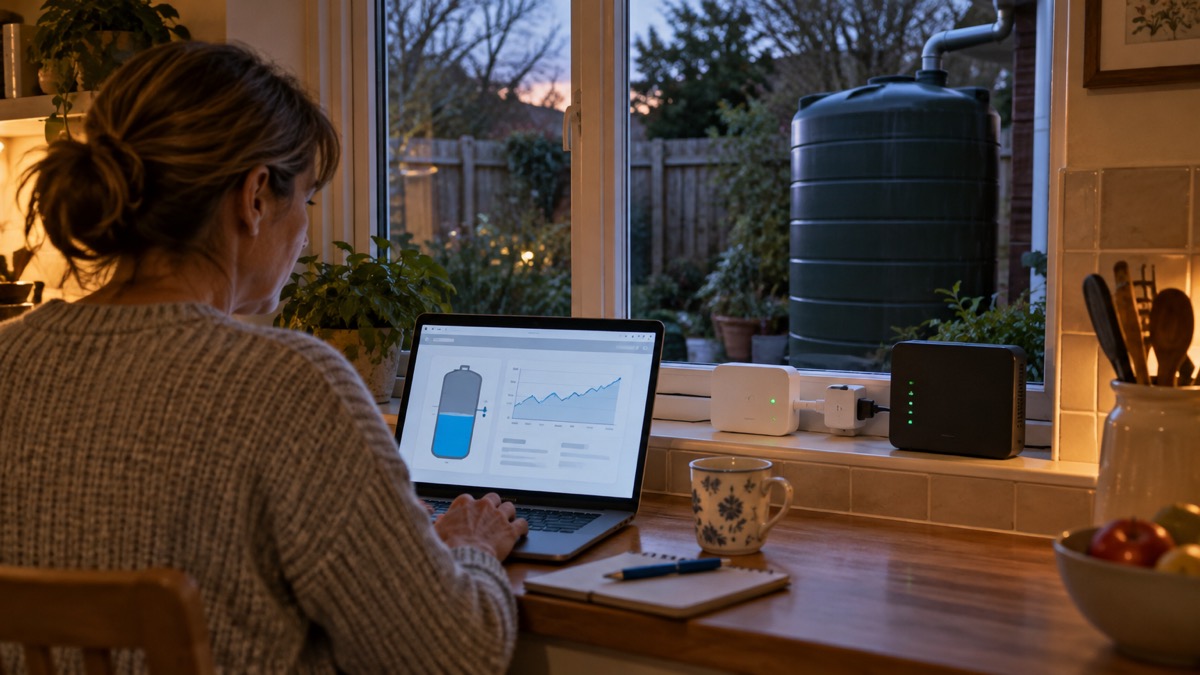
The maker lists four things you need: the Acculevel smart sensor and Gateway, a USB power source for the Gateway, access to broadband via a router, and a browser or smart device to access the data1. Check each one before you order, because a missing link stops the whole chain.
- The sensor and Gateway. These come as the pair. The Gateway is the receiver that passes data onward1.
- A USB power source for the Gateway. The Gateway needs power from a USB supply1. Plan where that supply is and how the cable will reach the Gateway without being a trip hazard or exposed to water.
- Broadband via a router. The Gateway sends data through the home hub to your online account, so the router needs to be working and in range1.
- A browser or smart device. You view the data by logging in to tanklevels.co.uk, so you need a device that can reach the internet1.
Fitting itself is described by the maker as straightforward. The unit is supplied ready to fit the tank and filter system. You drop the sensor into the filter tube, power up the Gateway and follow the activation process on a smart device or web browser1.
If you are still choosing a system, the rainwater harvesting guide explains how a tank, filter and pump fit together, and the tank sizing guide covers how much storage a household needs. The Acculevel is the monitoring layer on top of that.
Where the Gateway must go
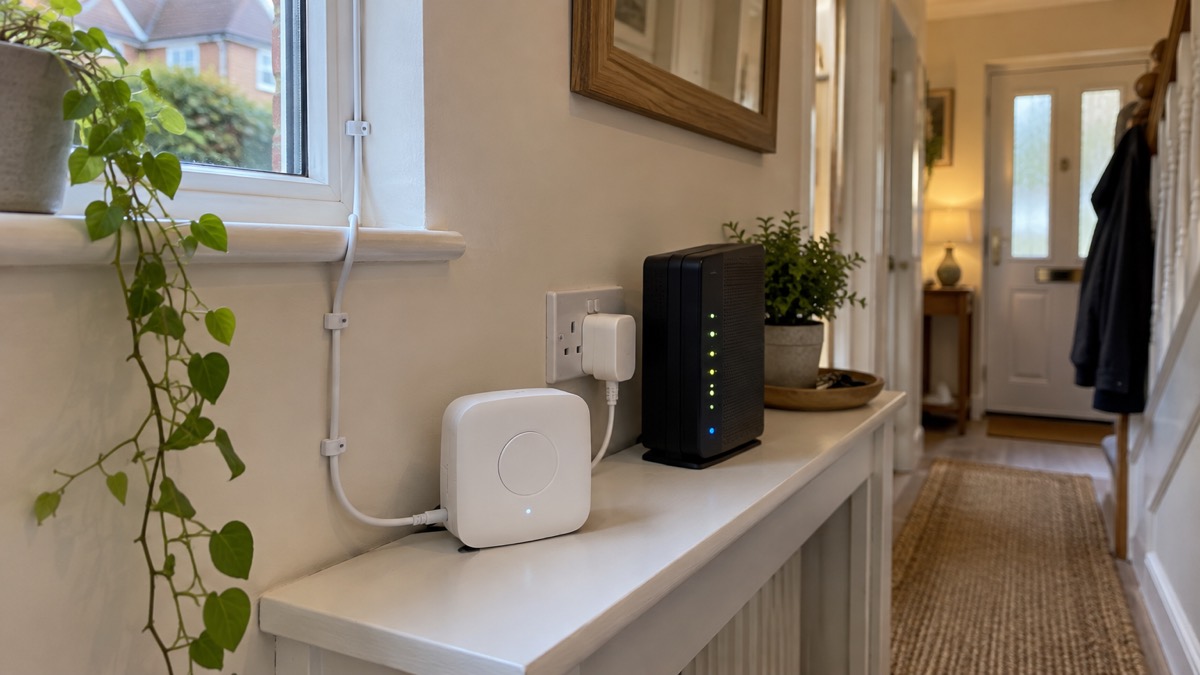
There is one siting rule that decides whether the Acculevel works: the Gateway must be within signal distance of your home hub or router. The maker states that the Acculevel will work anywhere as long as the Gateway is within signal distance of a home hub or router1.
That single sentence carries most of the installation risk. The sensor can be in a tank below ground or above ground, near or far, because it talks wirelessly to the Gateway1. The weak link is the hop from the Gateway to your router. Put the Gateway in a shed at the bottom of the garden with no signal back to the house and the readings will not reach your account, however well the sensor is working.
Before you commit, test the position. Take the Gateway to where you plan to put it, power it from a USB supply and check that it can reach your router. If it cannot, move it closer to the house or to the router.
Tanks it works with: below or above ground, over long distances
The Acculevel is designed to work on tanks below or above ground and over long distances, using wireless technology1. That covers the main types of rainwater storage a household is likely to have. The maker lists a version specifically for its F-Line tanks, described as a smart water level sensor for rainwater tanks1.
The F-Line range gives a sense of the sizes involved. The Acculevel is offered as an add-on across these, which is why the maker's product pages carry the note that it is not part of the standard kit2.
| Tank situation | What the maker says | Source |
|---|---|---|
| Below ground | Works on tanks below ground | 1 |
| Above ground | Works on tanks above ground | 1 |
| Long distance from the house | Works over long distances, wirelessly | 1 |
| F-Line tanks | A dedicated F-Line version is listed | 1 |
Above-ground tanks come in many shapes, from wall tanks of a few hundred litres to large vertical tanks for bigger properties4. The maker describes above-ground tanks as ideal for bigger installations such as schools, hotels, housing estates, farms, equestrian and commercial properties, and notes features such as moulded lifting eyes4. Whatever the tank, the Acculevel's job is the same: report the level so you do not have to climb up and look.
If your tank is underground, the underground tanks guide covers the designs and what they need. If it is above ground, the above-ground tanks guide sets out the types side by side.
Using tank levels to keep water in reserve for dry spells
A level gauge is only useful if it changes what you do. For a household with a rainwater tank, the reading lets you manage a reserve rather than discover too late that the tank is empty. The wider case for storing rain is well made by the water industry. Northumbrian Water, in a release dated 11 September 2026, urged customers to capture as much rain as possible when it arrives by installing water butts or checking existing ones are connected properly6. SES Water, in guidance dated 29 October 2026, explains that when river levels are lower earlier, reservoir storage is used for a longer period of time for supply and to support river flows7.
The RHS notes that with drier summers but more winter rain as the climate changes, larger systems, some with underground storage tanks, may be practical to support plants in hotter months8. That is the case for storage in general, and it is the case for knowing what is in your tank in particular.
How much storage a household needs depends on what the water is for. The maker's guidance is a minimum of 3000 litres for garden-only use, to make it financially viable9. For use inside the house, tanks are sized on 18 to 21 days of drought protection using a tank size calculator that takes account of bedrooms and maximum occupancy9. Its bedroom guide runs from 1500 litres for one bedroom, through 3000 litres for two, to 3000 to 5000 litres for three9.
| Use | Maker's sizing guidance | Source |
|---|---|---|
| Garden only | Minimum 3000 litres to be financially viable | 9 |
| Inside the house | Sized on 18 to 21 days of drought protection | 9 |
| One bedroom | 1500 litres | 9 |
| Two bedrooms | 3000 litres | 9 |
| Three bedrooms | 3000 to 5000 litres | 9 |
With a 15-minute reading history, you can see a dry spell coming in your own data. If the level is falling and no rain is forecast, you can hold water back for the plants or the toilet flush that matters most, rather than spending it on the lawn. The guide to what harvested rainwater can be used for sets out the permitted uses, and the drought and heatwave guide covers the wider household picture.
Support, setup and where to get help
The maker publishes a support article on how to set up the Rain Acculevel Gateway3, and the product page sets out what you need and how the sensor is fitted1. If readings stop appearing, work through the chain in order: is the Gateway powered from its USB source, is it still within signal distance of the router, and is the router itself working? Those are the three points the maker's description depends on1.
For the wider system, the maker's FAQ pages and essential questions cover how rainwater is collected, filtered and stored12. The rainwater maintenance guide covers keeping the tank and filter working through the year, which matters because a sensor can only report the level of a tank that is filling properly.
If you are weighing up whether a level gauge is worth adding to your setup, the rainwater harvesting section sets out the whole picture, from water butts to full household systems. And if your interest is in keeping water back for emergencies rather than garden use, the water in an emergency guide covers storing and rotating a household reserve.
Sources (13)
- Rain Acculevel Level Sensor for F-Line Tanks, Rainwater Harvesting Ltd, 2025-11-19
- F-Line 15000 Litre Gravity Feed System, Rainwater Harvesting Ltd, 2026-07-07
- How to set up the Rain Acculevel Gateway, Rainwater Harvesting Ltd, 2026-10-29
- Above Ground Tanks, Rainwater Harvesting Ltd, 2026-03-13
- 450 Litre Aqua Tower Rainwater Wall Tank, Rainwater Harvesting Ltd, 2026-10-23
- Northumbrian Water urges customers to continue saving water as reservoirs remain below normal levels, Northumbrian Water, 2026-09-11
- Come Rain or Shine: Drought 2026, SES Water, 2026-10-29
- Rainwater harvesting advice, Royal Horticultural Society, 2026
- New to Rainwater Harvesting, Rainwater Harvesting Ltd, 2025-07-28
- Essential Questions Answered, Rainwater Harvesting Ltd, 2026-04-09
- Reducing water use, Centre for Alternative Technology, 2025-06-27
- Rainwater Harvesting FAQ, Rainwater Harvesting Ltd, 2025-11-06
- Rainwater Harvesting in Simple Terms, Rainwater Harvesting Ltd, 2023-04-18