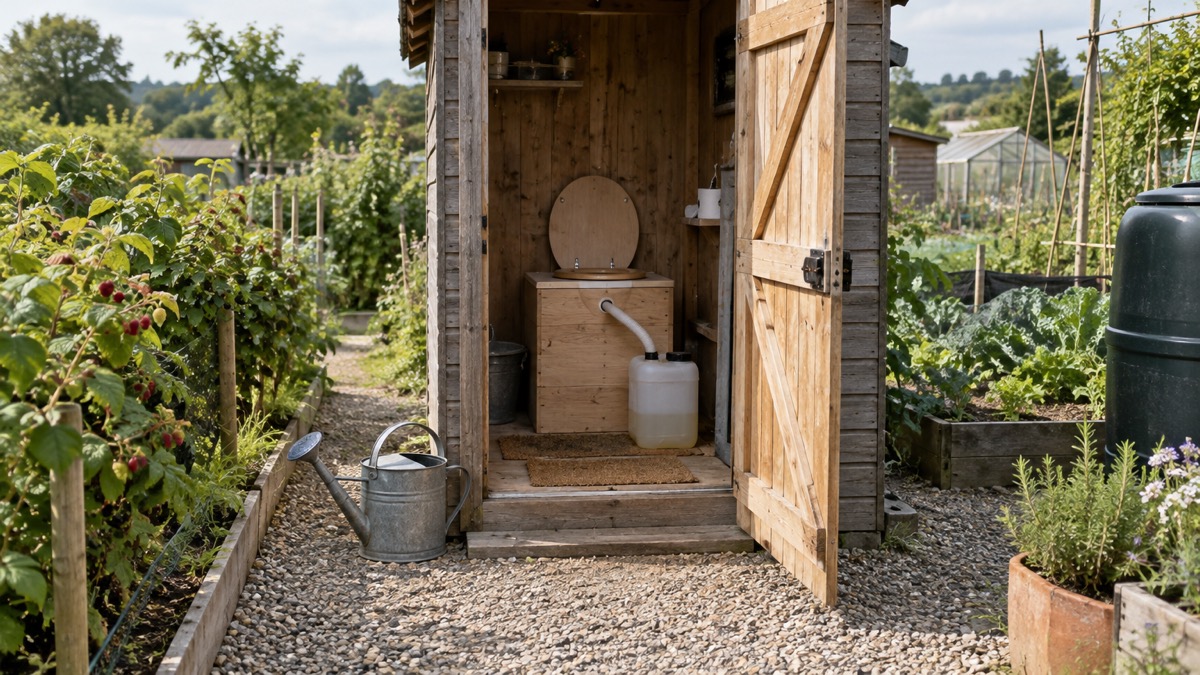
Urine is a free, steady source of plant food that most households pour away. Used carefully, it can feed fruit bushes, shrubs and flowers, and it can be kept out of a composting toilet so the compost breaks down properly instead of turning smelly. The rules are simple: keep it separate from solids, use it soon after collecting, dilute it about 1:10 in water, and keep it off any crop where the part you eat could touch it1.
If you have a composting toilet, the same separation matters. Keeping urine out of the solids is usually the key to successful composting, because otherwise the heap can become anaerobic and smelly1. Get that one thing right and the rest of the system, from chamber design to where you site it, follows more easily.
This page covers what to do with the urine you collect, how to store and dilute it, which plants to keep it away from, and how it fits with a composting toilet in a UK garden. It also covers the safety points that matter: hygiene when handling it, separation distances from water supplies, and the rules that apply if you are installing a toilet rather than just emptying a container.
Keep urine separate so the compost doesn't turn smelly
The single most useful habit is to keep urine out of the solids from the start. Independent guidance from the Centre for Alternative Technology is direct about why: keeping urine separate is usually the key to successful composting, otherwise it can become anaerobic and smelly1. A heap that has gone anaerobic is not just unpleasant; it is a sign the process has stalled.
That means a diverter at the toilet, or a separate container if you are collecting urine to use on the garden. The two streams then go to different places: solids to the compost chamber, liquid to a container for dilution and use.
Once you have collected urine without other contamination, use it ideally within a day or so, before ammonia levels build up and it starts to smell1. That timing is the practical limit on storing it. If you cannot get out to the garden that day, the smell will tell you it has waited too long.
Hygiene around the whole job matters. NHS Inform advises wearing gloves while gardening, especially when handling compost, because Legionella bacteria can be found in compost, and considering a mask for dusty work and washing hands afterwards2. Treat collected urine the same way: gloves on, hands washed after.
- Keep a lidded container for collection, and empty it the same day where you can1
- Use a diverter so solids and liquid never mix in the chamber1
- Wear gloves when handling compost or the collection container, and wash hands after2
- If the heap smells sour rather than earthy, check that urine is not getting in1
Two chambers, alternated each year, suit the UK climate
If you are building or choosing a composting toilet rather than just collecting urine, the chamber arrangement decides how well it works through a British year. Independent guidance says a reliable and robust approach for the UK climate is to alternate annually between two separate chambers1. One chamber is in use while the other rests and finishes composting.
That rhythm suits our weather. UK winters are now, on average, 12% wetter than between 1961 and 1990, and the latest UK Climate Projections point to hotter, drier summers and warmer, wetter winters in future3. A chamber that is resting has time to work through the wet months, and the alternation means you are never trying to finish compost in the same space you are filling.
A continuous system is the other route, and it settles down within a few months, after which no intervention such as adding worms or other decomposers should be necessary1. The choice is between a system you empty in batches once a year and one that processes continuously.
| Approach | How it works | What suits it |
|---|---|---|
| Two chambers, alternated annually | One in use, one resting and finishing, swapped each year1 | UK climate, households that can site two chambers1 |
| Continuous system | Processes steadily; settles within a few months1 | Households wanting no batch emptying1 |
A continuous system settles down within a few months
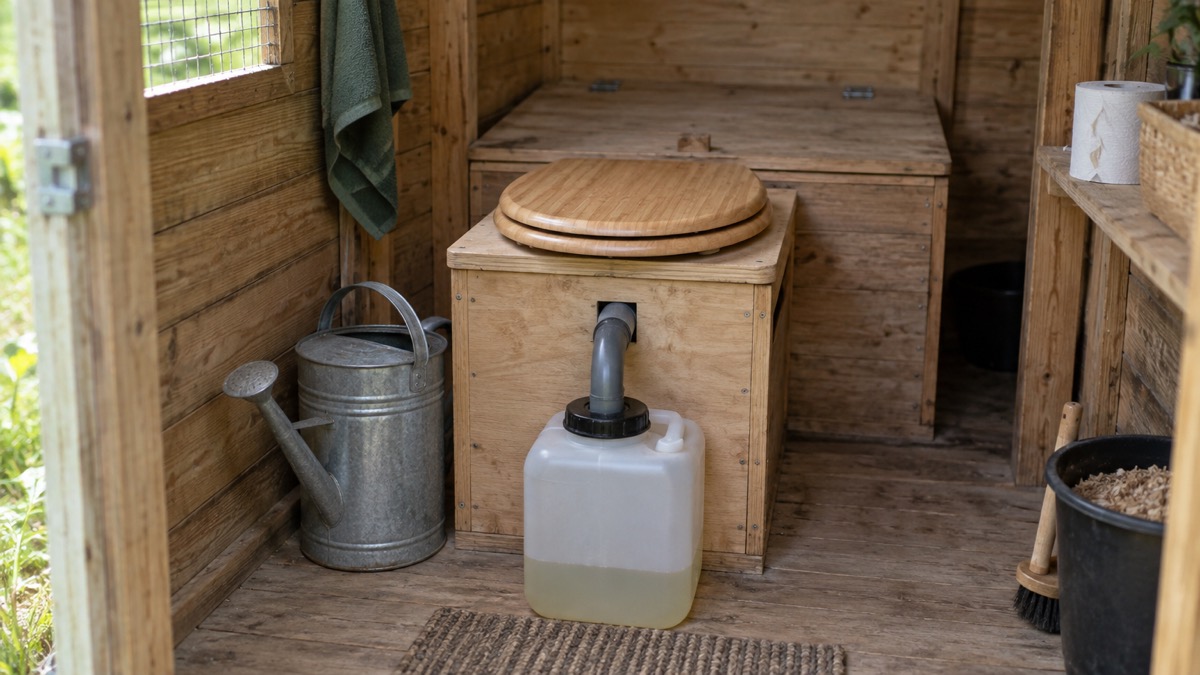
A continuous composting toilet does not need much from you once it is running. Independent guidance says a system like this should settle down within a few months, and after that no intervention in terms of adding worms or other decomposers should be necessary1. The temptation to tinker is the thing to resist.
That has a practical consequence for anyone wondering about worms. Give the system those first few months before judging it. If it is still not breaking down after that, the cause is more likely to be moisture, urine getting in, or the balance of material than a lack of worms.
The balance point is the same one that applies to any compost heap. London Fire Brigade's garden safety guidance says to keep a good balance of green and brown materials5. In a composting toilet the solids are the green, and the brown comes from the cover material you add after each use.
Soak material: adding it yourself or on a schedule
How the liquid leaves the system is where households differ most. Some add soak material by hand; others set up a schedule or a diverter that sends urine to a soakaway or container. Either way, the liquid has to go somewhere that will not contaminate water.
For garden use, the dilution is about 1:10 in water, and independent guidance limits that to non-food plants1. Avoid using urine on any crop where the bit you eat may come into contact with the urine, so it is fine round fruit bushes, shrubs and flowers but not for salad crops1. That is the line to hold: ornamentals and fruit bushes yes, leafy salads no.
There is a wider reason to be careful with anything that could carry contamination into soil. Official guidance on Cryptosporidium notes that Cryptosporidium in manure can contaminate fields, rivers and crops6. The same principle applies to any waste you put on the ground: keep it away from crops you eat and away from water.
If you are dealing with a private water supply, the risks run the other way too. Private supplies can be affected by animal waste, fertiliser or pesticide runoff, high mineral levels such as iron or manganese, low or high pH, and changes in water colour7. A garden fertiliser regime should not add to that list.
- Dilute about 1:10 in water for non-food plants1
- Apply round fruit bushes, shrubs and flowers, not salad crops1
- Do not hose the garden after contamination; it saturates the ground and prolongs the life of bacteria8
Where a composting toilet must not go: separation distances and sandy soil
Siting is the part that most often goes wrong, and it is the part with the clearest rules. Independent guidance gives a separation distance that can be reduced to 7.5m where the soil is sandy1. That is the figure to work from when placing a chamber or soakage near a water supply.
The Building Regulations angle matters too. Composting toilets are mentioned in Part G of the Building Regulations, and independent guidance sets out what that means in practice: they are fine when suitable arrangements can be made for disposal of waste on or off site, waste can be removed without carrying it through living space or food preparation areas, and no part of the installation would be rendered ineffective by entry of flood water1.
Flood water is not a hypothetical in the UK. If a chamber can be reached by flood water, it fails that test, so site it where flooding will not reach it. For more on siting and the distances involved, see How Far a Composting Toilet Should Be From Wells and Water Supplies.
Electrically heated dry toilets and other kit choices
The kit question comes down to how the toilet works, not which brand. Independent guidance is clear that dry toilets using electrical elements to heat the compost are not recommended, and that composting toilets should not be connected to an energy source other than for purposes of ventilation or sustaining the composting process1. A heater adds a dependency that a composting toilet does not need.
That matters in a power cut. A system that relies on a heater stops working when the electricity does, while a well-run chamber keeps going. Ventilation is the exception the guidance allows, because airflow is part of how the process works1.
For households weighing up a purchase or a build, the Composting Toilets: How They Work and How to Choose One page sets out the types, and the Composting Toilet Kit Checklist covers what to have ready. If you are also collecting rainwater for the garden, Using Rain and Grey Water in the Garden covers the other half of the picture.
Shared or public composting toilets
Shared systems work on the same principles but with more people adding to them, so the separation of urine and solids matters more, not less. A shared chamber that receives urine will go anaerobic faster because there is more liquid going in1.
For garden waste more generally, official guidance recommends that garden waste is composted or disposed of through a brown bin collection or your local recycling centre9. That is the fallback if a shared system is not coping.
If you are setting up a shared or community system, the siting rules apply as they would at home: separation distances, no route for waste through food preparation areas, and protection from flood water1. The Community Resilience section covers how neighbours can organise shared arrangements.
Staying safe: hygiene, water and what not to put on the garden
The safety points are few but they matter. Wear gloves when gardening and handling compost, because Legionella bacteria can be found in compost, and wash hands afterwards2. Keep urine off edible crops where the part you eat could touch it1. Keep everything away from water supplies, and know the risks to a private supply7.
There is a wider household rule that bears on this. Official guidance is firm that you should never throw antibiotics in the bin or flush them down the sink or toilet, because this can contaminate water sources11. Anything that goes into a toilet or a garden eventually reaches water, so the same care applies.
If a supply is contaminated, the response is practical. Official guidance on private water supplies describes disinfecting a system by filling it with a 20 mg/L solution of chlorine and leaving it to stand for several hours, preferably overnight, then draining it off and rinsing thoroughly with treated water12. That is a job for the supply owner, and it shows why keeping contamination out in the first place is easier.
For the wider picture on living without mains services, the Self-Reliance at Home section covers rainwater, off-grid power and the rest.
Sources (12)
- Composting toilets, Centre for Alternative Technology, 2025-06-27
- Summer health, NHS Inform, 2026-08-06
- Staffordshire's changing local climate, Staffordshire County Council, 2026
- Get climate ready: home improvements, Met Office, 2026-10-28
- Wildfires: protecting your home and garden, London Fire Brigade, 2026-10-25
- Cryptosporidium: public advice, GOV.UK, 2023-11-01
- Private water supplies, Highland Council, 2025-10-10
- What to do if a flood happens | nidirect, nidirect (Northern Ireland government)
- Bonfires and burning waste, Cheshire Fire and Rescue Service, 2026-10-29
- Garden bonfires, North Wales Fire and Rescue Service, 2026-10-29
- Health: antimicrobial resistance, Prepare, 2026-10-06
- Water storage, Drinking Water Inspectorate, 2025-11-05
 Hydroponic System Parts List
 Year-Round Sowing Calendar
 Preserving Equipment Checklist
 Blanching Vegetables
 Carrot Fly Protection
 Knowing When Chutney Is Ready
 Clubroot in Your Soil
 Drought-Resistant Vegetables
 Edible Flowers Safety
 Extending the Growing Season
 Freezing Fruit Without Sugar
 Garden Fleece Frost Protection
 Avoiding the Hungry Gap
 Keeping Varieties Pure for Seed
 Making Leafmould