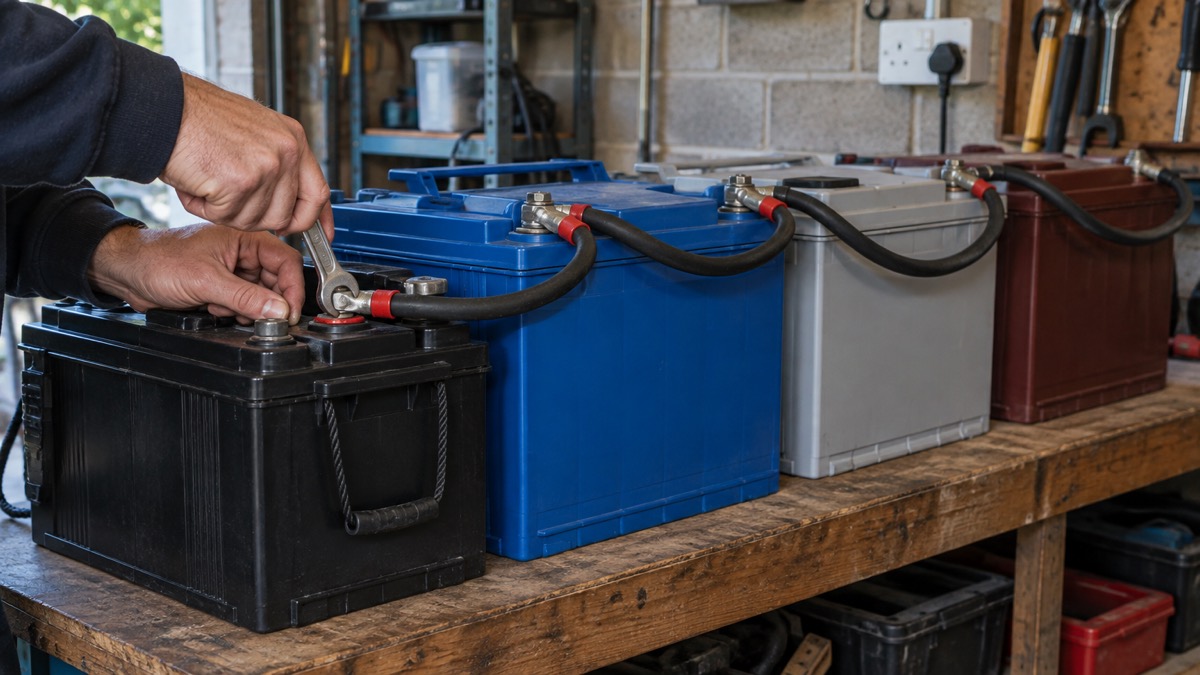
A battery bank is the heart of any off-grid solar system: the panels fill it by day, and it runs your lights, fridge and phone chargers through the night and through dull weather. The chemistry you choose decides how much of the electricity you actually get back, how often the bank needs attention, how heavy it is, and how it behaves when something goes wrong. Off-grid battery systems store low voltage, up to 48V, DC electricity, and they need protection from over- and under-charging with a suitable controller1.
The practical choice for a fixed UK bank is between flooded (wet) lead-acid, its sealed relatives AGM and gel, and lithium. Fire and rescue services describe lithium-ion batteries as lightweight, energy dense and long-lasting, but more volatile than traditional batteries2. Lead-acid is heavier and gives you less usable power for its rating, but it is predictable, straightforward to protect and forgiving of clumsy charging. Neither is simply "best": the right answer depends on where the bank lives, who will look after it, and whether weight matters.
This page walks through what each chemistry does in a fixed bank, how to size one honestly, how to charge and store it, the fire risks that come with lithium, and what to do with batteries at the end of their life. If you are new to off-grid power generally, start with how an off-grid solar system fits together.
Lead-acid or lithium: how each behaves in an off-grid bank
A fixed bank is built from individual batteries wired together, and everything about how the bank behaves follows from the chemistry inside those batteries. Flooded lead-acid, the type with caps you can open, is the traditional choice: robust, well understood, and happy to be charged hard, but heavy and needing regular attention. AGM and gel are the same chemistry sealed into a box that never needs topping up. Lithium is the other chemistry offered in off-grid kits, and several charge controllers and battery chargers are built to work with either lead-acid or lithium banks, so the two can sit behind the same equipment2.
The two families also differ in how they fail. A tired lead-acid battery tends to fade gradually: it holds less, takes longer to charge, and eventually will not start the day's work. A failing lithium battery can behave very differently, and the fire and rescue services are blunt that lithium-ion batteries are safe during normal use but can present a fire risk when over-charged, short-circuited, submerged in water or damaged8. That difference shapes where you put the bank and how you watch it.
Whichever chemistry you choose, build the bank from matching batteries. Duracell's guidance is to always replace batteries with the size and type specified by the manufacturer, and never to mix different battery types or brands: mixing lithium with alkaline reduces performance and may damage the device or cause leakage or rupture9. The same logic applies to a bank of twelve: identical batteries, the same age, bought together and replaced together. One odd battery in a bank drags the others down and hides its own failure inside the group.
Usable capacity: about half the rating for lead-acid, far more for lithium
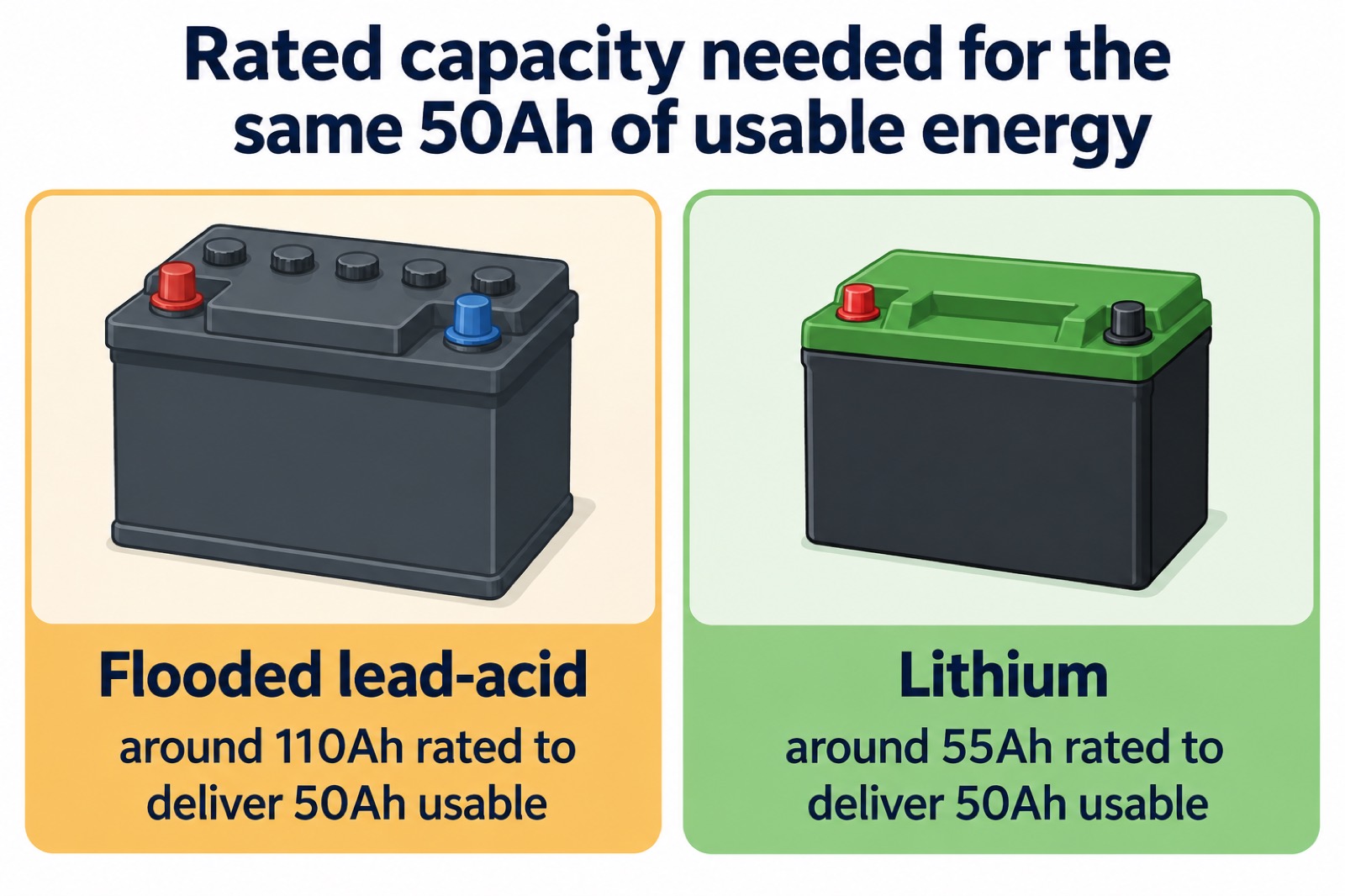
The number printed on a lead-acid battery is not the number you can use. Deep-cycle lead-acid banks should not be discharged deeply if you want them to last, so a bank's usable capacity is roughly half its rated amp-hours. Lithium banks tolerate much deeper discharge, so a lithium bank of about half the lead-acid rating delivers the same usable energy.
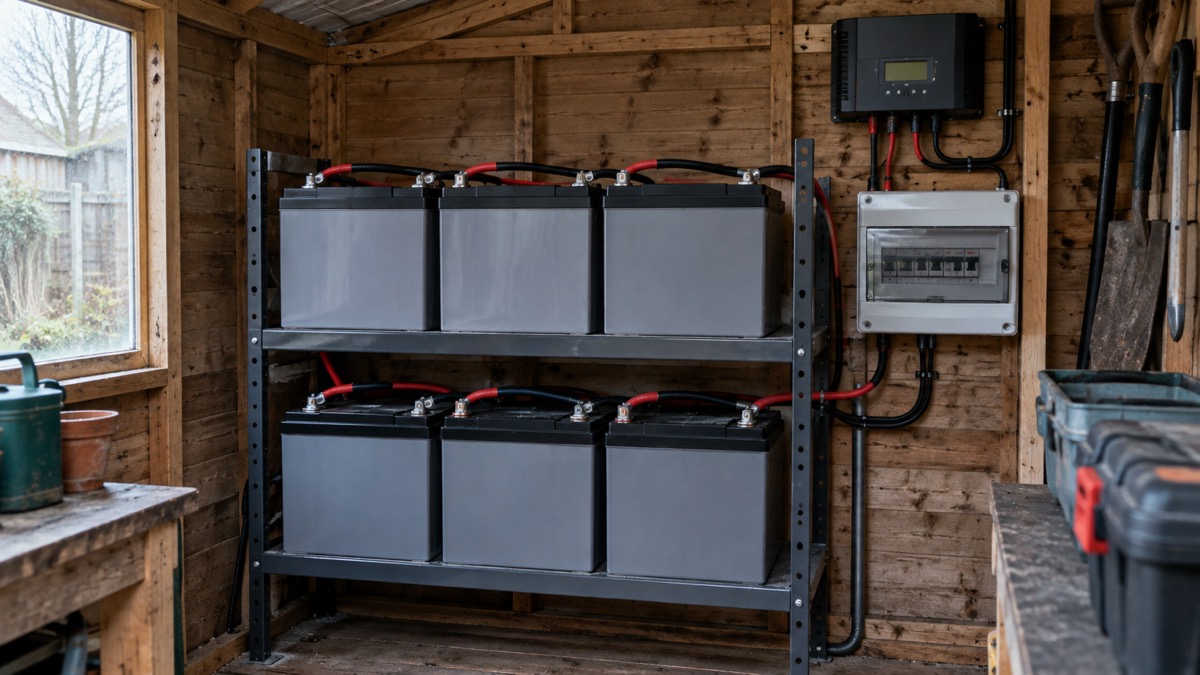
A worked example from leisure-battery guidance shows the arithmetic. If you expect to use 70Ah every 24 hours and your panels put back 20Ah a day, your net draw is 50Ah a day: 70Ah minus 20Ah. Away for one day, you need 50Ah of usable capacity, which means around 110Ah of rated lead-acid or 55Ah of lithium, so that neither becomes over-discharged3. Stretch the same trip to two days with no recharging and the need doubles to 140Ah, calling for around 300Ah of rated lead-acid or 150Ah of lithium3. Size the bank for your worst realistic stretch of weather, not your average day, and check the figures against your own daily watt-hours with our guide to sizing an off-grid solar system.
Charging speed is part of capacity planning too. The Caravan and Motorhome Club's technical advice is not to charge at more than one tenth of the battery's capacity, for example 6 Amp for a 60 Ah battery4. A big bank charged gently takes many hours to refill, which matters in a British winter when daylight is short. If you are charging two batteries continuously, the same guidance recommends a twin-bank charger with two separate outputs, which can accommodate two batteries simultaneously4.
AGM and gel: sealed lead-acid with no topping up
AGM (absorbed glass mat) and gel batteries are both sealed lead-acid: the acid is held in a mat or immobilised as a gel, so there is nothing to top up and nothing to spill if the case is cracked. That makes them the natural choice where a bank must live on its side, in a living space, or somewhere you cannot easily check it. The trade-off is that they are less forgiving of charging mistakes than the flooded type.
Sterling Power, describing its own charger, states that for best effect you should use open lead batteries and avoid gel, sealed and AGM batteries with that unit5. The reason it gives matters to anyone with a mixed system: alternator voltages up to 15V are great for open lead-acid batteries but fatal to an AGM, gel or sealed battery, so voltage reduction is necessary5. In practice that means a sealed bank must be charged by equipment set to its chemistry, not by whatever charger is to hand. If your bank will be charged from a vehicle, a generator or any source that can push high voltages, either choose flooded lead-acid or fit a charger that limits the voltage for sealed types.
The distinction between AGM and gel is smaller than the distinction between sealed and flooded. Both are maintenance-free and both dislike over-voltage. Gel types are the more sensitive of the two to high charging voltages, so if your charge sources vary, AGM is the more tolerant sealed choice. Whichever you fit, the controller between the panels and the bank must be configured for it; see our page on solar charge controllers for how those settings work.
Looking after flooded (wet) lead-acid batteries
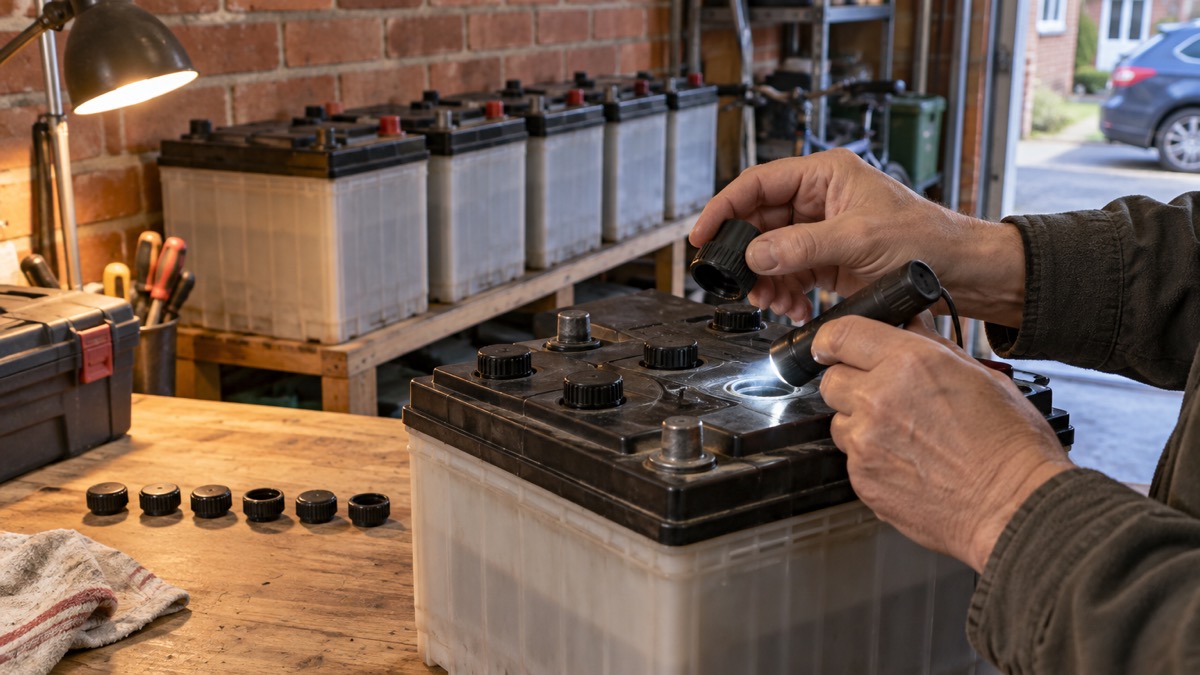
Flooded lead-acid batteries reward attention. They deliver their rated amp-hours without needing the extra capacity margin that deep discharge demands, they tolerate firm charging, and they can be checked from the outside: a look at the electrolyte level and a check of the charge tell you more than any sealed battery will. The price is routine work, and the acid inside deserves respect.
Government flooding guidance notes that car batteries are usually lead-acid batteries containing 35 per cent sulphuric acid, and that old batteries can leak this acid10. Handle them with rubber gloves, dispose of them at local civic amenity sites, and let the site operator know if one is leaking or contaminated10. If a household battery of another type leaks, Duracell's cleanup advice is to use either one tablespoon of boric acid in one gallon of water, or a 50/50 mixture of diluted vinegar or lemon juice with water11. That advice covers alkaline, NiCAD and NiMH batteries rather than lead-acid, but it is the maker's own instruction for the small batteries most households actually meet9.
A flooded bank also needs the right charging regime. Do not charge at more than one tenth of the battery's capacity, for example 6 Amp for a 60 Ah battery, and match the charger to the bank rather than pushing it harder4. Some flooded banks benefit from a periodic equalisation charge to bring every cell back into step; our page on equalisation charging covers which batteries need it and which must never have it. Sealed batteries must not be equalised, and a flooded bank that never gets one will slowly lose capacity cell by cell.
Charging an off-grid bank: chargers, controllers and voltages
Every off-grid bank lives or dies by what sits between it and the power coming in. The bank stores low voltage DC, up to 48V, and must be protected from over- and under-charging by a suitable controller1. That controller is not an optional extra: it is the piece of equipment that stops a bright spring day from cooking your batteries.
Between controller types, MPPT units convert the panels' higher voltage down to the battery's voltage efficiently. Marlec, describing the Morningstar TriStar range, quotes the industry's highest peak efficiency of 99 per cent for off-grid charge controllers12, and notes that the SunSaver MPPT enables the use of high voltage and thin film modules for off-grid battery charging12. In plain terms, an MPPT controller lets you use panels that would otherwise mismatch your bank's voltage, and wastes very little in the conversion. How PWM and MPPT controllers differ in practice is covered in full on our charge controllers page.
If your bank is also connected to the house, the Centre for Sustainable Energy notes that DC coupling might be a better option if you install solar panels and a battery at the same time, as they can be fully integrated13. And independent advice on domestic storage is that the best setup, environmentally and financially, is one that allows you to charge the battery from the grid as well as from solar panels, and to export from the battery to the grid during chosen periods1. For a truly off-grid bank none of that applies, but for a hybrid system it is worth designing in from the start.
One charging rule applies across chemistries: keep the rate within the battery's limits, no more than one tenth of capacity for a leisure-type lead-acid battery4, and never exceed the voltage a sealed battery can take5. For lithium, follow the maker's charging instructions exactly, because over-charging is one of the conditions the fire and rescue services list as a fire risk8.
Storing batteries between uses
A bank that sits unused for a season still needs a plan. Batteries left flat slowly damage themselves, and batteries left on the wrong charger can be over-charged, which the fire and rescue services list among the conditions that turn a lithium-ion battery into a fire risk8. The Lincolnshire guidance is simple and applies to every rechargeable battery: always read the manufacturer's safety instructions, and do not leave a lithium-ion battery on charge overnight or when away from the device14.
Where you store batteries matters as much as how. Surrey Fire and Rescue Service advises not to charge or store lithium batteries, e-bikes or e-scooters in corridors or on an exit route15, and the point carries over to a storage bank: never put it where a fire could block your way out of the building. Heat is the other enemy. Devon and Somerset Fire and Rescue Service warns that lithium-ion batteries in phones, vapes, e-bikes and e-scooters can become a fire risk when exposed to high temperatures or charged incorrectly16, so a bank should not live in a south-facing glazed porch or next to a boiler.
For lead-acid, storage means keeping the bank charged and checking it periodically, since a battery left flat for months may not recover. For lithium, storage means a cool, dry place away from escape routes, at the charge level the maker specifies, and a check for damage before it goes back into service. If a battery has been submerged in water, treat it as a fire risk and do not use or charge it8.
Lithium battery fire risks and the warning signs to watch for
Lithium-ion batteries are already all around the house, and in a household battery bank the same chemistry stores far more energy in one place, so the fire risk deserves plain treatment. Batteries are safe during normal use, but they present a fire risk when over-charged, short-circuited, submerged in water or damaged8.
The failure mode is fast and fierce. North Yorkshire Fire and Rescue Service describes what happens when a battery is overcharged or overheated: batteries rapidly overheat, release toxic fumes, and ignite, causing intense fires that are hard to extinguish17. Surrey Fire and Rescue Service adds that fires involving lithium batteries spread incredibly quickly and produce toxic fumes15. Mid and West Wales Fire and Rescue Service warns that cheap chargers and batteries may not meet UK safety standards and can be dangerous18, so a bank and its charger should come from a reputable source and carry the maker's own specifications.
If a lithium battery fire does start, the instruction from every fire and rescue service is identical: get out, stay out and call 999. Manchester Fire and Rescue Service says explicitly not to attempt to extinguish the fire21, and the London Fire Brigade says to get out immediately, raise the alarm, call 999 and not attempt to tackle the fire yourself20. These fires are not a bucket-of-water job: they burn intensely, produce toxic fumes, and can reignite. Your job is to get everyone out and let the fire service do theirs.
Home battery storage that keeps working in a power cut
A fixed lithium bank on the wall is not automatically backup power. The Centre for Sustainable Energy states plainly that not all batteries can deliver electricity during a power cut13, and the Centre for Alternative Technology explains why: most standard battery installations cut off during a power cut, to avoid sending electricity out to the grid and endangering engineers working on the lines1. A battery that cuts off is still doing its job as designed, but it is no use to you in an outage.
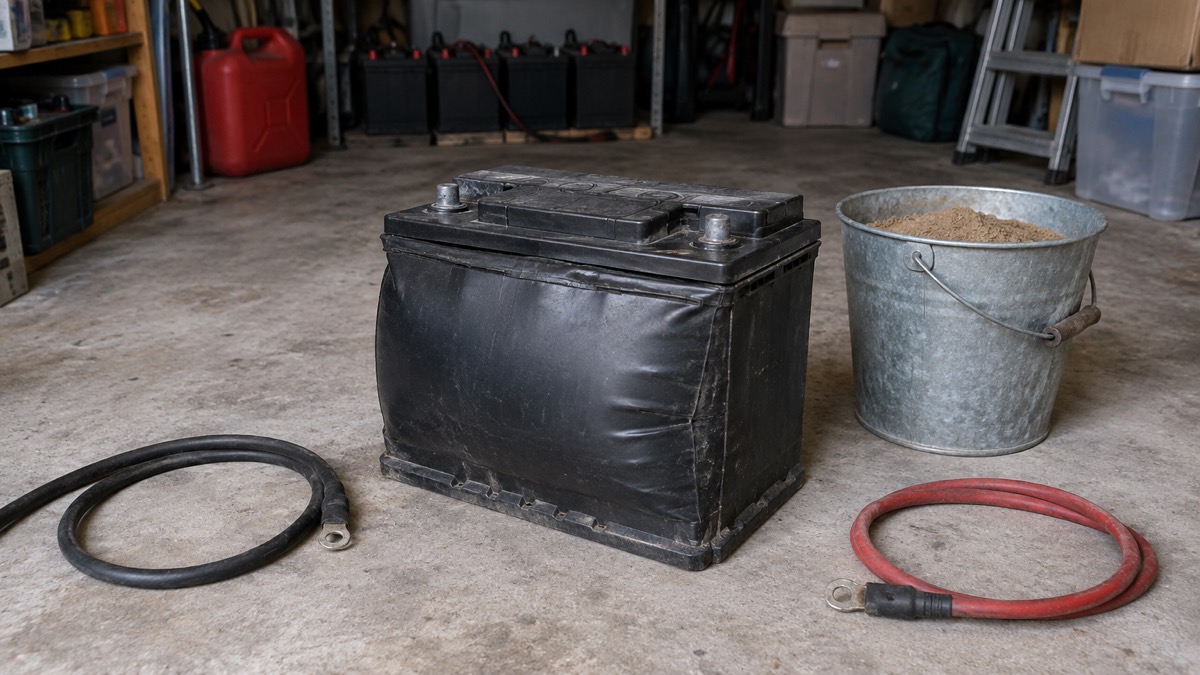
The fix is to specify backup capability when the system is designed. Government preparedness guidance says that if you have solar panels and a battery storage system with power backup capability, some installations can continue to provide power during a power cut if they are designed and configured to operate independently of the grid, which may help keep essential appliances running during an outage23. That means asking for it, and having the extra hardware fitted, before the system is installed rather than discovering the gap during the first storm.
For some households it is more than a convenience. The Centre for Sustainable Energy notes that battery storage systems that can provide back-up power during grid outages may be particularly beneficial for households that rely on electrically powered medical equipment to support health conditions13. If that describes your household, also register with your supplier's Priority Services Register, and read our guide to backup power at home for the full range of options, from power stations to wired-in systems.
How off-grid banks differ from a portable power station
A fixed bank and a portable power station share chemistry but not purpose. The fixed bank is wired into your system permanently, sized in hundreds of amp-hours, and charged by your panels every day. A portable unit, the kind sold for camping and emergencies, is a self-contained battery with its own inverter, sockets and charging electronics, meant to be carried to where it is needed and topped up from a wall socket, a car or a small panel.
The chemistries inside them overlap. Anker's SOLIX Solarbank 4 E5000 Pro, a balcony battery storage unit, uses LiFePO4 cells, and Anker states its backup function provides power through an off-grid socket rather than for the whole home24. Anker's SOLIX C800 Plus portable power station uses the maker's EV-Class LiFePO4 battery25. Not every portable unit uses that chemistry: EcoFlow's Solar Tracker has an internal NCM battery of 5000mAh26, a different lithium chemistry again. The lesson is to check the chemistry before you buy, because it shapes both lifespan and fire behaviour.
For emergency use, the two complement each other rather than compete. A fixed bank keeps a household running day to day off-grid; a portable power station is the thing you grab in a power cut to run a light, a phone charger and a CPAP machine for a night. Makers also note that lithium-ion batteries perform better than alkalines in cold conditions, delivering more consistent power and being less likely to fail in freezing temperatures27, which matters if your emergency kit lives in a cold garage or car. Our backup power section sets out the portable options side by side.
Disposing of old batteries safely
Batteries at the end of their life are a fire risk right up to the moment they are correctly recycled. Scottish Fire and Rescue Service warns that the disposal of lithium-ion batteries, such as incorrectly placing them in general household and recycling waste, can lead to significant waste fires28, and the service is explicit that they should never be placed in household waste28. A battery crushed in a bin lorry or compactor can short-circuit and ignite exactly as it would on a charger.
The correct route is your local household waste recycling centre. Manchester Fire and Rescue Service advises that if in doubt, you should always take damaged or end-of-life batteries to your local household waste recycling centre, the tip21. Most local recycling centres accept lithium-ion batteries, and they should be disposed of alongside Waste Electrical and Electronic Equipment (WEEE) items; check with your local authority for the specific recycling guidelines in your area28. The London Fire Brigade says to check your local authority's website or the recycle your electricals website for the safe way to dispose of lithium-ion batteries in your area, and not to put them in the same bins as your regular rubbish or recycling29.
Businesses and anyone handling several batteries at once should go further. Official guidance for businesses disposing of lithium batteries is to use UN-approved containers, partner with certified disposal companies, and segregate batteries by chemical type, for example LiFePO4 and LiCoO2, for proper recycling18. A household clearing out a bank of a dozen batteries would do well to follow the same principle: keep chemistries separate, keep damaged batteries apart from intact ones, and tell the site operator what you are handing over10.
Where to go next
Choose your chemistry to match the person who will look after the bank: flooded lead-acid if someone will check it regularly and the weight does not matter, AGM or gel if it must be sealed and the charging is controlled, lithium if weight and usable capacity matter most and the fire rules will be followed. Size the bank from your worst-case day, not your best. Then read our pages on charge controllers, battery care and inverter chargers to build the rest of the system around it, and our off-grid solar checklist to make sure nothing is missing before the panels go up.
Sources (30)
- Battery storage, Centre for Alternative Technology, 2025-06-27
- Lithium battery fire safety, Torfaen County Borough Council, 2026-10-29
- Leisure batteries - Leisure Battery Guide from 12 Volt Planet, 12 Volt Planet
- Batteries: technical advice, The Caravan and Motorhome Club, 2026-10-25
- 12V 50A BB1250 battery charger, Sterling Power, 2026-10-25
- Lithium-ion batteries, Staffordshire Fire and Rescue Service, 2026-10-29
- NFCC_Guidance_E-bikes_and_Scooters_.pdf, National Fire Chiefs Council (NFCC)
- Batteries and chargers, London Fire Brigade, 2026-10-25
- Which battery type should I use in extreme temperatures?, Duracell, 2026-10-26
- How to recover from flooding, UK Government, 2023-12-19
- Can Duracell rechargeable batteries be used in any device?, Duracell, 2026-10-26
- Morningstar PV controllers, Marlec, 2026-08-26
- Battery storage, Centre for Sustainable Energy, 2025-10
- Electrical safety: home fire safety, Lincolnshire County Council, 2026-10-29
- Lithium batteries: fire safety at home, Surrey County Council Fire and Rescue Service, 2026-10-28
- How to stay safe during a heatwave, Devon and Somerset Fire and Rescue Service, 2026-06-23
- E-scooter, e-bike and mobility scooter fire safety advice, North Yorkshire Fire and Rescue Service, 2026-03-25
- Lithium battery fire safety, Mid and West Wales Fire and Rescue Service, 2026-10-26
- Easy read fire safety booklet, London Fire Brigade, 2026
- Spot the warning signs: could your e-bike or e-scooter start a fire?, London Fire Brigade, 2026-10-25
- E-bikes, e-scooters and mobility scooters, Manchester Fire and Rescue Service, 2026-10-29
- E-bikes and e-scooters fire safety, Mid and West Wales Fire and Rescue Service, 2026-10-29
- Power cuts: be informed about hazards, UK Government Prepare campaign, 2026-10-21
- Anker SOLIX Solarbank 4 E5000 Pro, Anker SOLIX, 2026-10-25
- Anker SOLIX C800 Plus, Anker SOLIX, 2026-10-25
- Solar Tracker, EcoFlow, 2026-10-25
- Range 400, BioLite, 2026-10-25
- Lithium-ion batteries, Scottish Fire and Rescue Service, 2025-11-27
- How to dispose of batteries from your e-bike or e-scooter, London Fire Brigade, 2026-10-25
- Rechargeable lithium-ion battery safety advice, Cheshire Fire and Rescue Service, 2026-09-30
 Off-Grid Solar Kit Checklist
 Hydroponic System Parts List
 Year-Round Sowing Calendar
 Off-Grid Battery Care
 Solar Charge Controllers
 G98 DNO Notification
 Off-Grid Inverters
 Mounting and Wiring Solar Panels
 Solar Panel Types
 Sizing an Off-Grid Solar System
 Solar Water Pumping
 Off-Grid System Types
 Small Wind Turbines