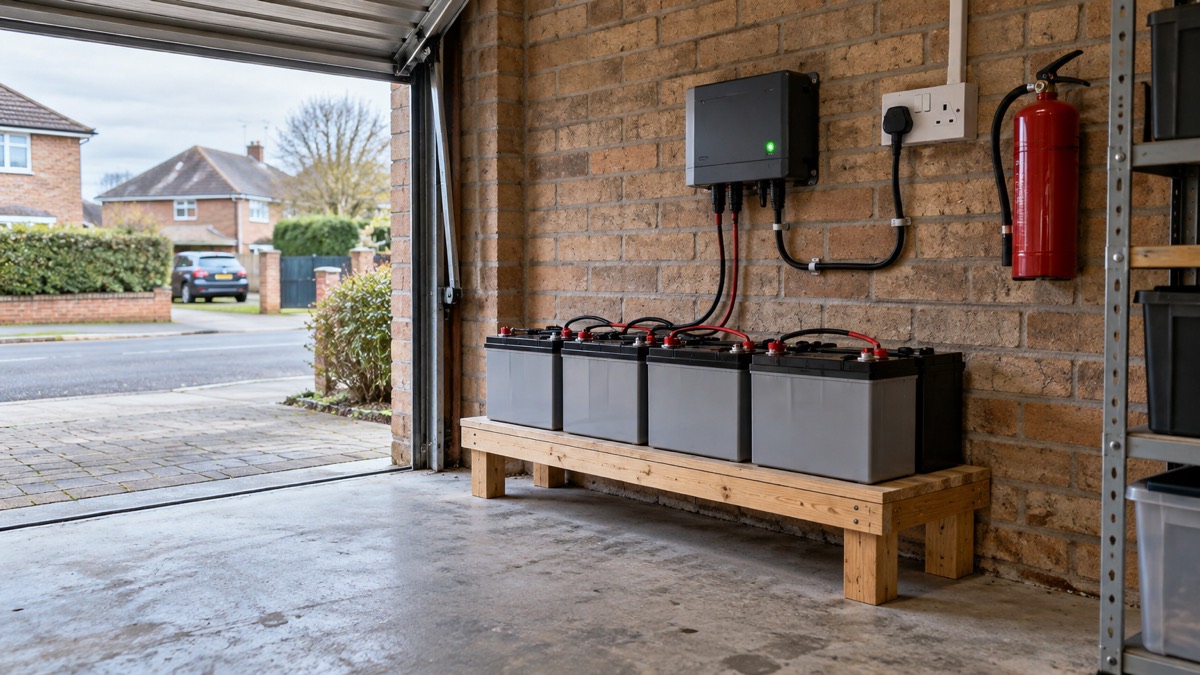
A battery bank is the quiet heart of an off-grid set-up: it holds what your solar panels or wind charger gather during the day and gives it back at night. Looking after it comes down to a handful of habits. Charge it only while you are awake, present and able to keep an eye on it, because fire and rescue services across the UK are unanimous: never leave a charging battery unattended or charging overnight1. Check it regularly for swelling, leaks, strange smells and slow charging, and stop using it the moment any of those appear1. And if a battery ever smokes or catches fire, get out, stay out and call 9992.
The chemistry you have shapes the rest. A flooded lead-acid bank needs its electrolyte topped up with distilled and de-ionised water when the plates are exposed, and it must never be left sitting below 12.4 V, because a battery left below that voltage deteriorates quickly and will not recharge to its original capacity3. A lithium bank needs none of that, but it asks for more care over charging and storage: the correct charger, a cool dry place, and no leaving it on charge after the cycle completes4. This page sets out what to do for each type, in the order you need it.
Never leave a battery bank charging unattended or overnight
This is the single rule that every UK fire and rescue service repeats, in the same words, for every kind of rechargeable battery. Manchester Fire and Rescue Service: "Never leave a charging battery unattended or leave it charging when you go to bed"1. West Yorkshire Fire and Rescue Service adds the positive side of the rule: always be present while charging and unplug once fully charged5. The same instruction appears in home fire safety checklists from Devon and Somerset6, in London Fire Brigade's advice on batteries and chargers4, and in Lincolnshire's electrical safety guidance, which tells households not to leave a lithium-ion battery on charge overnight or when away from the device7.
For an off-grid household this needs some thought, because a bank connected to solar panels is, in a sense, always connected to a charging source. The rule as the fire services state it applies to mains charging: when you plug a battery, a power station or any device into the wall to top it up, treat that as an active process you supervise, not something you leave running while you sleep or pop out. Oxfordshire County Council's Fire and Rescue Service puts the emergency side plainly: if a fire occurs, get out, stay out, call 9998.
Where and how you charge matters as much as when. Charge batteries in a safe, visible location, away from flammable materials and never in an escape route, so that if the worst happens you can still get out of the house9. Essex Fire and Rescue Service advises avoiding charging, using or storing batteries at very high or low temperatures10. Unplug once the charge cycle is complete rather than leaving items continuously on charge4.
Warning signs that a battery is failing
Batteries rarely fail silently. The fire services describe a consistent set of warning signs, and learning them is the most useful thing you can do after the charging rule itself. Scottish Fire and Rescue Service lists them directly: do not use or charge a device if you notice the battery producing smoke, feeling extremely hot to touch, looking swollen or showing any type of lump or leak, making a hissing or cracking sound, smelling unusual, or taking longer to charge or not fully charging11. Cheshire Fire and Rescue Service gives the same list in similar words, adding charging problems that are slow or incomplete, a bulging or swelling shape, a strong or unusual smell, hissing or cracking sounds, and smoke12.
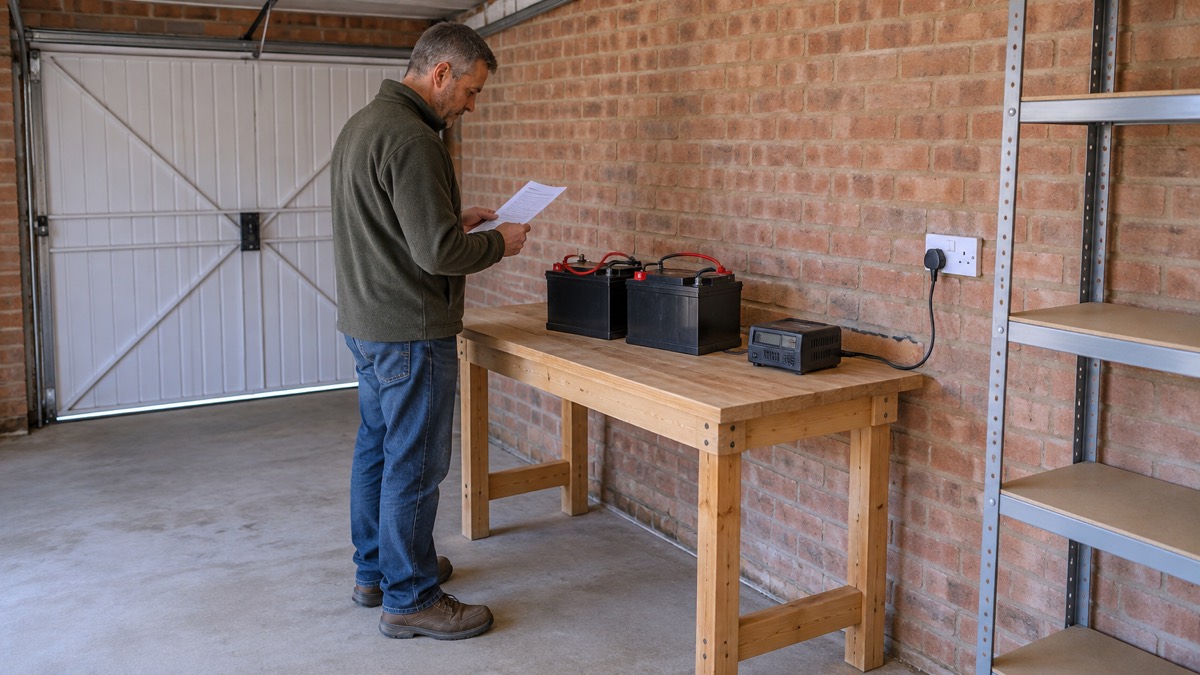
Surrey County Council's Fire and Rescue Service groups the early signs under function: batteries not fully charging, taking a very long time to charge, or being used up faster than normal can all be a sign that your battery is failing13. Its advice on what to do is just as direct: immediately turn off the device, unplug it from the power source and remove it from your home13. Manchester Fire and Rescue Service tells households to regularly check for signs of damage like swelling, leaks or strange smells, and to stop using damaged batteries immediately1.
For a bank rather than a phone, "remove it from your home" needs care. If a large battery is swollen or hot, do not manhandle it into a car boot. Turn off and isolate the charging source, keep people away from it, and contact the manufacturer for advice, as Cheshire Fire and Rescue Service recommends when a battery shows warning signs12. If it smokes or shows any sign of fire, the instruction changes: raise the alarm, get out, stay out and call 999 immediately13.
Lithium or lead-acid: how each one needs looking after
The two chemistries used in off-grid battery banks want different things from you. The table below sets the two side by side.
| What it needs | Flooded lead-acid | Lithium-ion |
|---|---|---|
| Topping up | Distilled and de-ionised water when plates are exposed; never tap water or fridge meltwater3 | Never top up; the cells are sealed |
| Charging | Lower rate for a longer period rather than a high rate for a short time3 | Correct charger only; unplug when fully charged4 |
| Storage voltage | Do not leave below 12.4 V; check every two months and recharge if necessary3 | Follow the maker's instructions for storage and maintenance over extended periods14 |
| Self-discharge | 0.1 to 0.2 per cent of charge per day at room temperature, even when new; rises with age and temperature3 | Be extra careful charging a battery unused for a long time; lithium batteries do not like being discharged to a very low voltage10 |
| Damage response | Replace and recycle if it will not hold charge | Stop using immediately, do not use or charge if damaged, recycle it11 |
For lead-acid, the Caravan and Motorhome Club's technical advice is the practical backbone. If the battery is not 100 per cent charged, recharge at a lower rate for a longer period rather than at a high rate for a shorter time3. Sealed lead-acid batteries, which include the AGM and gel types common in smaller off-grid systems, should be charged with an automatic or voltage-controlled battery charger, available from most battery specialists3. That matters because a plain unregulated charger can push voltage too high for a sealed battery, which is where a charge controller or a voltage-controlled charger does the work of holding the voltage in bounds.
For lithium, the maker's instructions carry more weight than for lead-acid, because the battery's own protection electronics and charging profile vary between designs. Mid and West Wales Fire and Rescue Service advises following the manufacturer's instructions for the storage and maintenance of lithium-ion batteries if they are not going to be used for extended periods14, and Lincolnshire's guidance says simply: always read the manufacturer's safety instructions7. Manchester Fire and Rescue Service makes that a general rule for rechargeable batteries, covering using, charging, storing and disposing of them1.
One point of difference worth knowing: a lithium bank does not need to be held at a full charge the way a lead-acid bank on float does. London Fire Brigade advises not leaving items continuously on charge after the charge cycle is complete4, and West Yorkshire's advice to unplug once fully charged points the same way5. Holding a lithium battery on charge adds risk without adding useful stored energy.
Topping up a flooded lead-acid bank
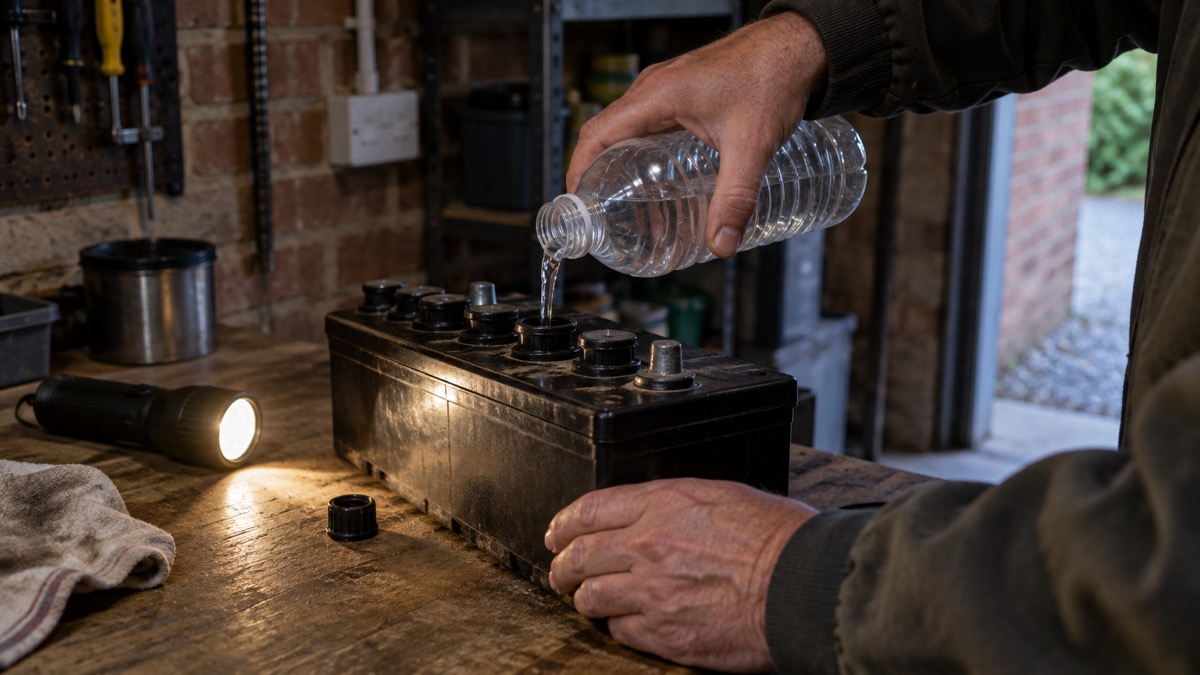
A flooded lead-acid battery is the one type in common off-grid use that you open up and maintain. The Caravan and Motorhome Club's advice is specific about the water: if the plates are exposed, top up with distilled and de-ionised water, and never use tap water or meltwater from a fridge3. Tap water carries dissolved minerals that settle onto the plates and steadily reduce the battery's capacity, and fridge meltwater carries the same problem along with whatever it has picked up in the freezer compartment.
Top up only when the plates are exposed, not as a routine. The electrolyte level falls as water is lost during charging, so a bank that is cycled hard will need attention more often than one that sits mostly full. Check the level before a full charge rather than after, so you can see the true resting level, and add distilled and de-ionised water to bring the plates back under cover.
To see how full the battery actually is, the Club's advice for leisure installations is to check the battery's state of charge on the consumer unit, usually located above or alongside the main door in a caravan installation3. In a home off-grid set-up the equivalent is the system's monitor or meter, and the same principle applies: read the state of charge from the monitoring point rather than guessing. A hydrometer, which samples the electrolyte from each cell, is the other traditional way to test a flooded battery, and the reading tells you whether every cell is pulling its weight or one is falling behind.
Equalisation, a deliberate overcharge used on some flooded lead-acid banks to stir the electrolyte and bring lagging cells back, is a subject in itself, and it depends entirely on battery type: some batteries need it periodically and others, particularly sealed and lithium types, must never receive it. Our separate page on equalisation charging covers which is which and how it is done.
Sulphation, storage voltage and winter checks
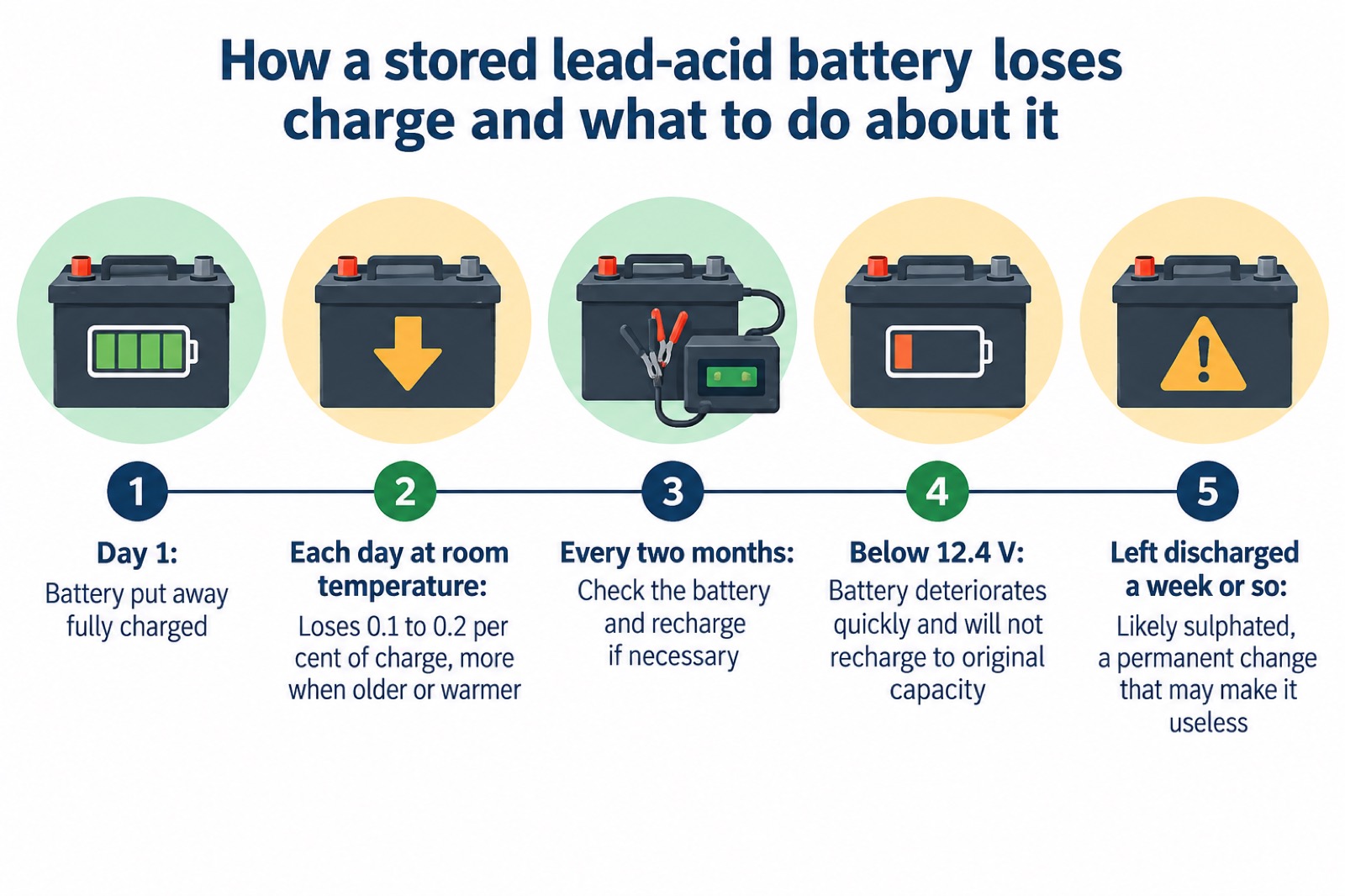
The failure mode that kills most lead-acid banks in storage is sulphation. The Caravan and Motorhome Club describes it plainly: if the battery was left discharged and had been run down for a week or so, it is likely that it has become sulphated, a permanent change which may render the battery totally useless3. The lead sulphate that forms on the plates during discharge hardens into a crystalline form that normal charging cannot reverse, which is why a battery that sat flat over a winter often never comes back properly.
The defence is voltage discipline. A battery left below 12.4 V will deteriorate quickly and will not be able to be recharged to its original capacity3, so treat 12.4 V as the floor for anything in storage. Check the battery every two months and recharge if necessary to ensure a long and trouble-free battery life3. That two-month rhythm matters because self-discharge never stops: modern batteries lose 0.1 to 0.2 per cent of their charge per day at room temperature, even when new, and as batteries age or temperature increases, so does the self-discharge rate3. A newly purchased battery may not be fully charged when you buy it, so give it a proper charge before it goes into service or storage3.
Cold weather slows self-discharge down, which works in your favour, but it also means a battery brought in from a cold shed and charged needs to warm up first, since Essex Fire and Rescue Service advises avoiding charging at very low temperatures10. If you run a second battery as a reserve, the Club's advice is to charge it fully before you need it: a second battery, charged up before going away, will maintain a good state of charge for some weeks and can remain disconnected as a reserve, to be swapped with the main battery once that one runs low3.
Storing lithium batteries at charge, somewhere cool
Lithium batteries ask for less routine work but stricter conditions. West Yorkshire Fire and Rescue Service's storage advice is to keep batteries in a cool, dry place, away from metal objects like keys or coins that can short the terminals5. Oxfordshire's Fire and Rescue Service says the same for e-bikes and their batteries: store them in a cool place, avoiding extreme temperatures8, and Essex Fire and Rescue Service advises avoiding storing, using or charging batteries at very high or low temperatures10.
Two storage habits matter for an off-grid household. First, do not put a lithium bank or spare battery away at a very low charge. Essex Fire and Rescue Service warns that lithium batteries do not like being discharged to a very low voltage, and to be extra careful when charging a device that has not been used for quite some time10. A battery that has sat empty for months is the one most likely to behave badly when charging restarts, so charge it while you are present and watching. Second, follow the maker's own storage instructions for extended periods out of use, as Mid and West Wales Fire and Rescue Service advises14, because different lithium chemistries and battery management systems have different expectations.
Physical protection matters as much as electrical care. Manchester Fire and Rescue Service advises avoiding dropping, puncturing or exposing batteries to water, because damaged batteries are a fire risk1. For a bank in a shed or garage, that means a stable surface, nothing stacked on top of it, and no risk of it being knocked over or flooded. Keep spare batteries away from loose metal, and tape over the terminals of any battery being kept for recycling, as Torfaen County Borough Council advises, to prevent short circuits and fire risk9.
Chargers, damage and thermal runaway
Most lithium battery fires trace back to how the battery was charged or what condition it was in. Devon and Somerset Fire and Rescue Service describes the mechanism: rapid overheating, a process called thermal runaway, leading to fire or explosion, and if one cell of a lithium-ion battery overheats it can quickly spread to other cells15. North Yorkshire Fire and Rescue Service describes the same process as one where internal temperatures of the battery continue to increase, making it unstable, with a heightened risk of explosion16.
The causes are well documented. Cheshire Fire and Rescue Service names using incorrect or incompatible chargers as a cause of damage to lithium-ion batteries12. Mid and West Wales Fire and Rescue Service warns that cheap chargers and batteries may not meet UK safety standards and can be dangerous17. Dorset and Wiltshire Fire and Rescue Service reports that poorly designed or poorly manufactured lithium-ion batteries present a risk of thermal runaway which can result in a serious fire or explosion18. The lesson for an off-grid set-up is simple: use the charger the battery was designed for, buy chargers from reputable sources, and replace a charger that shows any damage or wear and tear with an official one, as Scottish Fire and Rescue Service advises11.
Product recalls show how this plays out in real households. A Valiant radiator fan sold through several major online and high-street retailers was recalled in November 2025 because the product presented a risk of fire: the battery may fail during charging or while in normal use, leading to thermal runaway, and if the product is charged or left unattended in standby mode, a fault may occur leading to thermal runaway and the product catching fire19. Check gov.uk product safety alerts, reports and recalls if you own one, and treat any recalled battery-powered product as something to stop using and return.
The conditions that push a healthy lithium battery into fire are consistent across every fire service: over-charging, short-circuiting, submersion in water, or damage15. Devon and Somerset notes these batteries are safe during normal use, which is worth holding onto: the risk is not that lithium banks are inherently dangerous, but that a small number of conditions turn them dangerous, and every one of those conditions is avoidable15.
"If one cell of a lithium-ion battery overheats, it can enter a state of thermal runaway which can quickly spread to other cells."
Lithium-ion fire risk in an off-grid bank
An off-grid bank is larger than a phone battery, so the consequences of failure scale with it. Staffordshire Fire and Rescue Service notes that improperly charged, handled, stored or disposed of lithium-ion batteries carry a risk of overheating, catching fire or explosion, and that this increases the risk of a house fire, garage fire or personal injury20. North Yorkshire Fire and Rescue Service describes what an overcharged or overheated battery does: it rapidly overheats, releases toxic fumes and ignites, causing intense fires16. Scottish Fire and Rescue Service warns that where batteries fail seriously, they can explode or lead to a rapidly developing fire11.
Damage is the trigger to watch for. Mid and West Wales Fire and Rescue Service warns that where a battery is damaged, it can overheat and catch fire without warning, so check your battery regularly for any signs of damage, and if you suspect it is damaged it should be replaced and should not be used or charged14. London Fire Brigade's disposal advice for e-bike batteries makes the same point: if they get damaged or overheat, they may catch fire21. For a bank in daily service, that means a visual check whenever you are near it: no dents, no swelling, no cracks in the case, no signs of water ingress.
Where you site the bank is a safety decision in itself. Charge and site batteries away from flammable materials and never in an escape route9. A garage or outbuilding that is not your main escape route is a better home for a large bank than a cupboard under the stairs. Humberside Fire and Rescue Service notes that lithium-ion batteries are a main cause of waste fires as well as a household risk22, which is a reminder that the risk follows the battery through its whole life, not just its working years.
For households that rely on electrically powered medical equipment, the Centre for Sustainable Energy notes that battery storage systems able to provide back-up power during grid outages may be particularly beneficial23. If that is your situation, the maintenance habits on this page matter even more, because your bank is not a hobby: read the manufacturer's safety instructions in full7 and consider the extra help available through our backup power guidance.
If a battery catches fire: get out, stay out, call 999
Every fire and rescue service in the UK gives the same instruction, in the same six words. Tower Hamlets Council: "Get out. Stay out. Call 999"2. Cheshire Fire and Rescue Service: if a fire occurs, get out, stay out, call 99912. Staffordshire Fire and Rescue Service: in the event of a fire, always get out, stay out and call 99920. North Wales Fire and Rescue Service adds the part people most want to skip: in the event of a fire, don't try and tackle it yourself, leave and call 99924.
The reason not to tackle it is the nature of the fire. Devon and Somerset Fire and Rescue Service describes thermal runaway as an explosive chemical reaction similar to several fireworks going off at once, with such ferocity and intense heat that it cannot be put out easily15. A domestic extinguisher or a bucket of water will not stop a lithium battery in full thermal runaway, and staying to try costs you the minutes that get your household out.
Disposing of old batteries safely
A battery's last job is to be disposed of correctly, and this is where households cause fires without realising it. The rules are short and absolute. Manchester Fire and Rescue Service's Be Battery Aware campaign: do not put old batteries or electrical items in any of your household bins, including recycling bins, and check items for hidden batteries before recycling25. Scottish Fire and Rescue Service: lithium-ion batteries should never be placed in household waste, and when punctured or crushed they can cause fires in bin lorries or landfill sites11. London Fire Brigade explains the mechanism for e-bike batteries: if they are put in household bins, they can be crushed and create fires inside bin lorries21.
Instead, use the proper routes:
- Drop batteries off at designated collection points in shops and supermarkets, or check with your local authority, as West Yorkshire Fire and Rescue Service advises5.
- Most local recycling centres accept lithium-ion batteries, disposed of alongside Waste Electrical and Electronic Equipment (WEEE) items; check with your local authority for specific local guidelines, as Scottish Fire and Rescue Service advises11.
- Check your local authority's website or the recycle your electricals website for the safe way to dispose of lithium batteries in your area, as London Fire Brigade advises for e-bike batteries21.
- Tape over the terminals with electrical tape to prevent short circuits and fire risk, and store the battery in a cool, dry place until disposal9.
- For a damaged, swollen or overheating battery, take it directly to the Reuse and Recycling Centre rather than leaving it in the house or putting it in any bin2.
- Dorset and Wiltshire Fire and Rescue Service adds that damaged or end-of-life batteries should not go in household waste or normal recycling: use the manufacturer's recycling service or your local authority's arrangements18.
The same care applies to the small batteries around the house. Great Ormond Street Hospital's guidance on button batteries makes the point that even dead batteries can be dangerous: when a battery has died, dispose of it safely straightaway, do not store them up to dispose of in one go, and use the special disposal containers many supermarkets provide, found via your council's website26. Check with your council for your nearest one.
Sources (26)
- Battery safety, Manchester Fire and Rescue Service
- Battery safety, London Borough of Tower Hamlets
- Batteries: technical advice, The Caravan and Motorhome Club, 2026-10-25
- Batteries and chargers, London Fire Brigade, 2026-10-25
- Battery safety, West Yorkshire Fire and Rescue Service, 2026-10-29
- Home fire safety checklist, Devon and Somerset Fire and Rescue Service
- Electrical safety, Lincolnshire County Council, 2026-10-29
- Charging safety, Oxfordshire County Council Fire and Rescue Service
- Lithium battery fire safety, Torfaen County Borough Council, 2026-10-29
- Batteries and charging safety, Essex County Fire and Rescue Service, 2026-10-29
- Lithium-ion batteries, Scottish Fire and Rescue Service, 2025-11-27
- Rechargeable lithium-ion battery safety advice, Cheshire Fire and Rescue Service, 2026-09-30
- Lithium batteries, Surrey County Council Fire and Rescue Service, 2026-10-28
- E-bikes and e-scooters fire safety, Mid and West Wales Fire and Rescue Service, 2026-10-29
- Battery fires, Devon and Somerset Fire and Rescue Service, 2026
- E-scooter, e-bike and mobility scooter fire safety advice, North Yorkshire Fire and Rescue Service, 2026-03-25
- Lithium battery fire safety, Mid and West Wales Fire and Rescue Service, 2026-10-26
- E-bikes and e-scooters, Dorset and Wiltshire Fire and Rescue Service, 2026-02-02
- Product recall: Valiant Radiator Fan, UK Government, 2025-11-07
- Lithium-ion batteries, Staffordshire Fire and Rescue Service, 2026-10-29
- How to dispose of batteries from your e-bike or e-scooter, London Fire Brigade, 2026-10-25
- Batteries, Humberside Fire and Rescue Service, 2026-10-29
- Battery storage, Centre for Sustainable Energy, 2025-10
- Lithium-ion batteries, North Wales Fire and Rescue Service, 2026-10-25
- Be Battery Aware, Manchester Fire and Rescue Service, 2026-10-29
- Button batteries: using them safely, Great Ormond Street Hospital, 2018-10-01
 Off-Grid Solar Kit Checklist
 Hydroponic System Parts List
 Year-Round Sowing Calendar
 Off-Grid Battery Banks
 Solar Charge Controllers
 G98 DNO Notification
 Off-Grid Inverters
 Mounting and Wiring Solar Panels
 Solar Panel Types
 Sizing an Off-Grid Solar System
 Solar Water Pumping
 Off-Grid System Types
 Small Wind Turbines