

Victron Energy is a maker of power electronics: inverters and inverter chargers, solar charge controllers, batteries and battery monitors, and battery chargers. For a UK household preparing for emergencies, its relevance is narrow and practical. It is the kind of equipment that can keep a fridge, a freezer, a router, some lights and a phone charger running when the mains goes off, and that can recharge itself from solar panels between outages. It is not plug-and-play consumer kit, and it is not sold as a single box that you switch on in a storm.
The most useful figure for planning is the maker's own: an 800VA inverter charger may be sufficient to cover the base load of a two-person household1. That is a starting point for a small, carefully chosen set of loads, not a whole-house supply. A working Victron energy storage system needs at least one inverter charger (MultiPlus or Quattro) and one GX device such as the Cerbo GX or Ekrano GX1. Everything else, the batteries, the solar, the monitoring, is built around those two.
The other thing to know before you buy anything is who fits it. The Health and Safety Executive is direct: electrical installations must be installed by someone who has the necessary training, skills and experience to carry out the work safely2. Fire and rescue services across the UK repeat the same advice for the home3. So the realistic path for most households is to decide what you want kept running, then have a qualified installer specify and fit a system, rather than to buy components and wire them in yourself.
What Victron makes for UK households
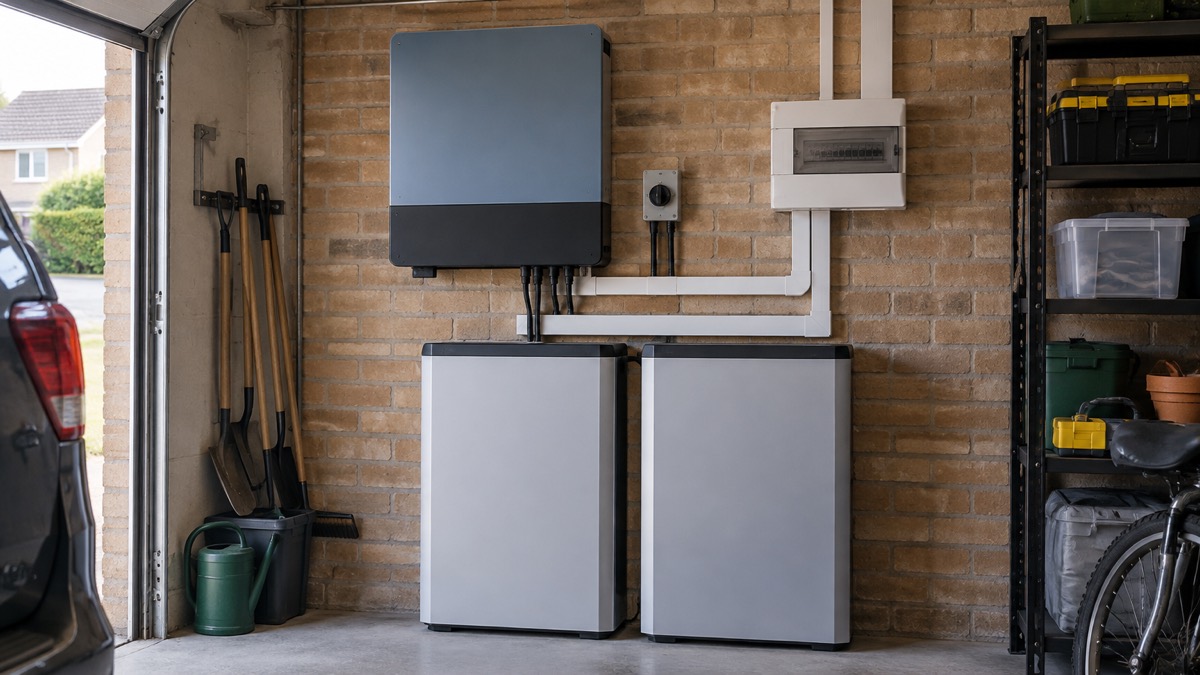
Victron's range divides into four things a household might actually use in an emergency plan. Inverters and inverter chargers turn battery power into mains electricity and, in the charger models, also recharge the batteries from the mains when it is on. Solar charge controllers manage the output of solar panels into a battery bank. Batteries store the energy, and battery monitors tell you how much is left. Battery chargers recharge batteries from a mains socket, which is useful for keeping a spare battery topped up rather than for running the house.
That maps onto the way a household plan usually works. You decide which loads matter: the fridge and freezer so food is not lost, the router and phone chargers so you can stay informed, a light or two, and anything medical that needs power. You size a battery bank and an inverter to carry those loads for the hours you expect an outage to last. You add solar if you want the system to recover on its own during a longer cut. Then you keep it maintained and charged so it works when called on.
The Backup Power at Home guide sets out the household side of this planning, and the Self-Reliance at Home section covers off-grid power more broadly. Victron is one maker in that space, and this page covers only what its own documentation says about its equipment.
From boats to home backup: where Victron kit comes from
Victron equipment has a long history in marine and vehicle electrical systems, and much of its catalogue is designed for that world. That matters to a household for one reason: not all of it transfers to a house. The maker's design manual for its energy storage system states that the system cannot be used in vehicles or boats, and explains why in terms of a specific hazard. After unplugging a shore cord, the manual warns, the shore power plug can remain live with 110/230 Volts AC on the terminals for a moment before the back-feed relay opens1.
"No, you cannot. After unplugging the shore cord it can take up a moment for the system to detect the loss of mains and o"
The lesson for a household is to specify a system for a fixed installation, designed around a consumer unit and the way mains power enters a house, rather than to adapt marine or vehicle kit. The components overlap, the design case does not. An installer who works with home backup will know which parts of the range are intended for a building and which are not.
There is a second, quieter point. A home backup system is only as good as the plan around it. Official household emergency kit lists include spare keys for windows, car and house8, spare hearing aids with batteries9, and a torch with spare batteries, a first aid kit, prescription medicines, warm waterproof clothes, bottled water, snacks, a battery or wind-up radio and supplies for a baby or pet10. The power system supports that kit; it does not replace it. Keep the two together in your thinking, and in the same cupboard if you can.
Buying through a distributor or installer
Victron is not sold the way a kettle is. Its equipment reaches households through distributors and through installers who specify and fit systems. That has practical consequences for an emergency-prepared household: the person who supplies the kit is often the person who fits it, which keeps the specification, the installation and the warranty in one place.
The general buying advice from fire and rescue services applies here as it does to any electrical product. Buy from a shop you know and trust, an approved retailer, or direct from the manufacturer of the same name as the device11. Where components are bought separately, make sure they are compatible, and be especially careful buying at online auctions or on online platforms12. For a system that will be wired into a home, compatibility is not a detail: an inverter charger, a battery bank, a solar controller and a monitoring device have to work as one system, and the maker's manual is explicit that a working system needs at least one inverter charger and one GX device1.
A sensible sequence for a household is:
- Write down the loads you want kept running and for how long.
- Ask an installer to specify a system around those loads.
- Have the installer fit and commission it, and show you how to check it is working.
- Keep the paperwork, the warranty registration and the installer's contact details with your household documents.
Where you bought through a distributor or had the system fitted by an installer, that seller or installer is your first point of contact for a claim1.
Inverters and inverter chargers
The inverter charger is the heart of a home backup system. It takes the direct current stored in a battery and turns it into the alternating current that household appliances use, and in the charger models it also recharges the batteries from the mains when power is available. The maker's manual names the MultiPlus and Quattro families as the inverter chargers in its energy storage system1.
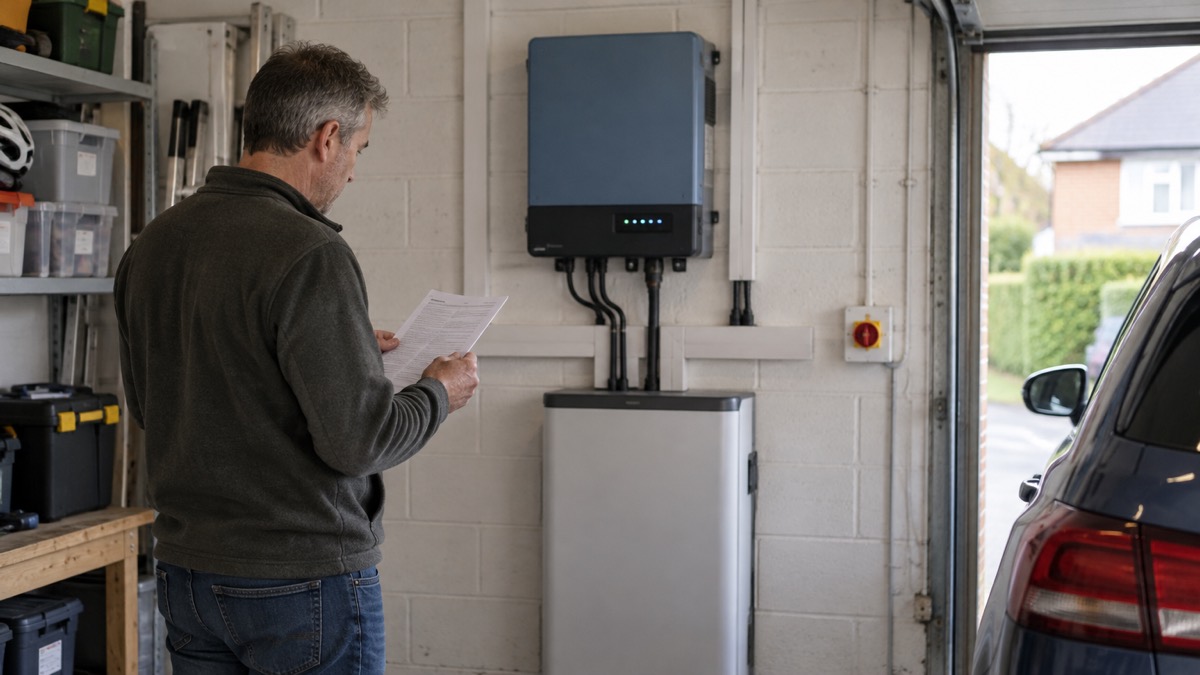
Sizing is the decision that matters most. The manual's guide figure is that an 800VA inverter charger may be sufficient to cover the base load of a two-person household1. Base load means the small, continuous draw: a fridge cycling on and off, a router, a few lights, a phone charger. It does not mean an electric shower, an oven or a tumble dryer. A household that wants to run heavier appliances for short periods needs a larger inverter and a battery bank sized to match, and that is a conversation for the installer.
What the system can and cannot do in a power cut comes down to three things: the inverter's output, the battery's capacity, and what you choose to plug in. A well specified system will carry the base load for the hours an outage typically lasts. A system sized for a few lights and a router will not run a freezer. Decide honestly which matters more to you, and tell the installer.
Solar charge controllers
A solar charge controller sits between solar panels and a battery bank. Its job is to take whatever the panels produce and charge the batteries safely, without overcharging them. For a household preparing for emergencies, solar is what turns a battery bank from a one-shot reserve into something that recovers during a long outage, or between shorter ones.
Victron's SmartSolar MPPT RS is covered on its own page in the Self-Reliance at Home section: SmartSolar MPPT RS. The wider question of how solar fits a household plan is set out in the Backup Power at Home guide.
Two practical points bear on emergency use. First, solar output depends on daylight and weather, so a system that relies on it should be sized with the shortest winter days in mind, not the longest summer ones. Second, the panels and their wiring are electrical work. Fire services advise using a qualified and competent installer where electrical work is required, for example fitting an outdoor socket13. The same applies to roof or garden panel installations.
Batteries and battery monitors
The battery bank is where the energy is stored, and it is the part of the system most often undersized in a household's imagination. The maker's manual gives guidance on which battery technologies suit its system and how to configure them. It recommends enabling the BatteryLife setting for OPzV and OPzS batteries, for GEL and AGM batteries, and for Victron 12.8V Lithium batteries and other lithium batteries that have passive cell balancing1.
Where an additional battery monitor is needed, the manual names two: the BMV-700 and the Lynx Shunt VE.Can1. A monitor matters in an emergency because it tells you how much charge is left, which is the difference between rationing power sensibly and being surprised by a flat battery at the wrong moment.
Lithium batteries bring their own safety considerations, and the fire and rescue services are consistent about them. Lithium-ion batteries are the rechargeable kind found in phones, vaping devices, e-bikes and scooters, vacuum cleaners, tablets and ear pods14. Charging advice from fire services includes buying from a reputable seller, making sure kit complies with British or European standards, and following the manufacturer's instructions15. For a home battery bank, that means a system specified and installed by a competent person, charged with the maker's own charger and settings16.
| Component | What it does in an emergency | What to check |
|---|---|---|
| Battery bank | Stores energy for the outage | Technology suited to the system; BatteryLife enabled where the manual says so1 |
| Battery monitor (BMV-700, Lynx Shunt VE.Can) | Shows charge remaining | Fitted where an additional monitor is necessary1 |
| Lithium batteries | Higher energy density | Passive cell balancing where applicable; registered with the maker1 |
Battery chargers
A battery charger is the simplest piece of Victron kit a household might own. It recharges a battery from a mains socket. That is useful for keeping a spare battery topped up, for maintaining a battery through the months when it is not being used, and for recovering a battery after an outage.
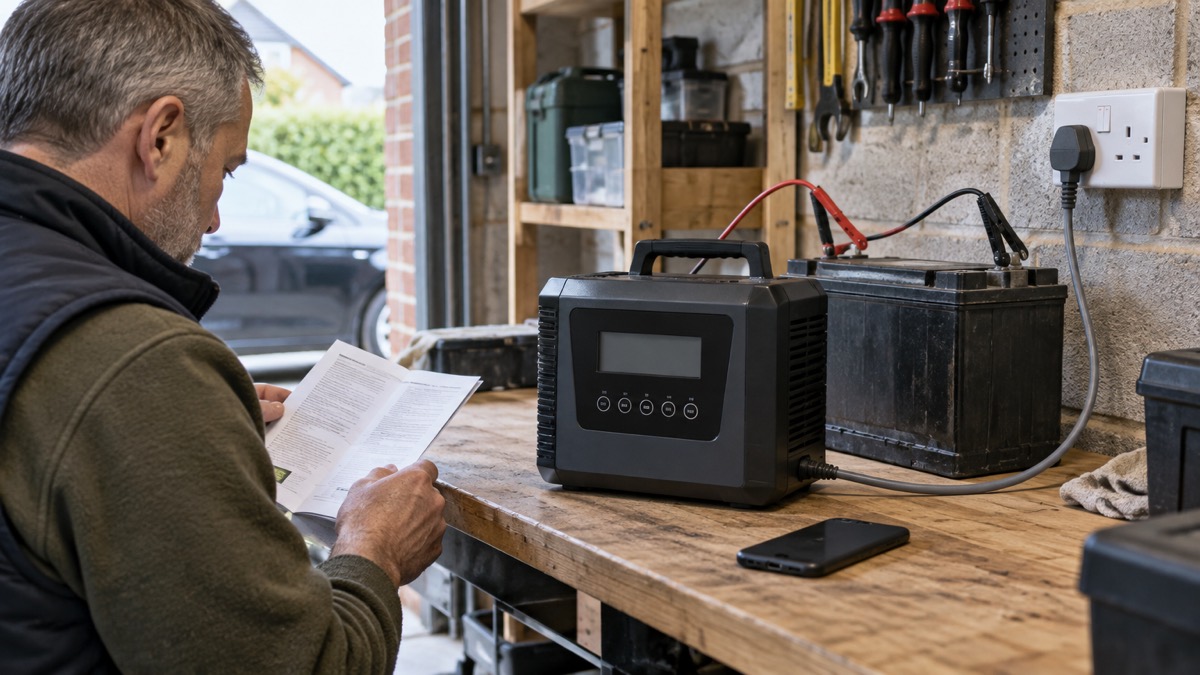
The Blue Smart IP22 12V 15A charger is an example from the range. It is a smart battery charger with a 230V input and a 12V charging voltage, a single output, a UK plug, and an efficiency figure of 93%5. It supports lithium charging using a dedicated charge approach suitable for Li-ion batteries, and its charging behaviour can be fine-tuned through the VictronConnect app, including key voltage stages and recondition settings, with advanced options in Expert mode5. It can connect with compatible Victron devices via wireless networking to share sensing data and improve charging accuracy5.
For emergency planning, the useful habit is to charge spare batteries on a schedule rather than when you remember. A battery that has sat unused for months may not hold what you expect. Keep the charger, its leads and the batteries it serves together with the rest of your emergency kit, and check them at the same time you check your torches and radio.
Safe installation and when to use a qualified electrician
This is the section to read twice. The Health and Safety Executive's position is unambiguous: you must ensure that your electrical installation and equipment is safe, and electrical installations must be installed by someone who has the necessary training, skills and experience to carry out the work safely2. Fire and rescue services across the UK say the same in household terms: find a certified electrician for any electrical installations, repairs or modifications3, and always have a qualified electrician carry out any electrical work to your property or appliances4.
If you think you have an unsafe electrical installation, the Health and Safety Executive advises warning everyone to stay away from it, switching it off if it is safe to do so, and then contacting a competent person such as an approved contractor17. For choosing an installer, government guidance is to choose someone registered with a competent person scheme who can self-certify that their work complies with building regulations18. A registered electrician works to the BS7671 safety standard, has their work regularly assessed, and is insured19.
Regular inspection is part of keeping a system ready. Fire services advise having your home's electrical installation inspected by a qualified electrician at least every 10 years, or every 5 years if you rent your home20. A backup power system adds to the installation, so it belongs in that inspection.
Warranty and support
Victron's product information lists a five-year manufacturer warranty on the Blue Smart IP22 12V 15A charger5. Warranty terms vary by product, so check the documentation that comes with the specific item you buy.
Where you bought through a distributor or had the system fitted by an installer, that seller or installer is your first point of contact for a claim. Keep the purchase paperwork, the installation record and the warranty registration together with your household documents10. Registering the product with the manufacturer is worth doing for two reasons: it validates warranties and it means you can be informed of safety recalls16.
A useful comparison from another maker's documentation shows why installation records matter. Vaillant states that it only grants a manufacturer's warranty if a suitably qualified engineer has installed the system in accordance with its instructions, and that requests during the guarantee period must be made to its service arm22. The principle is common across the industry: a documented professional installation protects the warranty. Keep the paperwork.
Safety notices and recalls
Electrical equipment can be recalled, and a household that relies on a backup system should know how to check. The Office for Product Safety and Standards issues recalls and alert notices on its website6. Electrical Safety First runs an online product checker and a list of recalled items that explains what to do with a recalled appliance7. Government guidance also points households to the list of product safety alerts, reports and recalls20.
Registering your equipment is the other half of the job. Fire services advise registering electrical items with the manufacturer so you can be informed of any safety recalls24, and registering e-bikes, e-scooters and mobility scooters with the manufacturer to validate warranties and receive safety updates16. The same habit applies to a home battery system: register it, and keep the registration details with your paperwork.
Finally, keep the system in proportion. A backup power system supports a household plan; it does not replace the rest of it. Keep a torch with spare batteries10, a battery or wind-up radio10, a first aid kit26, and a written plan that includes the power cut number, 10528. The Power Cuts guide covers what to do when the power goes, including switching off appliances like hair straighteners and irons that may turn back on automatically when power is restored29, and using battery-operated lights or torches rather than candles30. A well specified Victron system sits alongside those habits, quietly doing its job when the mains does not.
Sources (30)
- Energy Storage System design and installation manual, Victron Energy, 2024-10
- Introduction to electrical safety, Health and Safety Executive, 2026
- Electrical fire safety, Warwickshire County Council, 2026-10-29
- Electrical fire safety, Cheshire Fire and Rescue Service, 2026-10-29
- Victron Blue Smart IP22 12V 15A Charger, Fogstar, 2026-10-25
- Electrical safety, Greater Manchester Fire and Rescue Service, 2026-10-29
- Stay fire safe, Greater Manchester Fire and Rescue Service, 2026-03-25
- Planning for an emergency kit, Wiltshire Council, 2026-10-29
- Emergency kit, Ready Scotland, 2026-10-22
- Protecting your property from flooding, Met Office, 2026-10-25
- Electrical safety in the home, Mid and West Wales Fire and Rescue Service, 2026-10-29
- E-bikes and e-scooters fire safety, Mid and West Wales Fire and Rescue Service, 2026-10-29
- Plug-in solar panels: safety advice, London Fire Brigade, 2026-10-25
- Lithium-ion batteries, South Wales Fire and Rescue Service, 2026-01-13
- Rechargeable lithium-ion battery safety advice, Cheshire Fire and Rescue Service, 2026-09-30
- E-bikes, e-scooters and mobility scooters, Greater Manchester Fire and Rescue Service, 2026-10-29
- Electricity safety FAQs, Health and Safety Executive, 2026
- Oil storage regulations and safety, GOV.UK, 2026-10-29
- Electrical safety at home, Scottish Fire and Rescue Service, 2025-02-27
- Fire safety prevention, Fire Kills, 2026-03-25
- Electrical fire safety, Warwickshire County Council, 2026-10-29
- sensoCOMFORT operating instructions, Vaillant, 2026-02-23
- Electrical fire safety leaflet, Greater Manchester Fire and Rescue Service, 2026
- Electrical items, London Fire Brigade, 2026-10-29
- White goods, Cheshire Fire and Rescue Service, 2026-05-20
- Get help and advice in an emergency, Lincolnshire County Council, 2026-10-29
- First aid provisions, ProtectUK, 2026-06-01
- Prepare an emergency plan, Ready Scotland, 2026-10-29
- Energy outages, National Energy System Operator, 2026
- Power cuts, Scottish Fire and Rescue Service, 2026-10-25
 SmartSolar MPPT RS