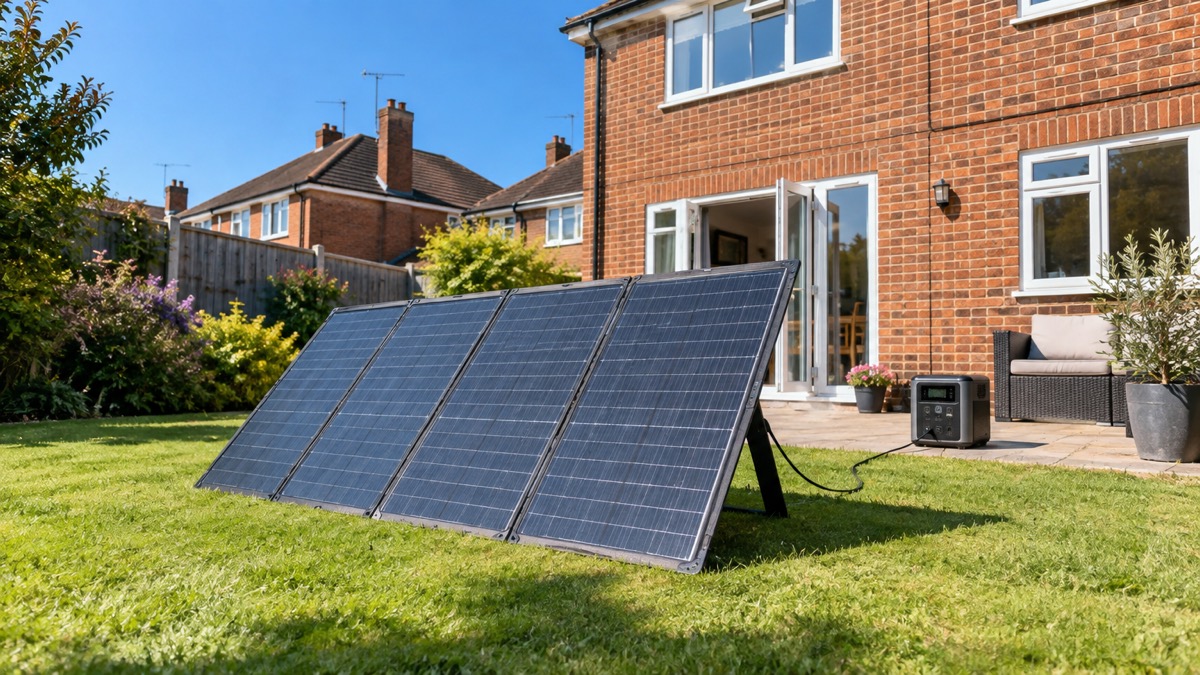
The EcoFlow 400W Portable Solar Panel is a folding panel you carry outdoors and plug into a portable power station to put charge back into it when the mains has failed. It is rated at 400W, weighs about 16kg on its own or about 19kg in its Kickstand Case, and connects with a Solar Connector and the supplied Solar to XT60 cable1. It is not a generator and it does not store anything: it only makes power while the sun is on it, and only as much as the light allows.
That last point is the one to hold on to. The maker's manual says that sunlight hitting the panel at a 90° angle usually generates 320W to 350W of power in the 400W panel4. So on a good clear day you are getting most of the rating, not all of it, and on a grey UK winter day you will get a good deal less. Plan around that rather than the headline figure.
For a household, the panel's job is to stretch a power station through a long outage: to top up the battery that runs the fridge, the router, phones and a lamp, day after day, without petrol and without noise. This page sets out what the panel is, what it will and will not do, how to connect and site it, how to keep it safe and dry, and what the maker's warranty and support cover.
Specifications: 400W rated output at up to 23% efficiency
The panel is built from monocrystalline silicon cells2. The maker's product page gives its efficiency as 22.60%1, while its own description of the same panel speaks of a solar conversion efficiency of up to 23% using multi busbar monocrystalline cells5. A separate EcoFlow page lists the 400W panel's efficiency as 22% to 23%, at or above 22.6%7. Treat 22.6% as the figure to quote and "up to 23%" as the maker's rounded description; the documents do not settle on one number.
| Specification | Maker's figure |
|---|---|
| Rated power | 400W1 |
| Efficiency | 22.60%1 |
| Cell type | Monocrystalline silicon2 |
| Open circuit voltage | 48V (Vmp 41V)1 |
| Short circuit current | 11A (Imp 9.8A)1 |
| Dimensions | 106.8 x 239.0 x 2.4 cm5 |
| Weight (panel) | Approx. 16kg2 |
| Weight (with Kickstand Case) | Approx. 19kg6 |
| Connector type | Solar Connector8 |
| Water and dust rating | IP682 |
| Warranty | 24 months2 |
Two of these figures are worth dwelling on for a household. The first is the open circuit voltage of 48V1. That is the voltage the panel can present to whatever you plug it into, and it is the number to check against your power station's solar input limit before you connect anything. The second is the current, 11A short circuit with 9.8A at maximum power1. Together they tell you the panel is a serious input, not a trickle charger, and it should be treated as electrical equipment rather than an accessory.
The dimensions, 106.8 by 239.0 by 2.4 cm5, describe a panel roughly two and a half metres long when open. That is longer than most garden tables and longer than many people expect. Before an emergency, measure the space where you intend to lay it out and check you can get it there from where it is stored.
Size and weight: about 16kg, or 19kg in the Kickstand Case
The panel weighs approximately 16kg on its own2. With the Kickstand Case it is approximately 19kg6. The maker's listings give the cased weight in more than one form, and one page shows "Approx. 41.9 (19kg)" for the same figure1; the 19kg reading is the one repeated across the maker's pages and is the one to plan with.
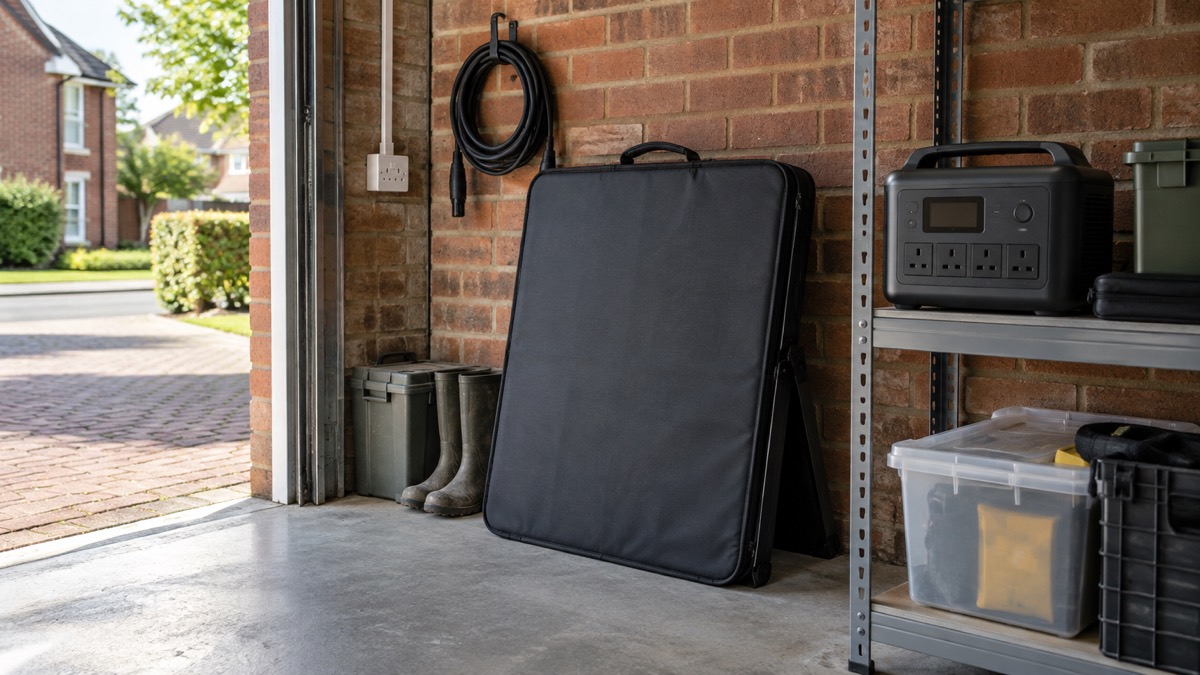
Nineteen kilograms is a two-handed lift for most adults and a genuine problem for some. If anyone in the household has mobility or strength limits, decide now who moves the panel and where it goes, rather than discovering the difficulty in the dark during an outage. The same applies to storage: a panel this size needs somewhere dry, out of the way and reachable without climbing.
The maker's manual gives two handling rules that matter for keeping the panel working:
- Keep the panel in a vertical position when you move or store it4.
- Do not apply pressure to the panel or allow it to be dropped on any of its corners, sides or faces4.
A cracked or bent panel may still look fine and produce nothing, so treat the panel as fragile kit even though it is weatherproof. Store it upright, somewhere it will not be leaned on or have things stacked against it.
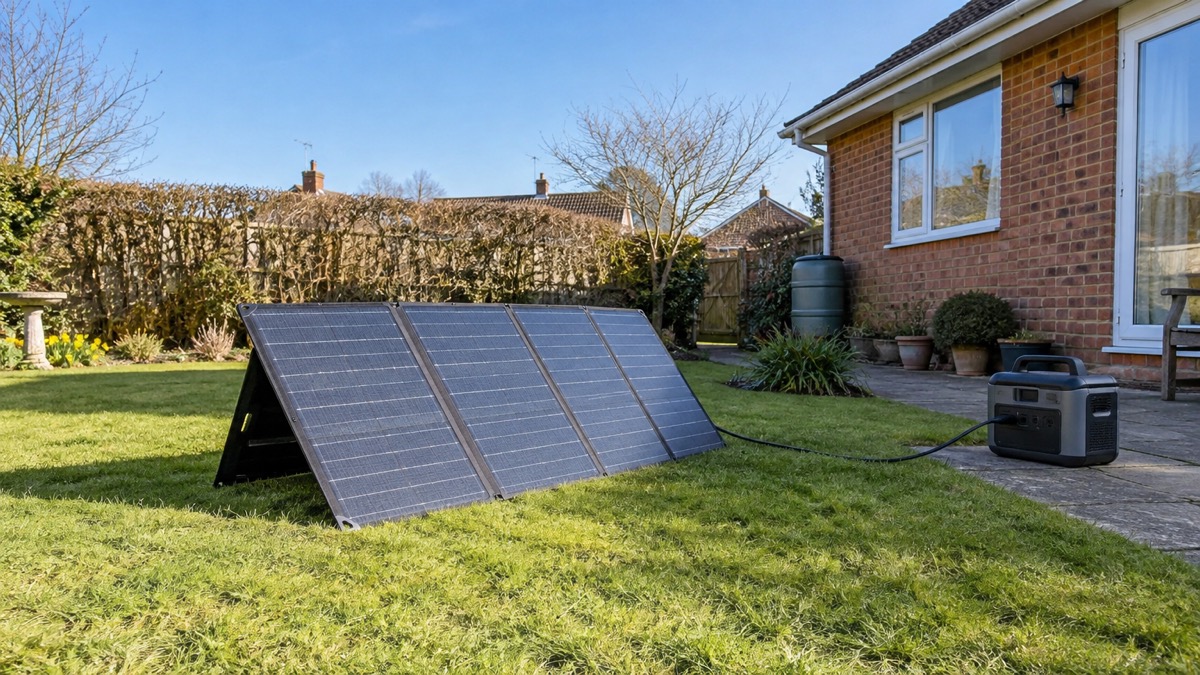
The Kickstand Case is not just packaging. The maker's manual says the protective case can be used as a kickstand to prop up the solar panel at a 40° to 80° angle4. That range covers the low winter sun and the higher summer sun, which is exactly what a UK household needs across the year.
Getting the most from it: outdoors and in direct sun
The single biggest factor in what the panel produces is where you put it. The maker's manual is direct: sunlight hitting the panel at a 90° angle usually generates 320W to 350W of power in the 400W panel4. That is the realistic clear-day figure, and it is the one to use when you are working out how much charge a sunny day will put back into a power station.
Everything else reduces it. Cloud, shade from a building or tree, a panel lying flat when the sun is low, and the angle of the sun through the seasons all cut the output. The maker's manual gives the 40° to 80° kickstand range for propping the panel4, and the Lightweight version of the panel is adjustable to 30°, 45° and 60°, which the maker describes as ideal for most high-latitude areas10. The principle is the same for either: tilt the panel towards the sun and move it as the sun moves.
For a household, the practical routine during an outage is:
- Set the panel up outdoors, in the open, with nothing casting a shadow across it.
- Angle it towards the sun using the Kickstand Case, adjusting through the day.
- Connect it to the power station and let it charge while the sun is on it.
- Bring it in or fold it down before dark, and store it upright.
If you are weighing up how much panel you need for your station, the site's guide to solar panel sizing and the explanation of how long solar charging takes in the UK set out the sums. The short version is that a 400W panel is a substantial input, and a clear day's sun can put a meaningful amount back into a mid-sized power station.
Connecting it: Solar Connector and XT60 cable
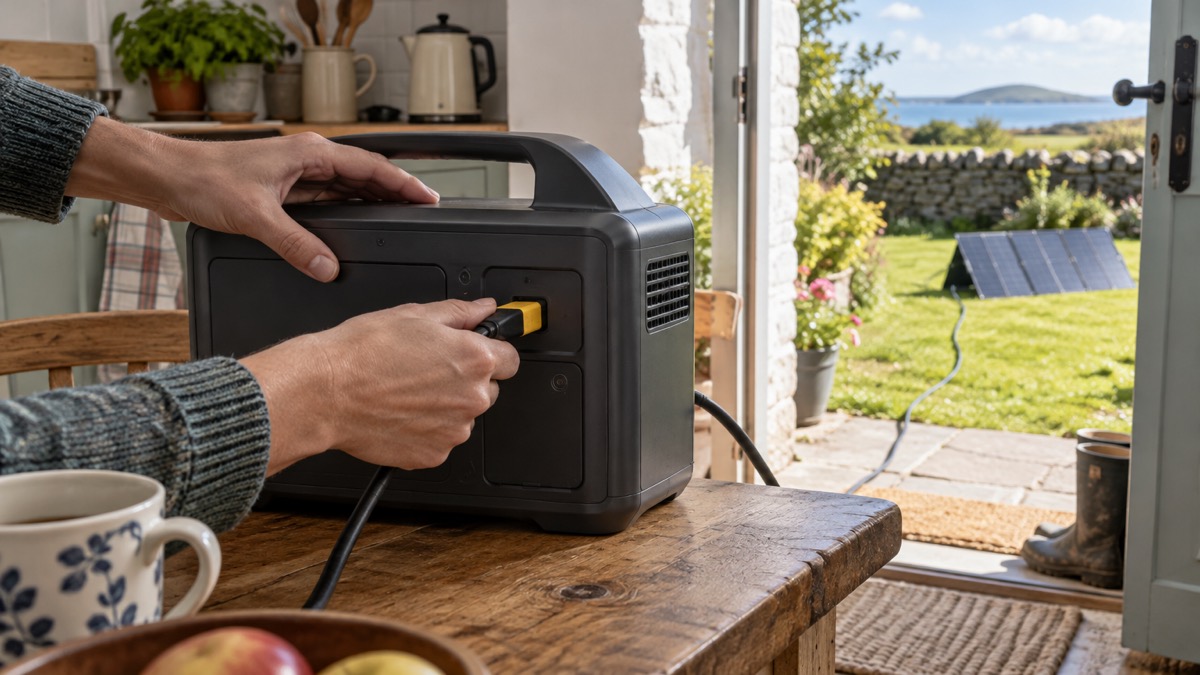
The panel uses a Solar Connector8, and the box includes a Solar to XT60 Charging Cable3. The XT60 end is what plugs into the solar input on an EcoFlow power station. The maker's manual describes the process: connect the XT60 connector of the solar charging cable to the XT60 port of the portable power station to recharge the unit4.
The manual also carries a restriction on the adapter cable that is worth reading carefully. In the maker's own words:
"Este cable sólo puede utilizarse para la conexión entre los paneles solares y el almacenamiento de energía."
In plain terms, that cable is for connecting solar panels to energy storage, and nothing else. Do not use it to feed anything other than a power station's solar input.
The manual also gives the panel's connector type as MC44, while the product page gives Solar Connector8. These describe the same family of connector under different names; the practical point is that the supplied cable takes the panel's output to an XT60 plug.
Before you connect, check two things against your power station's specification:
- Voltage: the panel's open circuit voltage is 48V1. Your station's solar input must be rated to accept it.
- Current: the panel's short circuit current is 11A1. Your station's input must be able to take it.
If you are not sure, do not connect. The site's guide to portable power stations explains how solar inputs are specified, and portable solar panels for charging in a power cut covers the wider picture.
Rain and storage: what IP68 covers
The panel is rated IP682. The maker describes it as having a protective ETFE film and a high IP68 resistance level, so the solar cells can withstand humid and wet environments2. Across its range, EcoFlow states that all its solar panels, including the flexible ones, are waterproof with a rating of IP6811, and describes its solar generators as carrying the same weatherproof rating12.
IP68 is a strong rating, but it is not unlimited. The maker's manual sets the boundary clearly: only the main body of the product is waterproof, and the junction box and connection points should not be immersed in water4. So rain falling on the panel face is within what it is built for; dropping the connector end into a puddle or a flood is not.
Storage matters as much as use. The maker's manual gives three rules:
- Keep the panel vertical when moving or storing it4.
- Do not apply pressure to it or drop it on its corners, sides or faces4.
- When storing the panel, always ensure that the positive and negative terminals of the junction box are not exposed to sunlight4.
That last rule is easy to overlook. Cover or tuck away the terminals when the panel is put away, so sunlight does not fall on them while it is in storage.
For a household preparing for winter, the sensible routine is to check the panel and its cable before the storm season, store it upright and dry, and make sure the connectors are protected. The site's backup power checks before winter checklist covers the wider kit.
Where the panel must never be opened or hung
The maker's manual is explicit that the product and its junction box should only be opened or dismantled by qualified personnel4. That is not a suggestion to be worked around. If the junction box is damaged, or a connection fails, the answer is the maker's support, not a screwdriver.
The manual also prohibits hanging the panel when it is in use4. The Lightweight version of the panel carries a related warning: if you need to hang solar panels for extended periods, use rigid solar panels, and lightweight portable panels are not recommended for that10. The rigid 400W panel is the maker's product for permanent mounting, described as best suited for permanent mounting on the roofs of motorhomes, off-grid builds and homes7, and as ideal for both off-grid and on-grid homeowners looking to use solar energy to run their homes or prepare for outages13.
If your plan involves fixing a panel to a roof, a shed or a wall and leaving it there, the portable panel is the wrong tool. The rigid 400W panel is the one built for that job: it weighs 21.8kg14, uses a Solar Connector14, has an open circuit voltage of 37.10V and a short circuit current of 13.79A14, and comes with a 300mm charging cable14. The maker says well-mounted rigid panels can withstand a dynamic 2400pa wind pressure load, equivalent to a 130mph wind speed14, and that they work with existing 48V power systems and existing PV systems or Power Kits setups, on-grid and off-grid14.
| Portable 400W | Rigid 400W | |
|---|---|---|
| Weight | Approx. 16kg2 | 21.8kg14 |
| Connector | Solar Connector8 | Solar Connector14 |
| Open circuit voltage | 48V1 | 37.10V14 |
| Short circuit current | 11A1 | 13.79A14 |
| Cable supplied | Solar to XT603 | 300mm charging cable14 |
| Suited to | Carrying out and propping up | Permanent mounting7 |
For a household in a flat or a rented home, the portable panel is the practical choice because it can be set up in a garden or yard and taken in again. For a household with a suitable roof and a permanent installation in mind, the rigid panel is the maker's answer. The site's guide to portable solar panels sets out the wider options.
Warranty and support: 24 months
The 400W Portable Solar Panel carries a 24 month warranty2. The maker's manual for the panel gives a different warranty period, so the two documents disagree; the product page figure of 24 months is the newer and the one to raise with the maker if a claim arises. The Lightweight version of the panel carries a 5 year warranty10, and an earlier EcoFlow solar panel carried a 1 year warranty15, so cover varies by model. Check the warranty stated for the exact product you buy.
For support, the maker's manual lists contact addresses by region: support@ecoflow.com for North America, Latin America, Asia-Pacific, the Middle East and Africa, support.eu@ecoflow.com for the EU, and support.au@ecoflow.com for Australia4. UK customers should use the EU address unless the maker's UK site directs otherwise.
What the warranty does not cover is the damage the manual warns against: pressure on the panel, drops onto its corners, sides or faces, immersion of the junction box, and any attempt to open the product or its junction box without qualified personnel4. Keep the panel upright in storage, keep the connectors dry and out of the sun, and the warranty has a fair chance of being there when you need it.
For a household, the warranty is part of preparedness. A panel that fails in the first winter of an outage is no use, so register the product, keep the receipt and the manual together, and check the panel works before the season when you are most likely to need it. The site's backup power at home section covers the rest of the kit a household should have ready.
Sources (15)
- DELTA Max 400W Portable Solar Panel, EcoFlow, 2026-10-25
- DELTA 3 Series Solar Generator PV400W, EcoFlow, 2026-10-25
- DELTA 2 Max 400W Portable Solar Panel, EcoFlow, 2026-10-25
- EcoFlow 400W Solar Panel User Manual, EcoFlow, 2022
- WAVE 2 Portable Air Conditioner with DELTA 2 Max, EcoFlow, 2026-10-25
- GLACIER with DELTA 2 Max and 400W Panel, EcoFlow, 2026-10-25
- Portable Solar Panels, EcoFlow, 2026-10-25
- GLACIER Portable Refrigerator with DELTA Max, EcoFlow, 2026-10-25
- WAVE 2 Portable Air Conditioner with DELTA Max, EcoFlow, 2026-10-25
- DELTA 3 Max Series Solar Generator PV400W, EcoFlow, 2026-10-25
- Flexible Solar Panels, EcoFlow, 2026-10-25
- Solar Generators, EcoFlow, 2026-10-25
- Rigid Solar Panels, EcoFlow, 2026-10-25
- 400W Rigid Solar Panel, EcoFlow, 2026-10-25
- 110W Portable Solar Panel (Refurbished), EcoFlow, 2026-10-29

 BLUETTI Apex 300 Power Station
 BLUETTI Elite 100 V2
 Anker SOLIX C2000 Gen 2
 Anker SOLIX C1000 Power Station
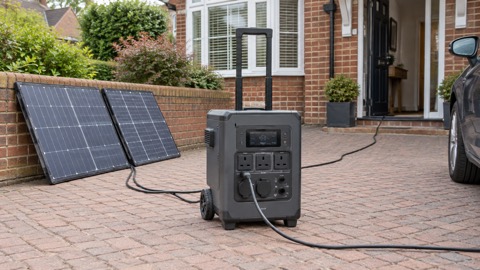 EcoFlow DELTA Pro
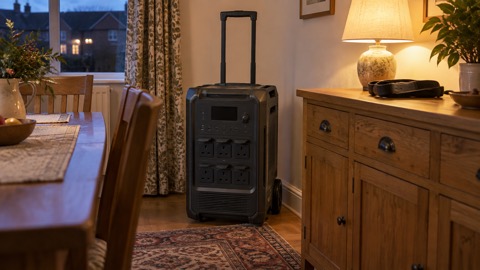 BLUETTI Elite 400
 Anker SOLIX C300 Power Station
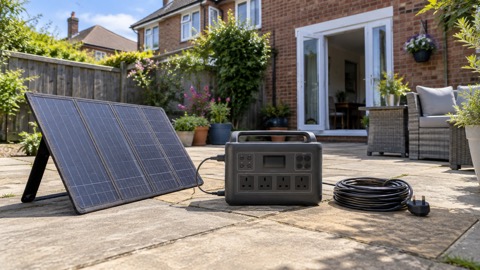 EcoFlow DELTA 3
 EcoFlow DELTA 2 and DELTA 2 Max
 EcoFlow DELTA and DELTA Max
 EcoFlow RIVER 3 and RIVER 3 Plus
 EcoFlow RIVER 2 and RIVER 2 Max